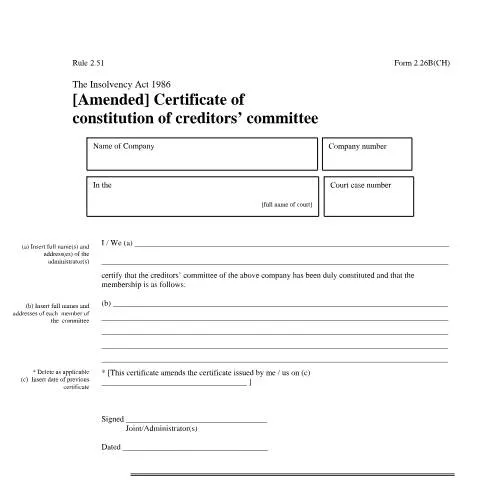
Unpacking the 2.26B(CH) Certificate: Essential Insights
The Amend Certificate of Constitution of Creditors' Committee, referred to as Form 2.26B(CH), plays a pivotal role in the framework of insolvency proceedings in the UK. When a company enters into insolvency, a creditors' committee is often established to represent the interests of the creditors. This certificate signifies that the committee has been duly constituted, and it updates or amends any previous certificate issued. Understanding the nuances of this form is crucial for administrators managing the insolvency process.
The Process of Obtaining the 2.26B(CH) Certificate
Obtaining the 2.26B(CH) certificate requires a clear understanding of the procedural steps involved. Below is a detailed breakdown of the process:
- Eligibility Check: Ensure that the creditors' committee is appropriately formed under the Insolvency Act 1986.
- Complete the Form: Fill out the form with the necessary details such as the full name and addresses of the administrators and committee members.
- Signature Requirement: The administrators must sign the certificate, confirming the constitution of the committee.
- Submission to Companies House: Send the completed and signed form to the Registrar of Companies at Companies House, Cardiff.
- Keep Records: Maintain a copy of the submitted form for your records, as it serves as a legal document of the committee's establishment.
Legal Implications of the 2.26B(CH) Certificate
The 2.26B(CH) certificate holds significant legal value. It not only formally documents the establishment of the creditors' committee but also protects the interests of both the creditors and the insolvency practitioner. Here are some vital points regarding its legal implications:
- Official Recognition: Once submitted, the certificate is recognised by all relevant authorities, including courts and regulatory bodies.
- Protective Measure: It safeguards the administrators' actions undertaken in relation to the committee, as it showcases compliance with legal requirements.
- Enforceability: The document can be used in legal proceedings if disputes arise regarding the committee's decisions or actions.
Duration and Validity of the 2.26B(CH) Certificate
The 2.26B(CH) certificate remains valid as long as the creditors' committee is active. However, several factors can necessitate amendments or updates:
- Changes in Membership: If there are any changes in the committee's composition, an amended certificate must be issued.
- Completion of Proceedings: Once the insolvency process is concluded, the certificate becomes obsolete.
It's crucial to be aware that regular updates are essential to maintain the integrity and legal standing of the committee throughout the insolvency process.
Addressing Issues: Lost, Incorrect, or Contested Certificates
Mismanagement of paperwork can lead to complications in the insolvency process. If the 2.26B(CH) certificate is lost or contains errors, several steps can be taken to rectify the situation:
Lost Certificates
In the event a certificate is misplaced:
- File a request for a duplicate certificate with Companies House, providing relevant details about the initial submission.
- Keep a clear record of the submission and any communication with Companies House for future reference.
Incorrect Information
If there are inaccuracies in the original submission:
- Contact Companies House immediately to report the discrepancy.
- Submit a corrected version of the certificate using the appropriate form.
Contested Certificates
In cases where the validity of the certificate is contested:
- Gather documentation and evidence supporting the committee's legitimacy.
- Consider seeking legal advice, especially if disputes escalate to court proceedings.
Practical Uses of the 2.26B(CH) Certificate
The certificate serves several functions within the insolvency framework. Its practical uses include:
- Verification of Committee Composition: Provides a formal record that can be presented to stakeholders and regulatory bodies.
- Facilitating Communication: Ensures transparency between creditors, the insolvency administration, and the court.
- Supporting Claims: Used by creditors to validate their claims and participate in committee meetings.
Several organisations may require this certificate, including financial institutions, legal advisors, and regulatory bodies overseeing insolvency matters.
Who is Authorized to Obtain the 2.26B(CH) Certificate?
Only designated administrators or insolvency practitioners are authorised to issue the 2.26B(CH) certificate. Their qualifications and responsibilities are critical in ensuring the committee's legitimacy. Key considerations include:
- Professional Qualifications: Individuals must be licensed and recognised by specific insolvency regulatory bodies.
- Experience in Insolvency Procedures: It is essential that they have a robust understanding of the Insolvency Act 1986 and associated regulations.
Furthermore, it is vital for administrators to maintain transparent communication with all committee members to ensure compliance and clarity about their roles and responsibilities.
Maintaining Compliance with the Data Protection Act
In handling the 2.26B(CH) certificate, administrators must adhere to the Data Protection Act 2018 and the UK GDPR. This is particularly relevant when processing personal data of creditors and committee members. Key points include:
- Data Minimisation: Collect and process only the data necessary for the committee's functions.
- Secure Handling: Ensure that all documents, including the certificate, are stored securely and access is limited to authorised personnel.
- Transparency: Communicate with creditors regarding how their data will be used and stored.
Compliance with these regulations protects the interests of all parties involved and upholds the integrity of the insolvency process.
Conclusion: The Importance of the 2.26B(CH) Certificate
The Amend Certificate of Constitution of Creditors' Committee (2.26B(CH)) is more than just a form; it serves as a cornerstone in the management of insolvency proceedings. The impact of this document extends to legal recognition, protection of creditor rights, and the facilitation of transparent communication within the insolvency framework. As such, understanding its purpose, the process of obtaining it, and maintaining compliance with legal standards is crucial for administrators in the ever-evolving landscape of corporate insolvency in the UK.
Understanding the Role of the Creditors' Committee
The creditors' committee is a pivotal body in the insolvency process in the UK. It consists of a group of creditors elected to represent the interests of all creditors in a particular case. Their primary role is to oversee the actions of the insolvency practitioner, ensure that the process is conducted fairly, and protect the rights of creditors. Members of the committee are usually chosen for their experience and understanding of the specific industry involved.
One significant responsibility of the creditors' committee is to assess whether the proposed actions of the insolvency practitioner are in the best interest of the creditors as a whole. This includes reviewing proposals for business sales, asset distributions, and other critical decisions that can impact the overall recovery rates for creditors. In this context, understanding how to amend the certificate of constitution is essential, as this document formalizes the composition and powers of the committee.
It is also important to note that the composition of the creditors' committee may change over time. New creditors can be added if they hold significant claims, or existing members may step down due to various reasons, including conflicts of interest or insolvency themselves. The process for amending the certificate of constitution reflects these dynamic changes and is vital for maintaining the integrity of the committee’s representation.
Fill in your form directly online
No printing: type your details into the boxes of the official form, tick, then download the PDF ready to send.
- 1Type into the form boxes
- 2Tick in one click
- 3Save and download the PDF
Procedures for Amending the Certificate of Constitution
Amending the certificate of constitution of the creditors' committee is a formal process that requires adherence to specific legal guidelines. It is essential to ensure that any amendments accurately reflect the current membership and authority of the committee, as specified in the Insolvency Act 1986.
The process typically begins with a formal request from the insolvency practitioner or a member of the committee. This request must detail the reasons for the amendment and provide evidence that supports the necessity of the change. Following this, a meeting of the creditors' committee should be convened to discuss the proposed amendments. During this meeting, all members must be given an opportunity to voice their opinions and concerns regarding the changes.
Once a consensus is reached, the proposed amendments must be documented and submitted for approval. In many cases, this involves a vote among the committee members. A clear majority is often required to validate the amendments. After obtaining the necessary approvals, the amended certificate must be submitted to relevant authorities, including the Insolvency Service or Companies House, as appropriate. This ensures that the changes are legally recognized and enforceable.
Additionally, any changes to the creditors' committee should be communicated to all creditors involved to maintain transparency and uphold the trust that is essential in these proceedings. Notifying creditors about the changes helps to prevent disputes and ensures that everyone is aware of who represents their interests moving forward.
Challenges in Amending the Certificate
While amending the certificate of constitution is a standard procedure, several challenges can arise during this process. One common issue is disagreement among committee members on proposed changes. Such disagreements can arise from different perspectives about the implications of adding or removing members or altering the committee's authority. To address these issues, it may be necessary to engage in mediation or seek advice from legal professionals specializing in insolvency law.
Another potential challenge is the timing of the amendment process. In the context of ongoing insolvency proceedings, timing is crucial. Delays in amending the certificate can hinder the committee's ability to act effectively or lead to further complications in the insolvency process. Therefore, it is essential that the committee prioritizes any necessary amendments and acts expediently to formalize changes.
Moreover, the potential for conflicts of interest can complicate amendments to the constitution of the creditors' committee. For instance, if a creditor who is part of the committee also has personal stakes in the outcome of the proceedings, their involvement may be questioned. It is crucial to address such conflicts as they arise to ensure that all actions taken by the committee are in the best interests of all creditors, not just a select few.
In summary, while the process of amending the certificate of constitution can be straightforward, it is fraught with challenges that require careful consideration and management. Understanding these challenges and addressing them proactively can lead to a more effective and representative creditors' committee.