Understanding the Amend Certificate of Constitution of Creditors' Committee
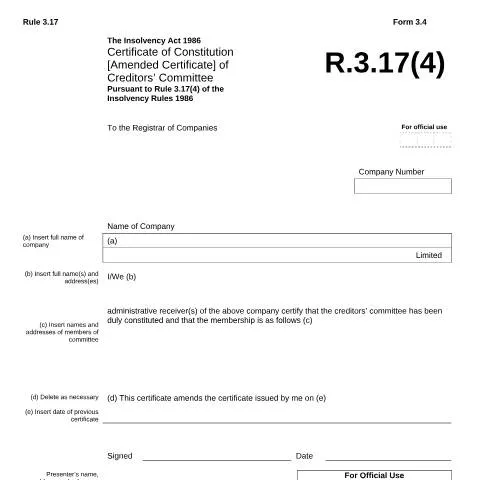
In the complex landscape of corporate insolvency, the Amend Certificate of Constitution of Creditors' Committee (Form 3.4) serves as a crucial document, primarily governed by the Insolvency Act 1986. It is essential for ensuring that the creditors’ committee is correctly constituted, reflecting the interests of creditors while adhering to statutory requirements. Understanding how to obtain and utilise this certificate can directly impact the smooth operation of insolvency proceedings. This article delves into the various aspects surrounding this important document.
Obtaining the Certificate: A Step-by-Step Guide
The process of obtaining the Amend Certificate of Constitution of Creditors' Committee involves several key steps. Whether you are a member of the creditors' committee or an administrative receiver, understanding these steps ensures compliance with legal obligations.
- Initial Constitution of the Committee: Before amending the certificate, the creditors' committee must be constituted through a meeting involving all creditors.
- Completion of the Form: The form requires detailed information, including the full name of the company, addresses of the members of the committee, and the date of the previous certificate.
- Signature of Committee Members: All members of the creditors' committee must sign the document to validate its authenticity.
- Submission to Companies House: The completed form must be submitted to Companies House for official registration.
Each of these steps is critical in ensuring that the amendment is legally binding and recognised by the relevant authorities.
The Legal Significance of the Certificate
The Amend Certificate of Constitution of Creditors' Committee holds significant legal weight within the context of insolvency proceedings. It serves as proof that the creditors' committee has been appropriately constituted, thereby giving it authority to act on behalf of the creditors. This is particularly vital in scenarios where:
- The committee needs to make decisions regarding the administration of the insolvent company.
- There is a need to address claims, distributions, and votes that require a formal committee structure.
In essence, the certificate not only facilitates the operation of the creditors' committee but also safeguards the interests of all parties involved, ensuring that decisions made are legitimate and enforceable under the law.
Who Can Obtain the Certificate and Under What Conditions?
Understanding the eligibility criteria for obtaining the Amend Certificate of Constitution of Creditors' Committee is paramount. The following entities or individuals are typically empowered to obtain this certificate:
- Members of the Creditors' Committee: Individuals who have been formally recognised as members of the committee.
- Administrative Receivers: These are professionals appointed to manage the assets of the company in insolvency proceedings.
To be eligible, the individuals must ensure that all requirements for the constitution of the committee are met, including the proper notification and agreement from all creditors. Failure to comply with these conditions may result in delays or rejections of the certificate.
Practical Uses and Related Bodies Requiring the Certificate
The practical applications of the Amend Certificate of Constitution of Creditors' Committee extend across various scenarios in insolvency management. It is primarily required by:
- Companies House: As the primary regulatory body for company registrations, Companies House requires this certificate as part of the formal insolvency process.
- Court Proceedings: In cases where the creditors' committee needs to present evidence of its constitution in court, this certificate becomes a critical document.
- Financial Institutions: Banks and other financial entities may require proof of the committee's legitimacy when dealing with outstanding debts.
These uses highlight the certificate's role in ensuring transparency and legitimacy in insolvency proceedings.
Validity Period and Renewal Process
Once issued, the Amend Certificate of Constitution of Creditors' Committee does not have an indefinite validity. Understanding the timeframes associated with this document is crucial:
| Action | Validity Period | Renewal Conditions |
|---|---|---|
| Initial Constitution Certificate | Until amended or the committee is dissolved | Requires fresh constitution meeting and new form submission |
| Amendment Certificate | Valid for the duration of the committee's activities | Any change in membership or structure necessitates a new amendment |
This structured approach to validity ensures that all stakeholders are aware of the current status of the creditors' committee and its members.
Addressing Errors and Contestations
Errors on the Amend Certificate of Constitution of Creditors' Committee can have significant repercussions. Whether due to inaccuracies in the names of committee members or incorrect submission dates, understanding how to address these errors is critical:
- Notification of Errors: Any member aware of a discrepancy must notify the committee immediately.
- Filing for Amendment: A new amendment form must be completed and submitted to rectify the initial errors.
- Dispute Resolution: In cases where there is a contestation regarding committee membership, members may need to seek legal clarification through the courts.
Addressing these issues promptly helps maintain the integrity of the creditors' committee and ensures compliance with legal standards.
Final Thoughts: Navigating the Complexity
As businesses navigate the challenging waters of insolvency, grasping the nuances surrounding the Amend Certificate of Constitution of Creditors' Committee is indispensable. This certificate is more than just a piece of paper; it serves as a foundational element in the operation of the creditors' committee, facilitating crucial decision-making and protecting the interests of creditors. By understanding its implications, obtaining the necessary documentation, and addressing any issues proactively, stakeholders can enhance the efficacy of the insolvency process.
Understanding the Process of Amending the Certificate of Constitution of Creditors' Committee
When dealing with insolvency in the United Kingdom, the composition and functioning of the creditors' committee can significantly influence the proceedings. The certificate of constitution of the creditors' committee, often referenced as a pivotal document in insolvency cases, must be precise and reflective of the actual circumstances surrounding the creditors involved. Amendments to this certificate are not uncommon and require a clear understanding of the legal framework and procedural nuances.
The process begins with identifying the reasons for the amendment. Common scenarios may include changes in the membership of the committee, alterations in the appointed representatives, or updates necessitated by the insolvency practitioners’ assessment of the creditor landscape. It’s essential to communicate these changes promptly to the relevant stakeholders, ensuring that all creditors are informed of their rights and the proceedings’ status.
To initiate an amendment, the insolvency practitioner must prepare a notice to all creditors outlining the proposed changes. This notice should detail the reasons for the amendment, the implications for the committee's functioning, and any decisions that need to be made by the creditors. This is critical under the provisions of the Insolvency Act 1986, ensuring transparency and fairness in the process.
Following the notice, a creditors' meeting may be called. This meeting serves as a platform for creditors to discuss the proposed amendments, raise any concerns, and ultimately vote on the changes. Under the Insolvency (England and Wales) Rules 2016, a decision can be made via a show of hands or a poll, depending on the complexity of the changes. The results must be duly documented and reported back to Companies House if required, reinforcing the legitimacy of the amendments made.
Once the amendments are approved, the updated certificate must be executed and submitted as per the guidelines set forth by the Insolvency Service. It’s important to highlight that failure to correctly amend and document changes could lead to complications in future proceedings, including potential challenges from disgruntled creditors who may feel inadequately represented.
Legal Implications of Failing to Amend the Certificate
Neglecting to amend the certificate of constitution of creditors' committee can have severe legal implications that are often overlooked. The creditors' committee plays a crucial role in the decision-making process regarding the management of the insolvent estate. If the certificate does not accurately reflect the current membership or the authority of representatives, decisions made by the committee may be called into question, potentially leading to disputes among creditors and even legal action against the insolvency practitioner.
One significant legal risk is the potential for claims of misrepresentation or breach of fiduciary duty. Creditors who feel inadequately represented or those who were not properly informed about changes may seek legal redress, asserting that they were denied their rightful participation in the proceedings. This situation can lead to costly litigation, which could drain the resources of the insolvent estate and further complicate the resolution of claims.
Fill in your form directly online
No printing: type your details into the boxes of the official form, tick, then download the PDF ready to send.
- 1Type into the form boxes
- 2Tick in one click
- 3Save and download the PDF
Moreover, an improperly constituted creditors' committee could jeopardize the entire insolvency process. If a court determines that the committee was not properly formed or that its decisions were invalid due to improper representation, it could lead to the annulment of previous decisions and a requirement to restart certain aspects of the insolvency process from scratch. This not only increases the administrative burden but also prolongs the uncertainty for all involved parties, further exacerbating tensions among creditors.
To mitigate these risks, it is advisable for insolvency practitioners to conduct regular reviews of the creditors' committee and ensure that the certificate accurately reflects its constitution. Proactive amendments and transparent communication can go a long way in maintaining trust among creditors and ensuring a smoother insolvency process.
Best Practices for Maintaining an Accurate Certificate
Maintaining an accurate certificate of constitution of creditors' committee is essential for effective insolvency management. Here are some best practices that insolvency practitioners should consider to ensure that the committee's constitution is continually up to date and reflective of the current situation:
Regular Communication: Establish a routine communication plan with creditors to keep them informed about any changes that may affect their representation on the committee. This could involve scheduled updates or ad-hoc notifications as necessary.
Document All Changes: It is imperative to document all changes meticulously. This includes keeping a log of communications sent to creditors, meeting minutes, and any voting outcomes related to amendments. Such records will serve as vital evidence should any disputes arise.
Engage with Stakeholders: Actively engage with key stakeholders within the creditors' committee. By fostering an open dialogue, practitioners can better understand the concerns and suggestions of creditors, leading to more effective governance and representation.
Review and Audit: Conduct periodic audits of the committee’s constitution and its membership. This practice ensures that any discrepancies are identified and rectified promptly, reducing the risk of legal complications later.
Professional Development: Encourage ongoing professional development for insolvency practitioners regarding the legal framework and best practices associated with creditor committees. Staying informed about recent developments can help practitioners navigate complex situations effectively.
By implementing these practices, insolvency practitioners can not only maintain accurate records but also fortify the integrity of the creditors' committee, thereby enhancing the overall effectiveness of the insolvency proceedings.