When Shipbuilding Meets Maritime Registration: The Role of MSF 4743
Every vessel that graces British waters or flies the Red Ensign requires proper documentation to establish its legitimacy and seaworthiness. At the heart of this maritime registration process lies the Builder's Certificate MSF 4743, a document that bridges the gap between shipyard craftsmanship and official vessel recognition. This certificate serves as the shipbuilder's sworn statement that a particular vessel has been constructed according to specified requirements and delivered to its rightful owner.
The Maritime and Coastguard Agency relies on this certification to maintain the integrity of the UK Ship Register, ensuring that every registered vessel can be traced back to its origins with absolute certainty. For builders, owners, and maritime authorities alike, the MSF 4743 represents more than paperwork—it's the foundational document that transforms raw materials and skilled labour into a legally recognised British vessel.
The Builder's Sworn Statement: What MSF 4743 Actually Certifies
The Builder's Certificate functions as a declaration under oath from the shipyard or individual craftsperson who constructed the vessel. Unlike a simple receipt or delivery note, this document carries significant legal weight within maritime law. The builder formally certifies three critical elements: that they personally built, moulded, or fitted out the vessel; that the construction was completed to the specific order of the named owner; and that all technical specifications accurately reflect the finished product.
This certification covers vessels across the entire spectrum of British maritime activity, from commercial fishing boats emerging from traditional boatyards to luxury yachts crafted in specialist facilities. The document establishes a clear chain of custody from construction to delivery, creating an unbroken legal link that maritime authorities can verify decades later if required.
Technical Specifications and Construction Details
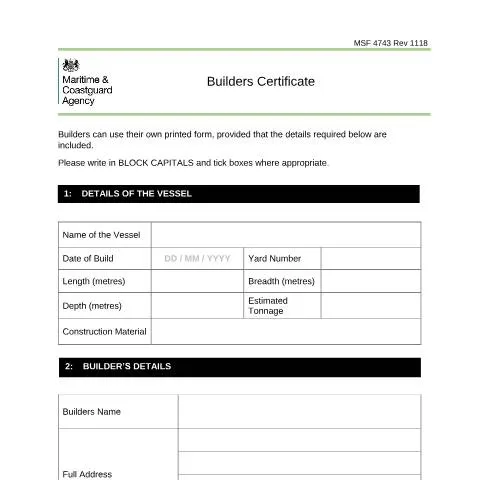
The certificate captures essential physical characteristics that define the vessel's identity and capabilities. These include precise measurements of length, breadth, and depth in metres, alongside estimated tonnage calculations that influence future regulatory requirements. Construction materials must be specified, whether traditional timber, modern fibreglass composites, steel, or aluminium alloys.
Each vessel receives a unique yard number from the builder, creating a permanent identifier that links the finished craft to specific construction records. This numbering system proves invaluable when investigating insurance claims, conducting safety inspections, or researching vessel histories years after initial construction.
Ownership Declaration and Transfer Documentation
The certificate serves dual purposes by simultaneously documenting construction completion and confirming the intended recipient. Builders must provide complete details of the ordering party, including full names for individuals or complete company designations for corporate entities. Multiple owners can be accommodated, with provision for additional sheets when ownership structures prove complex.
This ownership declaration becomes particularly significant in cases where vessels change hands before registration, as the MSF 4743 establishes the original commissioning relationship that underpins subsequent transfers.
Who Must Obtain and Submit Builder's Certificates
The responsibility for completing and submitting MSF 4743 falls squarely upon the entity that physically constructed the vessel. This includes traditional shipyards with centuries of maritime heritage, modern production facilities manufacturing recreational craft, and individual craftspeople building bespoke vessels in private workshops.
| Builder Type | Typical Vessels | Certification Requirements |
|---|---|---|
| Commercial Shipyards | Fishing vessels, cargo ships, passenger craft | Company representative must sign with official position stated |
| Recreational Boat Manufacturers | Sailing yachts, motor cruisers, racing dinghies | Production manager or authorised signatory required |
| Individual Craftspeople | Custom builds, restoration projects, traditional craft | Personal signature of the actual builder |
| Kit Boat Suppliers | Self-build sailing boats, motor launches | Final assembler/fitter-out must certify completion |
Important distinction: The certificate must originate from whoever performed the final construction or fit-out work, not necessarily the entity that supplied materials or components. When vessels are built from kits or require significant modification work, the party completing the final assembly bears responsibility for certification.
International Builders and UK Registration
Foreign shipyards constructing vessels destined for UK registration must also complete MSF 4743, with particular attention to accurately specifying the place of build including the country of construction. This international dimension adds complexity to the registration process but ensures that British-flagged vessels maintain proper documentation regardless of their construction origins.
Builders operating outside the UK should be aware that their certification may be subject to additional verification procedures, particularly for high-value vessels or those intended for commercial operation under British jurisdiction.
The Registration Journey: From Shipyard to Official Recognition
Once construction reaches completion and the vessel is ready for delivery, the builder initiates the certification process by completing MSF 4743 in its entirety. The form demands meticulous attention to detail, as errors or omissions can significantly delay registration or require costly corrections later in the process.
The completed certificate must be dispatched to the Registry of Shipping and Seamen at their Cardiff headquarters, where specialist officers examine each submission for completeness and consistency. This examination goes beyond simple form-checking; registry staff verify that technical specifications align with known construction standards and that ownership declarations provide sufficient detail for future reference.
Processing Timeline and Registry Procedures
Upon receipt, registry officers assign each certificate a unique tracking reference and begin the verification process. The MSF 4743 becomes the foundation document for creating a new entry in the UK Ship Register, with all subsequent registration materials cross-referenced against the original builder's certification.
Processing times vary depending on the complexity of the vessel and any additional documentation required. Straightforward recreational craft typically progress through the system more rapidly than commercial vessels requiring extensive regulatory compliance checks.
Critical requirement: The certificate must be signed by an authorised representative of the building organisation, with their position clearly stated if the vessel was constructed by a company rather than an individual. This signature carries legal weight and creates personal accountability for the accuracy of all certified information.
Alternative Documentation and Flexible Submission Options
The Maritime and Coastguard Agency recognises that builders operate diverse business models and may prefer to use their own documentation systems rather than standard government forms. MSF 4743 accommodates this preference by allowing builders to substitute their own printed certificates, provided all required information elements are included.
This flexibility proves particularly valuable for established shipyards with sophisticated internal documentation systems or builders serving international markets who must satisfy multiple regulatory requirements simultaneously. However, the core information requirements remain non-negotiable regardless of the chosen format.
Essential Information Elements for Alternative Formats
Builders opting to use their own certificate formats must ensure inclusion of all mandatory data fields. These encompass complete vessel specifications, comprehensive builder details including registered address, precise construction location if different from the builder's primary address, and full ownership particulars for the commissioning party.
The certification statement itself must clearly declare that the builder personally constructed, moulded, or fitted out the vessel to the specific order of the named owner. This declaration creates the legal foundation upon which all subsequent registration activities depend.
Digital Transformation and Modern Submission Methods
Recognising the maritime industry's evolution towards digital processes, the Registry of Shipping and Seamen now accepts electronic submission of Builder's Certificates through dedicated email channels. This modernisation significantly reduces processing times and provides builders with immediate confirmation of receipt.
Three separate email addresses serve different vessel categories: general Part I registry for commercial vessels, commercial registry for specific commercial operations, and fishing registry for vessels engaged in commercial fishing activities. This segregation ensures that certificates reach the appropriate specialist teams without delay.
Maintaining Security in Digital Submissions
Electronic submission requires careful attention to document security and authenticity. Builders must ensure that digital certificates maintain the same level of detail and formal declaration as their paper equivalents, with clear identification of the authorised signatory and their relationship to the construction organisation.
The registry maintains robust procedures for verifying electronic submissions, including cross-checking against known builder databases and conducting additional verification when circumstances warrant enhanced scrutiny.
When Certificates Go Wrong: Corrections and Resubmissions
Despite careful preparation, Builder's Certificates occasionally contain errors that prevent successful registration or create complications for future vessel operations. Common issues include incomplete ownership details, inconsistent technical specifications, or missing authorisation signatures that render the certification legally insufficient.
The registry's approach to certificate corrections depends on the nature and significance of the identified problems. Minor administrative errors such as postal code omissions may be resolved through supplementary correspondence, while fundamental issues affecting vessel identity or ownership typically require complete resubmission.
Avoiding Common Certification Pitfalls
Experienced builders develop systematic approaches to certificate completion that minimise error rates and streamline the registration process. Key practices include maintaining detailed construction records that can be easily transferred to the certificate, establishing clear procedures for ownership verification before construction begins, and implementing quality checks before submission.
Measurement accuracy proves particularly critical, as discrepancies between certified dimensions and subsequent surveys can trigger extensive investigations that delay registration and increase costs. Builders should use consistent measurement standards and document their methodology to support future verification activities.
The yard number system requires special attention, as duplicate or inconsistent numbering can create confusion in registry databases. Builders should maintain comprehensive records of all assigned yard numbers and ensure that each certificate accurately reflects the construction sequence within their facility.
Long-term Implications and Vessel Lifecycle Management
The Builder's Certificate MSF 4743 creates a permanent record that influences the vessel throughout its operational lifetime. Insurance companies regularly request copies when assessing coverage applications, while port authorities may examine certificates during inspections or investigations.
This enduring significance means that builders bear ongoing responsibility for the accuracy and completeness of their certifications. Vessels may change hands multiple times over decades of service, but the original builder's certificate remains the definitive record of construction specifications and initial ownership.
For the UK maritime industry, the MSF 4743 system provides essential infrastructure that supports everything from recreational sailing to commercial shipping operations. By maintaining rigorous standards for vessel certification, the Maritime and Coastguard Agency ensures that British waters remain safe and that UK-flagged vessels maintain their reputation for quality and reliability in international markets.
The certificate's role extends beyond simple registration to encompass broader maritime safety and security objectives. In an era of increasing regulatory complexity and international cooperation, the MSF 4743 provides the documentary foundation that enables effective vessel monitoring and compliance enforcement across diverse maritime sectors.
Common Challenges and How to Address Them
The MSF 4743 builder's certificate application process, whilst structured, can present several challenges that applicants frequently encounter. Understanding these potential hurdles and their solutions can significantly streamline your submission and reduce delays.
Incomplete technical specifications represent one of the most common rejection reasons. The Maritime and Coastguard Agency requires comprehensive details about construction materials, welding procedures, and structural calculations. If your initial design drawings lack sufficient detail, consider engaging a qualified naval architect to produce compliant technical documentation. The MCA will not accept hand-drawn sketches or incomplete engineering drawings, regardless of the vessel's size or intended use.
Documentation discrepancies often arise when multiple parties contribute to the application. For instance, if your surveyor's measurements differ from the builder's specifications, or if material certificates don't align with the construction records, the MCA will request clarification. Establish clear communication channels between all involved parties before submission, and designate one person to coordinate all documentation to ensure consistency.
Surveyor availability and scheduling can create unexpected delays, particularly during peak boating seasons or in remote locations. Independent surveyors accredited by recognised bodies such as the Royal Institution of Naval Architects or the Institute of Marine Engineering, Science and Technology often have busy schedules. Book your surveyor well in advance, ideally before construction begins, and maintain flexibility with inspection dates to accommodate weather conditions or construction delays.
Material certification issues frequently occur when builders use suppliers who don't provide adequate documentation. The MCA requires material certificates that demonstrate compliance with relevant British Standards or equivalent international standards. If your steel supplier cannot provide mill certificates showing grade and chemical composition, you may need to arrange independent testing, which adds both time and cost to your project.
Regulatory interpretation challenges can arise when dealing with innovative designs or unusual construction methods. The MCA's Small Vessel Team can provide preliminary guidance on whether your proposed approach aligns with current regulations, but this informal advice doesn't guarantee final approval. For complex projects, consider requesting a formal pre-application meeting with MCA technical staff to discuss your proposal before committing significant resources.
Payment and processing delays sometimes occur when applications are submitted during peak periods or when supporting documentation requires additional review. The MCA typically processes straightforward applications within their published timeframes, but complex cases involving new technologies or unusual designs may require extended evaluation periods. Monitor your application status through the MCA's online systems and respond promptly to any requests for additional information.
Post-Certificate Obligations and Ongoing Compliance
Receiving your MSF 4743 builder's certificate marks the beginning, not the end, of your regulatory obligations. The certificate establishes your vessel's legal identity and compliance status, but ongoing responsibilities ensure continued regulatory compliance throughout the vessel's operational life.
Certificate custody and record-keeping requirements extend beyond simply storing the original document safely. The MCA recommends maintaining certified copies for everyday use whilst securing the original certificate in fireproof storage. Digital copies should be stored securely and backed up regularly, as replacement certificates involve significant administrative processes and potential delays. Keep comprehensive records of all supporting documentation used in the original application, as these may be required for future modifications or insurance claims.
Modification and alteration procedures become relevant when you make significant changes to your vessel after certification. Any structural modifications, engine changes exceeding specified power limits, or alterations affecting stability characteristics may require formal notification to the MCA or, in some cases, re-certification. Minor modifications such as equipment additions or cosmetic changes typically don't require formal approval, but maintaining detailed records helps demonstrate continued compliance during future inspections.
Insurance and liability considerations often depend on valid certification status. Marine insurance providers typically require proof of current certification and may request copies of survey reports or modification records when assessing risk. Some insurers offer preferential rates for vessels with comprehensive certification documentation, recognising the reduced risk associated with properly documented construction standards.
Transfer of ownership procedures require careful attention to certificate documentation. When selling your vessel, the MSF 4743 certificate transfers with the vessel, but both parties should understand their respective obligations. The seller must provide all relevant certification documents, whilst the buyer assumes responsibility for ongoing compliance. The MCA doesn't require formal notification of ownership changes for recreational vessels, but maintaining clear documentation trails protects both parties' interests.
Periodic survey requirements may apply depending on your vessel's commercial use status and classification. Whilst recreational vessels don't typically require mandatory periodic surveys, vessels used for charter, training, or other commercial activities may need regular inspections to maintain their certification validity. Commercial operators should consult with the MCA's Commercial Vessel Team to understand specific requirements for their intended operations.
International travel considerations become important if you plan to cruise outside UK waters. Many countries recognise UK certification under various reciprocal agreements, but some destinations may require additional documentation or local surveys. Research destination requirements well in advance of travel, and carry comprehensive certification documentation including the original MSF 4743 certificate, construction records, and any relevant survey reports.
Integration with Related Maritime Certifications
The MSF 4743 builder's certificate operates within a broader framework of maritime certification requirements, and understanding these interconnections helps ensure comprehensive compliance for your vessel's intended operations.
Commercial endorsement pathways build upon the foundation established by your builder's certificate. If you later decide to use your vessel commercially, the MSF 4743 provides essential baseline documentation for MCA commercial certification processes. However, commercial operations typically require additional surveys, safety equipment, and crew certification that go beyond recreational vessel requirements. The transition from recreational to commercial status involves formal application processes and may require structural modifications to meet enhanced safety standards.
Radio licensing and electronic equipment certification create additional compliance layers that complement your builder's certificate. Ofcom regulates marine radio equipment, requiring appropriate licensing for VHF radios and other communication systems. Electronic navigation equipment may require separate type approval, particularly for vessels operating in commercial service or specific geographic areas with enhanced safety requirements.
Environmental compliance certifications increasingly intersect with vessel certification requirements. Anti-fouling paint systems must comply with biocide regulations, whilst waste management systems on larger vessels may require specific approvals. Engine emissions standards, particularly for commercial vessels, create additional certification requirements that must align with your builder's certificate specifications.
Insurance classification relationships often influence certification strategies for higher-value vessels. Whilst MSF 4743 certification provides regulatory compliance, some insurers prefer additional classification society surveys for comprehensive risk assessment. Lloyd's Register, DNV, and other classification societies offer voluntary certification schemes that complement MCA requirements whilst potentially reducing insurance premiums through enhanced risk documentation.
International convention compliance becomes relevant for larger vessels or those intended for extensive international cruising. The International Convention for the Prevention of Pollution from Ships (MARPOL) creates specific requirements for waste management and pollution prevention systems. Vessels over certain size thresholds may need additional certifications under the International Load Line Convention or other IMO instruments, requiring coordination with your builder's certificate documentation.
Crew certification requirements intersect with vessel certification when determining operational parameters. The MCA's recreational craft directive establishes baseline requirements, but specific operations or vessel sizes may trigger additional crew qualification requirements. Understanding these thresholds during the design phase helps ensure your vessel's certification aligns with your intended operational profile and crew certification capabilities.
Port state control considerations affect vessels engaged in international voyages, where foreign authorities may inspect your certification documentation. Comprehensive and properly maintained certification records, including your MSF 4743 certificate, construction documentation, and survey reports, facilitate smooth port state inspections and demonstrate compliance with international standards. Some jurisdictions maintain databases of recognised certification authorities, and UK MCA certification generally enjoys broad international recognition under various mutual recognition agreements.