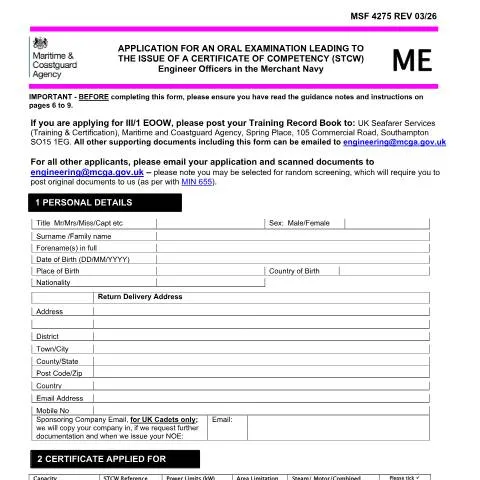
Engineer Officer Certificate of Competency: Your Gateway to Maritime Leadership
The UK merchant navy's engine rooms operate under some of the world's most stringent safety and competency standards, where a single technical failure can endanger lives and environmental safety. The engineer officer certificate of competency stands as the definitive professional qualification that determines who can take responsibility for these critical maritime systems. Unlike basic seafaring certificates, this credential represents years of specialised training, documented sea service, and rigorous examination that transforms technical knowledge into operational command authority.
When the Maritime and Coastguard Agency issues an engineer officer certificate of competency, it creates a legal framework that enables holders to serve in specific engineering capacities aboard UK-flagged vessels and internationally recognised positions worldwide. The certificate's STCW (Standards of Training, Certification and Watchkeeping) reference codes directly correlate to international maritime law, making this document essential for career progression in the global shipping industry.
Understanding the Certification Hierarchy and Power Limits
The engineer officer certification system operates on a sophisticated structure that matches professional responsibility with technical complexity and vessel power output. Each certificate level carries specific limitations and privileges that determine where and in what capacity the holder can serve.
| Certificate Level | STCW Reference | Power Limits (kW) | Area Limitations | Typical Career Stage |
|---|---|---|---|---|
| OOW Engineer | III/1 | Unlimited | None | Entry-level officer |
| Second Engineer | III/3 | Less than 3000 | Near Coastal/None | Mid-level officer |
| Second Engineer | III/2 | Less than 9000/Unlimited | Near Coastal/None | Senior officer |
| Chief Engineer | III/3, III/2 | Various power limits | Coastal/Unlimited | Command level |
The Officer of the Watch Engineer (III/1) represents the entry point for qualified engineering officers, carrying unlimited power restrictions but requiring comprehensive technical knowledge across all shipboard engineering systems. This certificate enables holders to maintain regular watches in machinery spaces or serve as duty engineers on vessels with unattended machinery spaces.
Power limitations directly affect the types of vessels where certificate holders can serve. A less than 3000 kW limitation typically applies to smaller commercial vessels, fishing boats, and coastal ferries, while unlimited power certificates open opportunities aboard large container ships, tankers, and cruise vessels where main engines can exceed 50,000 kW.
Comprehensive Application Requirements and Documentation
The application process for an engineer officer certificate of competency demands meticulous documentation that proves both theoretical knowledge and practical experience. The Maritime and Coastguard Agency requires specific evidence that demonstrates competency across multiple engineering disciplines.
Essential Qualifying Sea Service
Sea service requirements form the cornerstone of certificate eligibility, with the MCA demanding verifiable experience as an engineer officer on crew agreement. This service must involve regular watch duties over main propelling machinery or auxiliary machinery, or duty engineer responsibilities on ships with unattended machinery spaces. Day work engineering positions also qualify, provided they involve appropriate technical responsibilities.
All seagoing service must appear in an official Discharge Book or on Certificates of Discharge, supported by testimonials signed by the Chief Engineer, Engineer Superintendent, or Master. The MCA accepts sea service on foreign flag vessels under the same conditions as UK ships, provided verification meets international standards.
Duration calculations follow specific maritime conventions: voyage lengths must be recorded in calendar months and days, with odd days accumulated and converted at 30 days per month. For example, service from 3 January to 5 March equals exactly 2 months and 3 days, contributing to the total required sea time for certificate eligibility.
Medical Fitness and Safety Training Compliance
The ENG1 medical fitness certificate represents a mandatory requirement that must remain valid throughout the application process and certificate issuance. This medical standard, established under the Merchant Shipping Training & Certification (Medical Examination) Regulations 2002, ensures that engineer officers can safely perform demanding physical and mental tasks in challenging maritime environments.
STCW basic safety training forms another non-negotiable requirement, encompassing four core competencies:
- Elementary First Aid (STCW A-VI/1-3) - Essential medical response capabilities
- Fire Prevention and Fire Fighting (STCW A-VI/1-2) - Critical fire safety management
- Personal Survival Techniques (STCW A-VI/1-1) - Emergency abandonment procedures
- Personal Safety and Social Responsibilities (STCW A-VI/1-4) - Workplace safety awareness
Advanced certificates including Medical First Aid (STCW A-VI/4-1) and Certificate of Proficiency in Survival Craft and Rescue Boats (STCW A-VI/2) may be submitted during the initial application or provided later when collecting the final certificate of competency.
Academic Qualifications and Professional Assessment Pathways
The pathway to engineer officer certification varies significantly depending on educational background and professional training route. The MCA recognises multiple qualification frameworks, each designed to ensure comprehensive technical competency.
MNTB Training Programmes and College Certification
Candidates following Merchant Navy Training Board (MNTB) approved training programmes must provide college confirmation letters that specify enrollment dates and programme details. These letters serve as crucial evidence that training meets current MCA standards and STCW requirements.
The MNTB Training Record Book represents a detailed log of practical competencies gained during structured training programmes. This document tracks progress through specific engineering modules, workshop skills development, and supervised practical assessments that complement theoretical learning.
IAMI Assessment and International Qualifications
Applicants with international engineering qualifications typically require assessment through the Institute of Marine Engineering, Science and Technology (IAMI). This assessment process evaluates foreign qualifications against UK standards, determining whether additional training or examination is necessary for certificate issuance.
The IAMI assessment letter must accompany all relevant qualification certificates and academic transcripts, providing the MCA with detailed analysis of how international training aligns with UK competency requirements.
Specialised Technical Certifications and Modern Requirements
Contemporary maritime engineering increasingly demands specialised competencies that reflect technological advancement in ship design and operation. The MCA has adapted certification requirements to address these evolving technical demands.
High Voltage Systems Management
Modern vessels increasingly incorporate high voltage electrical systems exceeding 1000V, requiring specific certification for safe operation and maintenance. Candidates working with such systems must provide evidence of appropriate high voltage training, whether through college programmes, manufacturer certification, or documented shipboard experience under qualified supervision.
This requirement reflects the growing electrical complexity of modern ships, where propulsion systems, cargo handling equipment, and hotel services operate at voltages that pose significant safety risks without proper training and certification.
HELM Operational and Management Certificates
The Human Element Leadership and Management (HELM) certification addresses the critical soft skills required for effective maritime leadership. HELM Operational certificates focus on team leadership, communication, and decision-making skills, while HELM Management certificates cover strategic planning, resource management, and crisis leadership.
These certificates recognise that technical competency alone cannot ensure effective engineering leadership in complex maritime environments where human factors often determine operational success or failure.
Application Submission Procedures and Processing Protocols
The MCA has established specific submission procedures that vary depending on certificate level and applicant circumstances. Understanding these procedures ensures efficient processing and reduces delays in certificate issuance.
Document Submission Channels
Applicants for III/1 Engineer Officer of the Watch positions must post their Training Record Book to UK Seafarer Services at the Southampton office, while all other supporting documents can be submitted electronically to [email protected].
All other certificate applicants may submit applications and scanned documents electronically, though the MCA reserves the right to request original documents for random screening verification, following procedures outlined in MIN 655 guidance.
Electronic submissions require high-quality scanned documents that clearly show all text and official stamps. Poor quality submissions may result in processing delays or requests for resubmission.
Corporate Sponsorship and Cadet Communications
UK maritime cadets sponsored by shipping companies must provide their sponsoring company's email address on the application form. The MCA copies sponsoring companies on correspondence regarding additional documentation requests and Notice of Eligibility (NOE) issuance, ensuring corporate training managers remain informed of cadet progress.
This communication protocol supports structured training programmes where shipping companies maintain oversight of cadet development and provide additional support when required.
Certificate Validity, Revalidation, and International Recognition
Engineer officer certificates of competency carry specific validity periods and revalidation requirements that ensure holders maintain current competency throughout their careers. The certificate's value extends far beyond UK waters through international maritime agreements.
STCW Compliance and Global Recognition
UK engineer officer certificates comply with International Maritime Organization STCW standards, providing automatic recognition in most maritime jurisdictions worldwide. This recognition enables certificate holders to serve aboard vessels flagged in countries that are STCW signatories, significantly expanding career opportunities.
The STCW reference codes printed on UK certificates directly correlate to international competency standards, allowing port state control officers and foreign maritime authorities to immediately understand the holder's qualifications and limitations.
Ongoing Professional Development Requirements
Certificate validity depends on continued compliance with STCW requirements, including periodic revalidation through approved courses or documented sea service. Engineers must demonstrate ongoing competency in areas such as safety management, environmental protection, and emerging technologies.
The MCA monitors revalidation compliance through regular certificate renewal processes, ensuring that UK certificated engineers maintain professional standards throughout their careers. Failure to meet revalidation requirements results in certificate suspension until compliance is restored.
Addressing Documentation Issues and Application Complications
Complex application requirements inevitably create situations where standard procedures require modification or additional verification. The MCA has established protocols for handling various complications that may arise during the certification process.
Missing or Incomplete Sea Service Records
Applicants with incomplete discharge book records or missing certificates of discharge may provide alternative verification through shipping company records, port authority documentation, or sworn statements from senior officers who can verify service details.
The MCA evaluates each case individually, considering the reliability of alternative documentation and the specific circumstances that led to missing records. War zones, vessel casualties, or administrative failures by previous employers may create legitimate documentation gaps that require special consideration.
International Qualification Recognition Challenges
Candidates with qualifications from countries with different educational systems may face assessment challenges that require additional documentation or bridging courses. The IAMI assessment process provides detailed feedback on deficiencies and recommended remediation paths.
Some international qualifications may require supplementary training in UK-specific regulations, environmental standards, or safety procedures before full recognition can be granted. The MCA works with approved training providers to offer targeted courses that address these specific gaps.
Certificate holders experiencing delays or complications should maintain direct communication with MCA engineering certification staff, providing complete information about their specific circumstances and any constraints affecting their application timeline. The agency's flexibility in handling exceptional cases often enables resolution of complex situations that might otherwise prevent certification.
Understanding the Different Pathways to Engineering Officer Certification
The route to obtaining your Certificate of Competency as an Engineering Officer isn't one-size-fits-all. The Maritime and Coastguard Agency recognises several distinct pathways, each tailored to different career backgrounds and educational foundations. Understanding which pathway applies to your situation is crucial for assembling the correct documentation and meeting the appropriate requirements.
The traditional apprenticeship route remains the most common pathway for UK nationals entering the maritime engineering profession. This involves completing an approved maritime engineering cadetship, typically lasting between three to four years. During this period, you'll alternate between sea-going experience aboard merchant vessels and shore-based academic study at an approved maritime college. The cadetship must be with an MCA-approved training provider, and your sea service must be completed under the supervision of qualified engineering officers holding appropriate certificates.
For those entering from a land-based engineering background, the graduate conversion pathway offers an alternative route. This applies to holders of relevant engineering degrees from recognised institutions. However, simply possessing an engineering degree isn't sufficient – the qualification must be assessed for maritime relevance by the MCA. Mechanical, marine, electrical, or naval architecture degrees typically meet the academic requirements, though other engineering disciplines may be considered on a case-by-case basis. Graduates following this route must complete additional maritime-specific training modules covering topics such as marine safety, stability, and regulatory frameworks.
The international recognition pathway exists for those holding engineering certificates from other maritime administrations. Under various international agreements and mutual recognition arrangements, certain foreign certificates can be converted to UK equivalents. However, this process often requires additional assessment, including written examinations on UK-specific regulations and practices. The MCA maintains a list of recognised maritime administrations whose certificates are eligible for conversion, though requirements vary significantly depending on the issuing country.
Experienced marine engineers may qualify through the sea service and examination route, which allows practical experience to substitute for formal academic qualifications under specific circumstances. This pathway typically requires extensive documented sea service – often significantly more than other routes – combined with comprehensive written and oral examinations. The exact requirements depend on the level of certificate sought and the nature of your existing qualifications and experience.
Medical Fitness and Health Requirements Throughout Your Career
Medical fitness represents a cornerstone of maritime safety, and the requirements for engineering officers extend far beyond the initial application process. The MCA mandates specific medical standards that must be maintained throughout your seagoing career, with regular renewals and potential additional assessments depending on your age, health status, and the type of vessels you operate.
The initial medical examination must be conducted by an MCA-approved medical examiner – not just any qualified doctor. These examiners have specific training in maritime medicine and understand the unique physical and mental demands of shipboard life. The examination covers cardiovascular health, vision and hearing standards, musculoskeletal fitness, and psychological wellbeing. Particular attention is paid to conditions that might impair your ability to respond effectively in emergency situations or perform essential engineering duties.
Vision requirements are particularly stringent for engineering officers. You must demonstrate adequate visual acuity both with and without corrective lenses, acceptable colour vision for distinguishing safety-critical indicators and warning systems, and sufficient peripheral vision. If you wear glasses or contact lenses, you must carry spare sets while at sea, and your corrected vision must meet minimum standards. Some colour vision deficiencies may be acceptable depending on the specific nature of the deficiency and the type of certificate sought.
Hearing standards ensure you can detect auditory alarms, communicate effectively with crew members, and respond to emergency signals. The examination includes both pure tone audiometry and speech discrimination tests. If you have hearing loss within acceptable limits, you may still qualify provided you can demonstrate adequate functional hearing with or without hearing aids.
Medical certificates have defined validity periods that vary with age. Officers under 18 years require annual renewals, those aged 18-65 typically need renewals every two years, and those over 65 require annual medical assessments. However, certain medical conditions may necessitate more frequent monitoring. If you develop a significant health condition during your career, you're legally obligated to report this to the MCA, which may require additional medical assessment before you can continue sailing.
The MCA also recognises that medical standards may need adjustment for different types of operations. Officers working on vessels engaged in international voyages may face different requirements compared to those operating in domestic waters or specific trade routes. Additionally, certain specialist operations – such as working on offshore installations or in polar regions – may require supplementary medical assessments covering specific environmental hazards.
Continuing Professional Development and Certificate Renewal
Your Certificate of Competency represents the beginning, not the end, of your professional development obligations. The maritime industry's rapid technological evolution, changing regulatory landscape, and emphasis on continuous improvement mean that ongoing training and skill development are mandatory throughout your career.
The Standards of Training, Certification and Watchkeeping (STCW) Convention mandates specific refresher training requirements that must be completed at regular intervals. These include Basic Safety Training renewals every five years, covering personal survival techniques, fire prevention and firefighting, elementary first aid, and personal safety and social responsibilities. Additionally, you must complete approved refresher courses for any additional certifications you hold, such as Advanced Fire Fighting or Medical First Aid.
Certificate revalidation requires demonstrating both recent sea service and ongoing competence. For most engineering officer certificates, you must complete at least 12 months of relevant sea service within the five years preceding your revalidation application. If you cannot meet the sea service requirement – perhaps due to shore-based employment or career breaks – alternative pathways exist, including approved refresher courses, simulator training, or supernumerary sea service under the supervision of qualified officers.
The MCA increasingly emphasises competency-based assessment rather than simply time-served requirements. This means demonstrating that you can actually perform the duties associated with your certificate level, not merely that you've been present aboard ship for the required period. Evidence might include maintenance records you've supervised, emergency drills you've led, or complex technical problems you've resolved.
Many officers pursue higher-level certifications throughout their careers, progressing from junior engineer roles to chief engineer positions. Each advancement requires meeting additional sea service requirements, often in specific capacities, and may involve further examinations or assessments. The progression typically follows a structured pathway: Fourth Engineer, Third Engineer, Second Engineer, and ultimately Chief Engineer, with each level requiring demonstrated competence in increasingly complex and responsible roles.
Specialisation certificates can enhance your career prospects and may be required for certain types of vessels or operations. These might include certifications for specific propulsion systems, environmental compliance (such as ballast water management), or emerging technologies like hybrid and electric propulsion systems. As the industry moves toward greater automation and digitalisation, officers increasingly need qualifications in electronic systems, computerised maintenance management, and cybersecurity.
The MCA also expects officers to stay current with regulatory changes, industry best practices, and technological developments through professional reading, industry seminars, and participation in professional organisations. While not always formally mandated, this ongoing professional engagement often proves crucial during revalidation assessments and can significantly impact career advancement opportunities.