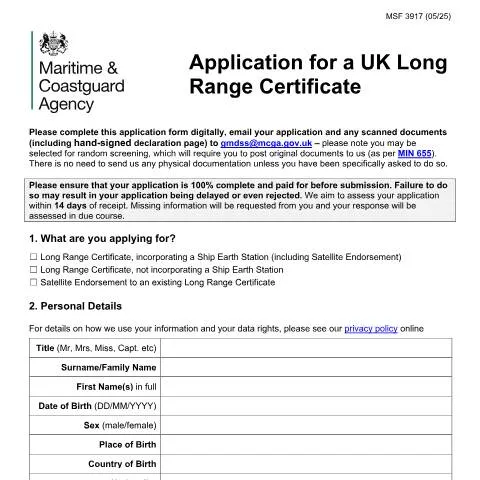
Understanding the UK Long Range Certificate: Your Gateway to International Maritime Communications
When maritime professionals need to operate advanced satellite communication systems aboard vessels venturing beyond coastal waters, the UK Long Range Certificate (LRC) becomes an essential qualification. This specialised certification, issued by the Maritime and Coastguard Agency, validates your competency in Global Maritime Distress and Safety System (GMDSS) operations for vessels engaged in international voyages.
The LRC represents more than just another maritime qualification—it's your professional passport to commanding communication responsibilities on vessels operating in A3 and A4 sea areas, where traditional VHF radio coverage gives way to satellite-based emergency and operational communications. Whether you're pursuing career advancement in the merchant navy, working on offshore installations, or commanding superyachts on transoceanic passages, this certificate opens doors that remain firmly closed to those without proper GMDSS credentials.
Three Distinct Pathways: Choosing Your Certificate Configuration
The Maritime and Coastguard Agency offers three specific variants of the Long Range Certificate, each tailored to different operational requirements and career trajectories. Understanding these distinctions proves crucial for selecting the appropriate pathway.
Long Range Certificate with Ship Earth Station Integration
This comprehensive option incorporates Ship Earth Station operations alongside the standard LRC competencies. Holders gain authority to operate Inmarsat terminals and other satellite communication equipment essential for vessels requiring constant shore contact. The integrated approach particularly benefits officers destined for commercial vessels where satellite communications form the backbone of operational efficiency.
Standalone Long Range Certificate
The streamlined version focuses purely on core GMDSS responsibilities without satellite endorsement components. This pathway suits professionals whose vessels rely primarily on MF/HF radio communications for long-range contact, or those seeking foundational certification before pursuing additional endorsements.
Satellite Endorsement Addition
Existing LRC holders can enhance their qualifications by adding satellite endorsement capabilities. This targeted approach allows experienced professionals to expand their competencies without repeating foundational assessments, making it particularly attractive for career progression within established maritime roles.
| Certificate Type | Core Competencies | Additional Capabilities | Typical Career Applications |
|---|---|---|---|
| LRC with Ship Earth Station | GMDSS operations, emergency procedures | Inmarsat operations, satellite communications | Commercial vessels, cruise ships, offshore |
| LRC Standard | GMDSS operations, emergency procedures | MF/HF radio operations | Fishing vessels, smaller commercial craft |
| Satellite Endorsement | Existing LRC competencies | Added satellite communication authority | Career advancement, role expansion |
Eligibility Requirements and Training Prerequisites
Obtaining a UK Long Range Certificate demands more than simply completing an application form. The Maritime and Coastguard Agency maintains strict standards aligned with international STCW conventions, ensuring certificate holders possess genuine competency rather than mere theoretical knowledge.
Mandatory Training Completion
All applicants must present course completion certificates from approved training providers. The MCA maintains a register of recognised institutions whose programmes meet international standards for GMDSS education. These courses typically span several days and combine theoretical instruction with practical simulator exercises, covering everything from routine satellite communications to emergency distress procedures.
Training providers must demonstrate their programmes address specific competency requirements including distress alerting procedures, search and rescue coordination, radiotelephony procedures, and equipment maintenance protocols. The practical component proves particularly crucial, as simulator exercises test your ability to handle emergency scenarios under pressure—skills that prove invaluable during genuine maritime emergencies.
Documentation and Identity Verification
The application process requires comprehensive identity verification through passport documentation and professional photography. Unlike many administrative procedures, the MCA requires passport-style photographs that meet specific technical standards, as these images appear on the issued certificates and serve for identity verification purposes during port state inspections.
International applicants face additional scrutiny regarding document authenticity, particularly for training certificates issued outside the UK. The agency reserves the right to verify qualifications directly with issuing institutions, potentially extending processing timelines for overseas applications.
Digital Application Process and Document Submission
The Maritime and Coastguard Agency has embraced digital transformation, requiring applications through email submission rather than postal services. This modernised approach accelerates processing while maintaining security through sophisticated verification protocols.
Electronic Submission Requirements
Applications must reach [email protected] as complete packages including all supporting documentation. The MCA accepts standard image formats and PDF documents but maintains strict restrictions on file sharing services. Dropbox, Google Drive, and OneDrive links face automatic rejection, reflecting security protocols designed to protect sensitive maritime qualification data.
Compressed files require .zip formatting exclusively—.rar extensions and other compression formats cannot be processed by MCA systems. This technical requirement reflects the agency's standardised digital infrastructure, designed to handle high volumes of maritime certification applications while maintaining data integrity.
Signature Authentication Protocols
Despite digital submission, the process retains traditional signature requirements that demand careful attention to detail. Applicants must print the declaration page, sign using black ball-point pen, then scan and include the signed document with their digital submission.
The signature requirements extend beyond simple authentication—your specimen signature becomes the official signature appearing on the issued certificate. Port state control officers and maritime employers use this signature for verification purposes, making consistency and legibility essential considerations.
Understanding Processing Timelines and Potential Delays
The Maritime and Coastguard Agency commits to assessing complete applications within fourteen days of receipt. However, this timeline assumes applications meet all requirements and include accurate, complete documentation from submission.
Random Screening Procedures
Selected applicants face random screening requirements under MIN 655 protocols, necessitating postal submission of original documents despite the otherwise digital process. This security measure, implemented to combat qualification fraud, can extend processing timelines significantly as applicants must arrange international courier services for document delivery.
The screening selection process remains opaque—the MCA provides no advance warning of selection, and criteria for choosing candidates for additional verification are not publicly disclosed. This uncertainty requires applicants to maintain flexibility in their certification timelines, particularly when career opportunities depend on prompt qualification receipt.
Incomplete Application Consequences
Applications lacking required elements face automatic delay or rejection. The agency operates a zero-tolerance policy regarding incomplete submissions, reflecting the critical safety implications of maritime communications qualifications. Missing passport photographs, unsigned declarations, or absent training certificates trigger immediate application suspension.
The MCA requests missing information through formal communication, but response assessment occurs "in due course" without specific timeline commitments. This process can extend total qualification times by weeks or months, particularly for international applicants facing postal delays or courier complications.
Fee Structure and International Courier Arrangements
While the UK Long Range Certificate itself carries no direct charge, courier fees create significant cost considerations that vary dramatically based on delivery destinations. The Maritime and Coastguard Agency maintains a tiered fee structure reflecting international shipping realities.
Geographic Fee Categories
UK addresses benefit from the most economical delivery option at £10.00, reflecting domestic postal efficiency and reduced customs complications. European Union and European Economic Area destinations face moderate charges of £20.00, while rest-of-world addresses encounter premium fees of £30.00.
These charges cover more than simple postage—they include secure handling, tracking services, and insurance coverage appropriate for official maritime qualifications. The fee structure also accounts for varying international customs requirements and potential delivery complications in different jurisdictions.
Payment Processing Options
The agency offers dual payment pathways: traditional BACS bank transfers and online payment portals specific to each geographic category. Bank transfer options require advance coordination with [email protected] to obtain current account details and payment references.
Online payment systems provide immediate confirmation and streamlined processing, though applicants must ensure their selected payment option matches their designated delivery address category. Mismatched payments and delivery addresses can trigger administrative delays requiring manual intervention to resolve.
Certificate Validity and Professional Recognition
The UK Long Range Certificate carries international recognition under STCW conventions, providing holders with professional mobility across global maritime jurisdictions. This recognition proves particularly valuable for career development, as many maritime employers specifically require GMDSS-qualified officers for vessels operating beyond coastal waters.
International Acceptance Standards
Port state control authorities worldwide recognise UK-issued LRC qualifications, reflecting the Maritime and Coastguard Agency's reputation for maintaining high certification standards. This acceptance proves crucial during vessel inspections, where communications officer qualifications face scrutiny alongside other safety-critical certifications.
The certificate's international validity eliminates the need for multiple national qualifications when working aboard vessels flagged in different jurisdictions. However, some employers may require additional endorsements or company-specific training to complement the basic LRC qualification.
Data Protection and Privacy Considerations
Application processing involves extensive personal data handling under the Data Protection Act 2018 and UK GDPR requirements. The Maritime and Coastguard Agency maintains detailed privacy policies governing information use, retention, and sharing with international maritime authorities.
Applicants consent to data processing necessary for certificate authentication and validity verification. This processing may include sharing qualification details with port state control authorities, maritime employers conducting verification checks, and international maritime organisations maintaining qualification databases.
The agency's privacy framework balances individual data protection rights with maritime safety requirements, ensuring qualified professionals can demonstrate their competencies while maintaining appropriate personal information security. Understanding these data handling practices proves particularly important for professionals working across multiple jurisdictions with varying privacy regulations.
Understanding the Marine and Coastguard Agency Assessment Process
The Maritime and Coastguard Agency (MCA) employs a rigorous multi-stage assessment process when evaluating Long Range Certificate applications. Understanding this process helps candidates prepare effectively and avoid common pitfalls that could delay approval.
Initial document verification typically takes 10-15 working days from receipt of your complete application. During this phase, MCA administrative staff check that all required documents are present and meet basic requirements. This includes verifying your identity documents, confirming medical certificate validity, and ensuring your sea service testimonials contain all mandatory information such as vessel details, voyage dates, and supervising officer signatures.
The technical assessment phase involves qualified marine surveyors reviewing your sea service records against specific criteria outlined in the Merchant Shipping Act 1995 and associated regulations. For deck officer certificates, assessors examine whether your watchkeeping experience demonstrates competency in navigation, cargo operations, and vessel safety management. Engineering candidates face scrutiny of their mechanical knowledge, maintenance procedures, and emergency response capabilities.
Candidates with mixed vessel experience—such as time served on both commercial and fishing vessels—may encounter extended assessment periods. The MCA must evaluate whether different vessel types provide equivalent training value. For instance, experience gained aboard offshore supply vessels operating in the North Sea carries different weight than coastal cargo operations, even if both qualify as commercial sea time.
Appeals procedures exist for unsuccessful applications, though these follow strict timelines. You must submit written appeals within 28 days of receiving your refusal notice, providing additional evidence or challenging the MCA's interpretation of your experience. The appeals process can extend overall timelines by several months, making thorough initial preparation crucial.
Quality assurance measures include random audits of approved certificates and periodic reviews of assessment standards. The MCA maintains detailed records of all decisions, enabling consistency across different assessment teams and geographical offices.
Special Circumstances and Alternative Pathways
Certain candidates may qualify for alternative certification pathways that deviate from standard Long Range Certificate requirements. These provisions acknowledge that maritime careers often follow non-linear paths, particularly in specialised sectors or following career interruptions.
Military veterans transitioning to civilian maritime roles may utilise recognised equivalencies for Royal Navy or Royal Fleet Auxiliary service. The MCA maintains conversion tables that translate military ranks and specialisations into civilian certificate equivalents. However, veterans must still complete bridging assessments to address differences between military and commercial operations, particularly regarding regulatory compliance and civilian safety management systems.
Candidates holding foreign certificates from countries with mutual recognition agreements may apply for direct certificate exchanges rather than starting the qualification process from scratch. The European Maritime Safety Agency (EMSA) maintains reciprocal arrangements with several non-EU nations, though Brexit has complicated some previously straightforward exchanges. Each case requires individual assessment to determine which qualifications transfer directly and which require supplementary training or examination.
Medical exemption procedures accommodate candidates with disabilities that might otherwise disqualify them from maritime service. The MCA works with maritime medical examiners to assess whether reasonable adjustments can enable safe performance of essential duties. This might include modified bridge equipment for candidates with hearing impairments or alternative communication protocols for those with speech difficulties.
Age-related considerations affect both new applicants and certificate renewals. While no upper age limit exists for initial Long Range Certificate applications, candidates over 65 face more frequent medical reviews and may require additional assessments of cognitive function. Conversely, younger candidates under 18 cannot hold certain certificates regardless of their sea service, creating timing considerations for career planning.
Fast-track provisions exist for candidates with exceptional circumstances, such as urgent employment requirements or time-sensitive vessel assignments. These expedited assessments require additional fees and supporting documentation from prospective employers, but can reduce processing times to as little as five working days in extreme cases.
Maintaining Your Certificate and Career Progression
Long Range Certificate holders face ongoing obligations that extend well beyond initial qualification. Understanding these requirements prevents inadvertent lapses that could ground your career or require expensive requalification procedures.
Revalidation requirements vary depending on your specific certificate type and the nature of your continuing sea service. Most Long Range Certificates require renewal every five years, with demonstrated continued competency through either ongoing sea service or approved refresher training. The MCA defines minimum sea service as 12 months within the preceding five years, though this can be accumulated across multiple vessels and employers.
Continuing professional development (CPD) obligations ensure certificate holders maintain current knowledge of evolving regulations, technology, and best practices. The MCA accepts various forms of CPD, including approved shore-based courses, distance learning programmes, and documented self-study. However, certain critical areas such as safety management systems and environmental protection require formal training from approved providers.
Medical certificate maintenance requires ongoing attention, as lapses can immediately invalidate your Long Range Certificate regardless of other qualifications. Medical certificates typically expire every two years for candidates under 65, annually thereafter. Some medical conditions may require more frequent reviews or specialist assessments, particularly those affecting vision, hearing, or cardiovascular health.
Career advancement often requires strategic planning around certificate upgrades and additional endorsements. Higher-level certificates such as Master Mariner or Chief Engineer typically require specific combinations of sea service, formal education, and examination success. Planning these progressions while maintaining employment can be challenging, particularly for candidates working extended rotations offshore or on international routes.
Record keeping becomes increasingly important as careers progress and certificates accumulate. The MCA recommends maintaining personal copies of all certification documents, sea service records, and training certificates. Digital copies stored securely can prevent delays if original documents are lost or damaged, though certified copies may still be required for certain applications.
International implications affect UK certificate holders working abroad or on foreign-flagged vessels. While Long Range Certificates are generally recognised internationally, some flag states or port authorities may require additional documentation or local endorsements. Understanding these requirements before accepting international assignments prevents complications that could affect both employment and certification status.