Understanding the Application Process for the Certificate of Proficiency for Able Seafarer Regulation II/5
The Maritime and Coastguard Agency (MCA) of the United Kingdom provides a clear pathway for seafarers seeking to obtain the Certificate of Proficiency for Able Seafarer Deck Regulation II/5. This certification is essential for individuals aiming to work in a deck capacity on merchant vessels, demonstrating their competence and adherence to international maritime safety standards.
Scope and Purpose of the Certificate
The Certificate of Proficiency (CoP) under Regulation II/5 confirms that the holder has met specific training and sea service requirements to operate as an able seafarer in a deck role. It is a key qualification for those wishing to progress in their maritime careers, particularly on vessels exceeding 24 meters in load line length or 80 gross tonnage. The certification aligns with the Standards of Training, Certification, and Watchkeeping (STCW) Convention, ensuring compliance with international maritime safety standards.
Eligibility and Prerequisites
Applicants must be at least 18 years old to qualify for this certification. They should also possess a valid UK-issued Navigational Watch Rating (NWR) Certificate under Regulation II/4, which demonstrates their foundational competence in navigational watchkeeping. Furthermore, applicants are required to have completed specific training courses, including:
- Personal Survival Techniques (STCW A-VI/1-1),
- Fire Prevention and Fire-Fighting (STCW A-VI/1-2),
- Elementary First Aid (STCW A-VI/1-3),
- Personal Safety and Social Responsibilities (STCW A-VI/1-4),
- MCA-approved Certificate of Proficiency in Survival Craft and Rescue Boat (excluding fast rescue boats),
- Efficient Deck Hand (EDH) Course,
Additionally, applicants must accumulate a minimum of 18 months of seagoing service in a deck department while holding a Navigational Watch Rating Certificate. This sea service must include a specified period in merchant vessels, with at least six months aboard vessels over 24 meters or 80 GT, and can include service in other ship types such as Royal Navy ships or Mobile Offshore Units, provided the sea service in merchant vessels is completed.
Application Procedure
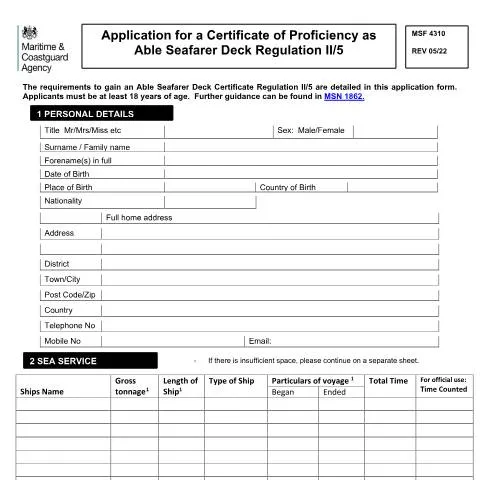
The application process involves completing the official application form (MSF 4310), which requires detailed personal information, sea service records, and proof of relevant training certificates. Applicants must also pay a fee of £34, payable via online payment methods approved by the MCA.
Once the application is submitted, it must be accompanied by:
- Proof of identity and nationality,
- Certificates of training courses,
- Sea service records,
- Any additional documentation requested by the marine office.
Submission and Processing
Applications should be sent to the relevant MCA Marine Office, which may include locations such as Aberdeen, Cardiff, Colchester, Glasgow, Hull, Liverpool, or Southampton. Applicants outside the UK must ensure that documents are declared with no commercial value to avoid import taxes. Payment is accepted via BACS transfer, credit, or debit card through the official online payment platform.
Post-Application and Certification
Following submission, the MCA Marine Office reviews the application and, if all requirements are met, issues the Certificate of Proficiency. The certificate confirms that the applicant is qualified to serve as an able seafarer in a deck capacity, subject to ongoing compliance with STCW standards and renewal requirements.
Additional Considerations
Applicants should ensure that their training certificates are current, with most being valid for less than five years. If certificates are outdated, updated training must be completed and documented before certification can be issued. Also, medical fitness is a prerequisite; a medical restriction stating “not fit for lookout duties” can prevent certification.
References and Further Guidance
For detailed legal and procedural guidance, applicants are advised to consult the official MCA documentation, including MSN 1862, and to contact their local MCA marine office for specific instructions and assistance. The process is designed to uphold high safety standards and ensure that qualified personnel are recognized across the maritime industry.