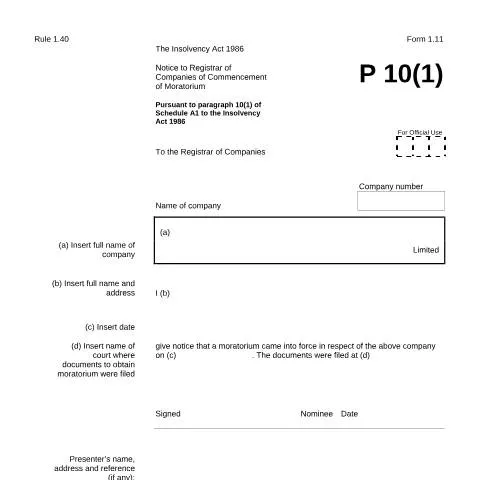
Understanding the Notice of Commencement of Moratorium: A Vital Step for Companies
In the face of financial distress, businesses may find themselves needing protection from creditors while they restructure or seek to resolve their financial difficulties. The Notice of Commencement of Moratorium (Form 1.11) is a formal notification that a moratorium has come into force for a company, allowing it a period of respite from creditor actions. This document is crucial for companies and their directors, but understanding its implications and correct usage is equally important.
Who Benefits from Submitting This Notice?
The audience for the Notice of Commencement of Moratorium primarily includes company directors, insolvency practitioners, and legal representatives involved in restructuring efforts. It becomes indispensable in scenarios where:
- A company is facing imminent insolvency and requires legal protection to reorganize its debts.
- Directors are seeking to avoid aggressive creditor actions while they explore options for the company's future.
- Shareholders are keen on preserving the value of their investments during turbulent financial periods.
In each of these situations, timely submission of the notice to Companies House is essential to secure the benefits of the moratorium under the provisions of the Insolvency Act 1986.
Delving into the Key Components of the Notice
The Notice of Commencement of Moratorium is not merely a formality; it encapsulates critical information about the moratorium and the company involved. Here are the primary components of the notice:
- Company Number and Name: It must include the full name of the company and its registration number to ensure correct identification.
- Date of Commencement: The specific date on which the moratorium came into force. This is crucial as it marks the beginning of the protection period.
- Court Information: The name of the court where the necessary documents for the moratorium were filed is required. This links the moratorium to the legal proceedings that initiated it.
- Signatory Details: The notice must be signed by the nominee overseeing the moratorium, adding a layer of accountability and formality.
How to Navigate the Process of Issuing the Notice
Submitting the Notice of Commencement of Moratorium involves several steps that must be followed meticulously to ensure compliance with legal requirements. The process typically unfolds as follows:
- Engage an Insolvency Practitioner: First and foremost, a licensed insolvency practitioner (IP) should be appointed, as they can provide expert guidance through the moratorium process.
- Gather Required Information: Collect all necessary details regarding the company, the moratorium, and any court filings related to the process.
- Complete the Notice: Fill out the Form 1.11 accurately, ensuring that all required fields are completed to avoid delays.
- Submit to Companies House: File the completed notice with Companies House. It is essential to adhere to the filing deadlines to avoid lapses in the moratorium's protection.
- Keep Records: Maintain copies of all documents submitted and received, as they may be pivotal in future proceedings or shareholder meetings.
Interlinking Documents and Procedures
The Notice of Commencement of Moratorium does not exist in a vacuum; it is part of a broader framework of insolvency procedures. Understanding how it interrelates with other documents can clarify its purpose:
| Document | Purpose |
|---|---|
| Insolvency Practitioner’s Report | Provides the rationale for entering into the moratorium, assessing the viability of the business post-moratorium. |
| Statement of Affairs | Gives creditors an overview of the company’s financial standing, which supports the moratorium's objectives. |
| Proposals for Company Voluntary Arrangement (CVA) | Outlines how the company plans to repay creditors, which may be developed during the moratorium period. |
This interconnectedness ensures that the moratorium is not seen as a standalone solution but rather as part of a comprehensive strategy to address financial challenges.
Recognizing Common Misinterpretations
While the process may seem straightforward, several misconceptions can lead to complications or misapplications of the moratorium:
- The Moratorium Automatically Prevents All Actions: It's essential to understand that while a moratorium protects against certain creditor actions, it does not stop all legal proceedings, particularly those initiated before the moratorium commenced.
- Duration of Moratorium: The moratorium is not indefinite; it typically lasts for 20 business days, but it can be extended if specific conditions are met.
- Creditor Consent is Not Needed: Some may mistakenly believe that creditor approval is necessary to initiate a moratorium; however, it is an automatic legal protection once filed correctly.
Clarifying these points can help ensure that directors and stakeholders have a realistic view of what the moratorium can achieve.
Key Concepts and Terminology to Master
Familiarity with specific terminology can significantly enhance understanding and facilitate smoother communication throughout the moratorium process. Here are several key terms:
- Moratorium: A legal suspension of payments to creditors, allowing time for restructuring.
- Insolvency Practitioner: A professional licensed to manage insolvency procedures, responsible for overseeing the moratorium.
- Creditor: An individual or entity to whom money is owed by the company.
- Notice Period: The timeframe during which creditors are informed about the moratorium and any changes in the company’s status.
Understanding these terms is not just academic; it is vital for effective communication with stakeholders, advisors, and legal representatives.
Utilizing the Notice for Strategic Advantage
Beyond its immediate purpose, the Notice of Commencement of Moratorium can be strategically leveraged to enhance the reputation of a company facing difficulties. Here's how:
- Demonstrating Proactive Management: Issuing the notice shows stakeholders that the company is taking proactive steps to address financial challenges, potentially restoring confidence among investors and employees.
- Facilitating Negotiations with Creditors: The moratorium allows for negotiations in a more stable environment, giving the company leverage to propose repayment plans or restructurings without the pressure of immediate creditor actions.
- Fostering Collaboration: Engaging with creditors during the moratorium can lead to mutually beneficial arrangements and potential for future collaboration, which might be more challenging under bankruptcy proceedings.
Leveraging the moratorium effectively can signal a turning point for the company, reminding stakeholders of its commitment to a recovery strategy.
Understanding the Moratorium Process for Companies in Financial Distress
In the context of UK insolvency law, a moratorium serves as a vital mechanism for businesses facing financial challenges. By obtaining a moratorium, a company can effectively halt creditor actions and provide itself with breathing space to explore restructuring or other options. It is essential to recognize that a moratorium is not a permanent solution; rather, it is a temporary status that allows companies to stabilize and seek professional advice on their financial predicament.
The commencement of a moratorium is governed by the Corporate Insolvency and Governance Act 2020, which introduced the moratorium as an option for companies in distress. To initiate a moratorium, certain steps must be followed, including the preparation of appropriate documents and notification to relevant stakeholders.
When giving notice of the commencement of a moratorium, a company must submit a notice to Companies House using the prescribed form (form MOR1). This form requires detailed information about the company, including its registered address, nature of business, and the name of the appointed insolvency practitioner, who will oversee the moratorium period. Failure to comply with these requirements could lead to the rejection of the moratorium application.
Once the moratorium is in place, it creates a 'breathing space' for the company during which creditors cannot take legal actions against it, provided the conditions of the moratorium are adhered to. This means that directors can focus on developing a viable plan to protect the company’s interests and avoid liquidation.
Key Considerations for Directors When Opting for a Moratorium
Directors contemplating a moratorium should consider several factors before proceeding. The first step is to ensure that the company is eligible for a moratorium. Only companies that meet specific criteria, such as not having any outstanding winding-up petitions or being subject to insolvency proceedings, can apply. This eligibility is critical, as breaches can lead to significant legal consequences.
Moreover, directors must be aware of their responsibilities during the moratorium period. They are required to act in the best interests of the company and its creditors. While the moratorium provides protection against creditor action, it does not absolve directors of their fiduciary duties. They must still ensure that the company is not trading while insolvent, as this could result in personal liability for debts incurred during this period.
It is also advisable for directors to seek professional advice from licensed insolvency practitioners. These experts can provide invaluable guidance on whether a moratorium is the best course of action, as well as assist in preparing the necessary documentation. Furthermore, they can help formulate a plan for the company’s recovery, whether through restructuring, negotiations with creditors, or exploring other avenues.
Impact of the Moratorium on Employees and Stakeholders
The commencement of a moratorium can have far-reaching implications, not only for the company but also for its employees and various stakeholders. During the moratorium, employees may have concerns regarding job security and their wages. It is imperative for companies to communicate transparently with their staff about the situation. Clear communication can help alleviate fears and maintain morale during uncertain times.
In addition to employees, suppliers and clients are also impacted by the moratorium. Suppliers may be hesitant to provide goods or services on credit to a company that has entered a moratorium, fearing that they will not be paid. Companies should proactively engage with their suppliers and reassure them of their commitment to resolving the financial situation.
For shareholders, entering a moratorium can signal potential financial distress. Companies should work to maintain transparency with their shareholders about the steps being taken during the moratorium and the anticipated outcomes. This is critical for maintaining trust and confidence among all stakeholders, which can play a key role in the company's recovery.
In conclusion, while the moratorium is a valuable tool for companies in distress, its effectiveness largely depends on the proactive management of communications with employees, suppliers, and shareholders, alongside compliance with legal obligations. By navigating these complexities effectively, companies can create a pathway toward recovery and sustainability.