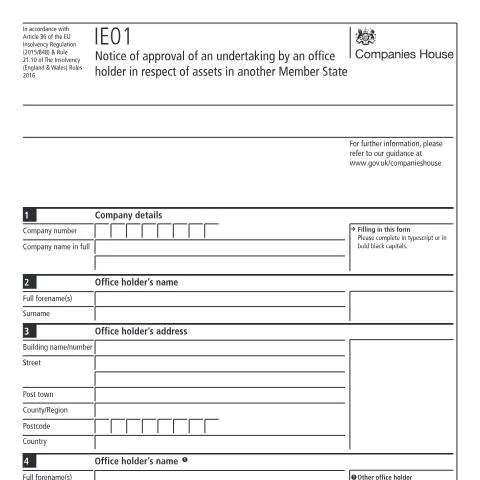
Navigating the IE01: Understanding the Notice of Approval of an Undertaking
The IE01 form serves a crucial role in the management of insolvency processes for companies operating across member states of the European Union. For company directors and insolvency practitioners, understanding the implications and the procedural requirements surrounding the IE01 can greatly facilitate compliance and avoid potential pitfalls.
Contextual Foundations: Where the IE01 Fits In
To grasp the significance of the IE01, it’s essential to contextualize it within the broader framework of insolvency regulations in the UK. The form is grounded in Article 36 of the EU Insolvency Regulation (2015/848) and governed by Rule 21.10 of The Insolvency (England & Wales) Rules 2016.
This means that the IE01 is deployed when an office holder (such as an administrator or liquidator) aims to notify Companies House of an undertaking concerning the assets of a company located in another EU member state. By adhering to this regulation, UK businesses can ensure that their international dealings are transparent and compliant with cross-border insolvency laws.
The Intricacies of Form Completion
Filling out the IE01 form may appear straightforward, but several details must be accurately captured to avoid delays or rejections:
- Company Details: Ensure the full company name and registration number align with official records held at Companies House.
- Office Holder Information: The name and address of the office holder must be clearly provided. This includes full forename(s), surname, and complete address details. There is also space for a second office holder, if applicable.
- Date of Approval: The date when the undertaking was approved must be filled in accurately. This date is critical as it can impact subsequent procedural timelines.
- Signature: The office holder must sign the form, confirming the accuracy of the information provided.
It is vital to remember that all information submitted through the IE01 will eventually appear on the public record, which emphasizes the importance of precision in completion.
Common Misinterpretations and Evasion of Pitfalls
When navigating the IE01 process, there are common misinterpretations that can lead to complications:
- Assuming All Information Is Optional: While the form may not require certain contact details, providing them can assist Companies House in addressing queries efficiently.
- Neglecting Attachments: The requirement for attaching supporting documentation, like a copy of the undertaking, is non-negotiable. Failing to include these can result in the form being returned for correction.
- Ignoring Deadlines: Understanding relevant timelines, especially in insolvency contexts, is crucial. For example, failure to submit the IE01 in a timely manner could compromise the approved undertaking.
Step-by-Step Guidance for Practical Application
Approaching the IE01 process systematically can alleviate confusion:
- Step 1: Gather all necessary information regarding the company and the office holder(s).
- Step 2: Confirm that the company name and registration number match the records in Companies House.
- Step 3: Complete the form in typescript or bold black capitals to ensure clarity.
- Step 4: Attach any required documents, particularly the copy of the undertaking.
- Step 5: Sign and date the form before submission.
- Step 6: Submit the IE01 to Companies House, preferably to the advised address for expediency.
Understanding the Target Audience: Who Should Utilize the IE01?
The IE01 form is primarily designed for use by office holders, including administrators, liquidators, and solicitors with responsibilities in insolvency matters. However, it may also be relevant for:
- Directors of companies undergoing insolvency proceedings.
- Legal professionals advising clients on cross-border insolvency issues.
- Stakeholders involved with assets in other EU member states, requiring formal recognition of management decisions.
The necessity of using the IE01 arises particularly when the assets involved are situated in a member state other than the UK. This scenario often occurs in multinational corporations where assets are dispersed across borders, making the IE01 indispensable for maintaining regulatory compliance.
Key Considerations When Engaging with the IE01
When utilizing the IE01, it’s important to keep the following considerations in mind:
- Legitimacy of Information: All details provided must be verifiable and consistent with company records. Inaccuracies could raise compliance issues or legal challenges.
- Understanding the Implications: Submission of the IE01 indicates that an undertaking regarding assets has been formally approved. This carries specific legal implications, especially in the context of insolvency.
- Future Accessibility: The information submitted will be accessible to the public. Therefore, sensitive information should be handled with caution.
Procedural FAQs: Important Insights
While the following points mirror common queries regarding the IE01, they focus on practical insights rather than direct questions:
- Documentation Queries: Ensure you are clear on what constitutes the 'required documents.' Generally, this will include the undertaking documentation.
- Changes Post-Submission: If alterations are needed after submission, understand the process for rectifying or resubmitting information.
- Communication with Companies House: If there are any uncertainties, always consider contacting Companies House directly for clarity. Their guidance can save significant time and resources.
Final Thoughts: Strategic Use of the IE01 in Operational Contexts
Engaging effectively with the IE01 form is not merely a matter of compliance; it forms a part of a broader strategy for managing insolvency within the evolving landscape of EU regulations. By thoroughly understanding the requirements and maintaining diligent documentation practices, company directors and insolvency practitioners can enhance their operational resilience and safeguard their interests.
Ultimately, the IE01 serves as a critical document bridging the regulatory obligations of companies operating across borders. By approaching this process with clarity and rigor, stakeholders can ensure that their engagements in cross-border asset management remain legally sound and strategically advantageous.
Understanding the IE01 Form: A Comprehensive Guide
The IE01 form is a crucial document for businesses operating within the UK that are engaging in cross-border transactions, particularly when it involves the approval of an undertaking for assets located in another EU or EEA member state. The process of giving notice of approval requires a clear understanding of both the legal implications and the administrative steps involved.
When submitting the IE01 form, it is essential to ensure that all information is accurate and complete to prevent delays or complications. This includes providing precise details regarding the undertaking, the assets in question, and any relevant agreements or contracts that pertain to the assets in the other member state. A thorough understanding of the Data Protection Act 2018 and UK GDPR is also pertinent, especially when handling personal data related to the assets or stakeholders involved.
The role of Companies House cannot be overlooked; they manage the registration of business entities in the UK. It is important that entities that wish to submit the IE01 form are in good standing with Companies House. Any discrepancies in registration details could lead to rejection of the form or additional scrutiny, resulting in significant delays in the approval process.
The Legal Framework Governing Cross-Border Undertakings
To effectively navigate the process of giving notice of approval of an undertaking for assets in another member state, one must consider the wider legal framework that governs cross-border transactions. The Transnational Company Law Directive provides an essential backdrop, enabling businesses to operate more flexibly across borders while ensuring adherence to national legal requirements.
This directive emphasizes the necessity for transparency and accountability in cross-border transactions. Hence, businesses must maintain robust records of all communications and agreements, especially those relating to the IE01 submission. Additionally, understanding the nuances of international tax regulations is vital, as tax implications can vary significantly between jurisdictions.
Furthermore, engaging with legal counsel who specializes in EU and UK business law can provide invaluable guidance through the complexities of this process. They can help interpret the implications of any bilateral agreements that may exist between the UK and the specific member state, potentially affecting the approval of the undertaking.
Practical Tips for Completing the IE01 Form
Completing the IE01 form accurately is paramount to ensuring a smooth approval process. Here are several practical tips that can assist businesses in this endeavor:
- Gather Required Documentation: Before filling out the IE01 form, compile all necessary documents. This may include proof of ownership of the assets, any agreements made with entities in the other member state, and any prior correspondence regarding the undertaking.
- Double-Check Information: It is advisable to meticulously review the completed form for errors or omissions. Mistakes in the National Insurance number or company registration number can lead to significant delays or rejections.
- Seek Professional Assistance: If there are any uncertainties regarding the form or the process, consulting with a professional experienced in international business transactions can provide clarity and help mitigate any potential risks.
- Stay Updated on Regulatory Changes: Laws and regulations governing cross-border transactions can evolve. Keeping abreast of any changes that may affect the IE01 process is crucial, particularly in light of the UK's evolving relationship with the EU.
By following these practical steps, businesses can enhance their chances of a successful submission of the IE01 form, paving the way for smoother operations across national borders.