Understanding the IE02 Notice: A Key Step in International Liquidation
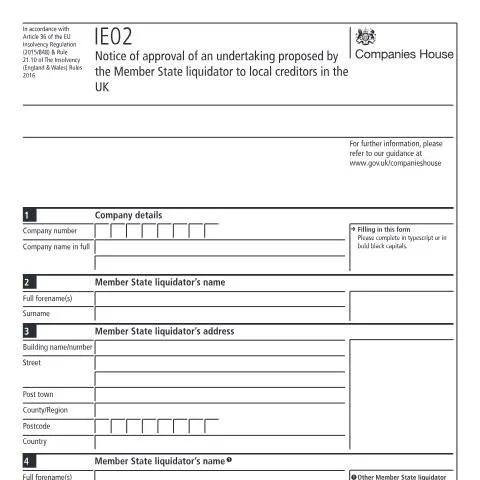
The IE02 Notice of Approval plays a critical role for companies under liquidation in the UK when dealing with local creditors. This document is not merely a procedural step; it bears significant implications for both the liquidators and the creditors involved. It acts as an official communication regarding the approval of a proposed undertaking by the Member State liquidator, as stipulated under Article 36 of the EU Insolvency Regulation and Rule 21.10 of The Insolvency (England & Wales) Rules 2016.
Process Flow: From Proposal to Notification
To effectively leverage the IE02 Notice, understanding its integration within the broader liquidation process is essential. Here’s a step-by-step breakdown:
- Proposal Submission: The Member State liquidator drafts a proposed undertaking, detailing how they intend to manage the liquidation process and address creditor claims.
- Approval Phase: Creditors are notified of the proposal, giving them the opportunity to respond or object.
- Issuance of the IE02 Notice: Once the proposal is approved, the IE02 Notice is issued to communicate this approval to local creditors in the UK.
- Documentation Submission: The liquidator must ensure all required documents, including the IE02 Notice, are submitted to Companies House.
- Public Record Update: Once received, Companies House updates the public record, ensuring transparency and accessibility for all stakeholders.
Contents of the IE02 Notice: What You Need to Know
Understanding the specific elements that comprise the IE02 Notice is crucial for both liquidators and creditors:
- Company Details: Essential information, including the full company name and its registration number, must be accurately provided.
- Liquidator Information: The name and address of the Member State liquidator are required, ensuring that there is a clear point of contact for any queries.
- Approval Date: The date on which the undertaking was approved must be clearly stated, as this serves as a timeline reference for creditors.
- Signature Confirmation: The liquidator must sign the notice to authenticate it formally, further validating the contents of the document.
Connecting the Dots: Related Documentation in Liquidation
The IE02 Notice does not exist in isolation; it is part of a suite of documentation that forms the backbone of the liquidation process. Here are some key documents that interact closely with the IE02:
| Document | Description | Relation to IE02 |
|---|---|---|
| Proposed Undertaking | A detailed plan by the liquidator outlining how they will handle creditor claims. | Foundation for the IE02 Notice. |
| Creditor Notification Letters | Formal communication sent to creditors about the proposed undertaking. | Precedes the issuance of the IE02 Notice. |
| Confirmation of Approval | Document confirming that creditors have accepted the proposed undertaking. | Essential for validating the IE02 Notice. |
| Companies House Submission | Official filing to update the public record regarding the company's status. | Incorporates the IE02 Notice after submission. |
Common Misinterpretations: Navigating the Legal Landscape
Engaging with the IE02 Notice can lead to various misinterpretations, especially given the complex nature of liquidation laws. Here are common pitfalls:
- Assuming Automatic Approval: Many may incorrectly think that the issuance of the IE02 Notice indicates that the undertaking has automatically been accepted by all creditors.
- Neglecting Public Record Implications: Failure to comprehend that the information submitted will be publicly available can lead to hesitance in disclosing necessary details.
- Confusion Over Liquidator Responsibilities: Some might assume that once the notice is issued, the liquidator's role diminishes, despite their ongoing involvement in managing the liquidation process.
Timelines and Essential Deadlines in Liquidation Proceedings
Understanding the key timelines associated with the IE02 Notice can significantly impact the efficiency of the liquidation process. Here are the critical timeframes that all parties should be aware of:
- Proposal Submission Deadline: The proposed undertaking must be circulated to creditors within a specified timeframe following the initiation of the liquidation. Delays can complicate the approval process.
- IE02 Notice Issuance: The notice must be issued promptly after the proposal is approved, ideally within a few days, to maintain momentum in the liquidation proceedings.
- Companies House Filing Deadline: The IE02 notice must be filed with Companies House within a strict timeframe to ensure that the information is registered properly. Failure to do so can lead to complications.
The Role of Creditors: Response and Engagement
Creditors play a pivotal role in relation to the IE02 Notice. Their engagement is not merely passive; it involves a few critical actions:
- Reviewing the Proposed Undertaking: Creditors should carefully evaluate the details of the undertaking to ascertain how it impacts their claims.
- Engaging in Dialogue: Should there be concerns or objections, creditors need to communicate these promptly to the liquidator, ensuring their voices are heard in the decision-making process.
- Monitoring the Process: After the issuance of the IE02 Notice, creditors should stay updated on the progression of the liquidation to safeguard their interests.
Consequences of Non-Compliance: What to Avoid
Failure to adhere to the requirements set forth in the IE02 Notice can have significant repercussions:
- Delays in Liquidation: Non-compliance can result in delays, leading to prolonged uncertainty for both creditors and the liquidating company.
- Legal Ramifications: Legal challenges can arise if the notice is improperly executed, which could complicate the entire liquidation process.
- Reputational Damage: Companies that fail to follow through with accurate and timely notices risk reputational harm, affecting future business opportunities.
A Closer Look: Best Practices for Liquidators
For Member State liquidators, there are best practices to ensure the IE02 Notice is utilized effectively:
- Thorough Documentation: Ensure that all information is meticulously documented and accurately reflects the company’s status and the proposed undertaking.
- Timely Communication: Keep communication lines open with all stakeholders, providing updates as necessary to preempt potential disputes.
- Consult Legal Experts: Engaging with legal professionals familiar with insolvency laws can help navigate complexities and mitigate risks.
Final Thoughts: The IE02 Notice in Context
The IE02 Notice of Approval serves a pivotal function within the larger framework of corporate liquidation, particularly in international contexts. By understanding its purpose, implications, and the necessary associated documentation, both liquidators and creditors can navigate this complex process more effectively.
This guide aims to empower users with the knowledge required to manage the procedural intricacies of the IE02 Notice, ensuring a smoother transition through the liquidation landscape.