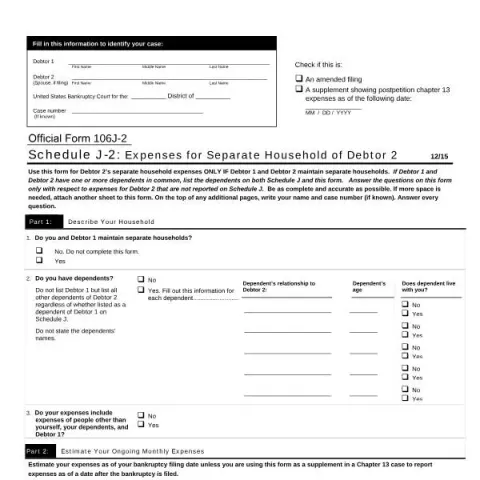
Understanding the Official Form 106J-2 Schedule J-2: Expenses for Separate Household of Debtor 2
The Official Form 106J-2 Schedule J-2 is a specialized legal document used in bankruptcy proceedings within the United States. It specifically addresses expenses related to the separate household of Debtor 2, when Debtor 1 and Debtor 2 maintain separate residences. This form is part of the broader bankruptcy filing process managed by the United States Bankruptcy Court and plays a crucial role in accurately reporting household expenses for individual debtors involved in a chapter 13 or chapter 7 case.
When and Why to Use Form 106J-2
This form should be completed only if Debtor 2 maintains a separate household from Debtor 1. Its primary purpose is to detail the ongoing monthly expenses associated solely with Debtor 2’s residence and living costs, which are not reported on the main Schedule J. If Debtor 1 and Debtor 2 live together or share household expenses, this form is not applicable.
For debtors who are filing for bankruptcy and have separate households, accurately filling out Schedule J-2 ensures that the court has a clear understanding of Debtor 2’s financial situation. This transparency can influence the court’s decisions regarding repayment plans, discharge eligibility, or asset management.
Key Sections and Information Required
Part 1: Describe Your Household
- Household Maintenance: The form asks whether Debtor 2 and Debtor 1 maintain separate households. If not, the form should be left unfilled.
- Dependents: Debtor 2 must list all dependents (excluding Debtor 1), specifying their relationship, age, and whether they live with Debtor 2. This helps establish the scope of household expenses and responsibilities.
- Additional Expenses: The form inquires whether expenses include others beyond Debtor 2 and dependents, ensuring comprehensive reporting.
Part 2: Estimating Monthly Expenses
This section requires Debtor 2 to estimate ongoing monthly expenses as of the bankruptcy filing date. It encompasses a wide range of categories, including:
- Housing: Rent or mortgage payments, property taxes, homeowner’s or renter’s insurance, and maintenance costs.
- Utilities: Electricity, water, sewer, garbage collection, internet, cable, and phone services.
- Living Expenses: Food, clothing, personal care, medical expenses, transportation, childcare, and education costs.
- Insurance and Taxes: Life, health, vehicle insurance, and taxes not deducted from income.
- Debt Payments: Car loans, lease payments, alimony, and other support payments.
- Additional Expenses: Entertainment, charitable contributions, and other miscellaneous costs.
Completing and Submitting the Form
Debtor 2 should complete all questions with as much accuracy as possible, providing specific dollar amounts for each expense category. If additional space is needed, extra pages can be attached, with the debtor’s name and case number clearly marked at the top.
It is essential to review the form carefully before submission, as incomplete or inaccurate information can affect the bankruptcy process and court decisions. The completed Schedule J-2 is typically filed alongside other bankruptcy forms, such as Schedule I (Income) and Schedule J (Expenses for the household of Debtor 1).
Fill in your form directly online
No printing: type your details into the boxes of the official form, tick, then download the PDF ready to send.
- 1Type into the form boxes
- 2Tick in one click
- 3Save and download the PDF
Points of Attention and Practical Tips
- Accuracy: Ensure all expense estimates reflect current and typical monthly costs. Use recent bills or statements as references.
- Dependents and Shared Expenses: Clarify which expenses relate solely to Debtor 2’s household to avoid confusion with shared costs.
- Additional Documentation: Keep records of bills, receipts, or statements that support the figures reported in the form.
- Legal Guidance: When in doubt, consult a bankruptcy attorney or a legal professional experienced in bankruptcy filings to ensure compliance and accuracy.
Conclusion
The Official Form 106J-2 Schedule J-2 is a vital document for debtors maintaining separate households during bankruptcy proceedings. Proper completion ensures transparency and accuracy in representing Debtor 2’s financial obligations, ultimately supporting a fair and efficient bankruptcy process within the framework of U.S. federal law.