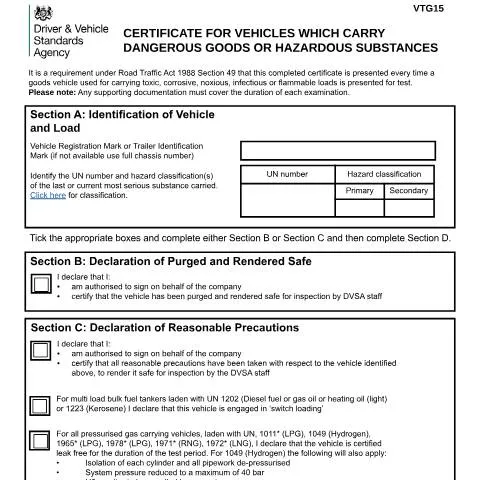
When Hazardous Cargo Vehicles Enter the Testing Station: Understanding the VTG15 Declaration
The moment a commercial vehicle carrying dangerous goods approaches a DVSA testing facility, a critical safety protocol activates. Under Section 49 of the Road Traffic Act 1988, no vehicle that has transported toxic, corrosive, noxious, infectious or flammable materials can undergo statutory testing without first presenting a completed VTG15 certificate. This declaration serves as the essential bridge between the hazardous transport world and vehicle inspection requirements, ensuring that DVSA staff can safely examine vehicles that have carried potentially lethal substances.
The VTG15 certificate represents far more than bureaucratic paperwork—it's a legally mandated safety barrier that protects testing station personnel from exposure to residual dangerous goods. Whether a tanker has carried diesel fuel, a refrigerated trailer has transported medical gases, or a specialist vehicle has moved corrosive chemicals, the certificate confirms that appropriate safety measures have been implemented before inspection begins.
The ADR Transport Chain: Where VTG15 Fits in Dangerous Goods Operations
Commercial vehicles operating under the Agreement concerning the International Carriage of Dangerous Goods by Road (ADR) exist within a tightly regulated ecosystem. The VTG15 certificate occupies a specific position in this regulatory framework, bridging the gap between operational transport duties and mandatory vehicle testing requirements.
ADR-certified vehicles must undergo regular statutory testing just like any commercial vehicle, but their cargo history creates unique safety considerations. The certificate ensures that vehicles which have carried substances classified under UN dangerous goods categories can be safely presented for annual test, first test, or prohibition clearance without endangering inspection staff.
Understanding UN Classification Requirements
The certificate requires precise identification of the most serious substance previously carried, using UN numbers and hazard classifications. This isn't simply administrative detail—it determines the specific safety protocols required during vehicle preparation. For instance:
| UN Number | Substance | Primary Hazard | Preparation Requirements |
|---|---|---|---|
| 1202 | Diesel fuel/gas oil | Flammable liquid | Switch loading protocols may apply |
| 1049 | Hydrogen | Flammable gas | Cylinder isolation, depressurisation to 40 bar maximum |
| 1011 | LPG (Butane) | Flammable gas | Leak-free certification required |
| 3065 | Alcoholic beverages | Flammable liquid | Kemler code declaration mandatory |
Purged Versus Precautionary: Two Distinct Safety Pathways
The VTG15 certificate offers two fundamentally different approaches to vehicle safety preparation, each suited to specific operational circumstances and substance types. Understanding which pathway applies requires careful consideration of the vehicle's recent cargo history and current operational status.
Section B: Complete Purging and Decontamination
The purged and rendered safe declaration represents the most comprehensive safety approach. This pathway requires complete removal or neutralisation of all dangerous substance residues from the vehicle. For tank vehicles, this typically involves thorough cleaning, degassing, and potentially inert gas purging to eliminate any trace of hazardous materials.
Vehicles following this route have undergone professional decontamination procedures appropriate to their previous cargo. A tanker that carried corrosive acids would require different purging protocols compared to one that transported flammable liquids, but the end result is identical: complete elimination of hazardous residues.
Section C: Controlled Risk Management
The reasonable precautions pathway acknowledges that some vehicles may retain dangerous goods during testing, provided specific safety measures are implemented. This approach is particularly relevant for:
- Multi-load bulk fuel tankers engaged in switch loading operations with diesel fuel, gas oil, or kerosene
- Pressurised gas carriers that can demonstrate leak-free status throughout the testing period
- Hydrogen transport vehicles with properly isolated cylinders and depressurised systems
- Alcohol transport vehicles with appropriate emergency evacuation procedures
For hydrogen carriers specifically, the requirements become particularly stringent: each cylinder must be individually isolated, all pipework must be depressurised to a maximum of 40 bar, and the presenter must supply an H2 monitor for continuous atmospheric monitoring during inspection.
The Responsible Official: Authority, Accountability and Legal Liability
The VTG15 certificate places significant legal responsibility on the signing official, who must possess both the authority to represent their company and the technical knowledge to assess vehicle safety status. This isn't a role that can be delegated to junior staff or administrative personnel without appropriate dangerous goods expertise.
Qualifying for Signature Authority
The responsible official must demonstrate two distinct qualifications: corporate authorisation and technical competence. Corporate authorisation means the individual has been formally empowered by their company to make safety declarations on its behalf—typically documented through written delegation of authority or senior management position.
Technical competence involves understanding the specific dangerous goods carried, appropriate safety procedures, and the implications of the declaration being made. For companies operating multiple vehicle types or carrying various dangerous goods classifications, this often requires individuals with ADR safety adviser qualifications or equivalent expertise.
Legal Implications of the Declaration
By signing the VTG15 certificate, the responsible official creates legal liability under the Road Traffic Act 1988. False declarations or inadequate safety preparations that result in incidents during testing can lead to prosecution under dangerous goods regulations, health and safety legislation, and potentially corporate manslaughter provisions if serious harm occurs.
The declaration specifically certifies that "all reasonable precautions have been taken" or that the vehicle "has been purged and rendered safe". These aren't mere administrative statements—they represent legal warranties that appropriate professional standards have been applied to vehicle preparation.
Documentation Requirements: Building the Supporting Evidence Chain
The VTG15 certificate explicitly states that supporting documentation must cover the duration of each examination. This requirement extends far beyond the certificate itself, creating an evidence chain that substantiates the safety declarations made.
Purging and Decontamination Records
For vehicles declared purged and rendered safe, supporting documentation typically includes:
- Professional cleaning certificates from approved decontamination facilities
- Gas-free certificates confirming absence of hazardous vapours
- Analytical test results demonstrating residue levels below safety thresholds
- Photographic evidence of tank interior condition where applicable
- Waste disposal documentation for removed contaminated materials
Ongoing Safety Monitoring Documentation
Vehicles following the reasonable precautions pathway require different supporting evidence:
- Leak testing certificates for pressurised gas carriers, valid for the test duration
- Pressure monitoring records for hydrogen vehicles showing successful depressurisation
- Switch loading operational logs for multi-product fuel tankers
- Emergency response procedures specific to the substances being carried
- Insurance confirmation covering dangerous goods operations during testing
Operational Scenarios: Matching Certificates to Real-World Situations
Understanding when and how to apply VTG15 requirements becomes clearer through examining typical operational scenarios that dangerous goods operators encounter. Each situation presents unique challenges in balancing operational efficiency with safety compliance.
The Multi-Product Fuel Distributor
A distribution company operates articulated tankers carrying various petroleum products throughout the week. On Monday, a vehicle delivers diesel fuel to construction sites (UN 1202). Tuesday brings kerosene deliveries to rural heating suppliers (UN 1223). Wednesday involves petrol distribution to service stations (UN 1203). When this vehicle requires annual testing on Thursday, the operator faces a choice.
Given the vehicle's recent history with multiple flammable liquids, complete purging would require professional tank cleaning, potentially taking the vehicle out of service for several days. Instead, the operator opts for the reasonable precautions pathway, ensuring the vehicle is certified leak-free and declaring it as engaged in switch loading operations under the multi-load bulk fuel tanker provisions.
The Specialised Chemical Transporter
A chemical logistics company operates dedicated vehicles for corrosive substances. One tanker exclusively carries hydrochloric acid (UN 1789) to water treatment facilities. After six months of service, the vehicle requires statutory testing. The highly corrosive nature of the previous cargo means that reasonable precautions alone would be insufficient—traces of acid could pose severe risks to testing personnel.
This scenario demands the complete purging pathway. The vehicle undergoes professional decontamination at a specialised facility, including neutralisation of acid residues, thorough washing with appropriate solutions, and gas-free certification before the VTG15 can be completed.
The Medical Gas Supplier
A healthcare logistics company operates vehicles carrying compressed medical gases to hospitals and clinics. One vehicle regularly transports oxygen cylinders (UN 1072) and occasionally carries nitrous oxide (UN 1070). When testing is due, the vehicle contains a full load of oxygen cylinders destined for delivery immediately after the test.
The reasonable precautions pathway applies here, with the company providing leak-free certification for all pressurised systems. The oxygen presents lower risk than many other gases, but the certification process still requires comprehensive pressure testing and documentation to ensure no gas leakage during the inspection process.
Timing and Coordination: Integrating Safety Declarations with Testing Schedules
The VTG15 certificate creates specific timing challenges for dangerous goods operators, as safety preparation procedures must align with DVSA testing appointments while maintaining operational efficiency. Understanding these timing requirements helps operators plan effectively and avoid costly delays.
Advance Preparation Requirements
Professional purging and decontamination services often require advance booking, particularly for specialised chemical residues or complex tank configurations. Operators typically need to allow 3-7 days for complete purging procedures, depending on the substances involved and the availability of certified decontamination facilities.
For vehicles following the reasonable precautions pathway, preparation time varies significantly. Leak testing for gas carriers might be completed within 24 hours, while comprehensive pressure system verification for hydrogen vehicles could require several days to coordinate appropriate monitoring equipment and qualified technicians.
Supporting Documentation Validity Periods
The certificate's requirement that supporting documentation "cover the duration of each examination" creates specific validity constraints. Gas-free certificates typically remain valid for 24-72 hours after issue, depending on the certifying authority and substances involved. Leak testing certificates may have longer validity periods but must explicitly cover the planned test date.
Operators must coordinate these validity periods with DVSA test appointments, ensuring all supporting documentation remains current throughout the examination process. This often requires precise scheduling and contingency planning for potential test delays or rescheduling.
Beyond Compliance: Strategic Considerations for Dangerous Goods Fleet Management
While the VTG15 certificate addresses immediate testing requirements, successful dangerous goods operators integrate these obligations into broader fleet management strategies that optimise both safety compliance and operational efficiency.
Vehicle Specialisation Versus Flexibility
Companies operating mixed dangerous goods fleets face strategic decisions about vehicle allocation that directly impact VTG15 preparation requirements. Dedicating specific vehicles to particular substance categories can simplify purging requirements and reduce preparation costs, but may limit operational flexibility.
Conversely, maintaining multi-purpose vehicles capable of carrying various dangerous goods classifications provides operational flexibility but potentially increases preparation complexity when testing is required. The most sophisticated operators develop preparation matrices that identify optimal cleaning and safety procedures for different cargo transition scenarios.
Maintenance Scheduling Integration
Progressive dangerous goods operators coordinate VTG15 requirements with broader maintenance scheduling to maximise vehicle availability. Combining statutory testing with planned maintenance periods allows for comprehensive vehicle preparation without disrupting operational schedules.
This approach often involves scheduling major tank cleaning and inspection during planned maintenance windows, ensuring vehicles emerge from service periods with both current safety certificates and completed statutory testing requirements. Such coordination requires sophisticated planning systems but delivers significant operational benefits.
The VTG15 certificate ultimately represents the intersection of public safety, commercial operations, and regulatory compliance in the dangerous goods transport sector. Its proper completion requires technical expertise, operational planning, and legal accountability that extends far beyond simple form completion. For DVSA testing personnel, it provides essential assurance that vehicles entering their facilities pose no unacceptable risks. For dangerous goods operators, it represents both a legal obligation and an opportunity to demonstrate professional competence in managing complex safety challenges.
ADR Certificate Validity Periods and Renewal Scheduling
Understanding the validity periods for different ADR certificates is crucial for maintaining continuous compliance and avoiding operational disruptions. The standard ADR certificate of approval typically remains valid for one year from the date of issue, though this can vary depending on the specific dangerous goods classes your vehicle is approved to carry and any particular conditions noted on the certificate.
For vehicles carrying Class 1 (explosives) materials, certificates may have shorter validity periods—sometimes as brief as six months—particularly for specialised transport operations or vehicles with specific modifications. The Driver and Vehicle Standards Agency reviews each application individually, and certificate duration reflects the assessed risk profile and vehicle configuration.
Annual certificates require renewal applications to be submitted well in advance of expiry dates. DVSA recommends submitting renewal applications at least six weeks before your current certificate expires, allowing sufficient time for any necessary inspections and administrative processing. However, if your vehicle requires significant modifications or repairs following the previous test, you may need to allow additional time for pre-test preparation.
The renewal process involves declaring that your vehicle remains in the same condition as when last approved, unless you specifically notify DVSA of modifications. This declaration carries legal weight—providing false information constitutes an offence under the Road Traffic Act 1988. If you've made any alterations to the vehicle's structure, equipment, or safety systems since the last test, you must declare these changes and may need to undergo a full re-inspection rather than a standard renewal.
Certificate holders receive renewal notices approximately eight weeks before expiry, but these serve as reminders rather than automatic renewals. You remain responsible for ensuring continuous validity, and operating with an expired certificate constitutes a serious traffic offence that can result in vehicle prohibition, substantial fines, and potential prosecution.
Some operators maintain multiple vehicles with staggered renewal dates to avoid simultaneous expiries that could impact fleet availability. This strategic approach requires careful record-keeping but helps maintain operational continuity while spreading administrative workload throughout the year.
Common Vehicle Modifications That Affect ADR Compliance
Vehicle modifications can significantly impact ADR approval status, and certain changes automatically invalidate existing certificates, requiring fresh applications and full re-testing. Understanding which modifications trigger these requirements helps operators plan maintenance and upgrades while maintaining compliance.
Structural modifications represent the most significant category affecting ADR status. Changes to the vehicle chassis, body structure, or load-bearing components typically require complete re-evaluation. This includes alterations to the cargo area dimensions, installation of additional mounting points, or modifications to the vehicle's weight distribution. Even seemingly minor structural changes can affect the vehicle's crash performance or load security characteristics that were assessed during the original approval process.
Electrical system modifications require particular attention for ADR vehicles. Installing additional electrical equipment, modifying wiring routes, or changing the electrical earthing arrangements can affect the vehicle's explosion protection capabilities. Any changes to the electrical system in areas classified as potentially explosive atmospheres must be declared and may necessitate specialist electrical testing before DVSA inspection.
Fire suppression system modifications or upgrades represent another critical area. If your vehicle carries an approved fire suppression system, any changes to the system components, activation mechanisms, or coverage areas require notification. This includes routine component replacements with different specifications—even using alternative brands of suppression agents can affect system approval status.
Exhaust system modifications deserve special consideration for ADR vehicles. Changes to exhaust routing, silencer specifications, or heat shielding arrangements can affect the vehicle's ability to safely transport certain dangerous goods classes. Vehicles approved for Class 3 (flammable liquids) transport have particularly stringent exhaust system requirements that must be maintained throughout the vehicle's service life.
Equipment additions or removals also trigger declaration requirements. Installing additional storage compartments, changing securing equipment specifications, or removing originally approved safety equipment can invalidate existing approvals. This includes modifications to vehicle access equipment, lighting systems, or communication devices that were part of the original approval assessment.
Operators sometimes overlook that routine maintenance using non-equivalent parts can constitute modifications requiring declaration. Using brake components, tyres, or suspension parts with different specifications from those originally approved may affect vehicle performance characteristics relevant to dangerous goods transport.
Inspection Scheduling and DVSA Testing Centre Requirements
Securing appropriate testing slots at DVSA-approved facilities requires strategic planning, particularly during peak periods when testing demand exceeds available capacity. Understanding the testing centre network and booking procedures helps ensure timely compliance without operational disruption.
DVSA operates dedicated ADR testing facilities at selected locations across England, Scotland, and Wales. These specialised centres possess the equipment and expertise necessary for dangerous goods vehicle assessments, but their limited number means booking availability can be constrained. Major testing centres include facilities in Birmingham, Leeds, Bristol, and Glasgow, though specific location availability may vary based on your vehicle type and required testing scope.
Booking procedures typically open approximately twelve weeks in advance, with slots released on a rolling basis. High-demand periods—particularly approaching the end of the tax year in March and during the summer months when many operators schedule maintenance—see rapid booking fill-up. Commercial operators managing large fleets often maintain booking calendars extending several months ahead to secure preferred dates.
Different testing centres may specialise in particular vehicle types or dangerous goods classes. Some facilities focus on smaller commercial vehicles and standard ADR configurations, while others accommodate specialist vehicles such as tank lorries, explosive transport units, or vehicles with complex multi-class approvals. Confirming your chosen centre's capabilities prevents booking inappropriate slots that could result in test deferrals.
Testing appointments typically require full-day allocation, particularly for comprehensive inspections involving multiple dangerous goods classes or complex vehicle configurations. DVSA recommends arriving with vehicles in optimal condition, as testing delays due to vehicle defects can affect other scheduled appointments and may incur additional charges.
Weather conditions can significantly impact testing schedules, particularly for outdoor inspection elements. Winter months may see increased test deferrals due to adverse conditions affecting vehicle access or inspector safety. Planning testing schedules with weather contingencies helps maintain compliance deadlines despite seasonal disruptions.
Some testing centres offer expedited services for urgent applications, though these typically incur premium charges and require justification of operational necessity. Emergency testing provisions exist for vehicles requiring immediate return to service following accident damage or equipment failure, but these services have limited availability and strict eligibility criteria.
Pre-test preparation requirements vary by centre but generally include ensuring vehicle cleanliness, accessibility to all inspection points, and availability of relevant documentation. Some centres provide detailed pre-arrival checklists to help operators prepare vehicles appropriately and avoid testing delays due to preparation deficiencies.