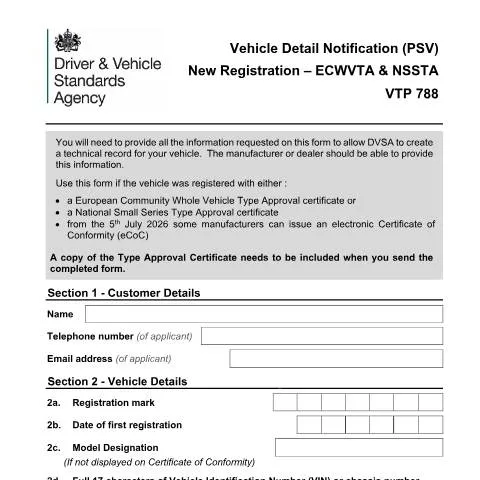
Setting Up Your Public Service Vehicle: Understanding the VTP 788 Technical Record Process
When you've just taken delivery of a new bus or coach that's been approved under European Community Whole Vehicle Type Approval (ECWVTA) or National Small Series Type Approval (NSSTA), there's a crucial administrative step that operators often overlook until the last minute. The DVSA requires a complete technical record for your public service vehicle before it can legally carry passengers, and the VTP 788 form serves as the gateway to establishing this essential documentation.
This notification process goes far beyond simple registration. While DVLA handles the basic vehicle registration that gets you a number plate, DVSA's technical record captures the intricate safety and operational specifications that determine everything from your vehicle's brake code classification to its eligibility for Low Emission Zone exemptions in London. Miss this step, and you could find your brand-new vehicle grounded despite having valid registration documents.
Decoding Type Approval Certificates: When VTP 788 Becomes Your Route Forward
The VTP 788 form specifically caters to vehicles that have received their approval through two distinct pathways, each with different implications for your application process.
European Community Whole Vehicle Type Approval (ECWVTA)
Vehicles approved under ECWVTA have undergone comprehensive testing across multiple European standards. Your manufacturer will provide a Certificate of Conformity that demonstrates compliance with EU-wide safety, environmental, and technical requirements. This certificate contains critical data points that you'll need to transfer accurately onto the VTP 788, including the precise model designation and technical specifications.
National Small Series Type Approval (NSSTA)
NSSTA applies to vehicles produced in limited quantities—typically fewer than 75 units annually for the same type. These vehicles meet UK-specific approval criteria and often serve niche markets like heritage transport or specialised accessibility services. The approval documentation differs slightly from ECWVTA certificates, but the VTP 788 accommodates both pathways seamlessly.
Essential requirement: You must include a copy of your Type Approval Certificate when submitting the completed VTP 788. DVSA cannot process your application without this supporting documentation, regardless of how thoroughly you complete the form itself.
Navigating the Customer and Vehicle Detail Sections: Precision Points That Matter
Section 1: Customer Information Strategy
While the customer details section appears straightforward, the contact information you provide here becomes DVSA's primary communication channel throughout the technical record creation process. Choose an email address that multiple team members can access, as DVSA may send follow-up queries or requests for additional documentation weeks after your initial submission.
The telephone number should connect to someone familiar with your vehicle specifications rather than a general reception desk. Technical officers may call to clarify brake system descriptions or passenger capacity calculations, particularly for vehicles with complex seating arrangements.
Section 2: Vehicle Specifications That Define Operational Capability
The vehicle details section contains several fields where precision directly impacts your operational permissions and legal obligations.
Registration Mark and First Registration Date Correlation
Ensure the registration mark matches exactly with DVLA records. Any discrepancy between the registration date you enter and DVLA's database could trigger additional verification steps. For imported vehicles, the "date of first registration" refers to UK registration, not the original registration in the country of manufacture.
Vehicle Identification Number (VIN) Accuracy
The full 17-character VIN serves as the definitive identifier linking your DVSA technical record to the physical vehicle. Double-check each character, as certain letters and numbers can appear similar when handwritten or poorly printed on documentation. The VIN location varies by manufacturer—some display it on the dashboard visible through the windscreen, others on the driver's door frame or chassis rail.
| VIN Position | Information Encoded | Common Issues |
|---|---|---|
| Positions 1-3 | World Manufacturer Identifier | Confusion between similar characters (0/O, 1/I) |
| Positions 4-9 | Vehicle Description Section | Model variants may have subtle differences |
| Position 10 | Model Year Code | May not match calendar year of registration |
| Positions 12-17 | Sequential Production Number | Leading zeros must be included |
Passenger Capacity Calculations: More Complex Than Simple Seat Counting
Section 2f requires detailed passenger accommodation figures that extend well beyond counting seats. This information directly affects your vehicle's classification, insurance requirements, and operational licensing conditions.
Understanding Crew Designations
Crew members include co-drivers and assistants but exclude the primary driver. On single-deck buses, this might include a conductor or passenger assistant. Double-deck vehicles often require crew members for safety supervision on the upper level. Each crew position reduces the total passenger capacity accordingly.
Wheelchair Accommodation Specifications
Wheelchair positions aren't simply additional passenger spaces—they require specific dimensional allowances, securing equipment, and access provisions. The number you enter affects everything from route planning to fare structure calculations. Modern buses typically feature flip-up seats in wheelchair areas, allowing flexible use depending on passenger needs.
Standee Calculations for Urban Operations
Standing passenger capacity depends on available floor space, grab rail positioning, and door configuration. Urban buses typically accommodate more standees than coaches designed for longer journeys. The figure you enter here establishes the legal maximum occupancy that drivers and inspectors will enforce.
Brake Code Determination: Technical Complexity Made Manageable
The brake code field represents one of the most technically demanding aspects of the VTP 788, yet it's crucial for operational safety and legal compliance. DVSA provides a dedicated PSV brake code calculator to assist with this determination, but understanding the underlying principles helps ensure accuracy.
Brake System Components That Influence Coding
Your brake code reflects the specific combination of service brakes, secondary braking systems, and parking brake arrangements fitted to your vehicle. Different configurations receive different codes, which in turn affect maintenance requirements, inspection protocols, and driver licensing categories.
The manufacturer's braking system description—typically found in technical documentation accompanying your Type Approval Certificate—provides the detailed specifications needed for accurate code calculation. This description covers aspects like:
- Air brake configurations: Single or dual-circuit systems with different pressure requirements
- Retarder systems: Engine brakes, exhaust brakes, or electromagnetic retarders as secondary systems
- ABS integration: Anti-lock braking system specifications and emergency brake assist functions
- Parking brake mechanisms: Spring-loaded air systems versus manual mechanical arrangements
Brake Code Implications for Operations
Your assigned brake code influences several operational aspects beyond simple technical classification. Insurance providers may adjust premiums based on brake system sophistication, while maintenance schedules vary according to system complexity. Additionally, certain brake codes may affect driver training requirements or restrict operation in specific geographical areas with challenging terrain.
Low Emission Certificate (LEC) Status: Environmental Compliance and Financial Benefits
The LEC question in section 2g carries significant financial and operational implications that extend far beyond the simple yes/no checkbox format might suggest.
London Low Emission Zone Impact
If you answer "NO" to the LEC question, DVSA will not notify Transport for London of your vehicle's environmental credentials. This oversight could result in your vehicle being charged daily fees when operating within the London Low Emission Zone (LEZ), even if it actually meets the emission standards for exemption. The LEZ charge currently applies to older buses and coaches that don't meet Euro VI emission standards.
Excise Duty Reduction Eligibility
Similarly, DVLA won't receive notification of your vehicle's low-emission status, potentially affecting eligibility for reduced Vehicle Excise Duty rates. While you can subsequently provide evidence to claim appropriate reductions, proactive notification through the VTP 788 streamlines the process significantly.
When to Answer "YES" to LEC Status
Answer "YES" only if you possess a valid Low Emission Certificate issued by the Vehicle Certification Agency (VCA) or an equivalent recognised body. The certificate must specifically cover your vehicle's engine and emission control systems. Generic manufacturer statements about emission compliance don't constitute valid LEC documentation for this purpose.
Data Protection Considerations and Submission Protocols
Section 3 addresses data protection obligations under the Data Protection Act 2018 and UK GDPR, reflecting DVSA's commitment to transparent data handling practices.
Information Sharing Scenarios
DVSA may share your personal data in specific circumstances beyond routine administrative processing. Criminal investigations involving vehicle safety violations, fraud prevention activities, and regulatory compliance checks all constitute lawful bases for information sharing. Understanding these scenarios helps you make informed decisions about the contact details and business information you provide.
Electronic Submission Advantages
The VTP 788 accepts electronic signatures when submitted via email to [email protected], streamlining the process for operators managing multiple vehicle registrations. Electronic submission also provides automatic delivery confirmation and faster initial processing times compared to postal applications.
Pre-Submission Verification Steps
Before emailing your completed VTP 788, verify that all mandatory fields contain accurate information and that your Type Approval Certificate copy is clearly legible. Incomplete applications generate automatic rejection notices, adding weeks to the processing timeline while you gather missing information.
Post-Submission Process: From Application to Active Technical Record
Once DVSA receives your completed VTP 788, the technical record creation process follows a structured timeline that varies depending on application complexity and current processing volumes.
Initial Processing and Validation
DVSA's technical team first validates the information against your Type Approval Certificate and cross-references vehicle specifications with manufacturer databases. Any discrepancies or unclear entries trigger follow-up communications, typically within 10-15 working days of submission.
Technical Record Activation Timeline
Standard applications processed without complications typically receive technical record activation within 4-6 weeks. Complex applications involving unusual specifications, imported vehicles, or modified configurations may require additional validation steps extending the timeline to 8-10 weeks.
Operational Impact of Technical Record Status
Your vehicle cannot legally carry paying passengers until DVSA activates its technical record, regardless of valid registration, insurance, and operator licensing. This requirement applies even to vehicles replacing identical units in your existing fleet. Plan your vehicle delivery and service introduction schedules accordingly, particularly during peak processing periods in spring and autumn when many operators renew their fleets.
The completed technical record enables DVSA inspections, operator compliance monitoring, and integration with other regulatory systems including Traffic Commissioner databases and local authority licensing platforms. This interconnected approach ensures consistent safety standards across the public service vehicle sector while supporting efficient regulatory oversight.
PSV Operator Licensing Compliance and Record Keeping
Operating a public service vehicle requires strict adherence to operator licensing requirements administered by the Traffic Commissioner for your region. Your PSV operator's licence directly links to vehicle records held by DVSA, creating a dual-layer compliance framework that demands meticulous attention to detail.
When registering or modifying PSV details, you must ensure your operator's licence reflects accurate fleet information. The Traffic Commissioner maintains separate records of your authorised fleet size, operating centres, and vehicle specifications. Any changes to individual vehicle records through DVSA must align with your operator licence conditions, particularly regarding:
- Maximum authorised vehicle numbers on your licence
- Vehicle capacity restrictions (passenger numbers, wheelchair accessibility)
- Operating centre authorisations for vehicle parking and maintenance
- Environmental standards compliance (Euro emission categories)
Discrepancies between DVSA vehicle records and operator licence details can trigger compliance investigations. For instance, if you register a PSV with increased passenger capacity that exceeds your licence authorisation, the Traffic Commissioner may initiate disciplinary proceedings. Similarly, adding vehicles beyond your authorised fleet size without prior licence variation constitutes a serious regulatory breach.
The operator licensing system recognises different PSV categories with distinct record-keeping obligations. Standard national licences permit operations throughout Great Britain, whilst restricted licences limit operations to specific geographical areas or service types. Community bus permits operate under separate frameworks but still require DVSA vehicle registration.
Digital integration between DVSA and Traffic Commissioner systems means vehicle changes trigger automatic cross-referencing. When you submit PSV details through the online portal, the system validates information against your current operator licence status. This automated checking identifies potential compliance issues before formal processing, reducing administrative delays and enforcement risks.
Maintenance records form a crucial component of PSV compliance monitoring. DVSA vehicle records must accurately reflect maintenance intervals, inspection schedules, and safety certificate validity periods. The Traffic Commissioner expects operators to maintain comprehensive maintenance documentation, with vehicle records serving as the foundation for compliance audits and public inquiries.
International Operations and Cross-Border Documentation
PSV operations extending beyond UK borders require additional documentation layers that significantly impact vehicle record management. European Union regulations continue influencing UK international transport operations through bilateral agreements and reciprocal recognition arrangements established post-Brexit.
International operator licences demand enhanced vehicle specification records, particularly regarding emission standards, safety equipment, and passenger protection measures. When registering PSVs intended for international services, you must provide detailed technical specifications that meet both UK and destination country requirements. This includes Euro emission compliance certificates, accessibility equipment specifications, and emergency evacuation system details.
The Community Licence system, whilst modified following Brexit, still requires UK operators conducting EU services to maintain specific vehicle documentation. Your PSV records must include certified translations of technical specifications, insurance documentation meeting minimum EU requirements, and driver qualification records linked to individual vehicles for crew scheduling purposes.
Border control authorities increasingly scrutinise PSV documentation during international crossings. Vehicle records maintained by DVSA serve as primary verification sources for customs and immigration officials. Incomplete or inaccurate records can result in service delays, passenger inconvenience, and potential penalties from foreign authorities.
Specialist international PSV services, such as tour operations or school transport crossing borders, face additional documentation requirements. Vehicle records must include detailed route authorisations, passenger manifest capabilities, and emergency contact procedures for each operating jurisdiction. The complexity of maintaining accurate records across multiple regulatory frameworks demands sophisticated record management systems and regular compliance reviews.
Digital documentation standards vary between jurisdictions, creating challenges for operators maintaining consistent vehicle records. Some European countries require specific electronic formats for PSV documentation, whilst others maintain paper-based systems. Your DVSA vehicle records should accommodate these varying requirements through flexible document generation capabilities and multi-format compliance options.
Enforcement Actions and Record Rectification Procedures
DVSA enforcement activities directly impact PSV record accuracy and operator compliance standing. Traffic Commissioners possess extensive powers to investigate operator performance, with vehicle records serving as primary evidence sources during disciplinary proceedings and public inquiries.
Enforcement officers conduct roadside inspections using mobile access to DVSA vehicle databases, enabling real-time verification of PSV documentation and compliance status. Discrepancies identified during inspections can result in immediate prohibition notices, preventing vehicle use until record corrections are completed and verified.
The graduated enforcement approach employed by Traffic Commissioners considers vehicle record accuracy as a key performance indicator for operator competence. Repeated failures to maintain accurate records may trigger formal warnings, undertakings, or licence curtailment proceedings. Serious record-keeping failures can result in operator licence revocation, effectively ending your PSV operation.
Record rectification procedures follow strict timelines established by Traffic Commissioner guidance. When enforcement action identifies record inaccuracies, operators typically receive 28 days to submit corrections with supporting evidence. Extensions may be granted for complex technical issues, but failure to meet deadlines can escalate enforcement responses significantly.
The appeals process for disputed enforcement actions requires comprehensive vehicle record documentation to support your case. Tribunal hearings examine detailed evidence regarding record-keeping systems, staff training, and compliance monitoring procedures. Poor documentation quality can undermine otherwise valid appeals, emphasising the importance of maintaining meticulous records throughout your operation.
Rehabilitation following enforcement action demands enhanced record-keeping standards and regular compliance reporting. Traffic Commissioners may impose specific conditions requiring monthly vehicle record audits, independent compliance assessments, or enhanced staff training programmes. These conditions remain in force until operators demonstrate sustained improvement in record management standards.
Industry guidance from organisations such as the Confederation of Passenger Transport emphasises proactive record management as the most effective enforcement prevention strategy. Regular self-audits, staff training updates, and system reviews help identify potential compliance issues before they attract regulatory attention, maintaining your operational reputation and avoiding costly enforcement proceedings.