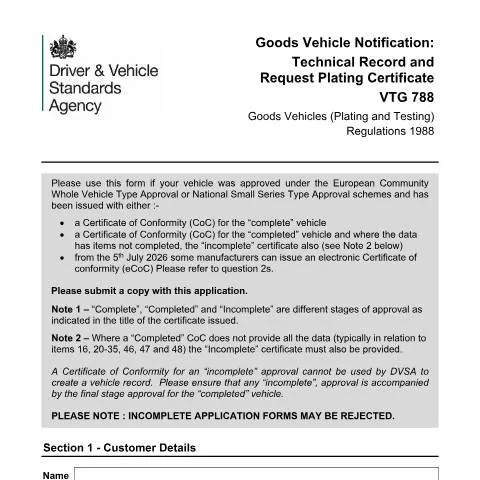
When Your HGV Requires Official Technical Registration with DVSA
Heavy goods vehicle operators face a critical juncture when their newly acquired lorry needs official recognition from the Driver and Vehicle Standards Agency. The VTG 788 Goods Vehicle Notification form serves as the gateway between European type approval documentation and the British Ministry Plate system that governs commercial vehicle operations across the UK.
This technical registration process becomes essential when your HGV arrives with a European Community Whole Vehicle Type Approval or has undergone National Small Series Type Approval, requiring translation of continental certification into domestic operational authority. Without this administrative bridge, even the most sophisticated commercial vehicle remains legally unfit for British roads.
The Certificate of Conformity Hierarchy That Determines Your Application Route
The VTG 788 form operates within a precise framework of European approval stages, each demanding different documentation approaches. Understanding these distinctions prevents costly application rejections and processing delays.
Complete Vehicle Approvals
Vehicles bearing a "complete" Certificate of Conformity represent the simplest scenario. These lorries have undergone full type approval as finished products, with manufacturers providing comprehensive technical specifications covering all regulatory requirements. The CoC contains complete data across all mandatory fields, enabling DVSA to establish technical records without additional documentation.
Completed Vehicle Approvals with Data Gaps
The "completed" approval category introduces complexity requiring careful attention to certificate completeness. Whilst the vehicle has reached its final configuration, the accompanying CoC may lack specific technical details, particularly regarding items 16, 20-35, 46, 47, and 48 within the certification framework.
Operators must scrutinise their completed CoC against these critical data points. Missing information necessitates submission of the original "incomplete" certificate alongside the completed version, providing DVSA with the technical foundation required for accurate record creation.
Incomplete Approvals: The Regulatory Dead End
DVSA explicitly refuses applications based solely on incomplete Certificates of Conformity. These documents represent interim approval stages within the European framework, lacking sufficient technical detail for British technical record establishment. Operators holding only incomplete approvals must obtain final-stage completed certification before attempting VTG 788 submission.
Navigating the Customer Details and Vehicle Identification Requirements
Section 1 demands straightforward contact information, yet the address field carries particular significance. DVSA dispatches all correspondence, including the crucial Ministry Plate, to the nominated address. Operators using temporary premises or forwarding services should consider delivery implications, particularly given the time-sensitive nature of commercial vehicle operations.
The telephone and email requirements reflect DVSA's commitment to rapid communication during processing. Technical queries or documentation clarifications often require immediate operator response to prevent application suspension.
Registration Mark and VIN Precision
Section 2a requires the exact registration mark assigned by DVLA, whilst the Vehicle Identification Number must match the CoC precisely. Discrepancies between VIN entries and certification documentation trigger automatic application rejection, necessitating complete resubmission.
The first registration date follows standard British formatting (dd/mm/yy), reflecting the vehicle's initial DVLA registration rather than manufacturing or approval dates. This distinction proves crucial for vehicles experiencing delays between production and registration.
Revenue Weight Calculations and Alternative Fuel Classifications
Revenue weight determination significantly impacts ongoing operational costs, forming the basis for Vehicle Excise Duty calculations. Operators must provide the exact weight figure supplied to DVLA during initial registration, recognising that subsequent modifications may require separate notification procedures.
| Vehicle Type | Weight Consideration | Additional Requirements |
|---|---|---|
| Rigid HGV | Revenue Weight Only | Body type specification mandatory |
| Rigid with Trailer Coupling | Revenue Weight + Trailer Weight | Coupling type identification |
| Articulated Unit | Revenue Weight | Fifth wheel coupling confirmation |
Alternative and Zero Emission Classifications
The form's environmental vehicle categories reflect evolving regulatory frameworks supporting decarbonisation initiatives. Alternatively fuelled vehicles encompass those powered wholly or partially by electricity, hydrogen, natural gas (including biomethane), liquified petroleum gas, or mechanical energy from onboard sources including waste heat recovery systems.
Zero emission vehicles require either complete absence of internal combustion engines or emissions below 1g CO2/kWh. These classifications may attract beneficial weight allowances detailed within item 13.3 of the manufacturer's Certificate of Conformity, potentially increasing legal operating weights without penalty.
Coupling Systems and Train Weight Implications
Towing capability determination represents a critical aspect of HGV registration, directly impacting operational flexibility and revenue potential. The form distinguishes between various coupling arrangements, each carrying specific technical and legal implications.
Fifth Wheel Configurations
Articulated units typically feature fifth wheel couplings, enabling connection with semi-trailers. DVSA requires confirmation of fifth wheel presence, with train weights derived from manufacturer specifications within CoC items 44, 45, or 45.1.
Drawbar Coupling Variations
Rigid vehicles may feature various drawbar coupling types, categorised by weight capacity. Ball couplings and jaw hitches to 3500kg serve lighter trailer applications, whilst jaw hitches above 3500kg accommodate heavier commercial trailers. Recovery equipment represents specialised coupling arrangements for breakdown and recovery operations.
Vehicles lacking manufacturer-assigned train weights face operational restrictions, unable to legally tow trailers regardless of physical coupling presence. Operators requiring towing capability must submit separate VTG 10 applications with supporting evidence to establish appropriate train weight allocations.
Brake System Specifications and Safety Critical Components
Brake system classification affects testing requirements, maintenance schedules, and operational safety standards. The form categorises systems into five primary types: Full Air, Air Hydraulic, Vacuum, and Hydraulic arrangements.
Full air systems predominate in heavy commercial applications, offering superior stopping power and reliability under demanding operational conditions. Air hydraulic combinations provide enhanced modulation for specific vehicle applications, whilst vacuum and hydraulic systems serve lighter commercial categories.
Service Brake Split Arrangements
Regulatory requirements mandate brake system redundancy through split arrangements, ensuring partial braking capability during component failure. Operators must specify the exact split configuration, typically involving front/rear axle separation or diagonal arrangements across multiple axles.
Secondary brake integration within service brake systems requires careful identification, as this affects testing procedures and maintenance requirements. Transmission parking brakes provide additional security during vehicle stationing, particularly relevant for vehicles operating in challenging terrain or loading environments.
Tyre Specifications and Load Index Compliance
Tyre specification accuracy proves essential for legal operation and safety compliance. The form demands comprehensive tyre details for each axle, including size designation, load index, speed rating, and single or twin fitment configuration.
All specified tyres must appear within Certificate of Conformity section 35 or 52, ensuring manufacturer approval for the particular vehicle application. Operators proposing alternative tyre specifications require manufacturer VIN-specific declarations confirming suitability and compliance.
| Axle Position | Typical Configuration | Load Index Considerations |
|---|---|---|
| Axle 1 (Steer) | Single Fitment | Must support front axle weight plus steering loads |
| Axle 2 (Drive) | Twin Fitment | Combined load index covers drive axle weight |
| Axle 3+ (Trailer/Tag) | Single or Twin | Distribution varies with vehicle configuration |
Load Index and Speed Rating Correlation
Load indices represent maximum tyre carrying capacity under specific conditions, whilst speed ratings indicate safe continuous operating speeds. The combination must accommodate vehicle design weights and operational requirements, with DVSA verification against manufacturer specifications ensuring compliance.
Processing Pathways: Plating Versus Voluntary Testing Routes
The form's final technical section addresses testing requirements, distinguishing between mandatory plating and testing versus voluntary examination routes. Most commercial vehicles exceeding 3.5 tonnes require compulsory plating and testing, establishing baseline safety and environmental standards for ongoing operation.
Voluntary testing applies to specific vehicle categories or operators seeking certification beyond minimum requirements. This route may benefit vehicles destined for specialised applications or export markets demanding enhanced certification standards.
Post-Approval Modifications
Vehicle alterations following type approval trigger additional scrutiny and potential testing requirements. Modifications affecting weight distribution, braking performance, or emissions characteristics may necessitate supplementary certification before DVSA accepts the technical record application.
Operators must honestly declare any post-approval changes, as subsequent discovery of undisclosed modifications may invalidate certification and create legal complications during roadside enforcement encounters.
Electronic Submission and Data Protection Compliance
DVSA encourages electronic submission through [email protected], streamlining processing and reducing postal delays. Digital signatures receive equal recognition to handwritten versions, enabling rapid application completion for time-sensitive registrations.
The agency's data protection statement reflects compliance with UK GDPR requirements, outlining collection, usage, and storage parameters for personal information. Operators should note DVSA's authority to share data for criminal investigations or fraud prevention, emphasising the importance of accurate, honest application completion.
Complete applications receive priority processing, whilst incomplete submissions face rejection and resubmission requirements. Given the operational implications of delayed Ministry Plate issuance, thorough preparation and documentation verification prove essential for successful HGV registration within the British commercial vehicle framework.
Understanding DVSA's Compliance and Investigation Powers
The Driver and Vehicle Standards Agency wields considerable enforcement authority when it comes to HGV record-keeping, extending far beyond routine inspections. Under the Road Traffic Act 1988 and subsequent regulations, DVSA enforcement officers possess statutory powers to examine, seize, and retain vehicle records during compliance checks or investigations.
During a roadside encounter, officers can request immediate production of various documents, including your vehicle registration certificate (V5C), operator's licence, driver hours records, and maintenance documentation. Failure to produce these records can result in prohibition notices, effectively grounding your vehicle until compliance is demonstrated. The penalty structure is progressive: first-time administrative oversights might warrant a verbal warning, while systematic record-keeping failures can trigger formal investigations leading to operator licence curtailment or revocation.
DVSA's Traffic Commissioners hold quasi-judicial powers over commercial vehicle operators. They can summon operators to public inquiries where inadequate record systems feature prominently in proceedings. These inquiries examine not just individual incidents but patterns of compliance behaviour. Operators who demonstrate robust, consistent record-keeping practices typically fare better in such proceedings than those with sporadic or incomplete documentation systems.
The agency employs risk-based targeting, using data analytics to identify operators with higher probability of compliance issues. Factors influencing selection include previous infringement history, vehicle age profiles, maintenance interval patterns, and cross-referencing with Driver and Vehicle Licensing Agency (DVLA) databases. Operators maintaining exemplary records often find themselves subject to less frequent targeted enforcement action.
Digital record systems face particular scrutiny regarding data integrity and tampering prevention. DVSA investigators are trained to identify manipulation of electronic tachograph data, GPS tracking inconsistencies, and suspicious patterns in maintenance scheduling. The agency collaborates with specialist forensic analysts when sophisticated data manipulation is suspected, particularly in cases involving multiple vehicles or systematic fraud.
Sector-Specific Record Requirements and Variations
Different HGV operating sectors face distinct record-keeping obligations beyond standard DVSA requirements. Dangerous goods transport demands additional documentation under the Carriage of Dangerous Goods and Use of Transportable Pressure Equipment Regulations 2009. Operators must maintain ADR training certificates, vehicle approval certificates, and loading/unloading records with specific retention periods varying by hazard classification.
International haulage introduces complexity through multiple regulatory frameworks. Vehicles operating under Community Licence arrangements must maintain journey logs demonstrating compliance with cabotage restrictions—the limitation on domestic transport operations within other EU member states. Post-Brexit arrangements require additional customs documentation, with DVSA cross-referencing vehicle movements against HMRC import/export records during compliance checks.
Passenger service vehicles, while technically distinct from freight HGV operations, share similar DVSA oversight mechanisms. School transport operators face enhanced scrutiny, with vehicle condition records subject to more frequent examination due to safeguarding considerations. Local authority contracts often specify record-keeping standards exceeding minimum DVSA requirements.
Construction and plant hire sectors encounter unique challenges when HGVs transition between public highway use and off-road operations. DVSA requires clear documentation of vehicle status changes, particularly regarding statutory inspection intervals and insurance coverage. Temporary exemption certificates for specialist movements must be accurately recorded with supporting documentation readily available for inspection.
Agricultural operators benefit from certain regulatory exemptions but must maintain precise records demonstrating eligibility. Seasonal variations in vehicle utilisation require careful documentation, particularly when vehicles alternate between agricultural and commercial transport roles. DVSA officers are trained to identify inappropriate exploitation of agricultural exemptions through detailed examination of operational records.
Emergency service vehicles and military transport operate under specialised frameworks, yet civilian contractors supporting these sectors must maintain standard commercial records. The distinction between exempt and non-exempt operations requires meticulous documentation, with DVSA applying strict interpretation of exemption criteria during compliance assessments.
Technology Integration and Future-Proofing Your Record Systems
Modern HGV operations increasingly rely on integrated technology platforms combining vehicle telematics, maintenance management, and regulatory compliance systems. DVSA recognises this evolution, adapting its examination procedures to accommodate digital-first operators while maintaining stringent accuracy standards. The agency's digital strategy emphasises interoperability between operator systems and government databases, potentially streamlining future compliance verification processes.
Application Programming Interface (API) development allows sophisticated fleet management systems to interface directly with DVLA vehicle databases, ensuring registration details remain current automatically. However, DVSA maintains that ultimate responsibility for record accuracy rests with operators, regardless of technological solutions employed. System failures, data corruption, or integration errors cannot excuse non-compliance with statutory record-keeping obligations.
Blockchain technology presents emerging opportunities for creating tamper-evident maintenance and inspection records. Some progressive operators are piloting distributed ledger systems to demonstrate the integrity of their compliance documentation. While DVSA has not yet formally endorsed specific technologies, the agency monitors developments that could enhance record reliability and reduce administrative burden.
Cloud-based storage solutions offer scalability and accessibility benefits but introduce considerations around data sovereignty and security. Under the Data Protection Act 2018, operators must ensure that third-party providers offer adequate protection for sensitive operational data. DVSA investigators require the same level of access to cloud-stored records as traditional paper-based systems, necessitating robust access controls and audit trails.
Artificial intelligence and machine learning applications can identify patterns in vehicle performance data, potentially predicting maintenance requirements before failures occur. Such predictive capabilities could revolutionise record-keeping from reactive documentation to proactive compliance management. DVSA's technical advisory groups are evaluating how emerging technologies might be incorporated into future regulatory frameworks.
Mobile applications enable real-time record updates from remote locations, particularly valuable for multi-depot operations or long-distance haulage. However, connectivity limitations and device failures can disrupt data capture, requiring robust backup procedures. DVSA expects operators to demonstrate resilience in their recording systems, maintaining compliance regardless of technological setbacks.
Integration with financial management systems allows correlation between maintenance expenditure and vehicle condition records, providing additional verification layers during DVSA examinations. Such integration can demonstrate systematic investment in vehicle maintenance, supporting operator credibility during compliance assessments or public inquiry proceedings.