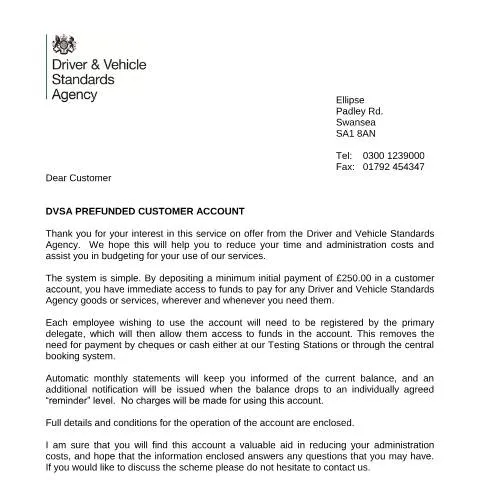
Pre-funded Accounts: DVSA's Solution for Fleet Operators and Regular Service Users
For businesses managing multiple vehicles or conducting frequent testing operations, the traditional payment methods at DVSA testing stations—cash or cheques at each visit—create significant administrative overhead. The DVSA pre-funded account system addresses this operational challenge by establishing a centralised payment mechanism that streamlines transactions across all agency services, from MOT tests to commercial vehicle inspections.
This account structure proves particularly valuable for fleet management companies overseeing dozens of vehicles, commercial transport operators requiring regular compliance testing, and vehicle testing stations themselves when outsourcing certain inspections. Rather than processing individual payments for each service, account holders deposit funds in advance and draw against this balance as needed, creating predictable cash flow management and reducing transaction costs.
The system operates on a minimum initial deposit of £250, establishing immediate access to DVSA services nationwide. Account holders receive monthly statements tracking expenditure patterns, whilst automated notifications prevent unexpected service interruptions when balances approach predetermined thresholds.
Eligibility Framework and Business Case Requirements
The DVSA pre-funded account targets commercial entities and high-volume users rather than individual vehicle owners conducting occasional transactions. Primary candidates include:
- Commercial vehicle operators managing fleets requiring regular safety inspections, annual tests, and roadworthiness assessments
- Vehicle testing facilities subcontracting specialised testing services or accessing DVSA's central booking systems
- Logistics companies with extensive trailer and heavy goods vehicle portfolios subject to periodic compliance testing
- Vehicle rental businesses maintaining diverse fleets across multiple locations
- Municipal authorities operating public transport or service vehicle fleets
The agency reserves discretionary authority to refuse account applications where operational concerns arise. This typically occurs when applicants demonstrate irregular payment histories with other government departments, present insufficient business documentation, or request account access for purposes falling outside DVSA's service scope.
Individual motorists seeking convenience for annual MOT tests generally find the administrative requirements and minimum deposit threshold disproportionate to their usage patterns. The system's design favours organisations processing multiple transactions monthly rather than sporadic users.
Delegate Registration and Operational Authority Structure
The account framework operates through a primary delegate system where the account holder designates authorised personnel to conduct transactions. This structure accommodates complex organisational hierarchies whilst maintaining financial control and accountability.
The primary delegate—typically the account holder or designated financial officer—retains ultimate responsibility for all account activity and expenditure. This individual possesses exclusive authority to:
- Register additional delegates for account access
- Modify delegate permissions or remove authorised users
- Change the primary delegate designation
- Request account number changes following security breaches
- Establish reminder thresholds for balance notifications
Delegate registration requires written confirmation to DVSA Finance, including full contact details and operational scope. The agency accepts postal submissions to their Swansea facility or electronic applications via [email protected]. Each delegate receives individual credentials whilst transactions remain consolidated under the master account.
| Delegate Level | Registration Method | Authority Scope | Modification Rights |
|---|---|---|---|
| Primary Delegate | Account opening application | Full account management | All functions including delegate changes |
| Registered Delegate | Written nomination by primary | Transaction authorisation only | Service purchases within account balance |
| Removed Delegate | Written instruction by primary | Immediate access termination | No account interaction permitted |
Application Completion and Documentation Requirements
The DVSA 0143 PFA application form demands comprehensive business information establishing both identity and operational legitimacy. Account holder details must reflect the legal entity responsible for payment obligations, whether individual proprietorship, partnership, or corporate structure.
Essential information includes complete postal address, primary contact details, and designated telephone/fax numbers for account communications. The reminder level field requires particular attention—this threshold determines when DVSA issues low-balance notifications, preventing service interruptions. Conservative settings around 20-30% of typical monthly expenditure provide adequate warning whilst avoiding excessive notifications.
Statement delivery addresses may differ from the primary business location, accommodating centralised accounting departments or third-party financial management. This flexibility proves valuable for multi-site operations requiring consolidated reporting or franchised businesses with separate administrative functions.
The delegate nomination section accepts multiple authorised users, though space limitations may require supplementary documentation for extensive lists. Large organisations typically submit comprehensive delegate schedules as separate attachments, referencing the main application.
Email address provision enables electronic statement delivery and online account management registration. Whilst optional, digital access significantly enhances account monitoring capabilities and reduces postal delays affecting balance awareness.
Payment Methods and Initial Funding Options
Four distinct funding mechanisms accommodate varying organisational preferences and cash flow requirements. Each method involves different processing timelines and administrative procedures:
Balance Transfer from Existing Accounts
Organisations operating multiple DVSA accounts may consolidate funds by transferring balances between accounts. This method requires the existing account number and specific transfer amount, processing immediately upon verification. Fleet restructuring or departmental reorganisation commonly necessitates such transfers, maintaining operational continuity whilst adjusting administrative structures.
Credit Card Funding
Corporate credit card payments offer immediate account activation with DVSA Finance contacting applicants directly upon form receipt. This method suits organisations requiring rapid account establishment, though credit limits and corporate card policies may restrict available amounts. Processing typically completes within two working days of telephone contact.
BACS Electronic Transfer
Bank transfer funding provides secure, traceable payment suitable for substantial initial deposits. DVSA Finance issues unique account numbers enabling direct electronic transfers, though processing requires additional verification steps. This method accommodates high-value initial deposits exceeding credit card limits whilst maintaining full audit trails for corporate accounting requirements.
Cheque Payments
Traditional cheque payments accompany postal applications, though clearing delays may postpone account activation. Cheques must be drawn on UK banking institutions and made payable to "Driver and Vehicle Standards Agency". This method suits organisations preferring established payment procedures despite longer processing timelines.
Security Protocols and Account Number Protection
Account security relies primarily on account number confidentiality, as this identifier serves as the primary authentication mechanism for service purchases. Unlike credit card systems with multiple verification layers, DVSA accounts depend on number secrecy for transaction security.
Account holders must implement appropriate internal controls limiting number distribution to authorised delegates exclusively. Common security breaches occur when account numbers appear on widely-circulated documentation, are shared via unsecured electronic communications, or remain accessible to former employees following personnel changes.
Suspected security compromises require immediate notification to DVSA Finance, followed by written confirmation detailing the circumstances. The agency responds by suspending the compromised number and issuing replacement credentials, though this process may temporarily disrupt service access. Account holders should maintain contingency payment methods during transition periods.
Regular delegate audits help maintain security integrity, particularly in organisations with high staff turnover. Removing delegate access for departing personnel prevents unauthorised account usage whilst protecting remaining balance funds.
Terms and Conditions: Operational Boundaries and Restrictions
DVSA reserves substantial discretionary authority over account management, including the right to refuse applications without detailed justification. This protection mechanism enables the agency to exclude applicants presenting operational risks or falling outside intended user profiles.
Account holders assume full financial responsibility for all delegate transactions, regardless of authorisation disputes or internal policy violations. This liability extends beyond simple payment obligations to include potential service misuse or fraudulent activity by registered delegates. Organisations must therefore implement robust internal controls matching their risk tolerance and operational requirements.
Service availability depends entirely on accurate account number quotation at transaction points. DVSA personnel cannot provide services when numbers are incorrectly stated, even when alternative verification might be possible. This strict protocol prevents unauthorised access whilst ensuring consistent application across all service locations.
The agency maintains authority to modify terms and conditions with appropriate notice periods, though fundamental account structures typically remain stable across extended periods. Changes generally address operational improvements or regulatory compliance requirements rather than fundamental service alterations.
Online Account Management and Digital Service Integration
Following account establishment, DVSA offers digital management capabilities through their online portal system. This service enables real-time balance monitoring, transaction history review, and electronic top-up functionality, significantly enhancing account utility for active users.
Registration for online access occurs automatically unless specifically declined during application. Account holders receive separate credentials and setup instructions following initial account activation, maintaining security separation between payment and monitoring functions.
Digital services prove particularly valuable for multi-location operations requiring frequent balance checks or financial departments monitoring expenditure patterns across accounting periods. Real-time access eliminates delays associated with postal statements whilst enabling proactive balance management.
The online system accommodates electronic top-ups through various payment methods, though initial account funding must follow traditional application procedures. This hybrid approach balances security requirements with operational convenience for established users.
Organisations declining online access continue receiving paper statements and telephone-based account management, though response times may be extended compared to digital alternatives. This option accommodates entities with restricted internet policies or preferring traditional administrative methods.
Managing Your Pre-Funded Account Balance and Transactions
Once your vehicle testing pre-funded account is operational, effective balance management becomes crucial for maintaining seamless testing operations. The DVSA provides comprehensive online account management tools through their digital portal, allowing you to monitor transactions, track spending patterns, and plan future testing requirements.
Your account dashboard displays real-time balance information, including pending transactions and reserved funds for scheduled tests. Each test booking automatically reserves the appropriate fee amount, preventing double-booking of funds whilst maintaining accurate available balance calculations. This reservation system typically holds funds for 48 hours before releasing unused amounts back to your available balance.
Transaction history provides detailed breakdowns of all account activity, including test fees, top-up payments, refunds, and administrative adjustments. Each entry includes timestamps, reference numbers, vehicle registration details where applicable, and running balance totals. This comprehensive record-keeping proves invaluable for business accounting purposes and VAT calculations where relevant.
The system automatically generates monthly statements summarising account activity, which can be downloaded in various formats including PDF and CSV for integration with accounting software. These statements include VAT breakdowns where applicable, making them suitable for business expense claims and tax return preparation.
Balance alerts can be configured to notify account holders when funds drop below specified thresholds. These automated warnings help prevent test booking failures due to insufficient funds, particularly important for businesses managing multiple vehicle fleets with varying testing schedules.
Refund processing follows established DVSA procedures, with most refunds appearing within 5-10 working days of the triggering event. Common refund scenarios include cancelled test appointments (subject to cancellation terms), duplicate payments, or system errors. Refunds typically return to the original payment method, though alternative arrangements may be possible in specific circumstances.
Multi-User Access and Delegation Arrangements
Large organisations often require multiple personnel to access vehicle testing accounts, necessitating careful user management and delegation protocols. The DVSA pre-funded account system accommodates various access levels, from full administrative control to limited booking-only permissions.
Primary account holders can designate additional users through the online portal, specifying individual permission levels for each delegate. Standard permission categories include full account management (including financial transactions), test booking and management, view-only access for monitoring purposes, and restricted access for specific vehicle categories or testing centres.
Each additional user requires separate authentication credentials, typically involving email verification and security question setup. The system maintains comprehensive audit trails showing which user performed each action, providing accountability and transparency for organisations with complex approval hierarchies.
Delegation arrangements must comply with data protection requirements under UK GDPR, particularly regarding access to vehicle and driver information. Account holders remain ultimately responsible for all account activity, regardless of which authorised user performs specific actions.
Some organisations implement internal approval workflows before test bookings, using the account's reservation system to hold funds whilst awaiting management approval. This approach provides financial control whilst maintaining booking flexibility for urgent testing requirements.
User permissions can be modified or revoked at any time through the account management interface, with changes taking effect immediately across all system access points. This flexibility proves particularly valuable for organisations with changing personnel or evolving operational requirements.
The system supports role-based access appropriate for different organisational structures, from small family businesses to large corporate fleets. Fleet managers might receive comprehensive booking permissions whilst finance personnel maintain oversight of spending and top-up arrangements.
Integration with Fleet Management and Compliance Systems
Modern fleet operations increasingly rely on integrated systems for managing vehicle compliance, maintenance schedules, and testing requirements. The DVSA pre-funded account system offers various integration possibilities to streamline these complex operational demands.
API access may be available for qualifying organisations, enabling direct integration between fleet management software and the DVSA testing system. This connectivity allows automated test booking based on MOT expiry dates, maintenance schedules, or compliance monitoring systems, reducing administrative overhead and minimising human error risks.
Data export capabilities support integration with existing business systems, even where direct API connectivity isn't available. Regular exports of testing schedules, costs, and compliance status can feed into broader fleet management dashboards and reporting systems.
Many organisations develop internal workflows linking pre-funded account management with vehicle acquisition, disposal, and maintenance planning. New vehicle additions automatically trigger account balance reviews and testing schedule updates, whilst vehicle disposals prompt account reconciliation and potential refund processing.
Compliance monitoring becomes more sophisticated when integrated with pre-funded account data. Organisations can track testing costs against budgets, identify patterns in test failures or retests, and optimise maintenance schedules based on historical testing performance.
The system's transaction data provides valuable insights for fleet optimisation, revealing cost patterns across different vehicle types, testing centres, and time periods. This information supports strategic decisions about fleet composition, testing centre selection, and maintenance provider performance.
Integration with insurance and risk management systems helps organisations maintain comprehensive vehicle compliance records, supporting insurance claims processes and demonstrating due diligence in fleet management practices.
Some advanced users develop automated reporting systems that combine pre-funded account data with other compliance information, generating regular management reports on fleet testing performance, costs, and upcoming requirements. These integrated approaches significantly reduce administrative burden whilst improving compliance oversight and cost control.