Navigating the Specialised World of UK Tanker Operations: Understanding the Application Process
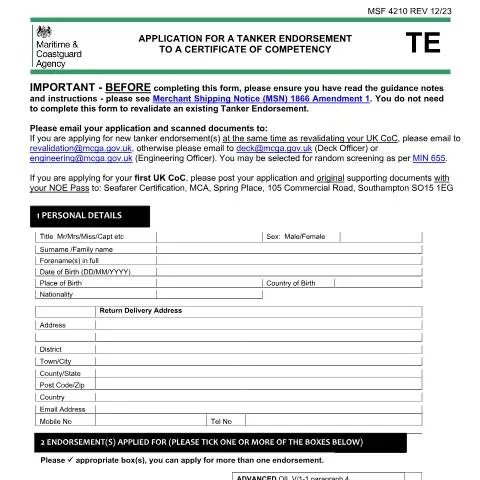
The maritime industry's most hazardous cargo operations require specialised qualifications that go far beyond standard seafaring credentials. When qualified mariners seek to handle oil, chemical, or liquefied gas cargoes aboard UK-flagged tankers, they must obtain specific endorsements to their existing Certificate of Competency through the Maritime and Coastguard Agency's rigorous assessment framework. This specialisation process, governed by form MSF 4210, represents a critical gateway for maritime professionals seeking to advance into lucrative but demanding tanker operations.
Unlike routine certificate renewals or basic competency applications, tanker endorsement applications require candidates to demonstrate recent, relevant experience combined with specialised training that must be completed within strict timeframes. The MCA's approach reflects international safety standards where cargo handling mistakes can result in catastrophic environmental damage, making this one of the most scrutinised areas of maritime certification.
Decoding the Five Distinct Endorsement Categories and Their Strategic Implications
The application form presents five distinct tanker endorsement options, each corresponding to specific STCW regulation paragraphs and cargo types. Understanding these distinctions proves crucial for career planning, as each endorsement unlocks different vessel types and salary levels within the tanker industry.
Basic Level Endorsements: Entry Points into Specialised Operations
Basic Oil & Chemical (V/1-1 paragraph 2) serves as the foundational endorsement for handling petroleum products and chemical cargoes. This endorsement applies to vessels carrying crude oil, refined petroleum products, and various chemical substances that require specialised loading and discharge procedures. Mariners often pursue this first, as it provides the broadest employment opportunities across the tanker fleet.
Basic Liquefied Gas (V/1-2 paragraph 2) covers operations involving liquefied petroleum gas (LPG), liquefied natural gas (LNG), and other gaseous cargoes transported under pressure or at extremely low temperatures. This specialisation requires additional technical understanding of cryogenic systems and pressure vessel operations, making it particularly valuable in the expanding LNG trade routes.
Advanced Endorsements: Commanding Premium Positions
The advanced endorsements represent significant career milestones, typically required for senior officer positions on large tankers or vessels carrying the most hazardous cargoes. Advanced Oil (V/1-1 paragraph 4) and Advanced Liquefied Gas (V/1-2 paragraph 4) build upon their basic counterparts, requiring additional training and more extensive sea service experience.
Advanced Chemicals (V/1-1 paragraph 6) represents the most specialised endorsement, covering operations with highly toxic, corrosive, or reactive chemical cargoes. Holders of this endorsement can work aboard chemical tankers carrying products ranging from industrial acids to specialty chemicals used in manufacturing processes.
| Endorsement Type | Typical Vessel Operations | Career Impact | Training Duration |
|---|---|---|---|
| Basic Oil & Chemical | Product tankers, crude carriers | Entry to tanker operations | 1-2 weeks |
| Basic Liquefied Gas | LPG carriers, small LNG vessels | Specialised gas operations | 2-3 weeks |
| Advanced Oil | VLCCs, senior positions | Command track eligibility | 3-4 weeks |
| Advanced Liquefied Gas | Large LNG carriers, senior roles | Premium LNG positions | 4-5 weeks |
| Advanced Chemicals | Chemical tankers, parcel carriers | Highest specialisation level | 4-6 weeks |
The Critical Five-Year Window: Timing Training and Sea Service Requirements
The MCA enforces a strict five-year validity period for both training certificates and qualifying sea service, creating strategic timing considerations that can significantly impact application success. This requirement reflects the rapidly evolving nature of tanker technology and safety procedures, where outdated knowledge poses unacceptable risks.
Understanding the Training Timeline
All training certificates supporting a tanker endorsement application must bear completion dates within five years of the application submission. This includes the mandatory MNTB Tanker Fire Fighting Training Certificate, which forms the foundation for all tanker endorsements, and any cargo operations training programmes. Maritime professionals often coordinate their training schedules to ensure multiple certificates remain valid simultaneously, particularly when pursuing multiple endorsements.
The five-year rule creates particular challenges for mariners transitioning between different vessel types or those returning to tanker operations after periods ashore. Unlike some other maritime qualifications that grandfather previous experience, tanker endorsements require recent, demonstrable competency that cannot be substituted with older credentials or general maritime experience.
Sea Service Validation and Documentation
The three-month minimum sea service requirement must be evidenced through discharge book entries and testimonials that specifically detail cargo operations during service periods. Generic sea service on tankers without cargo handling experience does not qualify, emphasising the MCA's focus on practical competency rather than mere vessel familiarity.
Testimonials require master's signatures and official ship stamps, creating documentation challenges for mariners who have served on vessels with frequent crew changes or those whose masters may be difficult to contact years later. The MCA recommends obtaining comprehensive testimonials immediately upon completing qualifying voyages, rather than attempting to reconstruct documentation retrospectively.
Navigating Application Pathways: Email Submissions Versus Traditional Postal Routes
The MCA has established different submission channels based on the applicant's circumstances and existing qualifications, reflecting both administrative efficiency and security considerations for original documents.
Digital Submission for Experienced Certificate Holders
Mariners adding tanker endorsements to existing UK Certificates of Competency benefit from streamlined email submission processes. Applications should be directed to [email protected] for deck officers or [email protected] for engineering officers, with scanned supporting documents attached. This digital pathway significantly reduces processing times, typically allowing endorsement within 4-6 weeks compared to 8-12 weeks for postal applications.
When combining tanker endorsement applications with certificate revalidations, the specialised [email protected] address ensures coordinated processing that prevents timing conflicts between different certification activities. This proves particularly valuable for mariners whose certificates approach expiry dates while pursuing new endorsements.
Postal Requirements for First-Time UK Certificate Applicants
Candidates applying for their first UK Certificate of Competency must submit original documents alongside their Notice of Eligibility pass to the Southampton processing centre. This requirement reflects the MCA's need to verify original qualification documents before issuing UK credentials, a process that cannot be completed through digital submissions.
The Southampton facility at Spring Place handles these complex applications where multiple verification processes occur simultaneously, including academic qualification recognition, foreign certificate validation, and tanker endorsement assessment. Processing times extend accordingly, often requiring 12-16 weeks for completion.
Dissecting the Application Form: Critical Sections and Common Complications
Personal Details Section: Precision in Identity Verification
The personal details section requires exact correspondence with existing maritime documents, as discrepancies can trigger extensive verification processes that delay application completion. Particular attention must be paid to name variations across different documents, especially for mariners whose certificates were issued in different countries with varying naming conventions.
The MCA cross-references application details against existing databases, including STCW records and previous UK certificate applications. Inconsistencies in birth dates, places of birth, or nationality declarations can result in application suspension while additional documentation is requested to resolve conflicts.
Sea Service Documentation: Avoiding Common Pitfalls
The sea service section demands comprehensive vessel information including IMO numbers, gross tonnage figures, and specific cargo types handled during qualifying periods. Incomplete vessel details frequently result in application delays, as the MCA verifies ship particulars against Lloyd's Register and other maritime databases.
Cargo type descriptions require technical precision rather than generic terms. Stating "chemicals" without specifying whether operations involved acids, gases, or organic compounds provides insufficient information for endorsement assessment. Similarly, "oil products" should distinguish between crude oil, refined products, or vegetable oils, as these distinctions affect endorsement scope.
Training Requirements Breakdown: Meeting Dual Pathways to Competency
The MCA offers alternative pathways to demonstrate tanker competency, recognising that practical experience and formal training can substitute for each other under specific circumstances.
The Training Centre Route
Formal training programmes approved by the MCA provide structured learning environments that cover theoretical knowledge and practical exercises using shore-based simulators. These programmes typically span 1-5 weeks depending on endorsement level and include comprehensive assessments of cargo system knowledge, emergency response procedures, and regulatory compliance.
MCA-approved training centres must demonstrate compliance with detailed syllabus requirements that mirror actual shipboard operations. Simulator exercises replicate challenging scenarios including cargo contamination incidents, system failures, and emergency discharge procedures that mariners might encounter infrequently during normal operations.
Onboard Assessment Alternative
Experienced mariners may demonstrate competency through structured onboard assessments conducted by MCA-approved assessors during actual cargo operations. This pathway requires documented evidence of competency in specific learning objectives, typically recorded in approved training record books that track individual skill development.
Onboard assessments must include minimum numbers of loading and unloading operations, ensuring candidates demonstrate competency across different operational scenarios. The assessment process requires coordination between shipping companies, training providers, and MCA-approved assessors, making it more complex to arrange than shore-based training.
Financial Considerations and Processing Logistics
Each tanker endorsement application incurs a £73 fee, with additional courier charges applicable for postal submissions requiring secure document return. Multiple endorsement applications submitted simultaneously benefit from consolidated processing, though each endorsement requires separate fee payment.
The MCA's fee structure reflects the administrative complexity of tanker endorsement processing, including document verification, sea service validation, and training certificate authentication. Fees remain fixed regardless of processing time, though expedited services are not available for tanker endorsements due to the thorough verification requirements.
Random Screening Procedures
Applications may be selected for random screening under MIN 655 procedures, involving additional verification steps that can extend processing times by 4-6 weeks. This screening includes enhanced document authentication, additional background checks, and sometimes supplementary interviews to verify claimed experience.
Random screening selection is automated and cannot be appealed or avoided, representing the MCA's commitment to maintaining certification integrity within the high-risk tanker sector. Mariners should factor potential screening delays into their career planning, particularly when coordinating endorsement applications with employment opportunities.
Strategic Application Timing and Career Planning Implications
Successful tanker endorsement applications require careful coordination of training schedules, sea service accumulation, and career transition timing. The five-year validity window creates ongoing obligations for maintaining current qualifications, while the specialised nature of tanker operations demands continuous professional development.
Maritime professionals often pursue multiple endorsements simultaneously to maximise career flexibility, though this approach requires significant time and financial investment. The interconnected nature of different endorsement types means that strategic sequencing can reduce overall training requirements, particularly when advanced endorsements automatically confer basic-level privileges.
The tanker endorsement process represents more than administrative compliance—it serves as a gateway to specialised maritime careers offering enhanced earning potential and professional recognition. However, the rigorous requirements reflect the genuine risks and responsibilities inherent in tanker operations, where competency gaps can result in environmental disasters and significant legal consequences for both individuals and employers.
Medical and Health Requirements for Tanker Operations
Tanker endorsement applications require enhanced medical certification beyond the standard seafarer medical requirements. The Maritime and Coastguard Agency mandates specific health assessments that reflect the additional risks associated with handling hazardous liquid cargoes and the demanding operational environment aboard tanker vessels.
Your ENG1 medical certificate must remain valid throughout the endorsement process and include specific annotations for tanker operations. The examining doctor must assess your fitness for work in enclosed spaces, your ability to use emergency breathing apparatus, and your cardiovascular capacity for emergency response scenarios. Particular attention is given to respiratory function, as tanker operations frequently involve exposure to vapours and require the use of breathing protection equipment.
Mental health assessments form a crucial component of tanker medical requirements. The MCA recognises that tanker operations can involve extended periods at sea, high-stress cargo operations, and responsibility for environmentally sensitive materials. Medical examiners evaluate psychological resilience, stress management capabilities, and any history of substance abuse that could compromise safety in a tanker environment.
Certain medical conditions may result in restrictions or require additional documentation. Diabetes requiring insulin, epilepsy, or significant cardiovascular conditions typically require specialist reports and may limit the scope of your endorsement. Hearing impairments must be carefully assessed, as tanker operations rely heavily on audio alarms and communication systems during cargo handling operations.
Vision requirements for tanker endorsement holders exceed standard maritime medical requirements. You must demonstrate adequate colour vision for distinguishing cargo system indicators, emergency signals, and safety equipment markings. Night vision capabilities are particularly important for tanker operations, which often continue around the clock during port operations.
The medical examination must be conducted by an MCA-approved doctor, and the certificate must be issued within three months of your endorsement application. Some medical centres specialise in maritime medical examinations and maintain current knowledge of MCA requirements, which can streamline the process and reduce the likelihood of delays or requests for additional information.
Career Progression and Advanced Tanker Qualifications
Obtaining your initial tanker endorsement represents the foundation of a specialised career path within the maritime industry. The progression from basic tanker operations to senior positions requires strategic planning and continuous professional development that extends well beyond the initial endorsement requirements.
Advanced tanker endorsements include specialised categories such as liquefied gas tankers, which require additional training modules covering cryogenic cargo handling, gas detection systems, and emergency response procedures specific to LNG and LPG operations. These endorsements typically require completion of IMO Model Course 1.04 (Liquefied Gas Tanker Cargo Operations) and demonstrate competency in handling different gas types, each with unique safety and operational characteristics.
Chemical tanker specialisation represents another progression pathway, requiring detailed knowledge of chemical compatibility, cargo segregation systems, and specialised cleaning procedures. The diversity of chemical cargoes means ongoing education in new products, handling techniques, and regulatory requirements across different trading regions. Many chemical tanker operators require additional company-specific training that goes beyond MCA minimum requirements.
Senior officer positions on tankers demand enhanced leadership and decision-making capabilities in high-risk environments. Chief Officers and Masters require demonstrated competency in cargo planning, terminal liaison, and emergency management. The MCA expects evidence of progressive responsibility and successful completion of advanced training programmes that address commercial, technical, and safety leadership aspects of tanker operations.
Port State Control inspections are more frequent and rigorous for tanker vessels, making regulatory compliance knowledge essential for career advancement. Senior tanker officers must understand international conventions including MARPOL, SOLAS, and regional regulations such as European Union directives on port reception facilities and cargo handling standards. This knowledge directly impacts vessel detention rates and commercial operations.
Digital competency increasingly influences tanker operations and career progression. Modern tanker fleets employ sophisticated cargo management systems, predictive maintenance programmes, and integrated bridge systems that require ongoing technical education. Officers who demonstrate proficiency with emerging technologies often find enhanced career opportunities within progressive shipping companies.
Commercial awareness distinguishes successful tanker officers from their general cargo counterparts. Understanding freight markets, charter party terms, and cargo documentation requirements enables officers to contribute effectively to vessel commercial performance while maintaining operational safety standards.
Regulatory Compliance and International Recognition
UK tanker endorsements operate within a complex international regulatory framework that extends far beyond national requirements. Understanding this broader context is essential for maintaining compliance and ensuring your qualifications remain valid across different jurisdictions and trading areas.
The International Maritime Organization's International Convention on Standards of Training, Certification and Watchkeeping (STCW) provides the foundation for tanker endorsement recognition worldwide. However, regional variations and flag state interpretations can create practical challenges when serving on vessels operating in different areas. Some port states maintain additional requirements or interpretations that may affect the practical application of your UK endorsement.
European Union regulations significantly impact tanker operations within EU waters, regardless of flag state. The EU's Port State Control Directive and various environmental regulations create specific compliance requirements that may exceed international standards. UK endorsement holders must understand how Brexit has affected recognition within EU member states and any additional documentation required for operations in European ports.
The United States Coast Guard maintains its own evaluation system for foreign certificates of competency, including tanker endorsements. Operations in US waters may require additional documentation or evaluation, particularly for certain cargo types or vessel operations. The USCG's National Maritime Center provides specific guidance on recognition procedures, but processing times can be lengthy and requirements may change based on bilateral agreements.
Regional port state control organisations, including the Paris MOU, Tokyo MOU, and others, maintain varying emphasis on tanker operations during inspections. Understanding regional focus areas and common deficiency patterns helps endorsement holders prepare effectively for inspections and maintain their vessels' good standing with port authorities.
Industry vetting systems operated by oil majors and chemical companies create additional compliance layers beyond regulatory requirements. These systems, such as SIRE (Ship Inspection Report Programme) and CDI (Chemical Distribution Institute), evaluate vessel and crew competency against industry best practices that often exceed regulatory minimums. Tanker endorsement holders must understand these systems' requirements and their impact on vessel employment opportunities.
Environmental regulations continue evolving rapidly, particularly regarding sulphur emissions, ballast water management, and greenhouse gas reduction. The International Maritime Organization's strategy for reducing shipping emissions will likely create new training and competency requirements for tanker operations, potentially affecting endorsement renewal requirements and continuing professional development obligations.
Flag state requirements vary significantly beyond the basic STCW framework. Some flag states maintain additional national requirements for tanker operations, while others may have specific procedures for recognising foreign seafarer qualifications. Understanding these variations is particularly important for officers considering employment with different flag state operators or those involved in flag state transfers of existing vessels.