When Heavy Goods Vehicles Escape the Annual Testing Net
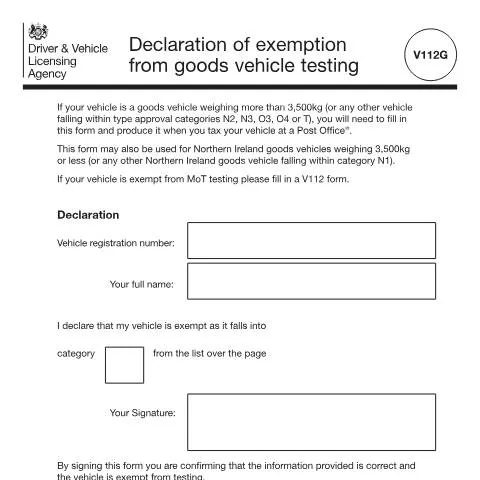
The annual MoT test represents a cornerstone of road safety for heavy goods vehicles, yet numerous categories of commercial vehicles legitimately sidestep this requirement. Form V112G serves as the official declaration that confirms your heavy goods vehicle falls within one of the 27 specific exemption categories established under the Road Traffic Act 1988. This seemingly straightforward document carries significant legal weight—presenting it incorrectly or fraudulently can result in prosecution, while failing to complete it properly may leave you unable to tax your vehicle at the Post Office.
Unlike the standard V112 form used for MoT-exempt vehicles, the V112G specifically addresses goods vehicles exceeding 3,500kg and vehicles within type approval categories N2, N3, O3, O4, or T. The distinction matters considerably: using the wrong form can invalidate your exemption claim and potentially expose you to penalties for operating an untested vehicle on public roads.
The Precise Boundaries of HGV Testing Exemption
The exemption landscape for heavy goods vehicles reflects the diverse nature of commercial vehicle operations across the UK. Category boundaries often prove more nuanced than initially apparent, requiring careful assessment of your vehicle's primary function rather than its technical specifications alone.
Weight Thresholds and Type Approval Categories
Goods vehicles weighing more than 3,500kg automatically fall within the testing regime unless specifically exempted. However, Northern Ireland operators face different rules: goods vehicles weighing 3,500kg or less, along with category N1 vehicles, may also use form V112G for exemption declarations. This geographical distinction frequently catches operators working across the Irish Sea off guard.
Type approval categories N2, N3, O3, O4, and T encompass a broad spectrum of commercial vehicles. Category N2 covers goods vehicles between 3,500kg and 12,000kg maximum gross weight, while N3 extends to vehicles exceeding 12,000kg. Categories O3 and O4 relate to heavy trailers, and category T covers agricultural and forestry tractors—each carrying specific exemption criteria that may apply differently depending on actual usage patterns.
The Mobile Machinery Distinction
Category 3 exemptions for mobile machinery generate frequent confusion among operators. The key test centres on whether the equipment serves as genuine mobile machinery rather than conventional transport. Machinery mounted on a motor vehicle chassis explicitly fails to qualify as mobile machinery, regardless of its specialised function. This distinction becomes crucial for operators of crane trucks, concrete pumps, or similar equipment where the boundary between transport and machinery blurs.
Professional Operators: Navigating Complex Exemption Scenarios
Commercial operators frequently encounter scenarios where exemption eligibility depends on precise usage patterns rather than vehicle specifications. The regulations acknowledge that identical vehicles may require different treatment based on their operational context.
Agricultural and Forestry Operations
Category T tractors face particularly complex exemption rules. While agricultural tractors generally qualify for exemption, those capable of exceeding 40 kilometres per hour lose this protection when used for haulage more than 15 miles from their operating base, unless the haulage directly relates to agricultural, horticultural, or forestry operations. This creates a challenging compliance environment for contractors serving multiple farms or forestry sites.
| Vehicle Type | Standard Exemption | Distance Limitation | Speed Limitation |
|---|---|---|---|
| Category T tractors | Yes, if agricultural use | 15 miles from base for non-agricultural haulage | 40 km/h design speed threshold |
| Agricultural motor vehicles | Yes | None specified | None specified |
| Agricultural trailers | Yes, when drawn by agricultural vehicle | Road use only | None specified |
Specialist Commercial Applications
Vehicles serving specialised commercial purposes often qualify for exemption, but the criteria demand careful interpretation. Fire fighting vehicles receive blanket exemption, while vehicles designed for medical, dental, veterinary, or educational purposes qualify only when the equipment remains permanently fixed and the primary purpose excludes commercial sale, hire, or loan activities.
The drain cleaning and sewerage exclusion within category 9 frequently surprises operators of specialist utility vehicles. Even vehicles primarily serving educational or health purposes lose their exemption if they engage in drain cleaning or refuse collection as secondary activities.
Cross-Border and International Vehicle Considerations
International operators and vehicles temporarily present in the UK benefit from specific exemption provisions, though these carry strict time limitations and documentation requirements.
Temporary Import Exemptions
Motor vehicles displaying registration marks under the Motor Vehicles (International Circulation) Regulations enjoy a 12-month exemption period from their last entry into the United Kingdom. This provision supports international haulage operations but requires careful tracking of entry dates to avoid inadvertent expiry of exemption status.
Similar provisions apply to trailers with operational bases outside the UK, though the exemption specifically requires that normal journey commencement occurs from the foreign base. This creates compliance challenges for operators establishing temporary UK operations or extending their stay beyond the intended 12-month period.
Northern Ireland Specific Provisions
Vehicles holding valid test certificates under Article 34 of the Road Traffic (Northern Ireland) Order 1981 qualify for exemption from GB testing requirements. This provision facilitates cross-border operations but requires operators to maintain awareness of certificate validity periods across different jurisdictions.
Completing Form V112G: Critical Details and Common Oversights
The V112G form demands precision in both completion and presentation. Unlike many DVLA forms, this declaration serves as a legal statement that you may need to defend if challenged by enforcement authorities.
Essential Declaration Elements
The form requires your vehicle registration number, full name, and signature, along with identification of the specific exemption category from the comprehensive list provided. Simply ticking a box proves insufficient—you must understand why your vehicle qualifies and be prepared to demonstrate compliance with the category requirements.
Your signature confirms that the information provided is correct and that the vehicle genuinely qualifies for exemption. This creates a legal obligation: providing false information constitutes an offence under Section 53(2) of the Road Traffic Act 1988, with potential prosecution consequences extending beyond simple administrative penalties.
Evidence and Supporting Documentation
While the form itself requires minimal information, smart operators maintain supporting evidence demonstrating their exemption eligibility. For mobile machinery, this might include manufacturer specifications confirming the equipment's primary function. Agricultural operators benefit from maintaining records of operational activities that demonstrate compliance with distance and purpose limitations.
Usage logs become particularly valuable for vehicles operating near exemption boundaries. Category 10 exemptions for vehicles used only for travelling between occupied lands require careful documentation of weekly mileage to ensure the six-mile aggregate limit remains unbreached.
The Vehicle Taxation Gateway
Form V112G serves a specific function within the vehicle taxation process, acting as a gateway document that enables Post Office taxation of exempt vehicles. This procedural role carries practical implications for fleet operators and individual vehicle owners alike.
Post Office Presentation Requirements
When taxing your exempt vehicle at a Post Office, you must present the completed V112G form alongside standard taxation documents. Post Office staff are trained to verify form completion but cannot assess exemption validity—this responsibility rests entirely with you as the vehicle operator.
The timing of form completion matters: you cannot retrospectively declare exemption for periods when your vehicle required but lacked valid testing. This creates challenges for operators discovering exemption eligibility after purchasing vehicles or changing operational patterns.
DVLA Online Services Integration
While the V112G form requires physical completion and presentation, DVLA's broader online services ecosystem supports various aspects of vehicle management. However, exemption declarations cannot currently be submitted electronically, reflecting the document's legal significance and the need for physical signature authentication.
Island Communities and Geographic Exemptions
Category 22 exemptions for vehicles used exclusively on certain islands reflect the practical challenges of accessing testing facilities in remote locations. However, the exemption boundaries prove more restrictive than many island residents initially assume.
The exemption explicitly excludes the Isle of Wight, along with the islands of Bute, Lewis, Mainland Orkney, Mainland Shetland, and Skye—all locations where bridge, tunnel, ford, or other suitable access routes enable convenient connection to mainland road networks. This geographic specificity requires island operators to carefully assess their exemption eligibility based on precise location and access arrangements.
Qualifying islands must lack any bridge, tunnel, ford, or other suitable way for motor vehicles to reach roads in other parts of the UK. This creates interesting boundary cases for islands with seasonal access routes or locations where vehicle transport requires ferry services despite physical connection possibilities.
Historic and Specialist Vehicle Exemptions
The exemption framework acknowledges both historical significance and technological diversity within the heavy goods vehicle population. These provisions support preservation of transport heritage while recognising practical limitations of testing requirements for specialist propulsion systems.
Pre-1960 Vehicle Provisions
Motor vehicles first used before 1 January 1960 qualify for exemption when operated unladen and not drawing laden trailers. This provision supports historic vehicle preservation but requires careful interpretation of "substantial changes in technical characteristics" that might invalidate exemption status.
The unladen requirement proves more restrictive than many historic vehicle enthusiasts anticipate. Even minimal cargo loading or trailer connection can invalidate the exemption, creating compliance challenges for vehicles used in demonstration or educational contexts.
Steam and Track-Laying Vehicles
Steam-propelled and track-laying vehicles receive blanket exemptions reflecting the practical impossibility of applying standard testing procedures to these specialist technologies. These exemptions support both heritage preservation and specialist industrial applications where conventional wheeled vehicles prove inadequate.
Track-laying vehicles in particular serve essential roles in construction, forestry, and agricultural applications where ground conditions preclude wheeled vehicle operation. The exemption recognises these operational necessities while acknowledging the specialised nature of maintenance and safety assessment requirements for such equipment.
Temporary Exemption Procedures and Emergency Situations
Whilst the V112G form provides the standard route for HGV annual testing exemptions, specific circumstances may warrant temporary exemption procedures or emergency protocols. Understanding these alternative pathways proves essential for operators facing urgent situations that prevent normal testing compliance.
Emergency exemptions typically apply when vehicles become stranded due to mechanical failure, severe weather conditions, or unforeseen circumstances beyond the operator's reasonable control. In such cases, DVSA may grant temporary relief from testing requirements, though this does not constitute a permanent exemption and requires immediate follow-up action once circumstances permit.
The temporary exemption process differs significantly from standard V112G applications. Operators must contact DVSA's emergency helpline within 24 hours of the incident, providing detailed documentation of the circumstances. This includes breakdown reports, weather warnings from the Met Office, or police incident numbers where applicable. The temporary relief typically extends for a maximum of 14 days, during which operators must arrange alternative testing or demonstrate continued compliance efforts.
Seasonal considerations also influence temporary exemption procedures. During severe winter weather, DVSA may issue blanket temporary reliefs for specific geographical areas, particularly affecting mountainous regions or areas subject to Met Office red weather warnings. These area-specific exemptions automatically apply to vehicles operating within designated postcodes, though operators remain responsible for monitoring DVSA communications and resuming normal testing schedules once conditions improve.
For vehicles involved in emergency services support—such as breakdown recovery during major incidents or emergency supply deliveries during natural disasters—DVSA maintains expedited exemption procedures. These typically require coordination with relevant emergency services and may involve simplified documentation requirements, reflecting the urgent nature of such operations.
International operators face additional complexities when seeking temporary exemptions. Vehicles entering the UK on temporary permits or engaged in international haulage may qualify for limited exemptions, particularly when their home country testing standards meet equivalent EU or international requirements. However, these exemptions require advance notification and may involve additional documentation proving compliance with origin country regulations.
The appeal process for denied temporary exemption applications follows accelerated timescales compared to standard V112G appeals. Operators typically receive decisions within 48-72 hours, reflecting the urgent nature of such applications. Successful appeals may result in retrospective exemption coverage, though operators must demonstrate they ceased vehicle operations pending the decision.
Record-Keeping Requirements and Compliance Documentation
Maintaining comprehensive records represents a fundamental aspect of HGV exemption compliance, extending far beyond the initial V112G application. DVSA expects operators to establish robust documentation systems that demonstrate ongoing compliance with exemption conditions and facilitate future inspections or audits.
The primary record-keeping obligation centres on maintaining detailed vehicle histories that track exemption periods, testing schedules, and any modifications affecting exemption status. These records must include original V112G applications, DVSA correspondence, exemption certificates, and any supporting documentation submitted during the application process. Digital storage proves acceptable, though operators must ensure backup systems prevent data loss and maintain accessibility for minimum five-year periods.
Vehicle-specific logbooks require particular attention when operating under exemptions. Standard driver hours records and vehicle inspection reports must include additional notations confirming exemption status and any special operating conditions. For vehicles operating under mileage-based exemptions, operators must maintain accurate odometer readings with supporting evidence such as fuel receipts, delivery documentation, or GPS tracking data.
Workshop records assume heightened importance for exempt vehicles. Maintenance schedules must demonstrate equivalent safety standards to MOT-tested vehicles, including detailed inspection reports covering brakes, steering, lighting, and emissions systems. Independent garage records prove particularly valuable, as they provide third-party verification of vehicle condition and maintenance standards.
Insurance documentation requires careful coordination with exemption records. Insurers may impose additional conditions or monitoring requirements for exempt vehicles, particularly those operating under specialist exemptions. Operators must ensure insurance policies explicitly cover exempt vehicle operations and maintain correspondence demonstrating insurer awareness of exemption status.
Driver training records become crucial when operating exempt vehicles with specific operational limitations. Training documentation must demonstrate driver competency in operating vehicles under exemption conditions, including awareness of speed restrictions, route limitations, or special handling requirements. This proves particularly relevant for agricultural vehicles transitioning between exempt and standard road use.
Audit trail maintenance ensures operators can demonstrate compliance history during DVSA inspections. This includes maintaining chronological files showing exemption renewals, condition changes, and any compliance issues or remedial actions. Electronic record systems must include user access logs and change histories, demonstrating data integrity and preventing unauthorised modifications.
Cross-referencing systems help operators manage complex fleets with mixed exemption statuses. Vehicle matrices showing exemption types, expiry dates, and renewal schedules prevent administrative oversights that could result in compliance failures. Integration with existing fleet management systems often provides the most effective approach, though operators must ensure system reliability and staff training in exemption-specific procedures.
Industry-Specific Exemption Applications and Sector Variations
Different industry sectors face varying challenges and opportunities when applying for HGV annual testing exemptions through form V112G. Understanding sector-specific requirements and common application patterns helps operators optimise their exemption strategies and avoid industry-typical pitfalls.
Agricultural operators represent the largest category of V112G applicants, though their applications require careful distinction between genuine agricultural use and commercial haulage activities. DVSA scrutinises applications involving vehicles that transport agricultural products beyond farm boundaries, particularly when crossing multiple county boundaries or engaging in retail distribution. Successful agricultural exemptions typically involve vehicles primarily used for field operations, with supporting documentation including farm business registrations, Agricultural Property Relief certificates, and detailed operating radius maps.
Construction industry applications face particular challenges regarding temporary versus permanent exemption status. Mobile crane operators, concrete mixer vehicles, and specialist construction equipment often qualify for exemptions when operating within construction site boundaries, though public road use triggers standard testing requirements. Applications must clearly delineate between on-site operations and public highway use, with many operators maintaining dual certification systems to ensure compliance flexibility.
Forestry operations encounter unique complications due to the remote nature of their operations and seasonal work patterns. Timber harvesting equipment often operates in locations inaccessible to standard testing facilities, making exemptions essential for operational viability. However, DVSA requires detailed environmental impact assessments and forestry commission permits to verify legitimate forestry operations, distinguishing them from general haulage activities using forestry vehicles.
Utilities sector exemptions involve complex coordination between multiple regulatory authorities. Gas, electricity, and water utility vehicles often require exemptions for emergency response capabilities, though these must be balanced against public safety requirements. Applications typically require coordination with Ofgem, Ofwat, or relevant utility regulators, demonstrating that exemption conditions maintain service reliability whilst ensuring vehicle safety standards.
Specialist transport operators—including fairground equipment, circus vehicles, and mobile exhibition units—face seasonal exemption challenges. These vehicles often operate intensively during summer months whilst remaining stationary for extended winter periods. DVSA considers seasonal operation patterns when evaluating exemption applications, though operators must demonstrate adequate maintenance during dormant periods and provide detailed seasonal operation schedules.
Quarrying and mining operations require exemptions that account for harsh operating environments and specialised vehicle modifications. Dump trucks, quarry tippers, and mining support vehicles often incorporate modifications that affect standard testing procedures. Applications must include engineering reports detailing vehicle modifications, environmental operating conditions, and alternative safety verification procedures.
Heritage and museum vehicle operators face unique exemption criteria based on historical significance and preservation requirements. Vintage commercial vehicles, steam-powered equipment, and historically significant transport often qualify for specialist exemptions that prioritise preservation over modern safety standards. Applications require detailed provenance documentation, heritage organisation endorsements, and restricted operation schedules that minimise public road use whilst preserving historical accessibility.
Emergency services contractors encounter expedited exemption procedures reflecting their critical operational requirements. Breakdown recovery operators, emergency supply contractors, and disaster response teams may qualify for enhanced exemption conditions that facilitate rapid deployment capabilities. These applications typically involve coordination with relevant emergency services and may include provisions for temporary exemption extensions during major incident responses.