When HGV Operations Fall Outside Standard Tachograph Requirements
Heavy goods vehicle operators across the UK regularly encounter situations where their vehicles, despite meeting weight thresholds that would typically mandate tachograph installation, actually qualify for exemptions under specific circumstances. The Driver and Vehicle Standards Agency recognises that numerous legitimate commercial and public service activities operate under conditions that make standard tachograph requirements either impractical or unnecessary for road safety purposes.
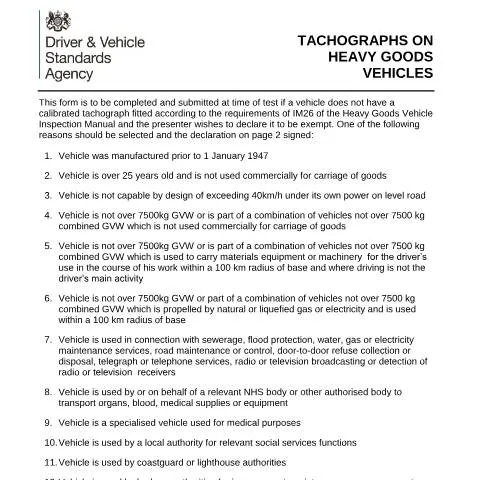
The DVSA's tachograph exemption declaration form serves as the official mechanism for operators to formally assert their vehicle's exempt status during MOT testing procedures. This declaration becomes particularly crucial when presenting vehicles for statutory inspection, as examiners must verify compliance with European Union regulations regarding drivers' hours and tachograph fitment—even in post-Brexit Britain, where these rules remain substantially in force.
Understanding which vehicles qualify for exemption requires careful consideration of operational characteristics, vehicle specifications, and the precise nature of goods being transported. The distinction between commercial carriage and ancillary transport activities forms the cornerstone of most exemption categories, with significant implications for operators who may unknowingly fall outside permitted parameters.
Navigating the Thirty Distinct Exemption Categories
The DVSA framework encompasses thirty specific exemption grounds, each addressing different operational realities within the UK's diverse transport landscape. These categories span from straightforward technical specifications to complex operational definitions that require careful interpretation.
Historic and Technical Vehicle Exemptions
Vehicles manufactured before 1 January 1947 receive automatic exemption, reflecting the obvious impracticality of retrofitting vintage machinery with modern recording equipment. Similarly, vehicles over 25 years old escape tachograph requirements provided they avoid commercial goods carriage—a provision particularly relevant for preservation societies and collectors operating heritage vehicles at shows or demonstrations.
Technical limitations also create exemption grounds. Vehicles incapable of exceeding 40km/h by design fall outside tachograph scope, acknowledging that such machinery typically serves specialised construction or agricultural purposes where speed monitoring offers minimal safety benefit.
Weight-Based Exemptions with Operational Qualifiers
The 7,500kg gross vehicle weight threshold creates several exemption categories, but each carries specific operational conditions. Vehicles below this weight avoid tachograph requirements when not engaged in commercial goods carriage, but operators must distinguish between commercial carriage and transport ancillary to other business activities.
Particularly nuanced is the exemption for vehicles carrying materials, equipment, or machinery for the driver's use within a 100km radius of base, where driving constitutes a secondary rather than primary work activity. This provision recognises tradespeople, maintenance engineers, and service technicians whose vehicle use supports rather than defines their professional role.
Public Service and Emergency Vehicle Categories
Emergency services, coastguard operations, and NHS transport activities receive comprehensive exemptions reflecting their operational priorities. Medical transport vehicles, whether carrying organs, blood supplies, or providing mobile healthcare facilities, operate under exemptions acknowledging that rigid drivers' hours monitoring could compromise critical healthcare delivery.
Local authority vehicles serving social services functions similarly escape standard requirements, as do specialised vehicles supporting essential infrastructure maintenance for utilities, telecommunications, and transport networks.
The Declaration Process During Vehicle Testing
The exemption declaration integrates directly into the MOT testing procedure, requiring completion and submission at the time of inspection when vehicles lack calibrated tachographs. This timing ensures that exemption claims receive immediate scrutiny from qualified examiners familiar with both technical requirements and operational exemptions.
| Declaration Element | Required Information | Verification Standard |
|---|---|---|
| Vehicle Registration | Complete registration mark | Cross-referenced with DVLA records |
| Exemption Reason | Numbered category (1-30) | Supporting evidence may be requested |
| Signatory Details | Name, position, business relationship | Authority to act for vehicle operator |
| Date of Declaration | Test date | Contemporaneous with inspection |
The declaration requires signature from someone with authority to act on behalf of the operating business, whether as owner, fleet manager, or designated representative. This requirement ensures accountability while preventing unauthorised exemption claims that could expose operators to subsequent enforcement action.
Documentation Standards and Supporting Evidence
While the form itself requires minimal information, operators should prepare supporting documentation demonstrating their exemption qualification. For radius-based exemptions, maintaining records of typical operational areas strengthens the declaration's validity. Agricultural operators might retain delivery records showing farm-to-market transport patterns, while utility companies could reference maintenance schedules demonstrating infrastructure support activities.
The DVSA emphasises that knowingly false declarations constitute criminal offences, with information potentially forwarded to enforcement teams for investigation. This warning underscores the importance of genuine qualification assessment rather than convenient interpretation of exemption categories.
Sectoral Applications Across UK Industries
Different industry sectors encounter distinct exemption scenarios, each requiring tailored understanding of applicable categories and operational boundaries.
Agricultural and Rural Operations
Agricultural undertakings benefit from comprehensive exemptions covering goods transport ancillary to farming activities within 100km radius limits. This provision encompasses feed delivery, livestock transport between farms and local markets, and equipment movement supporting agricultural operations. However, operators must distinguish between own account transport supporting their agricultural business and commercial haulage services provided to third parties.
Milk collection operations receive specific recognition, covering both collection from farms and return journeys carrying containers or animal feed products. This exemption acknowledges the unique operational patterns of dairy logistics while maintaining focus on activities directly supporting agricultural production rather than general commercial transport.
Construction and Infrastructure Maintenance
Utility maintenance vehicles serving water, gas, electricity, and telecommunications networks qualify for exemptions recognising their essential infrastructure support role. Road maintenance operations similarly escape standard requirements, reflecting the public service nature of highway management activities.
Specialised construction vehicles with fixed equipment—mobile cranes, concrete pumps, or drilling rigs—qualify for exemption when not towing goods trailers, acknowledging that their primary function involves equipment operation rather than goods transport.
Healthcare and Emergency Services
Medical transport receives multiple exemption categories, from NHS organ transport to mobile medical facilities providing community healthcare. Emergency service vehicles, including those operated by fire services, civil defence organisations, and rescue operations, operate under comprehensive exemptions prioritising rapid response over administrative monitoring.
The Royal National Lifeboat Institution receives specific recognition for lifeboat transport vehicles, while coastguard and lighthouse authorities enjoy exemptions supporting maritime safety operations around Britain's extensive coastline.
Operational Boundaries and Compliance Monitoring
Many exemptions incorporate geographical or operational limitations requiring ongoing compliance monitoring. The 100km radius restriction appears across multiple categories, from agricultural operations to breakdown recovery services, creating a clear boundary between local ancillary transport and longer-distance commercial activities.
Radius Calculations and Base Definitions
The 100km radius measurement typically calculates from the operator's main business premises or operational base, though specific exemptions may reference alternative starting points. Agricultural operations might measure from farm premises, while utility companies could reference regional depot locations serving particular infrastructure networks.
Operators should maintain records demonstrating typical journey patterns and distances, particularly where operations approach radius boundaries. GPS tracking data, delivery schedules, and maintenance records provide valuable supporting evidence for exemption compliance.
Commercial versus Ancillary Transport Distinctions
The fundamental distinction between commercial goods carriage and transport ancillary to other business activities underpins numerous exemption categories. Commercial carriage involves transport services provided to third parties as a primary business activity, while ancillary transport supports the operator's main business function.
A construction company transporting its own equipment to project sites operates under ancillary transport principles, but the same company providing haulage services to other businesses engages in commercial carriage subject to standard tachograph requirements.
Enforcement Implications and Ongoing Obligations
DVSA enforcement teams receive declaration information for potential investigation, creating ongoing compliance obligations extending beyond the initial MOT testing process. Operators claiming exemptions should maintain operational records supporting their declared status, as subsequent roadside checks or compliance investigations may scrutinise exemption validity.
Roadside Enforcement Encounters
Traffic enforcement officers encountering vehicles without tachographs will expect operators to demonstrate exemption qualification through operational evidence rather than merely referencing MOT declarations. Carrying copies of exemption documentation, recent delivery records, or operational schedules helps demonstrate legitimate exemption status during roadside encounters.
The DVSA's enforcement approach focuses on operational reality rather than technical compliance alone. Officers assess whether declared exemptions accurately reflect actual vehicle use, with particular attention to radius limitations, commercial carriage boundaries, and operational frequency patterns.
Record-Keeping Best Practices
Maintaining comprehensive operational records supports exemption compliance while providing evidence for potential enforcement encounters. Effective record-keeping systems should capture journey purposes, distances travelled, goods carried, and customer relationships distinguishing between own-account and commercial operations.
Digital fleet management systems increasingly support exemption compliance monitoring through automated journey logging, radius tracking, and operational pattern analysis. However, traditional paper-based systems remain equally valid provided they capture sufficient detail for exemption verification purposes.
Changes in Vehicle Use and Exemption Validity
Vehicle exemption status can change as operational patterns evolve, requiring operators to monitor ongoing qualification and potentially install tachograph equipment when exemptions no longer apply. Businesses expanding their geographical reach, changing operational focus, or increasing commercial carriage activities may inadvertently move outside exemption parameters.
The transition from ancillary to commercial transport often occurs gradually as businesses develop new revenue streams or expand service offerings. Agricultural operations beginning commercial haulage services, construction companies offering plant hire with transport, or utility contractors expanding into commercial logistics must reassess their exemption status as business models evolve.
Vehicles previously qualifying for exemption may require tachograph installation and calibration before resuming operations under changed circumstances. The DVSA expects operators to proactively manage these transitions rather than continuing under invalid exemption claims that could result in enforcement action.
Seasonal and Temporary Operations
Some exemption categories accommodate seasonal or temporary operational patterns, particularly relevant for agricultural operations, emergency services, and specialised transport activities. Harvest season transport, flood response operations, or temporary infrastructure projects may justify exemption claims during specific periods while requiring standard compliance during normal operations.
Operators managing mixed operational patterns should maintain detailed records distinguishing between exempt and non-exempt activities, ensuring tachograph compliance during periods when exemptions don't apply while properly claiming relief when qualification criteria are met.
Sector-Specific Exemption Scenarios and Documentation Requirements
Different industry sectors face unique challenges when determining tachograph obligations for their HGV operations. Understanding these sector-specific scenarios helps fleet operators and drivers navigate the regulatory landscape more effectively whilst ensuring compliance with DVSA enforcement standards.
Agricultural and Forestry Operations
Agricultural vehicles present some of the most complex exemption scenarios under UK tachograph regulations. Tractors and agricultural machines exceeding 3.5 tonnes are generally exempt when used exclusively for agricultural, horticultural, forestry, or fishery work within a 100-kilometre radius of their home base. However, the interpretation of "agricultural use" requires careful consideration.
When declaring exemption for agricultural HGVs, operators must demonstrate that the vehicle's primary function remains agricultural. This includes activities such as transporting livestock between farms, moving agricultural machinery to different field sites, or delivering farm produce directly from the production site. The key distinction lies in whether the transport activity forms an integral part of the agricultural operation rather than constituting independent commercial haulage.
Documentation for agricultural exemptions should include farm business registration details, proof of the vehicle's agricultural specification, and records demonstrating the nature of typical journeys. DVSA enforcement officers may request evidence showing that operations remain within the 100-kilometre radius and serve genuine agricultural purposes rather than general commercial transport.
Construction and Utilities Sector Considerations
Construction vehicles present another area where exemption declarations require careful assessment. Mobile cranes, concrete mixers, and specialist construction vehicles may qualify for exemptions based on their technical specifications and operational use. Vehicles designed and constructed for specific construction tasks, rather than general goods transport, often fall outside tachograph requirements.
Utility companies operating HGVs for infrastructure maintenance face particular challenges in determining exemption status. Emergency response vehicles attending power outages, water main repairs, or telecommunications infrastructure work may qualify for exemptions under specific circumstances. However, routine maintenance schedules or planned infrastructure projects typically require full tachograph compliance.
When declaring exemptions for construction or utility vehicles, operators should document the vehicle's specialist design features, typical operational patterns, and the nature of work performed. Evidence might include manufacturer specifications confirming the vehicle's construction purpose, contracts demonstrating the type of work undertaken, and operational logs showing the relationship between vehicle movements and construction activities.
Waste Management and Recycling Operations
Waste collection and recycling vehicles operate under specific regulatory frameworks that can affect tachograph obligations. Refuse collection vehicles following predetermined domestic or commercial routes may qualify for certain exemptions, particularly when operating within defined municipal boundaries. However, long-distance waste transport or hazardous waste movements typically require full tachograph compliance.
Skip lorries and similar waste handling vehicles present interesting exemption scenarios. When these vehicles primarily load and transport containers within local areas, they may qualify for exemptions based on their operational characteristics. However, operators must carefully document that activities remain within exemption parameters and don't constitute long-distance commercial haulage.
Technical Compliance and Digital Tachograph Integration
The transition to digital tachograph systems has introduced new complexities for operators declaring HGV exemptions. Understanding how digital systems interact with exemption declarations ensures proper compliance whilst avoiding unnecessary administrative burden or technical complications.
Smart Tachograph Implementation Challenges
Smart tachographs, mandatory for new HGVs registered after June 2019, include enhanced connectivity features that can complicate exemption scenarios. Even when vehicles qualify for tachograph exemptions, the presence of installed digital equipment may create confusion during roadside inspections or fleet management procedures.
Operators declaring exemptions for vehicles equipped with smart tachographs should maintain clear documentation explaining why the equipment remains inactive or unused. This documentation becomes particularly important when vehicles alternate between exempt and non-exempt operations, requiring careful management of tachograph activation and deactivation procedures.
Digital tachograph cards present another consideration for drivers operating exempt vehicles. Driver cards remain valid and should be retained even when primarily operating exempt vehicles, as occasional non-exempt duties may require immediate card availability. Operators should establish clear procedures for card management across mixed fleets including both exempt and non-exempt vehicles.
Fleet Management System Integration
Modern fleet management systems often integrate tachograph data for operational efficiency and compliance monitoring. When declaring HGV exemptions, operators must configure these systems appropriately to avoid conflicting data or unnecessary alerts regarding missing tachograph information.
Telematics systems should be programmed to recognise exempt vehicle classifications and adjust monitoring parameters accordingly. This includes modifying driver hour alerts, rest period calculations, and compliance reporting to reflect exemption status rather than generating false compliance warnings.
Training fleet managers and administrative staff on exemption handling within digital systems prevents operational confusion and ensures accurate record-keeping. Clear protocols should establish how exempt vehicles are identified within fleet management databases and how their operational data is processed differently from tachograph-equipped vehicles.
Cross-Border Operations and International Considerations
UK-based operators declaring HGV exemptions must consider how these exemptions apply during international operations. EU regulations may differ significantly from UK exemption criteria, potentially requiring tachograph compliance for the same vehicle when operating in continental Europe.
Post-Brexit regulations have created additional complexity for operators travelling between the UK and EU member states. Vehicles exempt under UK regulations may require full tachograph compliance when crossing into EU territory, necessitating careful planning and documentation management.
Operators should maintain separate compliance documentation for international operations, clearly identifying when UK exemptions apply versus when EU tachograph regulations take precedence. This dual compliance approach ensures legal operation across different jurisdictions whilst maintaining appropriate exemption status within the UK.
Enforcement Perspectives and Compliance Strategies
Understanding DVSA enforcement approaches to tachograph exemptions helps operators develop robust compliance strategies that withstand scrutiny during roadside inspections and compliance audits. Enforcement perspectives have evolved significantly as digital systems become more prevalent and exemption scenarios become increasingly complex.
Roadside Inspection Protocols
DVSA enforcement officers follow specific protocols when encountering vehicles claiming tachograph exemptions during roadside inspections. Officers are trained to verify exemption claims through documentation review, vehicle inspection, and operational assessment. Understanding these protocols helps operators prepare appropriate documentation and respond effectively to inspection queries.
During roadside inspections, officers typically examine vehicle construction, load characteristics, operational documentation, and driver credentials to verify exemption validity. Operators should ensure drivers carry comprehensive exemption documentation including vehicle specifications, operational purpose statements, and relevant regulatory references supporting the exemption claim.
Common inspection challenges arise when vehicles appear capable of both exempt and non-exempt operations. Multi-purpose vehicles or those with removable equipment may require additional documentation demonstrating their primary operational purpose and exemption qualification. Clear operational logs and purpose-specific documentation help address these challenges during roadside encounters.
Audit Trail and Record-Keeping Best Practices
Comprehensive record-keeping forms the foundation of successful exemption compliance strategies. DVSA audits increasingly focus on documentation quality and operational consistency when evaluating exemption claims. Operators must establish systematic approaches to documenting exemption rationale and maintaining supporting evidence.
Effective audit trails include vehicle purchase documentation, modification records, operational logs, customer contracts, and regulatory correspondence supporting exemption status. These records should demonstrate consistent operational patterns aligned with declared exemption categories rather than opportunistic exemption claims.
Digital record-keeping systems should integrate exemption documentation with operational data, creating comprehensive compliance databases accessible during audits or inspections. Regular internal audits help identify documentation gaps or operational inconsistencies before they attract regulatory attention.
Proactive Compliance Management
Forward-thinking operators develop proactive compliance management strategies that anticipate regulatory changes and enforcement trends. This includes monitoring DVSA guidance updates, participating in industry consultation processes, and maintaining dialogue with regulatory authorities on exemption interpretation.
Regular compliance reviews should assess whether operational changes affect exemption status, particularly as businesses evolve or expand their service offerings. Changes in customer base, operational geography, or vehicle utilisation patterns may impact exemption validity and require formal reassessment.
Training programmes for drivers and fleet management staff should cover exemption principles, documentation requirements, and inspection response procedures. Well-trained personnel can identify potential compliance issues early and take corrective action before problems escalate to enforcement proceedings.
Establishing relationships with transport law specialists and regulatory compliance consultants provides access to expert guidance on complex exemption scenarios. Professional advice becomes particularly valuable when operations involve multiple exemption categories or when regulatory interpretations remain unclear.