When Your Vehicle Sidesteps the Annual MOT: Understanding Form V112's Critical Role
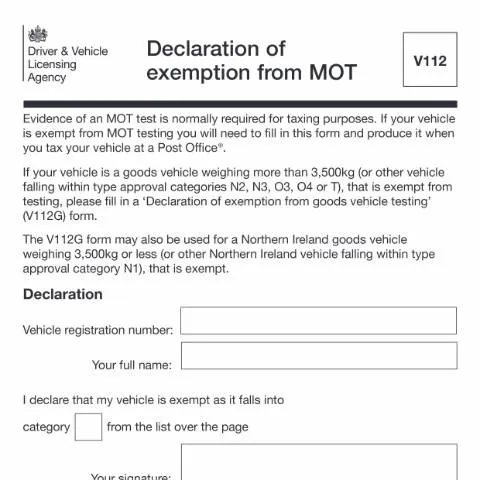
Every year, millions of vehicle owners across Britain queue at MOT testing stations, clutching their keys and hoping for a clean bill of health. Yet for certain categories of vehicles, this annual ritual becomes unnecessary—not through luck, but through legitimate exemption. The Declaration of exemption from MOT (V112) serves as your official passport to vehicle taxation without the usual MOT certificate, but only when your vehicle genuinely qualifies for this special status.
This isn't simply a convenient shortcut for avoiding inspection costs. The V112 form represents a formal declaration to DVLA that your vehicle falls within specific exemption categories established under road traffic legislation. When you present this document at a Post Office for vehicle tax renewal, you're essentially vouching that your vehicle meets precise legal criteria that render standard MOT testing inappropriate or unnecessary.
The form's deceptively simple appearance belies its importance in the vehicle taxation process. Without proper completion and presentation of the V112, owners of exempt vehicles face the impossible task of obtaining MOT certificates for vehicles that testing stations cannot or should not examine under standard procedures.
Decoding the Exemption Categories: From Motor Tractors to Historic Vehicles
The reverse side of form V112 reveals an extensive catalogue of vehicle types that escape the standard MOT regime, each with distinct reasoning behind their exemption status. Understanding these categories proves essential, as selecting the wrong classification can invalidate your declaration and potentially breach road traffic regulations.
Agricultural and Specialist Vehicles
Motor tractors and track-laying vehicles represent the most straightforward exemptions, designed for agricultural or construction work rather than general road use. These vehicles typically operate under different safety standards and usage patterns that make standard MOT testing procedures unsuitable.
Works trucks and vehicles used solely for passing between land occupied by the same keeper also qualify, reflecting their limited road exposure and specialized operational requirements. The key distinction lies in their primary purpose—if a vehicle serves industrial or agricultural functions rather than general transportation, exemption often applies.
Weight-Based and Commercial Exemptions
Invalid carriages weighing no more than 306kg when unloaded receive exemption, acknowledging their specialized nature and different construction standards. Similarly, goods vehicles exceeding 3,500kg fall under different testing regimes entirely, requiring the alternative V112G form rather than standard V112 documentation.
The legislation recognizes that heavier commercial vehicles undergo more rigorous testing procedures administered by different authorities, making standard MOT testing redundant or inappropriate for these vehicle classes.
Historic and Preserved Vehicles
Perhaps the most complex exemption category involves historic vehicles, where the rules distinguish between genuinely preserved examples and modified vehicles masquerading as classics. Vehicles over 40 years old qualify for exemption, but only if they haven't been substantially changed during the previous 30 years.
The definition of "substantially changed" proves crucial here. The legislation specifically excludes certain modifications from this definition, including chassis or monocoque bodyshell replacements with identical patterns, engine alternatives with the same cubic capacity, and efficiency-focused changes to axles and running gear.
| Modification Type | Exemption Impact | Key Considerations |
|---|---|---|
| Chassis replacement (same pattern) | Maintains exemption | Must be identical to original specification |
| Engine swap (different capacity) | Loses exemption | Alternative cubic capacities disqualify vehicle |
| Performance modifications | Loses exemption | Changes for efficiency/safety may be acceptable |
| Commercial to private conversion | Loses exemption | Change of use category affects qualification |
Navigating the Declaration Fields: Precision in Vehicle Documentation
The V112 form's apparent simplicity masks several potential pitfalls that can invalidate your declaration or create complications during vehicle tax renewal. Each field requires specific information that must align precisely with DVLA records.
Vehicle Registration Number Accuracy
The registration number must match exactly with DVLA records, including any suffix or prefix letters. Historic vehicles with Q-prefix registrations require particular attention, as these indicate vehicles of uncertain age or substantial reconstruction. If your vehicle carries a Q-prefix registration, you'll need additional evidence to support your exemption claim.
Category Selection and Supporting Evidence
The category selection box represents the form's most critical element. You must identify the specific letter corresponding to your vehicle's exemption category from the comprehensive list provided. Incorrect category selection can result in rejection of your tax application or, more seriously, potential prosecution for using an unroadworthy vehicle without proper certification.
For vehicles falling under category 'n' (vehicles used only on certain islands), you must provide the island's name in the designated box. This reflects the unique circumstances where geographic isolation makes standard MOT testing impractical or impossible.
Legal Declaration and Signature Requirements
Your signature on the V112 form carries significant legal weight. By signing, you confirm not only the accuracy of the information provided but also that your vehicle genuinely qualifies for exemption under current legislation. The form explicitly warns that using a vehicle without proper MOT certification when not legitimately exempt constitutes an offense under Section 47 of the Road Traffic Act or Article 63 of the Road Traffic (Northern Ireland) Order 1995.
Post Office Presentation and Alternative Taxation Routes
Unlike many DVLA transactions that have migrated online, vehicle tax renewal for MOT-exempt vehicles still requires physical presentation of the V112 form at Post Office branches. This reflects the need for manual verification of exemption claims and ensures proper documentation reaches DVLA records.
When visiting the Post Office, ensure you carry the completed V112 form alongside other required documentation, including valid insurance certificates and, where applicable, V5C registration certificates. Post Office staff are trained to verify that V112 forms are properly completed, but they cannot assess whether your vehicle genuinely qualifies for the claimed exemption category.
Timing Considerations for Tax Renewal
MOT-exempt vehicles must still comply with standard vehicle tax renewal deadlines. The exemption applies only to the testing requirement, not to taxation obligations. Plan your Post Office visit with sufficient time before your current tax expires, as processing may take longer than standard online renewals.
If your vehicle's exemption status changes—for example, through substantial modifications to a historic vehicle—you must obtain standard MOT certification before your next tax renewal. The transition from exempt to non-exempt status requires careful timing to avoid periods where your vehicle lacks proper certification.
Cross-Border Complications: Northern Ireland and Goods Vehicle Distinctions
The V112 form's scope extends beyond England, Scotland, and Wales, but Northern Ireland applications involve additional complexities. The form specifically references different legislation for Northern Ireland, citing the Road Traffic (Northern Ireland) Order 1995 rather than the standard Road Traffic Act.
Goods vehicles present particular complications, with different weight thresholds determining which form applies. Standard V112 forms cover most exempt vehicles, but goods vehicles exceeding 3,500kg require the alternative V112G form. This distinction reflects different testing regimes for commercial vehicles, where operator licensing and fleet management systems provide alternative oversight mechanisms.
Northern Ireland Specific Provisions
Northern Ireland goods vehicles weighing 3,500kg or less may use the V112G form when exempt, creating a different threshold structure compared to mainland Britain. This reflects historical differences in vehicle classification systems and ongoing administrative arrangements following devolution.
The complexity increases for vehicles that cross between Northern Ireland and mainland Britain regularly. Operators must ensure their exemption documentation remains valid across different jurisdictions and understand how differing enforcement practices might affect their vehicles.
Enforcement Implications and Legal Responsibilities
Completing a V112 form incorrectly or fraudulently carries serious consequences extending far beyond simple administrative penalties. The form's legal warning emphasizes that using vehicles without proper MOT certification when not genuinely exempt constitutes a criminal offense with potential prosecution under road traffic legislation.
Police officers and DVSA enforcement personnel can check vehicle exemption status during roadside inspections. If your vehicle doesn't genuinely qualify for the exemption category claimed on your V112 form, you face potential charges for using an unroadworthy vehicle, even if your vehicle would pass a standard MOT test.
Insurance and Liability Considerations
Vehicle insurance policies typically require compliance with legal roadworthiness requirements. Fraudulent exemption claims could potentially void insurance coverage, creating additional financial exposure beyond criminal prosecution. Insurers may investigate exemption claims following accidents, particularly for historic or modified vehicles where exemption status might be questionable.
The responsibility for maintaining roadworthy vehicles doesn't disappear with MOT exemption. Owners must still ensure their vehicles meet basic safety standards, even without formal testing requirements. This becomes particularly important for historic vehicles, where age-related deterioration might affect safety systems not covered by exemption provisions.
Future-Proofing Your Exemption Status
Vehicle exemption status can change over time through various circumstances, requiring ongoing attention to ensure continued compliance. Historic vehicles face particular scrutiny, where subsequent modifications might invalidate previously valid exemptions.
Legislative changes also affect exemption categories periodically. The 40-year rolling exemption for historic vehicles, introduced relatively recently, demonstrates how exemption criteria evolve with changing automotive landscapes and policy priorities. Staying informed about regulatory developments ensures your V112 declarations remain accurate and legally compliant.
Documentation and Record Keeping
Maintaining comprehensive records of your vehicle's history, modifications, and exemption basis provides essential protection against future challenges to exemption status. For historic vehicles particularly, photographic evidence of original condition and documentation of any subsequent changes can prove invaluable if exemption status faces scrutiny.
The V112 form represents more than administrative convenience—it serves as a formal declaration of your vehicle's legal status within Britain's complex vehicle regulation framework. Understanding its requirements, completing it accurately, and maintaining ongoing compliance ensures your exempt vehicle remains legally roadworthy while avoiding the potentially serious consequences of incorrect declarations.
Special Circumstances and Exemption Categories
The V112 declaration encompasses several distinct categories of MOT exemption, each with specific qualifying criteria that vehicle owners must understand thoroughly. Historic vehicles represent the most common exemption category, but the 40-year rule contains important nuances that catch many owners unaware.
For historic vehicle exemptions, the calculation begins from the exact date of first registration, not the model year. A vehicle first registered on 15th March 1983 becomes eligible for historic exemption on 15th March 2023, regardless of when the current MOT expires. However, substantial modifications can disqualify a vehicle from historic status, even if it meets the age criteria.
The DVLA defines substantial modifications as changes that significantly alter the vehicle's original character. This includes engine swaps to different fuel types, major chassis modifications, or conversion from commercial to passenger use. Period-appropriate modifications typically don't affect exemption eligibility—installing a period radio or upgrading to radial tyres from the vehicle's era generally remains acceptable.
Crown vehicles present another exemption category, covering vehicles owned by government departments, the Royal Household, or visiting forces. These vehicles receive automatic exemption but must still display valid tax and registration. Diplomatic vehicles follow similar principles, though the exemption process involves additional verification through the Foreign, Commonwealth & Development Office.
Military vehicles in civilian ownership create complex exemption scenarios. Genuine ex-military vehicles may qualify for historic exemption if they meet age criteria, but replica military vehicles built using civilian chassis typically require standard MOT testing. The key distinction lies in the vehicle's original military specification and service history.
Agricultural and construction vehicles face nuanced exemption rules based on their intended use and road access patterns. Vehicles used exclusively for agricultural purposes on private land remain exempt, but any regular road use, including travelling between fields owned by the same farmer, may trigger MOT requirements.
Documentation Requirements and Record Keeping
Successful V112 submissions require meticulous documentation that extends far beyond the basic application form. The DVLA's assessment process relies heavily on supporting evidence, making comprehensive record-keeping essential for exemption approval and ongoing compliance.
Vehicle identification documentation forms the foundation of any exemption claim. Original registration documents, including the V5C logbook, must clearly show the first registration date and vehicle specifications. For imported vehicles, additional documentation including import certificates, customs declarations, and foreign registration papers may be required to establish the vehicle's history and eligibility.
Photographic evidence plays an increasingly important role in exemption applications, particularly for historic vehicles where originality questions arise. Detailed photographs should document the engine bay, chassis numbers, interior configuration, and any period modifications. These images serve as baseline documentation for future inspections and help establish the vehicle's authentic character.
Insurance documentation requires special attention for exempt vehicles. Many insurers offer limited mileage policies specifically designed for historic vehicles, but these policies often contain restrictions on commercial use, daily driving, or storage requirements. Ensuring insurance coverage remains valid under exemption conditions prevents complications during roadside checks or accident investigations.
Maintenance records become particularly valuable for exempt vehicles, even though formal MOT testing doesn't apply. Comprehensive service histories, component replacement records, and safety inspection documentation demonstrate responsible ownership and can prove invaluable if exemption status faces challenges. Professional inspections by qualified mechanics, while not legally required, provide additional credibility for exemption claims.
For vehicles with complex modification histories, detailed documentation of all changes becomes essential. This includes invoices for parts and labour, photographs of work in progress, and certification that modifications comply with relevant regulations. Engineering reports may be necessary for significant modifications, particularly those affecting safety systems or structural integrity.
Storage and presentation of documentation requires consideration for long-term preservation. Digital copies provide convenient access and backup protection, but original documents may be required for certain verification processes. Organizing documentation chronologically and by category facilitates quick access during inspections or queries from authorities.
Legal Obligations and Compliance Monitoring
MOT exemption through V112 declaration doesn't eliminate all legal obligations for vehicle operation, creating ongoing compliance requirements that owners must navigate carefully. Understanding these continuing obligations prevents inadvertent violations that could result in penalties or exemption revocation.
Roadworthiness standards remain fully applicable to exempt vehicles, creating a legal requirement for owners to ensure their vehicles meet safety standards equivalent to MOT requirements. This obligation extends beyond basic functionality to include lighting systems, braking performance, steering accuracy, and emission controls where applicable.
The Construction and Use Regulations continue to apply regardless of MOT exemption status. These regulations cover vehicle dimensions, weight limits, lighting requirements, and equipment standards. Historic vehicles must comply with regulations that were in force when they were first registered, but subsequent safety improvements may be required in certain circumstances.
Insurance implications of MOT exemption require careful consideration, as many policies contain clauses relating to vehicle condition and roadworthiness. Some insurers require annual safety inspections by qualified engineers as a condition of coverage for exempt vehicles. Failure to maintain appropriate insurance coverage can result in serious legal consequences, including vehicle seizure and prosecution.
Police enforcement powers remain unchanged for exempt vehicles, with officers retaining authority to conduct roadside safety checks and issue prohibition notices for dangerous vehicles. Vehicle Defect Rectification Scheme notices can be issued to exempt vehicles showing safety defects, requiring rectification within specified timeframes.
Commercial use restrictions apply to many exemption categories, particularly historic vehicle exemptions intended for preservation purposes. Using an exempt historic vehicle for regular commercial activities may violate exemption conditions and could result in requirement to resume MOT testing.
Environmental compliance adds another layer of obligation for exempt vehicles, particularly in areas with Low Emission Zones or Clean Air Zones. Historic vehicles may receive exemptions from certain environmental restrictions, but emissions standards applicable at the time of manufacture typically remain in force.
Record-keeping obligations extend beyond the initial exemption application, with owners required to maintain evidence of ongoing compliance with exemption conditions. This includes documentation of any modifications, changes in use patterns, or maintenance activities that could affect exemption eligibility. Regular review of exemption conditions ensures continued compliance as regulations evolve.