Understanding Trailer Entry into UK Service: The Critical First MOT Application
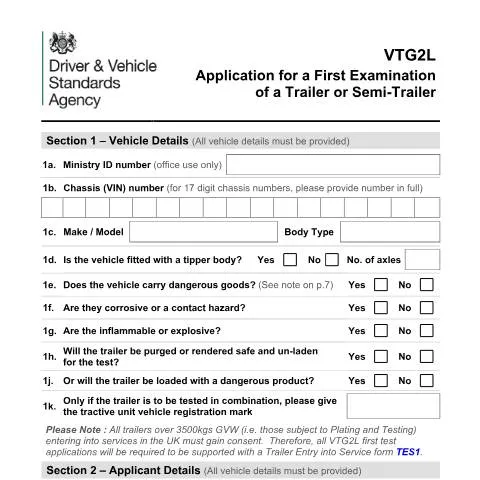
When a new trailer over 3,500kg gross vehicle weight (GVW) enters service in the United Kingdom, it must undergo a comprehensive first examination before it can legally operate on British roads. The VTG2L application form, administered by the Driver and Vehicle Standards Agency (DVSA), serves as the gateway for this mandatory process. This initial examination differs fundamentally from routine annual MOT tests, as it establishes the trailer's baseline safety standards and determines its operational parameters for years to come.
The regulatory framework surrounding trailer testing stems from European Union legislation that the UK retained post-Brexit, specifically focusing on commercial vehicles exceeding 3.5 tonnes. Unlike passenger cars or light commercial vehicles, heavy trailers present unique safety challenges due to their size, weight, and the nature of goods they transport. The DVSA recognises that a trailer's first examination requires more detailed scrutiny than subsequent annual tests, as this initial assessment sets the foundation for all future safety evaluations.
Mandatory Companion Documentation: The TES1 Requirement
A critical aspect often overlooked by applicants is the mandatory requirement for a Trailer Entry into Service form (TES1) to accompany every VTG2L application. This dual-form system reflects the DVSA's comprehensive approach to trailer safety management. The TES1 form provides consent for the trailer to enter UK service, whilst the VTG2L schedules and defines the parameters of the first examination.
The TES1 requirement applies universally to all trailers over 3,500kg GVW, regardless of their country of manufacture or previous service history. This includes:
- Newly manufactured trailers from UK or international manufacturers
- Second-hand trailers imported from other countries
- Trailers previously operated under different regulatory frameworks
- Converted or significantly modified existing trailers
Failure to submit both forms simultaneously will result in application rejection, causing delays that can impact business operations and vehicle deployment schedules.
Decoding Vehicle Identification and Specification Requirements
Section 1 of the VTG2L form demands precise vehicle identification details that extend beyond basic registration information. The chassis (VIN) number requirement specifies that 17-digit numbers must be provided in full, reflecting modern Vehicle Identification Number standards adopted across the automotive industry.
The form's inquiry about dangerous goods transportation reveals the DVSA's risk-based approach to trailer testing. Trailers designated for dangerous goods must declare whether they will carry:
| Hazard Category | Testing Implications | Special Requirements |
|---|---|---|
| Corrosive substances | Enhanced material inspection | Tank integrity verification |
| Flammable/explosive materials | Electrical system scrutiny | Earthing and bonding checks |
| General dangerous goods | Structural assessments | Load securing evaluations |
The critical question regarding whether the trailer will be purged or rendered safe and un-laden for the test versus loaded with a dangerous product determines the examination methodology. Testing loaded trailers requires specialised facilities and certified examiners, potentially limiting available test locations and extending scheduling timeframes.
Navigating Combined Vehicle Testing Scenarios
When trailers require testing in combination with a tractive unit, the application process becomes more complex. Semi-trailers, in particular, cannot be adequately assessed without their pulling vehicle, as braking systems, electrical connections, and coupling mechanisms must be evaluated under operational conditions.
The requirement to provide the tractive unit vehicle registration mark enables the DVSA to verify compatibility between trailer and towing vehicle. This verification encompasses:
- Gross combined weight ratings
- Braking system compatibility (air, hydraulic, or vacuum systems)
- Electrical system voltage matching
- Coupling mechanism specifications
Operators must ensure the designated tractive unit will be available at the scheduled examination time, as substitute vehicles may not provide equivalent testing conditions or may lack necessary compatibility features.
Technical Specifications and Engineering Details
Section 6 of the VTG2L form requires detailed dimensional information that directly impacts the trailer's operational capabilities and legal compliance. The measurements requested align with the Road Vehicles (Construction and Use) Regulations 1986, ensuring trailers meet UK-specific dimensional standards.
The distinction between drawbar trailers and semi-trailers significantly affects dimensional requirements. Drawbar trailers require measurement from the centre of the foremost axle to the centre of the rearmost axle, whilst semi-trailers focus on coupling-to-axle distances that determine turning circles and road space occupation.
Chassis cross-section documentation represents a unique aspect of UK trailer testing. The form provides standard cross-section diagrams, but operators with non-standard chassis designs must submit separate sketches. This requirement reflects the DVSA's understanding that trailer chassis design directly impacts structural integrity and load distribution capabilities.
Suspension and Tyre Loading Categories
The VTG2L form's treatment of suspension and tyre specifications introduces operators to the UK's sophisticated tyre loading category system. Standard category 2B provides unrestricted operation, but categories 2J and 2M offer higher payload capacities with corresponding operational restrictions.
Category 2J permits increased loading under two specific scenarios:
- Multi-stop collection and delivery services operating at maximum 40mph within a 25-mile radius of the permanent base
- Local authority operations including road cleansing, refuse collection, or regulatory enforcement activities, also limited to 40mph
Category 2M applies exclusively to low platform trailers with 20-inch rim diameter tyres or smaller, requiring distinctive "L" plate markings measuring 7" x 9" with 5-inch high letters.
Alteration Documentation and Modification History
Section 7's requirement for alteration documentation reflects the DVSA's recognition that many trailers undergo modifications between manufacture and first UK examination. The form specifically excludes "normal replacement of parts" from reporting requirements, focusing instead on structural or functional modifications that could impact safety or performance.
Significant alterations requiring documentation include:
- Chassis modifications affecting structural integrity
- Brake system upgrades or conversions
- Axle replacements or repositioning
- Suspension system modifications
- Coupling mechanism changes
When modifications have been performed by third parties, the form requires the modifier's name and address, establishing accountability and enabling the DVSA to contact modification specialists if questions arise during examination.
Strategic Test Location Selection and Scheduling
The choice of test location significantly impacts both examination scheduling and operational convenience. The DVSA operates Authorised Testing Facilities (ATFs) across the UK, but not all facilities can accommodate every trailer type or testing scenario.
Factors influencing test location selection include:
- Facility capabilities - Some ATFs specialise in specific trailer types or dangerous goods testing
- Geographic convenience - Proximity to operational base reduces transportation costs and time
- Scheduling availability - Popular locations may have longer waiting times
- Combined testing requirements - Not all facilities can accommodate trailer-tractor combinations
The DVSA's online facility finder tool, accessible through gov.uk/dvsa, provides real-time information about facility capabilities and availability. However, operators should verify specific requirements directly with chosen facilities, particularly for specialised trailers or testing scenarios.
Post-Application Processes and Certification Outcomes
Following successful VTG2L form submission and examination completion, trailers receive their initial Ministry plate and certification. This documentation serves as the foundation for all subsequent annual MOT tests and establishes the trailer's legal operational parameters.
The examination process may reveal deficiencies requiring rectification before certification. Unlike annual MOT tests where minor defects might receive advisory notices, first examinations typically require complete compliance with all safety standards before certification is granted. This stringent approach reflects the examination's role in establishing baseline safety standards.
Successful completion of the first examination enables trailers to enter commercial service immediately, provided all other regulatory requirements (such as operator licensing and insurance) are satisfied. The resulting certification remains valid until the trailer's first annual MOT test, typically due twelve months after the initial examination date.
For operators managing fleet expansions or regular trailer acquisitions, understanding the VTG2L process enables better planning and resource allocation. The detailed technical requirements and documentation standards established through this initial examination process ultimately contribute to the UK's commercial vehicle safety record and operational efficiency standards that benefit all road users.
Special Considerations for Different Trailer Categories
Not all trailers follow identical MOT requirements, and understanding your specific trailer category ensures you apply for the correct test format. The DVSA categorises trailers based on their maximum authorised mass (MAM) and intended use, which directly affects both the testing procedures and applicable standards.
For light trailers with a MAM not exceeding 3,500kg, the MOT focuses primarily on basic safety components such as brakes, lights, tyres, and coupling mechanisms. These trailers typically undergo a less intensive examination compared to their heavier counterparts, though all safety-critical elements receive thorough scrutiny.
Conversely, heavy trailers exceeding 3,500kg MAM face more comprehensive testing protocols. The examination includes detailed brake efficiency measurements, suspension system integrity checks, and more rigorous structural assessments. Heavy trailers often require specialised testing equipment, meaning not every MOT testing station can accommodate them—you'll need to identify facilities with the appropriate lifting gear and brake testing apparatus.
Specialised trailers present unique considerations. Car transporters, for instance, require inspection of their loading ramps, securing mechanisms, and upper deck structural integrity. Boat trailers need particular attention to their winch systems, keel rollers, and corrosion resistance given their exposure to marine environments. Agricultural trailers may have specific exemptions or modified requirements, particularly if they're primarily used on private land and only occasionally travel on public roads.
For trailers manufactured before certain dates, different construction standards may apply. Older trailers might not require certain modern safety features, but they must still meet the standards applicable when they were first registered. This can create complexity when determining exactly which requirements apply to vintage or imported trailers.
Import considerations add another layer of complexity. Trailers originally manufactured for other markets may not fully comply with UK construction standards, potentially requiring modifications before they can pass their first MOT. European trailers often need lighting modifications to meet UK requirements, whilst trailers from markets with different loading configurations might need structural adjustments.
Common First MOT Failures and Prevention Strategies
Understanding typical failure points helps trailer owners prepare effectively for their first MOT, potentially saving both time and expense. DVSA statistics reveal consistent patterns in first-time failures, many of which stem from overlooked maintenance during the trailer's early operational period.
Lighting defects account for a significant proportion of first MOT failures. New trailer owners often underestimate how quickly road salt, dirt, and moisture can compromise electrical connections. Common issues include corroded earth connections, damaged cable routing where wires rub against sharp edges, and inadequate weatherproofing at connection points. Before your test, systematically check every light function—indicators, brake lights, rear lights, and fog lights where fitted. Pay particular attention to the electrical connection between your towing vehicle and trailer, as intermittent faults here can be difficult to diagnose during the test.
Brake system failures frequently occur when trailers haven't been used regularly or have been stored incorrectly. Brake cables can seize, brake shoes can bind due to corrosion, and hydraulic systems can develop leaks or air locks. For trailers with overrun brakes, the damper and coupling head mechanism requires particular attention—these components experience significant stress and can deteriorate rapidly if not properly maintained. Auto-reverse mechanisms on boat trailers are particularly susceptible to corrosion and seizure.
Tyre-related failures often surprise new trailer owners who assume that low-mileage tyres remain in good condition indefinitely. However, trailers tyres are susceptible to sidewall cracking, uneven wear patterns from poor wheel alignment, and degradation from UV exposure during storage. Additionally, many trailer tyres carry different load ratings or speed restrictions compared to car tyres, and using inappropriate tyres constitutes an MOT failure.
Structural issues can develop surprisingly quickly, particularly on trailers used in harsh environments. Weld cracks around mounting points, corrosion in chassis members, and loose or missing fasteners all constitute serious failures. For trailers used near coastal areas or for launching boats, galvanic corrosion between dissimilar metals can cause rapid deterioration of crucial structural components.
To prevent these common failures, implement a systematic pre-MOT inspection routine. Create a checklist covering all testable items and work through it methodically. Pay particular attention to any warning signs during normal use—unusual noises, vibrations, or handling characteristics often indicate developing problems that will manifest as MOT failures.
Consider engaging a knowledgeable trailer specialist for a pre-MOT health check, particularly if you're unfamiliar with trailer maintenance requirements. This investment often proves cost-effective by identifying and addressing minor issues before they become expensive MOT failures requiring repeat tests.
Documentation Requirements and Record Keeping
Proper documentation plays a crucial role in the first MOT application process, and establishing good record-keeping practices from the outset prevents complications both during the initial test and throughout the trailer's operational life.
Your trailer's registration documents form the foundation of all official interactions. The V5C registration certificate contains essential information that MOT testers need to verify, including the trailer's exact specifications, weight limits, and construction details. Ensure these details match your trailer's actual configuration—discrepancies can delay or complicate the testing process. If you've made modifications since registration, you may need to update the V5C before applying for your first MOT.
Purchase documentation provides crucial provenance information, particularly for imported trailers or those bought from private sellers. Retain all invoices, import declarations, and correspondence relating to your trailer's acquisition. This documentation can prove invaluable if questions arise about the trailer's specification, age, or compliance with UK regulations.
For trailers requiring type approval, maintain copies of all relevant certificates and declarations. European Community Whole Vehicle Type Approval (ECWVTA) certificates, Individual Vehicle Approval (IVA) certificates, or Mutual Recognition certificates all demonstrate compliance with construction regulations. MOT testers may need to reference these documents, particularly for unusual or specialised trailers.
Maintenance records serve multiple purposes beyond simple record-keeping. They demonstrate responsible ownership, can help identify recurring issues, and provide valuable information for MOT testers investigating potential problems. Record all servicing, repairs, component replacements, and modifications with dates and details. Include photographs of any significant work, particularly structural repairs or modifications that might not be immediately obvious during visual inspection.
Insurance documentation, whilst not directly required for the MOT, should be current and appropriate for your intended use. Some specialised trailer applications require specific insurance coverage, and gaps in coverage can create legal complications if accidents occur during or around the testing period.
Establish a systematic filing system from the beginning. Create both physical and digital copies of all important documents, storing them securely but ensuring easy access when needed. Cloud-based storage systems provide excellent backup solutions, but remember that some MOT testing stations may not have reliable internet access if they need to verify digital documents.
Consider creating a trailer logbook documenting all significant events in your trailer's operational history. This proves particularly valuable for commercial operators who may need to demonstrate compliance with various regulatory requirements beyond the basic MOT test. Include details of loading patterns, route types, environmental exposure, and any incidents or unusual occurrences that might affect the trailer's condition or performance.
When scheduling your first MOT, organise all relevant documentation in advance. Bring original documents rather than copies where possible, and ensure any digital records are easily accessible on a reliable device. This preparation demonstrates professionalism and can expedite the testing process, particularly if any queries arise about your trailer's specification or compliance status.