When Business Meets Road Safety: The MOT Testing Station Authorisation Journey
Every year, millions of vehicles undergo their mandatory MOT test across the UK, ensuring they meet essential safety and environmental standards. Behind this crucial road safety mechanism lies a network of authorised testing stations, each one approved through a rigorous application process managed by the Driver and Vehicle Standards Agency. The DVSA VT01 form serves as the gateway for businesses seeking to enter this regulated sector, whether establishing their first testing facility or expanding existing operations.
The MOT testing industry represents a unique intersection of commercial enterprise and public responsibility. Unlike typical business ventures, operating a vehicle testing station carries statutory obligations under Section 45 of the Road Traffic Act 1988, making the authorisation process both comprehensive and exacting. The VT01 application form reflects this dual nature, combining standard business registration requirements with detailed technical specifications and stringent compliance commitments.
Regulatory Framework Governing MOT Testing Station Operations
The legal foundation for MOT testing stations stems from the Motor Vehicles (Tests) Regulations, which mandate periodic safety inspections for vehicles over three years old. This regulatory framework establishes authorised examiners as the cornerstone of the testing system, with each examiner responsible for one or more vehicle testing stations under their supervision.
The DVSA maintains strict oversight through a multi-layered authorisation structure. At the apex sits the Authorised Examiner (AE), who bears ultimate responsibility for all testing activities. Below this level, designated managers coordinate day-to-day operations, whilst individual testers conduct the actual inspections. This hierarchical approach ensures accountability whilst allowing operational flexibility across different business models.
The regulatory requirements extend beyond initial approval to encompass ongoing compliance monitoring. The Data Protection Act 2018 and UK GDPR govern the handling of vehicle and customer information, whilst health and safety legislation applies to workshop operations. Equipment calibration schedules, tester qualification maintenance, and record-keeping obligations create a continuous compliance burden that shapes every aspect of station management.
Statutory Obligations and Enforcement Powers
The VT01 form explicitly acknowledges DVSA's extensive enforcement powers, including unannounced inspections during normal working hours. These powers reflect the public interest in maintaining testing standards, as compromised MOT procedures directly impact road safety. The agency can terminate authorisations for non-compliance, false declarations, or failure to maintain required standards.
Criminal liability extends to providing false information, with potential prosecution under the Fraud Act 2006. This serious consequence underscores the importance of accuracy when completing the application, particularly regarding business structure, personnel qualifications, and technical capabilities.
Navigating the Application Pathways
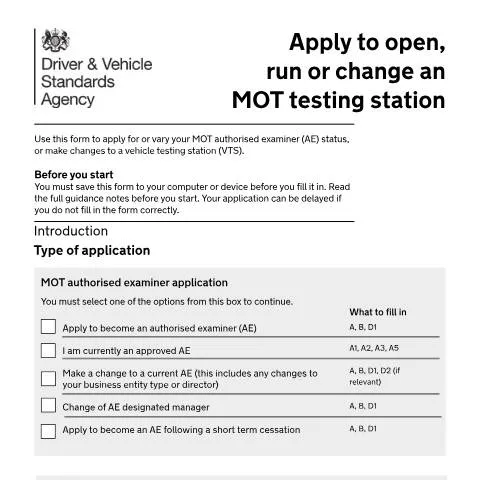
The VT01 form accommodates multiple application scenarios through a sophisticated routing system. Applicants must first identify their specific situation from eight distinct categories, each triggering different sections of the comprehensive form.
| Application Type | Required Sections | Typical Scenarios |
|---|---|---|
| New Authorised Examiner | A, B, D1 | First-time business entry, franchise acquisition |
| AE Business Changes | A, B, D1, D2 | Incorporation, partnership changes, director appointments |
| New Testing Station | C, D2, D3 | Expansion to additional locations |
| Station Modifications | C, D2, D3 | Equipment upgrades, test class additions |
The pathway selection process requires careful consideration of current status and intended changes. Existing authorised examiners expanding operations follow different procedures than new market entrants, reflecting their established compliance history and existing DVSA relationships.
Short-Term Cessation Scenarios
A particularly nuanced pathway addresses businesses resuming operations after short-term cessation. This provision recognises that temporary closures—due to facility upgrades, equipment replacement, or business restructuring—shouldn't necessitate complete re-authorisation. However, the definition of "short-term" remains deliberately vague, requiring case-by-case assessment based on cessation duration and reasons.
Dissecting the Declaration and Responsibility Framework
Part A of the VT01 form establishes the fundamental relationship between the applicant and DVSA through two critical components: the formal declaration and the comprehensive statement of responsibilities. These elements transcend mere paperwork, creating binding legal commitments that govern all subsequent operations.
The declaration requires signature by specific individuals based on business structure—sole traders sign personally, whilst partnerships and companies must designate authorised representatives. This personalisation of responsibility ensures accountability cannot be diluted through corporate structures.
Operational Responsibilities and Testing Standards
The statement of responsibilities section reads like a comprehensive operational manual, covering everything from equipment calibration to staff behaviour standards. Key requirements include:
- Location restrictions: Tests must occur only at premises specified on the authorisation certificate (VT9)
- Equipment compliance: Only approved, calibrated equipment in good working order
- Personnel limitations: Tests conducted solely by registered MOT testers
- Universal service obligation: Must test any vehicle in authorised classes unless physical limitations prevent safe testing
The universal service obligation represents a significant commercial commitment, preventing stations from cherry-picking profitable tests whilst rejecting difficult or time-consuming vehicles. This requirement balances commercial interests against public service obligations.
Mandatory Disclosure Requirements
The form mandates immediate disclosure of various events that could affect operational fitness, including criminal convictions, bankruptcy proceedings, and business structure changes. The conviction thresholds are precisely defined: prison sentences of three months or more, fines exceeding £2,500, or community service orders requiring over 60 hours of unpaid work.
These disclosure obligations extend beyond the primary applicant to encompass all key personnel, including MOT testers, designated managers, and company directors. The comprehensive coverage reflects DVSA's recognition that testing station integrity depends on all personnel maintaining appropriate standards.
Business Structure Documentation and Entity Recognition
Section A4 addresses business structure identification, a deceptively simple requirement with significant implications for ongoing compliance obligations. The form recognises four primary business types: sole traders, partnerships, limited companies, and designated councils, each carrying distinct regulatory requirements and liability structures.
Sole traders face unlimited personal liability for station operations, making comprehensive insurance coverage essential. The application process requires detailed personal information, including residential addresses and financial history, reflecting the direct personal responsibility inherent in this structure.
Partnership Complexities
Partnership applications present unique challenges, as each partner becomes jointly and severally liable for station operations. The form requires comprehensive details for all partners, not just designated representatives. Changes in partnership composition trigger mandatory variation applications, as the legal entity technically dissolves and reforms with each partner change.
Limited liability partnerships offer some protection whilst maintaining operational flexibility, but require additional documentation regarding designated members and their specific responsibilities within the MOT testing context.
Corporate Applications and Director Responsibilities
Limited company applications involve the most complex documentation requirements, reflecting the separation between corporate and personal liability. However, director personal guarantees often eliminate this protection in practice, particularly for smaller testing station operators.
The form requires detailed company information, including incorporation certificates, memoranda and articles of association, and current director appointments. Recent changes in company law regarding beneficial ownership disclosure add additional complexity to corporate applications.
Technical Infrastructure and Equipment Specifications
The technical sections of the VT01 form delve into the physical infrastructure required for MOT testing operations. These requirements extend far beyond basic workshop facilities to encompass sophisticated testing equipment, environmental controls, and safety systems.
Vehicle testing stations must accommodate different vehicle classes, from motorcycles to heavy goods vehicles, each requiring specific equipment configurations. The form requires detailed specifications for:
- Vehicle lifts and inspection pits with precise dimensional requirements
- Brake testing equipment calibrated to DVSA standards
- Emissions testing apparatus for petrol and diesel vehicles
- Headlight alignment equipment with regular calibration schedules
- Play detector units for suspension and steering system evaluation
Equipment Calibration and Maintenance Obligations
The regulatory framework demands rigorous equipment maintenance schedules, with calibration certificates required at specified intervals. These obligations represent ongoing operational costs that applicants must factor into their business planning. Failure to maintain calibration schedules can result in immediate suspension of testing authority, making equipment management a critical operational priority.
The form requires evidence of calibration arrangements, typically through contracts with approved service providers. Independent calibration capabilities require additional DVSA approval, adding complexity for larger operators considering in-house maintenance programmes.
Personnel Qualifications and Management Structures
The human element of MOT testing receives extensive attention within the VT01 application process. The form requires detailed information about all personnel involved in testing operations, from individual testers to senior management roles.
Authorised Examiner Designated Managers (AEDMs) occupy a crucial position within the regulatory structure, serving as the primary interface between DVSA and station operations. The form requires comprehensive background checks for AEDM candidates, including employment history, qualifications, and any relevant criminal convictions.
Tester Registration and Competency Requirements
Individual MOT testers must hold current qualifications for each vehicle class they intend to test. The application process requires evidence of initial training completion and ongoing competency maintenance through regular refresher courses and annual assessments.
The form addresses tester employment arrangements, recognising that modern testing stations often operate with a mix of employed and contracted personnel. This flexibility supports business efficiency whilst maintaining clear accountability chains for testing quality.
Succession Planning and Business Continuity
The regulatory framework acknowledges that personnel changes are inevitable in long-term operations. The VT01 form includes provisions for designating deputy managers and establishing clear succession arrangements. These requirements reflect DVSA's recognition that testing station continuity serves the public interest, particularly in areas with limited alternative facilities.
Emergency procedures must address scenarios where key personnel become unavailable, ensuring testing services can continue without compromising safety standards. The form requires evidence of robust management systems capable of maintaining operations during personnel transitions.
Financial Integrity and Commercial Viability Assessment
Behind the technical and operational requirements lies a fundamental question: can the applicant sustain a viable MOT testing business whilst maintaining required standards? The VT01 form addresses this through comprehensive financial disclosure requirements that extend beyond simple creditworthiness checks.
The financial assessment encompasses both historical performance and forward projections, recognising that testing station operations involve significant upfront investments in equipment and facilities. Applicants must demonstrate sufficient working capital to maintain operations during the inevitable initial period of customer acquisition and reputation building.
Insurance and Liability Coverage
Comprehensive insurance coverage represents a mandatory operational requirement, protecting both the business and the public from potential liabilities arising from testing activities. The form requires evidence of professional indemnity insurance, public liability coverage, and employer's liability protection where applicable.
The insurance requirements extend beyond standard commercial policies to address specific MOT testing risks, including potential claims arising from incorrect test results or equipment failures. Specialist insurers have developed products specifically for the testing station market, reflecting the unique risk profile of these operations.
The application process concludes with formal submission to DVSA for assessment, typically involving site inspections and detailed technical evaluations. Processing times vary based on application complexity and current workload, but applicants should anticipate several months between submission and final approval. The investment in thorough preparation during the application phase invariably pays dividends through smoother approval processes and more robust operational foundations.
Understanding the Different Categories of MOT Test Stations
The DVSA recognises several distinct categories of MOT test stations, each with specific authorisation requirements and operational constraints. Understanding these categories is crucial for determining the appropriate application route and ensuring compliance with regulatory standards.
Class 4 test stations represent the most common category, authorised to test cars, light vans, and three-wheelers. These stations must maintain specific bay dimensions, with minimum clearances of 5.5 metres length, 2.5 metres width, and 2.1 metres height. The testing bay requires adequate lighting levels of at least 600 lux, measured at floor level, and must be equipped with appropriate lifting equipment capable of safely raising vehicles for underside examination.
For operators seeking to expand their services, Class 7 test stations offer authorisation to test goods vehicles exceeding 3,000kg and buses with more than eight passenger seats. These facilities demand significantly larger infrastructure, including bays measuring at least 12 metres in length and 3.5 metres in width. The height requirement increases to 4.2 metres to accommodate larger commercial vehicles. Additionally, Class 7 stations must install specialised equipment such as brake testing rollers capable of handling heavier axle loads and headlight beam testers designed for commercial vehicle specifications.
Motorcycle test stations (Classes 1 and 2) cater specifically to two-wheeled vehicles, with Class 1 covering motorcycles up to 200cc and Class 2 extending to all motorcycle categories. These stations require smaller physical spaces but must maintain precise environmental controls, particularly regarding noise levels during testing procedures. The bay dimensions can be reduced to 4 metres length and 2 metres width, though adequate space for manoeuvring larger touring motorcycles remains essential.
Some operators may qualify for restricted authorisation, limiting testing to specific vehicle types or customer categories. For instance, fleet operators testing only their own vehicles may receive authorisation with conditions preventing public access. Similarly, manufacturers or importers might obtain restricted approval for testing vehicles before retail sale, subject to additional DVSA oversight and reporting requirements.
The application process varies significantly between categories, with Class 7 stations requiring additional documentation including structural engineering reports for lifting equipment and noise impact assessments for neighbouring properties. Motorcycle stations must demonstrate appropriate storage facilities for test certificates and adequate security measures given the higher theft risk associated with motorcycle documentation.
Managing Quality Assurance and DVSA Monitoring Requirements
Operating an MOT test station involves continuous quality assurance obligations extending far beyond the initial authorisation process. The DVSA implements a comprehensive monitoring framework designed to maintain testing standards and public confidence in the MOT system.
Annual Assessment Visits form the cornerstone of DVSA oversight, with Vehicle Testing Officers conducting unannounced inspections at all authorised test stations. These assessments evaluate multiple aspects of station operation, including tester competency, equipment calibration, record keeping, and adherence to prescribed testing procedures. Stations typically receive 24-48 hours' notice, though the DVSA reserves the right to conduct immediate inspections following customer complaints or identified irregularities.
During assessment visits, inspectors examine a random sample of recent test records, comparing documented outcomes with vehicle condition. They may re-examine vehicles tested within the preceding 28 days, checking for consistency in defect identification and classification. Any discrepancies between the original test outcome and inspector findings can result in tester retraining requirements, station sanctions, or in severe cases, authorisation suspension.
Equipment calibration schedules demand strict adherence, with most testing apparatus requiring annual verification by DVSA-approved calibration providers. Brake testing equipment, emissions analysers, and headlight beam testers must undergo comprehensive calibration procedures, with certification records maintained for inspection. Failure to maintain current calibration certificates can result in immediate testing suspension until compliance is restored.
The MOT Testing Service (MTS) computer system automatically monitors testing patterns, flagging unusual statistical variations for investigation. Stations with abnormally high pass rates, excessive advisory notices, or irregular testing volumes may trigger enhanced DVSA scrutiny. The system also tracks individual tester performance, identifying patterns that might suggest inadequate training or deliberate misconduct.
Customer complaint procedures provide an additional oversight mechanism, with the DVSA investigating allegations of testing irregularities, poor customer service, or fraudulent practices. Station operators must maintain complaint handling procedures and cooperate fully with DVSA investigations, providing access to records, CCTV footage, and staff interviews as required.
Quality assurance extends to administrative procedures, including proper completion of test certificates, accurate recording of vehicle identification numbers, and timely submission of statistical returns. The DVSA conducts periodic audits of administrative compliance, examining certificate stock control, security procedures, and data protection measures under the UK GDPR framework.
Stations demonstrating consistent high performance may qualify for reduced monitoring frequency, though this recognition requires sustained excellence over multiple assessment cycles. Conversely, stations with recurring quality issues face escalated intervention, potentially including increased inspection frequency, mandatory staff retraining, or conditional authorisation with specific performance targets.
Financial Planning and Revenue Considerations for MOT Station Operations
Establishing and operating an MOT test station requires careful financial planning, encompassing initial setup costs, ongoing operational expenses, and revenue projections based on local market conditions and testing capacity constraints.
Initial capital requirements vary significantly depending on station category and existing infrastructure. Converting an existing automotive workshop to MOT testing typically costs between £15,000 and £40,000, covering equipment purchase, facility modifications, and certification processes. Purpose-built facilities can require substantially higher investment, particularly for Class 7 stations where specialised lifting equipment and larger premises command premium costs.
Equipment procurement represents the largest single expense category, with brake testing rollers, emissions analysers, and lifting apparatus requiring significant capital outlay. Operators must balance equipment specification against budget constraints, noting that higher-specification equipment often provides enhanced reliability and reduced maintenance costs over the operational lifespan. Leasing arrangements may offer cash flow advantages, though total cost of ownership calculations should include interest charges and end-of-term options.
Ongoing operational costs include equipment maintenance contracts, calibration services, insurance premiums, and utility expenses. Maintenance contracts typically cost 8-12% of original equipment value annually, though coverage levels and response times vary between providers. Insurance requirements encompass public liability coverage (minimum £6 million), professional indemnity protection, and equipment replacement policies. Premiums vary based on station location, claims history, and coverage limits selected.
Staff costs represent another significant expense category, particularly for stations employing multiple testers to maximise throughput capacity. Qualified MOT testers command premium wages due to skill scarcity and regulatory responsibility, with experienced personnel often earning 15-25% above general automotive technician rates. Training costs for new tester qualification can exceed £3,000 per individual, including course fees, examination costs, and lost productivity during training periods.
Revenue projections depend heavily on local market dynamics, including competitor density, demographic factors, and vehicle age profiles within the catchment area. Urban locations typically support higher testing volumes but face increased competition and elevated property costs. Rural stations may enjoy reduced competition but must account for lower population density and seasonal fluctuations affecting testing demand.
The statutory maximum MOT test fee provides a revenue ceiling, currently set by the Department for Transport and subject to periodic review. However, actual market rates often fall below this maximum due to competitive pressure, with many stations using MOT testing as a loss leader to attract customers for higher-margin repair work. This strategy requires careful analysis of cross-selling potential and customer retention rates to ensure overall profitability.
Seasonal demand patterns significantly impact revenue stability, with peak testing periods typically occurring in March, September, and August corresponding to vehicle registration concentrations. Stations must plan for capacity utilisation variations, potentially requiring flexible staffing arrangements or extended operating hours during peak periods. Some operators supplement MOT income through complementary services such as vehicle servicing, tyre fitting, or automotive retail sales.
Financial monitoring should include key performance indicators such as tests per bay per day, average revenue per customer, and seasonal variance analysis. These metrics enable operators to identify operational inefficiencies, optimise pricing strategies, and plan capacity investments effectively. Regular benchmarking against industry standards helps maintain competitive positioning while ensuring sustainable profitability.