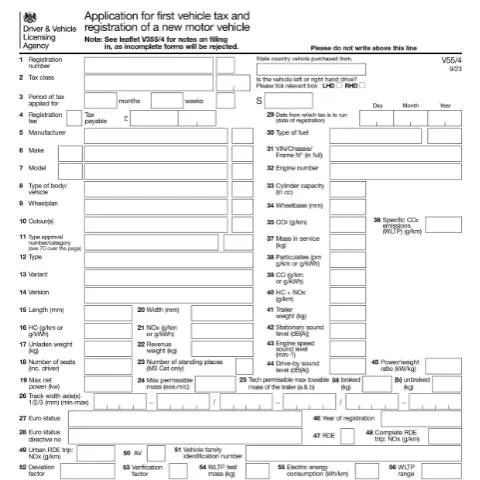
The Dual Gateway: First Registration and Taxation Combined
When purchasing a new motor vehicle in the UK, owners face a crucial administrative milestone that combines two essential processes into a single application. The V55/4 form serves as the gateway to both vehicle registration and first taxation, establishing the legal identity of your new car, van, or motorcycle whilst simultaneously securing the necessary road tax to drive it legally on British roads. This dual function makes it a particularly significant document in the vehicle ownership journey.
The form's comprehensive design reflects the DVLA's streamlined approach to new vehicle processing. Rather than requiring separate applications for registration and taxation, the V55/4 consolidates both requirements, capturing everything from basic vehicle specifications to complex emissions data and dealer information. This integrated system ensures that new vehicles enter the national database with complete documentation whilst their owners receive both a registration certificate and valid tax disc in a coordinated process.
The timing of this application proves critical for new vehicle owners. Unlike used vehicle transactions where registration already exists, first registration creates the vehicle's official identity within the UK system. The tax element becomes immediately active, with the chosen period determining when renewal will next be required. This makes the V55/4 distinctly different from standard vehicle tax renewals or V5C registration updates.
Technical Specifications and Vehicle Identification
The V55/4 form demands extensive technical detail that establishes the vehicle's official characteristics within DVLA records. The manufacturer, make, and model fields require precise matching with official designations, as any discrepancies can delay processing or result in rejection. The Vehicle Identification Number (VIN) or chassis frame number serves as the unique identifier, linking the physical vehicle to its documentary record permanently.
Engine specifications receive particular attention, with separate fields for engine number, cylinder capacity measured in cubic centimetres, and fuel type. These details determine not only the vehicle's tax classification but also its environmental impact ratings. The form captures CO2 emissions in grams per kilometre, a figure that directly influences the annual taxation rate under current environmental policies.
| Vehicle Category | Key Specification Requirements | Additional Documentation |
|---|---|---|
| Private Cars | CO2 emissions, engine capacity, fuel type | European Certificate of Conformity |
| Motorcycles | Engine capacity, power output, weight | Type approval documentation |
| Commercial Vehicles | Revenue weight, axle configuration, body type | Plating certificate if applicable |
| Specialist Vehicles | Individual Vehicle Approval details | IVA test certificate |
Physical dimensions including length, width, wheelbase, and various weight measurements populate the form's technical section. For commercial vehicles, revenue weight and maximum permissible mass become crucial for determining appropriate taxation bands. The form distinguishes between unladen weight and various load configurations, reflecting the complex regulations governing commercial vehicle taxation.
Environmental data extends beyond basic CO2 figures to include NOx emissions, particulate matter, and other pollutants measured during type approval testing. These measurements determine compliance with current emission standards and influence both taxation rates and potential access restrictions in low emission zones. The form also captures fuel consumption figures and electric vehicle energy consumption where applicable.
Dealer Information and Supply Chain Documentation
The V55/4 form establishes a clear record of the vehicle's supply chain through detailed dealer information sections. Original dealer details capture the initial point of sale, whilst selling dealer information records any intermediate transactions before first registration. This dual recording system helps DVLA track vehicle movements and ensures proper dealer accountability within the registration process.
Export and import codes become relevant for vehicles manufactured outside the UK or those destined for overseas markets. The form distinguishes between various dealer types including main dealers, independent retailers, and specialist importers, each carrying different responsibilities within the registration process. Fleet operators receive special consideration with dedicated coding that reflects their commercial status.
Keeper Details and Legal Responsibility
The registered keeper section establishes legal responsibility for the vehicle, creating obligations that extend far beyond simple ownership. The form distinguishes between individual and corporate keepers, with specific provisions for limited companies, partnerships, and other business entities. Corporate registrations require additional identification including company registration numbers and authorised signatory details.
Address information proves particularly critical as it determines where official correspondence will be sent, including renewal notices, enforcement letters, and legal documents. The form warns explicitly that V5C registration certificates may be delayed if postcode information is incomplete or incorrect. This reflects the increasing reliance on automated postal sorting systems within government administration.
Date of birth remains optional for individual keepers, though providing this information can assist with identity verification should queries arise. The form includes specific contact sections encouraging phone numbers and email addresses, recognising the DVLA's shift towards electronic communication for routine matters.
For business registrations, the form captures whether the vehicle represents a company car, fleet vehicle, or commercial asset. This classification influences both taxation treatment and the types of compliance obligations that apply. Fleet operators with multiple registrations may reference DVLA fleet numbers to streamline processing across their vehicle portfolios.
Special Circumstances and Exemptions
Certain vehicles qualify for taxation exemptions, requiring specific justification within the V55/4 application. Historic vehicles over forty years old may claim exemption from vehicle excise duty, though they must still complete the registration process. Disabled persons' vehicles, emergency service vehicles, and certain agricultural machinery receive preferential treatment under specific legislative provisions.
The form includes detailed questions regarding goods vehicles exceeding 3,500kg revenue weight, reflecting the complex regulations governing heavy commercial vehicles. Operators must specify intended use patterns, trailer configurations, and compliance with various weight restrictions that influence both taxation and operational permissions.
Tax Classification and Payment Structures
Vehicle taxation represents a significant component of the V55/4 process, with classification determining both initial costs and ongoing obligations. The form requires careful selection of tax class, with private light goods vehicles, motorcycles, and various commercial categories each carrying different rate structures. Misclassification can result in incorrect taxation or even legal complications if the vehicle is subsequently used outside its registered category.
The taxation period selection offers flexibility between six-month and twelve-month initial periods, though annual taxation typically provides better value. Payment accompanies the application, with the amount determined by the vehicle's environmental rating, engine capacity, or weight classification depending on category. Electric and ultra-low emission vehicles benefit from preferential rates reflecting government environmental policies.
For commercial vehicles, taxation calculations become more complex, incorporating revenue weight, axle configurations, and intended use patterns. The form captures whether vehicles will operate under various weight restrictions, pull trailers, or carry specific types of cargo that influence their tax obligations. Seasonal taxation options may apply to certain vehicle types with limited operational periods.
Processing Timeline and Administrative Handling
The DVLA processes V55/4 applications through specialised channels designed for new vehicle registrations. Processing typically takes longer than standard renewals due to the comprehensive verification required for first registrations. Technical specifications must be validated against type approval records, dealer credentials verified, and taxation calculations confirmed before registration numbers are assigned.
Applications submitted with complete documentation generally process within standard timeframes, though complex cases involving imported vehicles, specialist conversions, or unusual configurations may require additional scrutiny. The form's warning about incomplete submissions being rejected reflects the DVLA's systematic approach to data quality and the importance of accurate initial registration.
Electronic submission options may be available through registered dealer portals, though private individuals typically submit paper applications. The form includes specific guidance about signature requirements, with particular attention to corporate applications where authorised signatory status must be clearly established.
Supporting Documentation and Evidence Requirements
The V55/4 application requires substantial supporting documentation that validates both the vehicle's specifications and the applicant's entitlement to register it. European Certificates of Conformity serve as primary evidence for vehicles meeting EU type approval standards, containing detailed technical specifications that must match the form's entries precisely.
For vehicles without standard type approval, Individual Vehicle Approval certificates or other specialist documentation becomes necessary. Imported vehicles may require additional customs clearance documents, whilst converted or modified vehicles need evidence of their alterations and continued compliance with construction regulations.
Purchase documentation establishes the applicant's legal right to register the vehicle, though the form accommodates various acquisition methods including hire purchase agreements, lease arrangements, and corporate fleet acquisitions. Insurance evidence, whilst not explicitly required with the V55/4, becomes practically necessary as registration without valid insurance coverage creates legal complications.
Age-related exemptions require supporting evidence of the vehicle's manufacture date, often through heritage certificates or manufacturer documentation. Military vehicles, emergency service conversions, and other specialist applications need additional certification confirming their status and entitlement to preferential treatment.
Quality Control and Verification Processes
The DVLA employs systematic verification procedures for V55/4 applications, cross-referencing submitted information against multiple databases and official records. Technical specifications undergo comparison with type approval records, whilst dealer information is validated against registered trader databases. Any inconsistencies trigger additional scrutiny that can significantly extend processing times.
Vehicle identification numbers receive particular attention, with checks against theft databases, previous registration records, and manufacturer allocation systems. This comprehensive verification helps prevent fraudulent registrations and ensures the integrity of the national vehicle database.
Post-Application Procedures and Document Receipt
Following successful processing, applicants receive both registration certificates and tax confirmation as separate documents. The V5C registration certificate establishes the vehicle's official identity and the keeper's legal status, whilst tax confirmation provides evidence of payment and validity period. These documents arrive through different postal channels, reflecting their distinct administrative functions.
Registration numbers assigned during processing become permanent identifiers, though personalised number plate transfers remain possible through subsequent applications. The initial registration creates baseline records that influence all future transactions, making accuracy during the V55/4 process particularly important for long-term administration.
Tax validity begins from the registration date specified in the application, creating immediate legal authority to use the vehicle on public roads. However, keepers must ensure insurance coverage aligns with registration timing to avoid gaps in legal compliance. The tax period selected determines when renewal obligations commence, with DVLA sending reminder notices to the registered address.
Should processing reveal errors or inconsistencies, the DVLA contacts applicants using the details provided in section 69 of the form. Resolution typically requires additional documentation or clarification, potentially extending the registration timeline. This underscores the importance of providing accurate contact information and responding promptly to any official correspondence.
The completed registration establishes ongoing obligations including annual tax renewals, notification of address changes, and compliance with various regulatory requirements. The V55/4 process thus represents not merely an administrative formality, but the foundation for the entire legal relationship between keeper, vehicle, and state that will continue throughout the vehicle's operational life.
Complex Registration Scenarios and Documentation Requirements
Certain vehicle registration situations demand additional scrutiny and documentation beyond the standard V55/4 process. Understanding these complexities helps avoid delays and ensures your application progresses smoothly through DVLA's verification procedures.
Kit Cars and Substantially Modified Vehicles
If you're registering a kit car or a vehicle that's been substantially modified from its original specification, the V55/4 process becomes considerably more involved. DVLA requires extensive evidence to establish the vehicle's age, construction standards, and compliance with relevant regulations.
For kit cars built from components of different ages, you'll need to provide detailed documentation showing the age of major components including the engine, chassis, and transmission. The vehicle's age for registration purposes typically follows the age of the newest major component, which affects both the registration prefix and applicable safety standards.
Substantially modified vehicles—those where modifications affect the vehicle's structural integrity, emissions, or safety systems—require additional engineering reports. These must come from appropriately qualified engineers and demonstrate compliance with Construction and Use Regulations. Common modifications requiring special attention include engine swaps, significant bodywork alterations, or changes to suspension geometry that affect the vehicle's handling characteristics.
Import Documentation and Customs Clearance
Vehicles imported from outside the UK present unique documentation challenges that extend well beyond the standard V55/4 requirements. The complexity varies significantly depending on the vehicle's country of origin, age, and intended use.
For vehicles imported from EU countries, you'll need to provide evidence of VAT payment or exemption status. This typically involves customs documentation showing the vehicle cleared UK customs properly. Vehicles imported under personal transfer arrangements may qualify for VAT relief, but this requires specific evidence of previous ownership and usage patterns.
Non-EU imports face additional hurdles, particularly regarding type approval and emissions compliance. Vehicles not meeting European type approval standards may require Individual Vehicle Approval (IVA) testing before registration becomes possible. This testing covers safety, environmental, and security aspects, and failure means the vehicle cannot be registered for road use.
Military vehicles present particularly complex scenarios. Ex-military vehicles often lack standard civilian documentation and may require specialist engineering assessments to determine their suitability for civilian road use. Some military vehicles may be exempt from certain civilian standards but must still meet basic safety requirements for registration.
Understanding DVLA Processing Timelines and Expedited Services
DVLA processing times for V55/4 applications vary considerably based on application complexity, seasonal demand, and the completeness of submitted documentation. Understanding these variations helps set realistic expectations and plan accordingly.
Standard Processing Expectations
Straightforward V55/4 applications for new vehicles from main dealers typically process within five to seven working days during normal periods. However, this timeline assumes all documentation is correct and complete, including proper dealer certification and valid insurance evidence.
Applications submitted during peak periods—particularly around March and September when new registration plates are released—may experience significantly longer processing times. DVLA receives substantially higher application volumes during these months, potentially extending processing to two to three weeks even for routine applications.
Complex applications involving imports, kit cars, or vehicles requiring additional verification can take considerably longer. DVLA may need to consult external databases, request additional documentation, or seek specialist technical advice. In such cases, processing times of four to six weeks are not uncommon, and more complex scenarios may take even longer.
Factors Affecting Processing Speed
Several factors significantly influence how quickly DVLA processes your V55/4 application. Incomplete or incorrect documentation is the primary cause of delays, as DVLA must return applications for correction or request additional information.
Insurance verification presents a common bottleneck. If DVLA cannot verify your insurance details through their electronic systems, they may request additional evidence or contact your insurer directly. This process can add several days to processing times, particularly if your insurer takes time to respond to DVLA queries.
Vehicle identification number (VIN) verification issues can cause significant delays. If DVLA's systems cannot verify the VIN against manufacturer databases, they may require additional documentation or physical inspection. This is particularly common with imported vehicles or those from manufacturers with limited UK presence.
Address verification can also slow processing, especially for applicants who have recently moved or whose addresses don't match standard postal databases. DVLA may request additional proof of residence, such as recent utility bills or council tax statements.
Expedited Processing Options
While DVLA doesn't offer a premium processing service for V55/4 applications, certain circumstances may warrant expedited handling. Emergency services, diplomatic missions, and vehicles required for urgent commercial purposes may receive priority processing, though this requires specific evidence and prior arrangement with DVLA.
Ensuring your application is complete and accurate provides the best chance of quick processing. Double-checking all documentation, ensuring insurance is active and verifiable, and providing clear, legible copies of all supporting documents significantly reduces the likelihood of delays.
Post-Registration Responsibilities and Ongoing Compliance
Successfully completing the V55/4 process and receiving your registration certificate marks the beginning, not the end, of your responsibilities as a registered vehicle keeper in the UK. Understanding these ongoing obligations helps maintain compliance and avoid potential penalties.
Vehicle Tax and SORN Obligations
Once registered, your vehicle immediately becomes subject to vehicle tax obligations, regardless of whether you intend to use it on public roads. The tax class assigned during registration determines your ongoing tax liability, which may be annual or six-monthly depending on your preference and the vehicle type.
If you're not using the vehicle on public roads, you must declare it off-road by submitting a Statutory Off Road Notification (SORN). This declaration must be made before the vehicle tax expires and renewed annually while the vehicle remains off-road. Failure to maintain either valid tax or a current SORN can result in automatic penalties.
Electric vehicles currently qualify for zero-rate vehicle tax but still require annual tax renewal. This requirement may change as government policy evolves, so staying informed about tax obligations remains important even for zero-emission vehicles.
Insurance and MOT Requirements
Continuous insurance requirements apply from the moment your vehicle is registered, regardless of whether it's being used. The Motor Insurance Database must show valid insurance for your vehicle at all times unless it's officially declared off-road with a SORN.
MOT requirements begin three years after the vehicle's first registration date for most vehicle types. However, certain commercial vehicles and those used for specific purposes may have different MOT timing requirements. Planning for this obligation early helps ensure compliance when the time comes.
Some vehicle modifications made after registration may affect MOT requirements or insurance validity. Significant modifications should be declared to both DVLA and your insurer to maintain proper coverage and compliance.
Address Changes and Keeper Transfers
DVLA must be notified of address changes within specific timeframes to maintain accurate records. Failure to update your address can result in missed correspondence about tax renewals, penalties, or other important notifications.
When selling or transferring your vehicle, proper completion of the V5C logbook is essential. Both the new and previous keepers have specific responsibilities in this process, and incorrect completion can lead to ongoing liability for vehicle tax and penalties.
Understanding these post-registration responsibilities from the outset helps maintain compliance throughout your vehicle ownership and ensures a smooth experience with DVLA's systems and requirements.