When Public Service Vehicles Must Prove Their Accessibility Standards
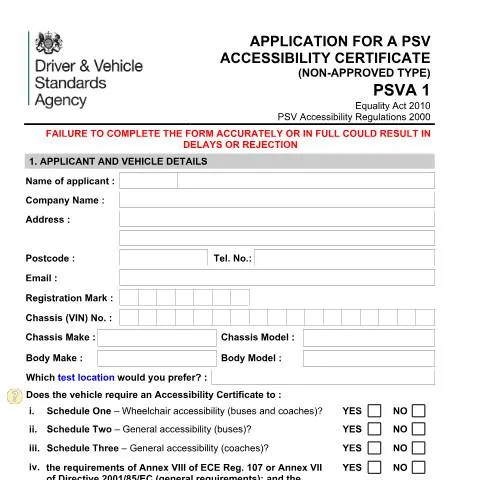
Operating a public service vehicle in the UK requires more than just a standard vehicle inspection. Buses and coaches carrying passengers must demonstrate compliance with stringent accessibility regulations designed to ensure equal access for all users, including those with disabilities. The PSVA 1 form, administered by the Driver and Vehicle Standards Agency, serves as the gateway to obtaining an accessibility certificate for non-approved type vehicles that haven't undergone standard type approval processes.
This certificate isn't merely bureaucratic paperwork—it represents legal compliance with the Equality Act 2010 and the PSV Accessibility Regulations 2000. Without it, operators face significant legal and operational consequences, from prosecution to insurance invalidation. The assessment process examines everything from wheelchair accessibility features to destination equipment, ensuring vehicles meet the exacting standards required for public passenger transport.
Understanding the Three Schedules of Accessibility Compliance
The accessibility certificate system operates through three distinct schedules, each targeting specific vehicle types and accessibility requirements. Understanding which schedule applies to your vehicle determines the entire certification pathway.
Schedule One: Wheelchair Accessibility for Buses and Coaches
Schedule One addresses the most comprehensive accessibility requirements, covering both buses and coaches that must accommodate wheelchair users. This includes provisions for wheelchair spaces, securing systems, boarding equipment, and internal circulation areas. Vehicles seeking Schedule One certification undergo the most rigorous assessment, examining both the physical adaptations and their integration with the vehicle's overall design.
Schedule Two: General Accessibility for Buses
Bus operators typically encounter Schedule Two requirements, which focus on general accessibility features beyond wheelchair accommodation. This encompasses visual and audible information systems, handrails and grab poles, colour contrast requirements, and lighting standards. The assessment verifies that buses provide safe, accessible transport for passengers with various mobility challenges, not exclusively wheelchair users.
Schedule Three: General Accessibility for Coaches
Schedule Three applies specifically to coaches, recognising their different operational context compared to buses. While maintaining accessibility standards, the requirements acknowledge coaches' longer-distance travel patterns and different passenger flow dynamics. The certification process evaluates features like accessible seating arrangements, information systems, and boarding assistance capabilities.
| Schedule Type | Vehicle Category | Primary Focus | Key Requirements |
|---|---|---|---|
| Schedule One | Buses & Coaches | Wheelchair Accessibility | Wheelchair spaces, lifts, ramps, securing systems |
| Schedule Two | Buses | General Accessibility | Information systems, handrails, lighting, colour contrast |
| Schedule Three | Coaches | General Accessibility | Accessible seating, boarding assistance, information systems |
European Regulation Compliance: ECE 107 and Directive 2001/85/EC
The PSVA 1 application includes provisions for vehicles already meeting European standards, specifically ECE Regulation 107 or Directive 2001/85/EC. These represent significant compliance pathways that can streamline the UK certification process.
Vehicles approved under ECE Regulation 107's Annex VIII or Directive 2001/85/EC's Annex VII already meet substantial accessibility requirements. However, they must still demonstrate compliance with UK-specific destination equipment regulations. This creates two distinct certification routes:
- Full Assessment Route: Vehicles requiring both general accessibility compliance and destination equipment verification
- Destination Equipment Only Route: Vehicles with existing European approval needing only UK destination equipment certification
The fee structure reflects this distinction, with destination-equipment-only assessments charged at the single-schedule rate, while combined assessments incur double-schedule fees. Applicants must provide their vehicle's Certificate of Conformity to qualify for the streamlined route.
Detailed Vehicle Modification Documentation Requirements
The PSVA 1 form demands comprehensive documentation of accessibility-related modifications. This isn't simply listing installed equipment—operators must demonstrate how modifications integrate with the vehicle's original design and capacity calculations.
Wheelchair Accommodation Systems
Wheelchair accessibility modifications require detailed specification of both restrained and unrestrained wheelchair positions. Restrained positions include securing systems that hold wheelchairs during transit, while unrestrained positions accommodate wheelchairs without additional securing mechanisms. Each type affects passenger capacity calculations differently and requires separate documentation.
Boarding equipment specifications must distinguish between power-operated lifts, power-operated ramps, and portable ramps. Each system type undergoes different assessment criteria, with power-operated equipment requiring additional safety system verification and maintenance protocols.
Capacity Recalculation Following Modifications
Accessibility modifications invariably affect passenger capacity, requiring careful recalculation across multiple scenarios:
- Upper deck capacity (for double-deck vehicles)
- Lower deck capacity without wheelchair positions occupied
- Lower deck capacity with all wheelchair positions in use
- Standing passenger allowances
- Crew seating arrangements
These calculations must account for circulation spaces, emergency evacuation routes, and accessibility compliance requirements. Incorrect capacity declarations can invalidate insurance coverage and operating licences.
Special Vehicle Features Affecting Stability and Safety Assessment
The DVSA assessment extends beyond accessibility features to evaluate how modifications interact with vehicle stability and safety systems. This holistic approach ensures accessibility improvements don't compromise passenger safety.
Air Conditioning and Weight Distribution
Air conditioning systems require location specification because they affect weight distribution and structural loading. Roof-mounted units alter the vehicle's centre of gravity, while rear-mounted systems affect axle loading. The assessment verifies that accessibility modifications haven't compromised the vehicle's stability margins established by the manufacturer.
Braking and Retarding Systems
Retarder systems—auxiliary braking devices that reduce wear on service brakes—require specification because accessibility modifications can affect braking performance. Additional passenger equipment, wheelchair securing systems, and boarding apparatus add weight that influences braking distances and retarder effectiveness.
The assessment evaluates whether existing braking systems remain adequate following modifications, or whether upgrades are necessary to maintain safety standards.
Physical Dimension Verification and Structural Integrity
Accessibility modifications often alter vehicle dimensions, requiring updated measurements for regulatory compliance and operational planning. The PSVA 1 form captures three critical dimensions:
| Dimension | Measurement Unit | Significance |
|---|---|---|
| Maximum Length | Centimetres | Route planning, depot access, legal limits |
| Maximum Height | Centimetres | Bridge clearances, depot compatibility |
| Wheelbase | Centimetres | Manoeuvrability, stability calculations |
Height modifications frequently result from wheelchair lift installations or accessible seating arrangements. Even minor increases can affect route compatibility, particularly on services using low bridges or covered bus stations. Length modifications, while less common, can occur with extended wheelchair accommodation areas or additional boarding equipment.
Payment Methods and Administrative Processing
The DVSA offers multiple payment options designed to accommodate different operator preferences and administrative systems. Understanding these options helps ensure smooth application processing without delays caused by payment complications.
Traditional Payment Methods
Postal applications accept cheques and postal orders made payable to "Driver and Vehicle Standards Agency" or "DVSA". While traditional, these methods can extend processing times due to manual handling and clearing periods. Operators choosing this route should factor additional processing time into their planning.
Credit and debit card payments offer greater convenience but require a two-stage process. After receiving the postal application, the DVSA contacts applicants via email with card payment instructions. This system prevents card details being transmitted through postal services while maintaining payment security.
Pre-Funded Customer Accounts
Regular users of DVSA services can establish pre-funded customer accounts, significantly streamlining the payment process. These accounts require authorised delegates who can approve expenditure on behalf of the organisation. The delegate signing the PSVA 1 form must hold proper authorisation to use the account.
Pre-funded accounts offer the fastest processing times because payments are immediate and don't require manual intervention. For operators managing multiple vehicles or frequent applications, this system provides substantial administrative benefits.
Legal Declarations and Compliance Commitments
The PSVA 1 form concludes with legally binding declarations that extend beyond simple form completion. Signatories commit to specific compliance standards and examination conditions that carry legal consequences if breached.
The primary declaration confirms that vehicles will be built according to required standards contained in relevant Construction and Use of Vehicles (COIF) regulations and Accessibility Regulations. This isn't merely stating current compliance—it's a commitment to maintain standards throughout the certification process.
Additionally, signatories confirm that examination conditions will be met at the appointed time. These conditions, detailed in the appointment letter received after application processing, may include specific preparation requirements, documentation availability, or vehicle presentation standards.
Data protection compliance under the Data Protection Act 2018 and UK GDPR governs how the DVSA processes personal information contained in applications. The agency may share data for legitimate purposes including criminal investigations and fraud prevention, requiring applicants to understand these potential disclosure scenarios.
Electronic applications accept typed signatures as legally valid, reflecting modern business practices while maintaining legal enforceability. However, all declaration sections must be completed—partial declarations invalidate the entire application regardless of payment method or supporting documentation quality.
HTML:When Public Service Vehicles Must Prove Their Accessibility Standards
Operating a public service vehicle in the UK requires more than just a standard vehicle inspection. Buses and coaches carrying passengers must demonstrate compliance with stringent accessibility regulations designed to ensure equal access for all users, including those with disabilities. The PSVA 1 form, administered by the Driver and Vehicle Standards Agency, serves as the gateway to obtaining an accessibility certificate for non-approved type vehicles that haven't undergone standard type approval processes.
This certificate isn't merely bureaucratic paperwork—it represents legal compliance with the Equality Act 2010 and the PSV Accessibility Regulations 2000. Without it, operators face significant legal and operational consequences, from prosecution to insurance invalidation. The assessment process examines everything from wheelchair accessibility features to destination equipment, ensuring vehicles meet the exacting standards required for public passenger transport.
Understanding the Three Schedules of Accessibility Compliance
The accessibility certificate system operates through three distinct schedules, each targeting specific vehicle types and accessibility requirements. Understanding which schedule applies to your vehicle determines the entire certification pathway.
Schedule One: Wheelchair Accessibility for Buses and Coaches
Schedule One addresses the most comprehensive accessibility requirements, covering both buses and coaches that must accommodate wheelchair users. This includes provisions for wheelchair spaces, securing systems, boarding equipment, and internal circulation areas. Vehicles seeking Schedule One certification undergo the most rigorous assessment, examining both the physical adaptations and their integration with the vehicle's overall design.
Schedule Two: General Accessibility for Buses
Bus operators typically encounter Schedule Two requirements, which focus on general accessibility features beyond wheelchair accommodation. This encompasses visual and audible information systems, handrails and grab poles, colour contrast requirements, and lighting standards. The assessment verifies that buses provide safe, accessible transport for passengers with various mobility challenges, not exclusively wheelchair users.
Schedule Three: General Accessibility for Coaches
Schedule Three applies specifically to coaches, recognising their different operational context compared to buses. While maintaining accessibility standards, the requirements acknowledge coaches' longer-distance travel patterns and different passenger flow dynamics. The certification process evaluates features like accessible seating arrangements, information systems, and boarding assistance capabilities.
| Schedule Type | Vehicle Category | Primary Focus | Key Requirements |
|---|---|---|---|
| Schedule One | Buses & Coaches | Wheelchair Accessibility | Wheelchair spaces, lifts, ramps, securing systems |
| Schedule Two | Buses | General Accessibility | Information systems, handrails, lighting, colour contrast |
| Schedule Three | Coaches | General Accessibility | Accessible seating, boarding assistance, information systems |
European Regulation Compliance: ECE 107 and Directive 2001/85/EC
The PSVA 1 application includes provisions for vehicles already meeting European standards, specifically ECE Regulation 107 or Directive 2001/85/EC. These represent significant compliance pathways that can streamline the UK certification process.
Vehicles approved under ECE Regulation 107's Annex VIII or Directive 2001/85/EC's Annex VII already meet substantial accessibility requirements. However, they must still demonstrate compliance with UK-specific destination equipment regulations. This creates two distinct certification routes:
- Full Assessment Route: Vehicles requiring both general accessibility compliance and destination equipment verification
- Destination Equipment Only Route: Vehicles with existing European approval needing only UK destination equipment certification
The fee structure reflects this distinction, with destination-equipment-only assessments charged at the single-schedule rate, while combined assessments incur double-schedule fees. Applicants must provide their vehicle's Certificate of Conformity to qualify for the streamlined route.
Detailed Vehicle Modification Documentation Requirements
The PSVA 1 form demands comprehensive documentation of accessibility-related modifications. This isn't simply listing installed equipment—operators must demonstrate how modifications integrate with the vehicle's original design and capacity calculations.
Wheelchair Accommodation Systems
Wheelchair accessibility modifications require detailed specification of both restrained and unrestrained wheelchair positions. Restrained positions include securing systems that hold wheelchairs during transit, while unrestrained positions accommodate wheelchairs without additional securing mechanisms. Each type affects passenger capacity calculations differently and requires separate documentation.
Boarding equipment specifications must distinguish between power-operated lifts, power-operated ramps, and portable ramps. Each system type undergoes different assessment criteria, with power-operated equipment requiring additional safety system verification and maintenance protocols.
Capacity Recalculation Following Modifications
Accessibility modifications invariably affect passenger capacity, requiring careful recalculation across multiple scenarios:
- Upper deck capacity (for double-deck vehicles)
- Lower deck capacity without wheelchair positions occupied
- Lower deck capacity with all wheelchair positions in use
- Standing passenger allowances
- Crew seating arrangements
These calculations must account for circulation spaces, emergency evacuation routes, and accessibility compliance requirements. Incorrect capacity declarations can invalidate insurance coverage and operating licences.
Special Vehicle Features Affecting Stability and Safety Assessment
The DVSA assessment extends beyond accessibility features to evaluate how modifications interact with vehicle stability and safety systems. This holistic approach ensures accessibility improvements don't compromise passenger safety.
Air Conditioning and Weight Distribution
Air conditioning systems require location specification because they affect weight distribution and structural loading. Roof-mounted units alter the vehicle's centre of gravity, while rear-mounted systems affect axle loading. The assessment verifies that accessibility modifications haven't compromised the vehicle's stability margins established by the manufacturer.
Braking and Retarding Systems
Retarder systems—auxiliary braking devices that reduce wear on service brakes—require specification because accessibility modifications can affect braking performance. Additional passenger equipment, wheelchair securing systems, and boarding apparatus add weight that influences braking distances and retarder effectiveness.
The assessment evaluates whether existing braking systems remain adequate following modifications, or whether upgrades are necessary to maintain safety standards.
Physical Dimension Verification and Structural Integrity
Accessibility modifications often alter vehicle dimensions, requiring updated measurements for regulatory compliance and operational planning. The PSVA 1 form captures three critical dimensions:
| Dimension | Measurement Unit | Significance |
|---|---|---|
| Maximum Length | Centimetres | Route planning, depot access, legal limits |
| Maximum Height | Centimetres | Bridge clearances, depot compatibility |
| Wheelbase | Centimetres | Manoeuvrability, stability calculations |
Height modifications frequently result from wheelchair lift installations or accessible seating arrangements. Even minor increases can affect route compatibility, particularly on services using low bridges or covered bus stations. Length modifications, while less common, can occur with extended wheelchair accommodation areas or additional boarding equipment.
Payment Methods and Administrative Processing
The DVSA offers multiple payment options designed to accommodate different operator preferences and administrative systems. Understanding these options helps ensure smooth application processing without delays caused by payment complications.
Traditional Payment Methods
Postal applications accept cheques and postal orders made payable to "Driver and Vehicle Standards Agency" or "DVSA". While traditional, these methods can extend processing times due to manual handling and clearing periods. Operators choosing this route should factor additional processing time into their planning.
Credit and debit card payments offer greater convenience but require a two-stage process. After receiving the postal application, the DVSA contacts applicants via email with card payment instructions. This system prevents card details being transmitted through postal services while maintaining payment security.
Pre-Funded Customer Accounts
Regular users of DVSA services can establish pre-funded customer accounts, significantly streamlining the payment process. These accounts require authorised delegates who can approve expenditure on behalf of the organisation. The delegate signing the PSVA 1 form must hold proper authorisation to use the account.
Pre-funded accounts offer the fastest processing times because payments are immediate and don't require manual intervention. For operators managing multiple vehicles or frequent applications, this system provides substantial administrative benefits.
Legal Declarations and Compliance Commitments
The PSVA 1 form concludes with legally binding declarations that extend beyond simple form completion. Signatories commit to specific compliance standards and examination conditions that carry legal consequences if breached.
The primary declaration confirms that vehicles will be built according to required standards contained in relevant Construction and Use of Vehicles (COIF) regulations and Accessibility Regulations. This isn't merely stating current compliance—it's a commitment to maintain standards throughout the certification process.
Additionally, signatories confirm that examination conditions will be met at the appointed time. These conditions, detailed in the appointment letter received after application processing, may include specific preparation requirements, documentation availability, or vehicle presentation standards.
Data protection compliance under the Data Protection Act 2018 and UK GDPR governs how the DVSA processes personal information contained in applications. The agency may share data for legitimate purposes including criminal investigations and fraud prevention, requiring applicants to understand these potential disclosure scenarios.
Electronic applications accept typed signatures as legally valid, reflecting modern business practices while maintaining legal enforceability. However, all declaration sections must be completed—partial declarations invalidate the entire application regardless of payment method or supporting documentation quality.