Understanding the PSV Accessibility Certificate: A Comprehensive Guide
In the realm of public transport, ensuring accessibility for all users is paramount. The Public Service Vehicle (PSV) Accessibility Certificate stands as a vital document that signifies a vehicle’s compliance with established accessibility regulations. For operators of buses and coaches, obtaining this certificate from the Driver and Vehicle Standards Agency (DVSA) is essential not only for legal compliance but also for facilitating inclusive transportation. This guide delves into the nuances of obtaining this certificate, its implications, and the critical role it plays in promoting accessibility.
Navigating Eligibility and Application Process
Before embarking on the journey to acquire a PSV Accessibility Certificate, it’s essential to ascertain who is eligible to apply. The application must be submitted by an individual authorised on behalf of the vehicle's manufacturer or converter. This requirement ensures that the person applying has the requisite knowledge about the vehicle's specifications and compliance.
Who Can Apply?
- Manufacturers: Entities that produce vehicles designed for public transport.
- Converters: Companies that modify existing vehicles to meet accessibility criteria.
- Fleet Operators: While not the primary applicant, operators must ensure that their vehicles possess valid certificates.
Key Conditions for Application
To initiate the application, you must meet the following conditions:- The vehicle must conform to the technical specifications as outlined in the PSV Accessibility Regulations 2000.
- A completed application form PSVA 6 must be submitted to the DVSA.
- The vehicle should be either registered or the registration date must be indicated as “N/A” if applicable.
The Application Document: PSVA 6 Form
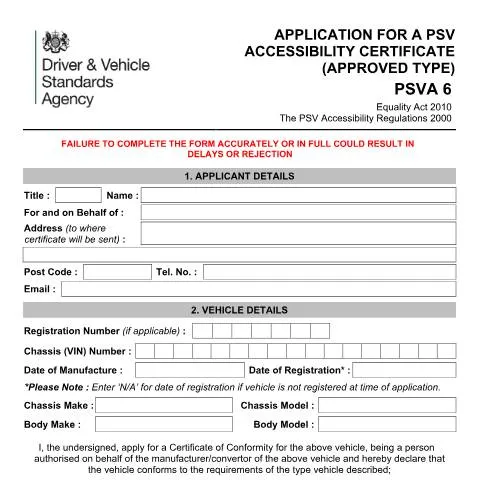
The core of the application process revolves around the PSVA 6 form, which is designed to capture essential details of both the applicant and the vehicle. Completing this form accurately is crucial, as inaccuracies can lead to delays or even rejection of the application.
Essential Sections of PSVA 6
- Applicant Details: This section requires the applicant's name, contact information, and their position within the manufacturing or converting company.
- Vehicle Details: Information such as registration number, chassis number, date of manufacture, and vehicle make and model must be included.
- Declaration: The applicant must certify that the vehicle adheres to all necessary regulations.
- Payment Information: This outlines the payment method, including options for postal applications.
Payment Options and Fees
Depending on the method chosen for the application, the payment for the PSV Accessibility Certificate can be made through various channels. Understanding these options can facilitate a smoother application experience.
| Payment Method | Details |
|---|---|
| Cheque/Post Order | Payable to ‘Driver and Vehicle Standards Agency’ and accepted only with postal applications. |
| Credit/Debit Card | Payment instructions will be provided via email once the application is received. |
| DVSA Pre-Funded Customer Account | An efficient choice for regular users of the scheme; must be an authorised delegate. |
Legal Implications of the Certificate
The PSV Accessibility Certificate is not merely a formality; it carries significant legal weight. By obtaining this certificate, the operator confirms that their vehicle meets all legislative requirements stipulated under the Equality Act 2010 and the PSV Accessibility Regulations 2000.
What the Certificate Attests
- Compliance: Confirms the vehicle meets all necessary accessibility features as legislated.
- Legal Assurance: Provides protection against potential legal actions related to accessibility issues.
- Operational Validity: Essential for ensuring that vehicles are roadworthy and licensed for public transport.
Validity and Renewal of the PSV Accessibility Certificate
Once issued, the PSV Accessibility Certificate remains valid as long as the vehicle continues to comply with the standards set out in the regulations. However, there are conditions under which renewal or reassessment may be necessary.
Duration of Validity
The certificate does not have a fixed expiration date; however, it is advisable for operators to regularly review compliance with accessibility standards as part of their operational practices.Renewal Process
Should there be any modifications to the vehicle or a change in regulations, a new application might be necessary. The steps include:- Review and ensure the vehicle still complies with the current accessibility standards.
- Complete a new PSVA 6 application form.
- Submit the form along with payment to the DVSA.
Addressing Issues: Loss, Errors, or Controversies
While the aim is to maintain a seamless application process, issues can arise. Understanding how to address these issues is vital for stakeholders.
What to Do in Case of Loss
If the PSV Accessibility Certificate is lost, the following steps should be taken:- Contact the DVSA's Customer Service Centre immediately.
- Request a reissuance of the certificate, providing details of the original application.
Rectifying Errors in the Certificate
Errors can occur during the application process. In such cases:- Contact the DVSA with documentation of the error.
- Provide any necessary supporting evidence to correct the information.
Disputing a Decision
If an application is rejected, the applicant has the right to appeal. The steps include:- Request a detailed explanation for the rejection.
- Gather supporting documentation that addresses the points raised by the DVSA.
- Submit an appeal within the stipulated timeframe.
Conclusion: The Importance of Compliance and Accessibility
The PSV Accessibility Certificate represents a commitment to inclusivity in public transportation. For operators, ensuring that their vehicles comply with the relevant regulations is not just a legal requirement; it reflects a broader responsibility towards the community. By understanding the application process, the legal implications, and addressing potential issues, operators can ensure that they contribute positively towards making public transport accessible to all. As the UK continues to prioritize accessibility, the role of certifications like the PSV Accessibility Certificate will remain crucial in shaping an inclusive future.
Understanding the Importance of Type Approval for Public Service Vehicles
Type approval for public service vehicles (PSVs) is not merely a bureaucratic step; it plays a vital role in ensuring that these vehicles are safe, accessible, and meet specific environmental standards. The importance of this certification is particularly evident in the light of UK regulations, which emphasize the need for PSVs to comply with accessibility rules as outlined in the Equality Act 2010. The type approval process helps to confirm that vehicles are equipped to accommodate individuals with disabilities, including features like low floors, designated wheelchair spaces, and audio-visual aids.
Moreover, the type approval certificate serves as an essential document for operators in demonstrating compliance with local regulations. Failure to obtain or renew this certificate can result in penalties and may hinder the operator's ability to secure contracts or grants aimed at providing accessible transport services. Therefore, understanding the various components of type approval and actively engaging in the process is crucial for any PSV operator seeking to enhance their service offerings.
Step-by-Step Process for Obtaining a Type Approval Certificate
Acquiring a type approval certificate entails several steps that operators must navigate carefully to ensure compliance. Here’s a detailed breakdown of the process:
- Identify the Appropriate Type Approval Scheme: There are various schemes under which PSVs can gain approval, such as the European Whole Vehicle Type Approval (EWVTA) or the UK National Type Approval Scheme. Operators should select the scheme that aligns with their business model and operational requirements.
- Preparation and Submission of Application: Once the appropriate scheme is identified, operators must prepare their application. This involves compiling documentation that includes vehicle specifications, design blueprints, and any existing safety certifications. Be prepared to submit this application to the relevant authority, which in most cases will be the DVSA (Driver and Vehicle Standards Agency).
- Vehicle Testing: Following the submission, the vehicle will undergo a series of tests to evaluate its compliance with safety and accessibility standards. Tests may include examination of the braking system, emissions, and passenger accessibility features. Be ready to provide a vehicle for testing at an approved facility.
- Receiving the Type Approval Certificate: Upon successful completion of the testing phase, a type approval certificate will be issued. This document validates that the vehicle meets all regulatory requirements and is safe for public use. Keep a copy of this certificate accessible, as it may be required for inspections or audits.
Operators should note that the type approval certificate remains valid as long as the vehicle maintains compliance with the standards it was approved under. Regular checks and timely renewals are essential to ensure that any modifications made post-approval do not compromise the vehicle’s compliance.
Common Challenges Faced During the Type Approval Process
While obtaining a type approval certificate is crucial, operators often encounter various challenges throughout the process. Recognizing these challenges can help prepare operators to navigate the system more effectively.
One of the most common issues is the lack of understanding of the various regulations and requirements needed for compliance. This can lead to incomplete applications, resulting in delays or rejections. To mitigate this, it’s advisable to consult directly with the DVSA or a qualified consultant who specializes in type approval.
Another challenge is the financial implications of the testing process. Not only do operators need to cover testing fees, but they must also consider any modifications required to meet compliance standards. This can strain budgets, particularly for small operators. To address this, operators should explore grants, subsidies, or financial assistance programs aimed at supporting accessibility initiatives in public transport.
Moreover, logistical challenges may arise in coordinating vehicle availability for testing. Operators may need to manage their fleet effectively, ensuring that vehicles are not out of service for extended periods while undergoing assessments. Planning and scheduling testing during off-peak operational times can help alleviate this issue.
By anticipating these common challenges and seeking assistance when needed, PSV operators can streamline their type approval process, ensuring that they meet the necessary accessibility standards while maintaining their operational efficiency.