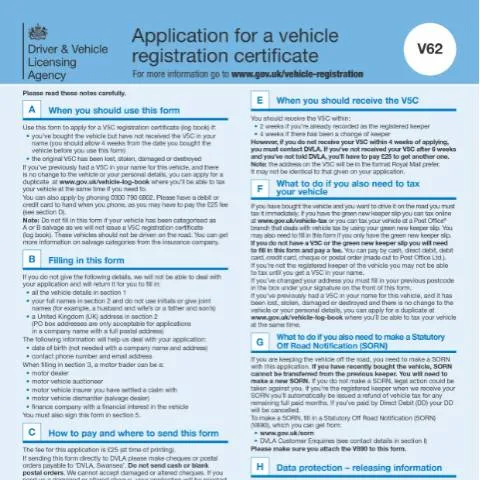
When Your V5C Registration Certificate Goes Missing: The V62 Lifeline
Picture this scenario: you've just purchased a vehicle from a private seller, handed over the cash, and driven away with nothing but a handwritten receipt and promises that "the V5C will arrive in the post". Weeks pass, and your letterbox remains stubbornly empty. Or perhaps you're the registered keeper of a vehicle whose V5C has vanished into thin air – lost during a house move, damaged in a flood, or simply mislaid in the chaos of everyday life. This is precisely when form V62 becomes your essential gateway back to legitimate vehicle ownership documentation.
The V62 application represents the Driver and Vehicle Licensing Agency's official mechanism for obtaining a replacement vehicle registration certificate when the original V5C is unavailable. Unlike the straightforward online processes available for many DVLA transactions, this particular situation demands a paper-based approach, reflecting the agency's need to verify identity and ownership claims more rigorously when original documentation has gone astray.
Navigating the Eligibility Maze: Who Can Apply and Under What Circumstances
The V62 form serves multiple scenarios, each with distinct eligibility criteria that determine both your right to apply and the supporting evidence required. Primary applicants fall into several categories, starting with individuals who have purchased a vehicle but never received the V5C registration certificate. The form explicitly states that you should allow four weeks from the date of purchase before initiating a V62 application, acknowledging the postal delays that can occur in legitimate transfers.
Current registered keepers facing lost, stolen, damaged, or destroyed V5Cs represent another major category. However, the DVLA maintains strict protocols here – if you're applying because the original has been stolen, you'll need to provide police incident numbers and potentially additional verification. The agency's systems cross-reference these details against their records to prevent fraudulent applications.
Special Circumstances and Complex Ownership Situations
Business applications require additional layers of documentation, particularly when company vehicles are involved. Fleet managers and business owners must provide company registration details, and the signatory must demonstrate authority to act on behalf of the organisation. The form accommodates both limited companies and partnerships, though each structure demands specific supporting evidence.
Motor traders occupy a unique position within the V62 framework. Licensed dealers who have purchased vehicles for resale but haven't received registration documents can apply, though they must provide their motor trader licence numbers and demonstrate legitimate business interest. Similarly, vehicle dismantlers with appropriate authorisation can apply when acquiring vehicles for salvage purposes.
| Applicant Type | Primary Requirement | Additional Evidence |
|---|---|---|
| New Purchaser | Proof of purchase within 4 weeks | Receipt, invoice, or sales agreement |
| Current Keeper | Identity verification | Driving licence or passport details |
| Business Entity | Company registration details | Authorised signatory evidence |
| Motor Trader | Valid trader licence | Business premises verification |
Decoding the £25 Fee Structure and Payment Exemptions
The standard V62 application attracts a £25 fee, payable at the time of submission. This charge reflects the administrative burden of verifying applications and issuing replacement documentation outside the normal transfer process. However, several exemption categories exist that can eliminate this cost entirely, provided you meet specific criteria and can demonstrate eligibility.
New keeper exemptions apply when you're the incoming registered keeper and the previous keeper failed to notify DVLA of the change. In these circumstances, you must provide the green new keeper slip from the original V5C, effectively proving that the transfer process was initiated but not completed through the seller's negligence rather than your own.
Insurance-Related Fee Waivers
Vehicles categorised as Category C or S (formerly Cat C and Cat S) salvage by insurance companies qualify for fee exemptions, though this applies specifically to scenarios where the insurance company has destroyed the original V5C as part of their salvage procedures. The applicant must provide evidence of the insurance settlement and salvage categorisation to qualify for this exemption.
Post Office branch applications dealing with vehicle tax transactions may also qualify for fee refunds in specific circumstances, though these typically require the branch to process the refund after DVLA verification rather than upfront exemption.
Critical Documentation Requirements and Supporting Evidence
The V62 form demands comprehensive supporting documentation that varies significantly depending on your circumstances and the reason for application. Identity verification forms the cornerstone of every application, with driving licence numbers serving as the primary identifier for UK residents. The form specifically requests your driving licence number, though it clarifies this isn't legally mandatory – however, providing it significantly expedites processing.
Vehicle identification requires multiple data points to prevent fraudulent applications. The registration number represents the obvious starting point, but you'll also need make, model, colour, and crucially, the VIN, chassis, or frame number. This latter requirement often proves challenging for applicants, as many vehicle owners don't routinely record these details. The number typically appears on the vehicle's chassis plate, door frame, or engine bay, though location varies by manufacturer.
Proof of Purchase and Ownership Claims
Recent purchasers must provide robust evidence of their transaction, going beyond simple receipts to demonstrate legitimate acquisition. Sales invoices, finance agreements, insurance documentation showing you as the policyholder, and bank transfer records all strengthen your application. The DVLA scrutinises these documents against their records and may request additional verification if discrepancies arise.
For vehicles acquired through inheritance, divorce settlements, or business transfers, the documentation requirements become more complex. Probate documents, court orders, or company dissolution papers may be necessary to establish legitimate transfer of ownership outside normal commercial transactions.
The V5C Certificate: Legal Standing and Practical Applications
The vehicle registration certificate obtained through V62 application carries identical legal weight to any V5C issued through standard processes. This document serves as prima facie evidence of your entitlement to be registered as the vehicle's keeper, though it's crucial to understand that keeper status differs from legal ownership – a distinction that frequently causes confusion among vehicle users.
Insurance companies routinely request V5C details when providing quotes or processing claims, using the registration certificate to verify vehicle specifications and keeper details. Many insurers will provide temporary cover based on other documentation, but permanent policies typically require V5C confirmation, making the V62 process essential for maintaining continuous insurance coverage.
DVLA Database Integration and Record Updates
Once processed, your V62 application triggers comprehensive database updates across multiple government systems. The new V5C reflects current keeper details as provided in your application, but also incorporates any changes in vehicle status, taxation class, or technical specifications that may have occurred since the original certificate was issued.
This database synchronisation affects vehicle tax calculations, SORN declarations, and MOT reminder systems. If you've been unable to update your address or other details due to the missing V5C, the new certificate reflects these changes immediately upon issue, potentially affecting future correspondence and legal notifications.
Processing Timelines and Expedited Alternatives
Standard V62 applications typically require two to four weeks for processing, though this timeline can extend during peak periods or when additional verification becomes necessary. The DVLA processes applications in receipt order, but complex cases involving disputed ownership, incomplete documentation, or flagged vehicles may face significant delays while investigations proceed.
Urgent applications receive no special processing priority through the V62 route, reflecting the security-focused nature of replacement certificate issues. However, if you need immediate proof of keeper status for insurance or other urgent purposes, the DVLA customer service team may provide verbal confirmation of your keeper status over the phone, though this carries limitations on what organisations will accept as valid verification.
Digital Integration and Future Developments
While the V62 remains a paper-based process, the DVLA has begun integrating digital elements into verification procedures. Online vehicle checker services now provide more comprehensive information that can support applications, and the agency's internal systems can cross-reference multiple databases to verify claims more efficiently than previously possible.
The introduction of digital driving licences and enhanced online verification systems suggests that future iterations of the V62 process may incorporate digital submission options, though the high-security nature of replacement certificate applications means paper-based verification will likely remain standard for the foreseeable future.
Taxation Implications and SORN Considerations
Obtaining a replacement V5C through V62 application can trigger immediate taxation obligations, particularly if the vehicle has been off-road without a valid SORN declaration. The new certificate enables you to make a Statutory Off Road Notification if you're keeping the vehicle off public roads, but you must act quickly to avoid accumulating vehicle tax arrears.
Recent vehicle purchasers face particular complexity here, as they may need to make SORN declarations for vehicles they intend to use on public roads, simply to establish their legal keeper status before proceeding with taxation and insurance arrangements. The V62 guidance specifically addresses this scenario, noting that SORN applications cannot be processed until keeper details are properly recorded.
If you do not make a SORN, legal action could be taken against you if you're the registered keeper when the next DD payment is cancelled or Direct Debit (DD) system will be cancelled.
This warning, embedded within the V62 documentation, highlights the interconnected nature of vehicle registration, taxation, and legal compliance. The replacement certificate doesn't just restore your documentation – it reactivates your position within the entire regulatory framework governing vehicle ownership and use.
Understanding V62 Processing Times and Status Updates
The DVLA typically processes V62 applications within four to six weeks from receipt, though this timeframe can extend during peak periods or if additional verification is required. Unlike online applications that provide immediate confirmation, postal V62 submissions don't generate automatic acknowledgments, leaving applicants uncertain about processing status.
Several factors can influence processing duration. Applications requiring identity verification checks may take longer, particularly for first-time applicants or those with limited UK address history. If your supporting documents raise queries—such as unclear photocopies or insufficient proof of entitlement—the DVLA may request additional evidence, adding several weeks to the timeline.
Complex ownership situations also extend processing times. When applying for vehicles with outstanding finance agreements, the DVLA must verify details with finance companies, which can add two to three weeks. Similarly, imported vehicles requiring compliance checks or those with modified specifications may undergo additional scrutiny.
Unfortunately, the DVLA doesn't provide a direct tracking service for V62 applications. You cannot check status online or by telephone during standard processing periods. However, if your application exceeds the stated timeframe significantly—typically eight weeks or more—you can contact the DVLA customer service line on 0300 790 6802 for updates.
If you need to drive before receiving your V62, remember that you can legally drive immediately after purchasing a vehicle, provided you have valid insurance and the vehicle is roadworthy. The New Keeper Supplement (V5C/2) from the previous owner serves as temporary proof of your entitlement to drive, though this document has limitations for certain purposes like selling the vehicle or registering with some insurance providers.
V62 Rejection Scenarios and Resolution Strategies
The DVLA rejects approximately 15-20% of V62 applications due to various deficiencies, most of which are preventable with careful preparation. Understanding common rejection reasons helps avoid delays and additional fees.
Insufficient identity verification represents the leading cause of V62 rejections. The DVLA requires clear, legible copies of acceptable identity documents—not originals, which they won't return. Passport pages must show your photograph and personal details clearly, while driving licence copies should display both sides. Bank statements or utility bills serving as address proof must be recent (within three months) and show your full name matching other documents exactly.
Inadequate proof of entitlement causes frequent rejections, particularly for vehicles acquired through unconventional channels. Private sale receipts lacking essential details—seller's name, address, vehicle description, sale date, and price—won't satisfy DVLA requirements. For inherited vehicles, basic will extracts may prove insufficient; the DVLA often requires full probate documentation or letters of administration.
Applications for vehicles with outstanding finance face rejection if hire purchase or lease agreements aren't properly disclosed. The DVLA must verify your legal right to register the vehicle, which requires finance company confirmation. Attempting to circumvent this by omitting finance details will result in automatic rejection once their systems detect the encumbrance.
When your V62 application is rejected, the DVLA returns your fee along with a detailed explanation letter. This correspondence typically arrives two to three weeks after the rejection decision and outlines specific deficiencies requiring correction. You can resubmit immediately after addressing the stated issues, though you'll need to pay the full fee again.
Some rejections result from vehicle history complications that require specialist resolution. If the vehicle appears on the DVLA database with conflicting information—perhaps showing as exported, scrapped, or subject to an active police marker—standard V62 processing cannot proceed. These cases require telephone contact with DVLA specialist teams who can investigate and potentially override system blocks.
For rejected applications involving imported vehicles, additional documentation may be necessary beyond standard V62 requirements. European vehicles might need Certificate of Conformity documentation, while non-EU imports could require Individual Vehicle Approval certificates or vehicle identity checks by approved testing stations.
Special Circumstances and Alternative Registration Pathways
Certain vehicle acquisition scenarios require modified approaches to V62 applications or alternative registration pathways entirely. Understanding these special circumstances prevents inappropriate applications and potential complications.
Company vehicle transfers present unique documentation challenges when businesses dissolve, merge, or restructure. If acquiring a vehicle from a company no longer trading, standard commercial invoices may be unavailable. In such cases, you'll need evidence of the company's authority to sell—perhaps administrator appointments for insolvent businesses or board resolutions for active companies. The DVLA may request Companies House documentation confirming the selling entity's legal status.
Vehicles acquired through court proceedings—including bailiff seizures, divorce settlements, or debt recovery actions—require specialized documentation beyond typical sale evidence. Court orders must explicitly grant ownership rights, not merely possession. County Court judgments allowing vehicle seizure don't automatically confer ownership; subsequent court orders or High Court writs of execution may be necessary to establish clear title.
Kit cars and rebuilt vehicles follow distinct registration pathways that bypass standard V62 procedures. These vehicles typically require Individual Vehicle Approval (IVA) testing before DVLA registration becomes possible. The V62 form isn't appropriate for vehicles requiring age-related plates or those built from substantial component combinations. Instead, specialized application processes through DVLA's technical teams determine appropriate registration categories and requirements.
Vehicles with cherished number plates or retention certificates involve additional complexity beyond basic V62 applications. If purchasing a vehicle displaying a personal registration currently retained on certificate, you cannot simply apply for the displayed number through V62. The retention certificate holder must first assign the number to your vehicle through separate DVLA procedures, after which standard registration processes apply to both the cherished number and any replacement registration required.
Emergency services and military vehicles transitioning to civilian use require specific DVLA approval pathways. Former police cars, ambulances, or fire engines may retain specialized equipment or modifications requiring compliance verification before civilian registration. Military vehicles often lack standard civilian documentation trails, necessitating Ministry of Defence disposal certificates or specialized military release documentation.
For vehicles acquired from insurance companies following total loss settlements, the registration status may be complicated by Category A, B, S, or N damage classifications. While Category S and N vehicles can return to roads following appropriate repairs and inspections, the V62 application must acknowledge previous damage history. Insurance company disposal documentation should clearly indicate the damage category and any repair requirements completed before sale.
Agricultural and off-road vehicles entering public road use for the first time may require registration approaches beyond standard V62 procedures. These vehicles might need type approval documentation, emissions compliance certificates, or specialized safety inspections before DVLA registration becomes possible. The V62 form assumes vehicles previously held valid registrations, which may not apply to machines transitioning from purely agricultural or industrial use.