Understanding the Importance of an Authorised Testing Facility Pre-Funded Account
When operating within the transport sector in the UK, the establishment and maintenance of an Authorised Testing Facility (ATF) account is crucial for businesses that require vehicle testing services. To facilitate this, the Driver and Vehicle Standards Agency (DVSA) provides a specific form aimed at creating a pre-funded account. This account allows ATFs to make payments for testing services efficiently, thus streamlining operations and ensuring compliance with necessary regulations.
The Journey Begins: Initiating Your Application
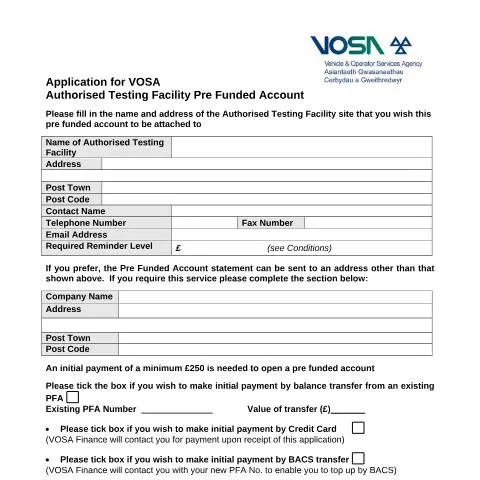
The process of applying for a pre-funded account starts with filling out the application accurately. This document serves as a conduit for establishing a financial relationship with the DVSA, allowing the ATF to manage payments for testing services. The initial step involves providing essential details about your facility, such as the name and address.
- Name of Authorised Testing Facility: This should be the registered name of your testing operation.
- Address: Ensure that the complete address is provided to avoid any correspondence issues.
- Contact Information: Include the name of a contact person along with their telephone number, fax number, and email address for efficient communication.
The application requires a minimum initial payment of £250, which can be settled via various methods, including bank transfer, cheque, or credit card. This upfront payment is a key requirement to activate your pre-funded account.
Funding Your Account: Payment Options Explained
Once you’ve completed the application form, the next step involves funding your pre-funded account. This is where your initial payment comes in. Understanding the payment options available is essential to ensuring your account becomes active without unnecessary delays.
| Payment Method | Description |
|---|---|
| Balance Transfer | Transfer funds from an existing pre-funded account (PFA). |
| Credit Card | Payment via credit card, with DVSA Finance contacting you post-application. |
| BACS Transfer | A standard bank transfer, with DVSA providing necessary account details. |
| Cheque | Submit a cheque with your application—make it payable to the DVSA. |
Choosing the appropriate method can depend on your existing financial arrangements, but it is critical to ensure that the payment is processed promptly to avoid delays in initiating testing services.
Delivering Complete Documentation: Preventing Delays
Completing your application form correctly is essential, but you must also ensure that accompanying documentation is complete and accurate. Any missing information or errors can lead to delays in processing, which could hinder your testing operations. Here are some key elements to check:
- Ensure all required fields are filled in, particularly the contact details and payment method.
- Verify the amount of the initial deposit; it must meet the minimum of £250.
- Review your terms and conditions — by signing the application, you agree to abide by these regulations.
If any issues arise, such as missing information, the DVSA will contact you for clarification. Prompt response to these inquiries is crucial to avoid holding up your account activation.
Post-Application: What Happens Next?
Once your application has been submitted along with the payment, it undergoes processing. The DVSA aims to process applications swiftly, but the duration can vary based on workload and the accuracy of your submission. Here’s a rough timeline of what to expect:
- Application Review: The DVSA will assess the details you've provided.
- Confirmation: You’ll receive notice of your account number upon acceptance.
- Account Activation: Following confirmation, you can immediately start using the account.
It is advisable to maintain communication with the DVSA during this time. Following up on your application ensures you stay informed of any developments or requirements that might arise.
Managing Your Account: Security and Usage
After successfully establishing your pre-funded account, the focus shifts towards effective management and security. Here are some best practices to consider:
- Account Security: Keep your account number confidential. Report any suspicion of unauthorized access to the DVSA immediately.
- Account Funding: Regularly monitor your account balance. Setting up reminders based on a predefined threshold can help avoid running out of funds, triggering alerts from the DVSA.
- Delegate Management: If you wish to authorize others to use your account, ensure to submit their details in writing to the DVSA to maintain accurate records.
Implementing these practices will help ensure seamless operation and prevent issues that could arise from mismanagement.
Addressing Common Problems: Handling Refusals and Errors
In the event of an application being refused or errors encountered during processing, it is critical to understand how to resolve these issues. The DVSA reserves the right to reject applications based on specific criteria. Here’s how to navigate potential obstacles:
Refusal of Application: If your application is turned down, the DVSA will provide a reason. Common reasons for refusal might include inadequate documentation or discrepancies in operational credentials. Addressing these concerns promptly will be crucial for reapplication.
Errors in Submission: Should you discover an error in your application after submission, contact the DVSA immediately. They may allow for corrections depending on your situation, but timely communication is vital.
Missing Documentation: If the DVSA requests additional documents, gather and submit these as swiftly as possible to avoid delays in your account activation.
Understanding these scenarios and their resolutions will empower you to manage your application effectively and maintain a functional testing facility.
Exploring Alternatives: Differentiating Your Form from Similar Applications
When engaging with the DVSA, it’s essential to understand how the pre-funded account application distinguishes itself from other forms, particularly in relation to vehicle testing. This form specifically caters to ATFs, which may sometimes be confused with other DVSA applications such as vehicle licensing or operator licensing.
- Pre-Funded Account Application: Focuses on establishing a financial account for testing payments.
- Vehicle Licensing Applications: Concerned with the legal registration of vehicles for operation.
- Operator Licensing Forms: These ensure that the entity meets transport regulations as an operator.
By recognizing these distinctions, you can ensure that you are using the correct forms for your specific needs and reduce the likelihood of application errors or delays.
Ready to Start: Timelines and Future Actions
Once your pre-funded account is active, understanding the associated timelines and what actions to take next is vital for smooth operations. The DVSA requires that account holders maintain sufficient funds at all times, and managing this effectively is a key aspect of running an ATF.
- Initial Account Setup: Expect your account to be active shortly after processing confirmation, typically within a couple of weeks.
- Regular Monitoring: Set a reminder to check your account balance monthly, ensuring adequate funds for upcoming testing services.
- Annual Review: Consider annual evaluations of your account usage and funding needs to optimize financial management.
Navigating the pre-funded account process is more than just filling out a form; it requires strategic planning and management to ensure that your ATF operates efficiently and in compliance with DVSA regulations.
By following these guidelines and suggestions, applicants can successfully establish and manage their pre-funded accounts, ensuring their testing facilities operate seamlessly. Stay informed, proactive, and engaged with the DVSA to keep your operations running smoothly.
Understanding the Role of Authorised Testing Facilities (ATFs)
Authorised Testing Facilities (ATFs) play a crucial role in maintaining road safety standards in the UK. They are responsible for the inspection and testing of vehicles, particularly heavy goods vehicles (HGVs) and public service vehicles (PSVs). The facilities must adhere to strict regulations set forth by the Driver and Vehicle Standards Agency (DVSA). Understanding the difference between ATFs and other testing facilities is vital for operators and drivers.
ATFs are equipped to carry out the statutory annual tests that ensure vehicles are fit for use on public roads. This includes a thorough examination of the vehicle's condition, including safety, environmental compliance, and operational capabilities. The tests are carried out by specially trained Vehicle Examiners who follow a defined procedure, ensuring that every aspect of the vehicle meets the legal requirements.
To become an ATF, a facility must demonstrate compliance with DVSA requirements, including having the appropriate equipment, trained personnel, and sufficient space to conduct comprehensive vehicle assessments. This application process can be quite rigorous, involving detailed documentation and inspections by the DVSA. Once approved, ATFs can operate independently, providing essential testing services to clients across the UK.
Financial Eligibility and Requirements for Pre-Funded Accounts
When applying for a pre-funded account at an ATF, it is essential to understand the financial criteria involved. A pre-funded account allows clients to pay for testing services in advance, ensuring smooth operations and simplifying payment processes. However, certain financial prerequisites must be met before approval can be granted.
Applicants need to provide detailed financial statements demonstrating their capacity to maintain a pre-funded account. This includes bank statements, profit and loss accounts, and possibly credit references. The DVSA will review these documents to assess the applicant’s financial stability and ensure they can handle the upfront costs associated with recurring testing services. Keeping accurate financial records is vital, as any discrepancies could delay or even jeopardize the application process.
Additionally, it is important to maintain a minimum balance in the pre-funded account to avoid service interruptions. The DVSA may set specific thresholds based on the frequency and type of tests required. Applicants should also ensure that their account can be easily replenished as needed to facilitate uninterrupted testing. Understanding these financial obligations will help streamline the application process and foster a positive relationship with the ATF.
Benefits of Establishing a Pre-Funded Account with an ATF
Establishing a pre-funded account with an ATF offers a range of benefits that can greatly enhance the operational efficiency of businesses that rely on vehicle testing services. One of the primary advantages is the convenience of simplified payments. By pre-funding the account, businesses can bypass the need for frequent transactions and billing processes for each individual test, allowing for quicker service turnaround times.
Moreover, a pre-funded account typically grants clients priority scheduling for testing appointments. This is particularly advantageous for companies that operate fleets of vehicles, as it minimizes downtime and maximizes productivity. Clients can schedule their testing needs without the stress of last-minute availability issues, ensuring that their vehicles remain compliant and roadworthy.
Another significant benefit is the potential for cost savings. Some ATFs may offer discounts or preferential rates for clients who use pre-funded accounts, further reducing overall testing costs. These incentives can translate into substantial savings for businesses, especially those that require frequent testing. Additionally, having an established account creates a transparent financial history with the ATF, which can be beneficial for managing budgets and forecasting future expenses.
Lastly, pre-funded accounts help ensure that businesses stay compliant with legal requirements. By maintaining an ongoing relationship with an ATF and committing to regular vehicle inspections, operators can avoid potential fines and penalties associated with non-compliance. This proactive approach to vehicle safety and regulatory adherence ultimately contributes to safer roads and a better reputation for the business itself.