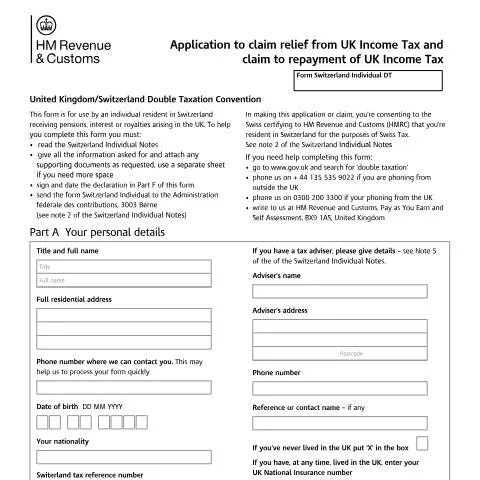
Navigating Swiss-UK Tax Relations: The Switzerland Individual Double Taxation Form
When Swiss residents receive UK-sourced income—whether state pensions, private annuities, interest payments, or royalties—they often face the prospect of being taxed twice on the same earnings. The Switzerland Individual DT form serves as the official gateway for claiming relief under the United Kingdom-Switzerland Double Taxation Convention, preventing this dual burden whilst ensuring compliance with both jurisdictions' tax requirements.
This specialised HMRC document addresses the complex cross-border tax situations that arise when individuals maintain financial ties across the Alpine and British tax systems. Unlike standard UK tax forms that assume domestic residence, this form navigates the intricate web of international tax treaties, requiring coordination between HMRC and Switzerland's Federal Tax Administration (Administration fédérale des contributions).
The form's unique positioning within UK tax administration reflects the sophisticated bilateral arrangements that govern modern international taxation, where residence determination and treaty benefits require careful documentation and mutual recognition between tax authorities.
Statutory Framework and Treaty Foundations
The Switzerland Individual DT form operates under the authority of the UK-Switzerland Double Taxation Convention, a comprehensive bilateral agreement designed to eliminate fiscal double taxation whilst preventing tax avoidance. This treaty framework establishes specific provisions for different income types, with particular attention to pensions, interest, and royalties—the three categories explicitly covered by this form.
Under UK domestic law, the form intersects with the Statutory Resident Test (SRT), introduced to provide clearer residence determination rules. The SRT's tie-breaker provisions become crucial when applicants have departed the UK during the current tax year, as they must confirm their non-resident status or eligibility for split-year treatment. This interaction between treaty benefits and domestic residence rules creates a sophisticated compliance framework that the form must navigate.
The Data Protection Act 2018 and UK GDPR govern the form's data handling, particularly relevant given the international data transfers required between HMRC and Swiss tax authorities. Applicants consent to Swiss authorities certifying their residence status to HMRC, establishing the mutual recognition mechanism essential for treaty benefit claims.
Eligibility Criteria and Residence Complications
The form exclusively serves individuals resident in Switzerland for Swiss tax purposes who receive specific UK-sourced income types. However, residence determination extends beyond simple geographic presence, encompassing complex scenarios involving previous UK residence, ongoing property ownership, and remittance-based taxation arrangements.
Applicants must navigate several critical eligibility thresholds:
- Swiss tax residence certification by cantonal authorities, requiring official confirmation of tax liability in Switzerland
- Absence of UK business activities or fixed base operations that might create UK tax residence
- Genuine departure from UK residence, demonstrated through property disposal or rental arrangements
- Full income remittance to Switzerland, unless specific partial remittance arrangements apply
Particular complexity arises for individuals who maintain UK property whilst claiming Swiss residence. The form requires comprehensive disclosure of continuing property interests, including rental income details and availability for personal use. These factors directly impact residence determination under both UK domestic rules and treaty provisions.
Income Categories and Relief Mechanisms
The form addresses three distinct income streams, each subject to different treaty provisions and relief mechanisms. Understanding these categories proves essential for proper completion and successful claims.
| Income Type | Relief Mechanism | Documentation Required | Processing Authority |
|---|---|---|---|
| UK State Pension | Relief at source | Payment commencement date | DWP coordination with HMRC |
| Private Pensions | Relief at source | Payer details and reference numbers | Pension provider notification |
| Interest/Royalties | Repayment or relief at source | Payer identification and amounts | HMRC processing |
| Incapacity Benefit | Relief at source | Benefit commencement confirmation | DWP benefit administration |
Relief at source arrangements prevent UK tax deduction from future payments, whilst repayment claims recover tax already withheld. The form accommodates both scenarios, though pension relief typically requires payment commencement before applications can proceed.
Notably, the form explicitly excludes bank and building society interest, as HMRC cannot arrange gross payment for these income sources through this particular relief mechanism. Such interest typically requires separate repayment procedures or alternative relief arrangements.
Swiss Authority Certification Requirements
The form's most distinctive feature involves mandatory certification by Swiss tax authorities, creating a bilateral verification process unique among UK tax forms. This certification occurs at two levels: cantonal and federal, reflecting Switzerland's decentralised tax administration structure.
Cantonal taxation authorities must provide official confirmation of the applicant's Swiss tax residence, including:
- Formal residence certification with official stamp
- Tax office identification and contact details
- Specific tax year confirmation
- Swiss tax reference number validation
The Federal Tax Administration of Switzerland provides additional endorsement, ensuring consistency with federal tax treaty obligations. This dual certification mechanism prevents treaty shopping whilst providing HMRC with authoritative residence confirmation from Swiss tax authorities.
Processing timelines often depend on Swiss administrative procedures, as cantonal tax offices may require several weeks to provide necessary certifications. Applicants should initiate contact with their local cantonal tax office well in advance of required submission deadlines.
Professional Representation and Advisory Support
Given the form's complexity and international scope, many applicants engage professional tax advisers familiar with UK-Swiss tax arrangements. The form accommodates professional representation through dedicated adviser details sections, enabling direct HMRC communication with qualified representatives.
Effective professional support proves particularly valuable for:
- Complex residence situations involving multiple jurisdictions or recent relocations
- Business income complications where UK trading activities might affect residence status
- Substantial income amounts where treaty benefit calculations become significant
- Previous UK tax compliance issues requiring careful coordination with ongoing HMRC matters
HMRC provides direct support through dedicated helplines, including international contact numbers (+44 135 535 9022 from outside the UK) and domestic support (0300 200 3300). The online guidance at gov.uk offers additional resources, though complex situations typically require direct consultation.
Professional advisers must provide comprehensive contact details and reference information, enabling HMRC to maintain consistent communication channels throughout the application process. This proves essential when additional documentation or clarification becomes necessary.
Submission Procedures and International Coordination
Unlike standard UK tax forms submitted directly to HMRC, the Switzerland Individual DT form follows a unique routing procedure reflecting bilateral administrative arrangements. Completed forms must be submitted to the Administration fédérale des contributions, 3003 Berne, Switzerland's Federal Tax Administration, rather than UK tax offices.
This routing arrangement ensures Swiss authority verification before HMRC processing, maintaining the bilateral cooperation essential for treaty benefit administration. The Swiss Federal Tax Administration coordinates with HMRC to process relief applications and repayment claims, though processing timelines may extend beyond typical domestic UK tax procedures.
Submission requirements include:
- Complete form execution with all mandatory sections populated
- Supporting documentation as specified in the accompanying Switzerland Individual Notes
- Original signatures on the Part F declaration
- Swiss authority certifications with official stamps and signatures
Electronic submission options remain limited for international treaty forms, necessitating postal submission to Swiss authorities. Applicants should retain copies of all submitted documentation and consider registered post for valuable claims.
Ongoing Compliance and Status Changes
Treaty benefit claims create ongoing compliance obligations, particularly regarding residence status maintenance and income reporting changes. The form establishes baseline information that applicants must update when circumstances change materially.
Critical notification requirements include:
- Residence status changes affecting Swiss tax liability or UK residence determination
- Income source modifications involving new UK payers or changed payment arrangements
- Property status updates where UK property ownership or availability changes
- Business activity commencement in the UK that might affect residence status
Split-year treatment recipients face particular obligations, as they must remain non-resident for the complete following tax year. Any changes affecting this status require immediate HMRC notification to prevent treaty benefit complications.
The form's international nature means that compliance monitoring involves both UK and Swiss tax authorities, creating dual reporting obligations that applicants must navigate carefully. Regular review of changing circumstances ensures continued treaty benefit eligibility whilst maintaining compliance with both jurisdictions' requirements.
Successful navigation of the Switzerland Individual DT form requires understanding its unique position within international tax administration, where bilateral cooperation and mutual recognition create opportunities for legitimate tax relief whilst maintaining robust compliance frameworks that protect both jurisdictions' fiscal interests.
Navigating Swiss Cantonal Tax Variations Under the UK-Switzerland Treaty
One of the most complex aspects of UK-Switzerland double taxation relief involves understanding how Switzerland's federal tax structure interacts with the bilateral treaty provisions. Unlike the UK's centralised system, Switzerland operates a three-tier tax framework comprising federal, cantonal, and communal taxes, each with distinct rates and regulations that can significantly impact your relief calculations.
The treaty applies uniformly across all Swiss cantons, but the practical implementation varies considerably depending on your canton of residence or source of income. For instance, if you're a UK resident receiving rental income from property in Geneva, you'll face different withholding tax rates compared to similar income from Zurich or Zug. Geneva applies a 4.5% cantonal withholding rate on rental income, whilst Zug's rate sits at 1.5%, creating substantial variations in your preliminary tax burden before treaty relief.
Capital gains present particularly intricate scenarios under the cantonal system. Some cantons, notably Schwyz and certain municipalities within Zug, impose minimal capital gains taxation on private wealth, whilst others like Basel-Stadt maintain more substantial rates. When claiming treaty relief through HMRC, you must specify the exact cantonal source and applicable rates, as these directly influence the credit calculations on your UK Self Assessment.
Professional income earned across multiple cantons requires careful apportionment under Article 15 of the treaty. If you're a UK tax resident providing consultancy services to clients in both Geneva and Bern, each canton will assert taxing rights based on the days worked within their territory. The treaty's tie-breaker rules generally favour the canton where the economic substance of your activities occurs, but documentation requirements vary significantly between cantonal tax administrations.
Swiss withholding tax certificates (Quellensteuer-Bescheinigung) differ in format and detail across cantons, yet all must meet minimum standards for HMRC recognition. Vaud's certificates include detailed breakdowns of federal, cantonal, and communal components, whilst simpler formats from smaller cantons may require additional documentation to satisfy UK credit requirements. Always request the comprehensive annual certificate rather than monthly versions, as HMRC's processing systems align better with annual summaries.
Managing Cross-Border Pension Transfers and Retirement Planning
Cross-border pension arrangements between the UK and Switzerland represent one of the treaty's most frequently utilised provisions, yet they harbour numerous technical complexities that can trigger unexpected tax liabilities without proper planning. The treaty's pension articles must be read alongside domestic legislation in both jurisdictions, creating a layered regulatory environment that requires careful navigation.
UK pension transfers to Swiss pillar 3a accounts qualify for specific treaty protections under Article 18, but the timing and structure of such transfers critically determines the tax treatment. Transfers executed whilst you remain UK tax resident generally escape immediate Swiss taxation, provided the receiving institution meets the treaty's qualified pension scheme criteria. However, subsequent withdrawals from Swiss pension vehicles may trigger UK taxation depending on your residence status at the time of distribution.
The five-year rule for pension contributions creates particular complications for individuals relocating between the jurisdictions. If you've made UK pension contributions within five years of claiming Swiss tax residence, those contributions may remain subject to UK taxation rules even after your relocation. This can result in double taxation scenarios where Switzerland taxes the pension growth whilst the UK maintains taxing rights over the underlying contributions.
State pension coordination under the treaty follows different principles from private pension arrangements. Your UK State Pension remains taxable exclusively in the UK regardless of your Swiss residence status, but Swiss AHV/AVS pensions paid to UK residents face Swiss withholding tax at source. The standard 15% withholding rate applies, but you can claim reduction to 5% by filing Form 85 with the Swiss Federal Tax Administration, provided you meet the treaty's beneficial ownership requirements.
Pillar 2 occupational pensions present hybrid characteristics under the treaty framework. Lump sum withdrawals upon leaving Switzerland typically face 4.5% withholding tax, but UK residents can claim partial relief through the treaty's pension article. The relief calculation requires careful consideration of the payment's character – whether it represents return of contributions, investment growth, or employer matching funds – as each component may qualify for different treaty benefits.
Early pension access arrangements require particular scrutiny under both domestic regimes. Switzerland's pillar 3a early withdrawal provisions for home purchase or business startup don't automatically qualify for UK treaty protection, potentially creating situations where the same income faces taxation in both jurisdictions. Similarly, UK pension freedoms allowing 25% tax-free withdrawals may not receive equivalent treatment under Swiss domestic law, necessitating careful treaty analysis to determine the final tax position.
Corporate Structures and Cross-Border Business Operations
The UK-Switzerland double taxation treaty's business profits provisions create sophisticated opportunities for multinational operations, but they also establish complex compliance requirements that vary significantly based on your corporate structure and operational model. Understanding these provisions becomes essential whether you're operating a UK company with Swiss activities, a Swiss entity serving UK clients, or more complex holding company arrangements spanning both jurisdictions.
Permanent establishment rules under Article 5 of the treaty determine where business profits face taxation, but the practical application often involves nuanced fact-patterns that require careful legal analysis. A UK software company providing implementation services to Swiss clients may create a permanent establishment if key personnel spend more than 183 days in Switzerland within any 12-month period, even if no formal Swiss entity exists. However, preparatory and auxiliary activities – such as market research or client meetings – generally don't trigger permanent establishment status provided they remain genuinely supportive rather than core business functions.
The treaty's definition of permanent establishment extends beyond physical presence to include dependent agent arrangements. If you engage Swiss representatives with authority to conclude contracts on your UK company's behalf, this can create Swiss taxing rights over attributable profits even without direct UK personnel presence. Conversely, independent agents operating in their ordinary course of business typically don't trigger permanent establishment status, but the independence test requires genuine commercial substance rather than mere contractual arrangements.
Attribution of profits to permanent establishments follows OECD principles embedded within the treaty, requiring detailed functional analysis of value creation activities. If your UK company's Swiss permanent establishment generates CHF 2 million in revenue, the taxable Swiss profit depends on the specific functions performed, assets used, and risks assumed within Switzerland. Transfer pricing documentation becomes crucial for defending profit attributions, particularly where intellectual property or management services cross borders.
Swiss holding company structures offer attractive treaty benefits for UK-source dividends, but qualification requires meeting both the treaty's beneficial ownership tests and Switzerland's domestic participation exemption criteria. A Swiss holding company receiving dividends from UK subsidiaries can claim treaty relief reducing UK withholding tax from 15% to 5%, provided it holds at least 10% of the paying company's capital. However, Swiss domestic law requires 20% participation for full exemption from Swiss taxation, creating potential double taxation gaps that require careful structuring.
Royalty payments between the jurisdictions benefit from the treaty's zero withholding rate, but qualification depends on meeting strict beneficial ownership and substance requirements. UK companies paying royalties to Swiss licensors must verify that the Swiss recipient genuinely owns the intellectual property and isn't merely a conduit for third-country beneficiaries. Swiss tax authorities increasingly scrutinise royalty arrangements for economic substance, particularly where the Swiss entity lacks significant development, enhancement, maintenance, protection, and exploitation functions.
Corporate restructuring transactions receive specific treaty protection under the exchange of information and mutual agreement procedures, but advance planning becomes essential to secure optimal outcomes. Cross-border mergers, demergers, or share exchanges may qualify for rollover relief in both jurisdictions provided they meet the treaty's legitimate business purpose tests. However, anti-avoidance provisions in both domestic systems can override treaty benefits where transactions appear primarily tax-motivated rather than commercially driven.