When Cross-Border Income Creates Double Tax Burdens: Navigating UK-Ireland Relief Claims
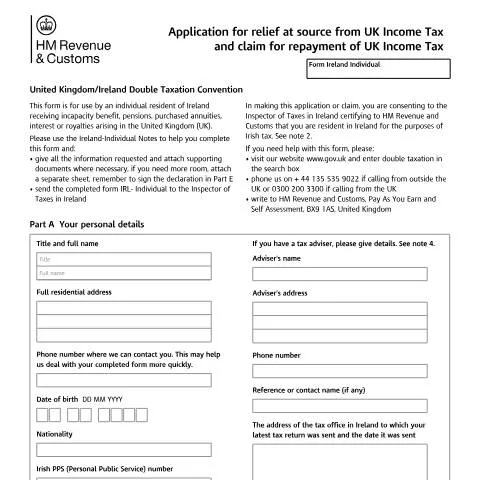
Picture this scenario: you've relocated from London to Dublin for work, but continue receiving a UK workplace pension alongside occasional royalty payments from a book you published years ago whilst living in Manchester. Each month, you watch UK tax being deducted at source from these payments, despite being an Irish tax resident who will declare and pay tax on the same income to Revenue in Ireland. This double taxation dilemma affects thousands of individuals caught between the UK and Irish tax systems, but the Double Taxation: UK-Ireland (Form Ireland-Individual) offers a structured pathway to relief.
This HMRC form serves as both a preventative measure and a corrective tool, allowing Irish tax residents to apply for relief at source from UK income tax on specific types of income, whilst simultaneously claiming repayment of tax already deducted. The form operates under the UK-Ireland Double Taxation Convention, a bilateral agreement designed to prevent the same income being taxed twice across both jurisdictions.
The scope covers five distinct income categories: UK State Pension, incapacity benefit, work pensions and purchased annuities, UK-sourced interest, and royalties. Each category carries specific conditions and documentation requirements, making this form particularly complex for those receiving multiple income streams from UK sources whilst maintaining Irish tax residency.
Establishing Your Irish Tax Residency Status: The Foundation of Your Claim
Before delving into income specifics, the form requires comprehensive evidence of your Irish tax residency status. Part A demands not merely an Irish address, but your Personal Public Service (PPS) number and details of your most recent Irish tax return submission. This information enables the Irish Inspector of Taxes to certify your residency status directly to HMRC, a crucial step that validates your entire application.
The residency verification process involves the Irish tax authorities stamping and signing a dedicated section of the form, confirming you meet Irish tax residency criteria. This isn't merely administrative theatre – HMRC relies on this certification to determine whether you qualify for treaty benefits under the UK-Ireland Double Taxation Convention.
Part B then probes deeper into your UK connections, particularly focusing on the Statutory Residence Test implications. Questions about previous UK residence, property ownership, and business activities help HMRC assess whether you've genuinely severed UK tax ties. The form specifically asks about departure dates, National Insurance numbers from your UK period, and whether you qualify for split-year treatment – a provision allowing part-year UK residence in your departure year.
Property ownership deserves particular attention here. Retaining a UK property doesn't automatically disqualify you from Irish tax residency, but it requires careful documentation. If you've kept a UK property but rent it out, you must provide expected annual rental income figures. If the property remains empty or has been sold, specific dates and circumstances must be detailed on separate sheets.
Split-Year Treatment Considerations
The split-year provisions can significantly impact your relief application. If you departed the UK partway through a tax year and qualify for split-year treatment, you're treated as UK resident for part of the year and non-resident for the remainder. However, claiming split-year treatment commits you to non-residence for the entire following tax year. Should your circumstances change – perhaps requiring an extended UK visit for family reasons – you must inform HMRC immediately, as this could affect your treaty claim status.
Dissecting Income Categories: From State Benefits to Creative Royalties
The form's modular structure in Part C reflects the diverse nature of UK-sourced income that Irish residents might receive. Each section targets specific income types with tailored relief mechanisms.
State Pension and Incapacity Benefits (Section C.1)
UK State Pension payments to Irish residents represent perhaps the most straightforward application of the double taxation treaty. Under Article 17 of the UK-Ireland agreement, state pensions remain taxable in the source country (UK) but Ireland typically provides credit relief to prevent double taxation. The form captures the commencement date of these payments, which helps HMRC track the relief period and calculate any backdated adjustments.
Incapacity benefit follows similar principles, though the classification can be more complex. Some incapacity payments qualify as social security benefits under the treaty, whilst others might be treated as employment-related income, affecting the relief calculation methodology.
Workplace Pensions and Purchased Annuities (Section C.2)
This section addresses private pension arrangements where UK tax may have been deducted under PAYE before you became Irish tax resident. The form asks whether you want HMRC to adjust for tax already deducted, acknowledging that pension payments often begin whilst individuals still maintain UK tax residence, only later becoming relevant for treaty relief when circumstances change.
Purchased annuities – investment products bought to provide regular income – fall under different treaty articles depending on their structure. Immediate annuities might qualify for different treatment than deferred annuities, and the form requires detailed provider information to enable HMRC's classification.
UK Interest Income (Section C.3)
Interest from UK banks, building societies, or other financial institutions often suffers UK withholding tax at source. The treaty typically reduces this rate or eliminates it entirely for Irish residents, but the relief mechanism depends on whether you're applying prospectively (for future payments) or claiming repayment of tax already deducted.
The form cross-references with Part D for repayment claims, recognising that many applicants will have mixed situations – some interest received with tax deducted before establishing Irish residency, and ongoing interest payments requiring future relief.
Royalty Payments (Section C.4)
Royalty relief presents the most complex scenarios, particularly around copyright and intellectual property rights. The form distinguishes between different royalty types: copyright royalties for literary, dramatic, musical, or artistic works versus other forms of intellectual property licensing.
A critical question asks whether you're the originator of the work generating royalties. This distinction affects both the treaty relief rate and the documentation requirements. Original creators typically qualify for more favourable treatment, whilst those who've acquired rights through assignment or licensing face additional scrutiny and must provide copies of the underlying agreements.
| Royalty Type | Required Documentation | Treaty Relief Rate |
|---|---|---|
| Copyright (original creator) | Contract with UK payer, work description | Typically 0% or reduced rate |
| Copyright (acquired rights) | Original assignment/licence agreement plus UK contract | Standard treaty rate applies |
| Patent/trademark royalties | Patent registration, licensing agreement | Reduced treaty rate |
| Performance royalties | Performance rights agreements, payment schedules | Case-by-case assessment |
Repayment Claims: Recovering Tax Already Deducted
Part D of the form shifts focus from prospective relief to retrospective repayment claims. This section becomes relevant when you've received UK-sourced income with tax deducted before establishing Irish tax residency, or during transition periods when your residency status was changing.
The repayment mechanism requires precise documentation of payments received, tax deducted, and the periods during which you qualified as an Irish tax resident. HMRC needs to verify not only that double taxation occurred, but that you were entitled to treaty relief during the specific periods in question.
Timing becomes crucial here. The UK generally allows repayment claims up to four years after the end of the tax year in question, but Irish tax residency must be established for the periods covered by your claim. If you became Irish tax resident partway through a UK tax year, your repayment entitlement might be pro-rated based on the split-year provisions.
Documentation for Repayment Claims
Supporting evidence for repayment claims extends beyond the basic form completion. You'll typically need:
- Original payment advices or certificates showing UK tax deductions
- Bank statements confirming receipt of net payments
- Irish tax returns demonstrating that you've declared and paid Irish tax on the same income
- Evidence of your Irish tax residency commencement date
For pension repayments, P60 certificates from UK pension providers offer the most reliable evidence of tax deductions. Interest repayments might require annual statements from UK financial institutions, whilst royalty repayment claims need detailed payment schedules from publishers, record labels, or licensing agencies.
Processing Pathways: How HMRC Handles Your Treaty Claim
Once submitted to the Irish tax authorities for certification, your completed form travels to HMRC's specialist double taxation unit at BX9 1AS. This centralised processing approach ensures consistency in treaty interpretation and application across different income types and claimant circumstances.
The processing timeline varies significantly based on claim complexity and supporting documentation quality. Straightforward state pension relief applications might receive approval within 6-8 weeks, whilst complex royalty claims involving multiple income streams and acquired rights could take 12-16 weeks or longer.
HMRC's initial review focuses on three key areas: verification of Irish tax residency certification, assessment of treaty entitlement under the relevant articles, and validation of supporting documentation. The department may request additional information during this phase, particularly for unusual income arrangements or where the treaty application isn't immediately clear.
Approval and Implementation
Successful applications result in HMRC issuing relief codes to UK payers, enabling them to reduce or eliminate future tax deductions at source. For repayment claims, HMRC processes refunds directly to your nominated bank account, typically within 28 days of approval.
The relief codes carry specific validity periods and conditions. Changes in your circumstances – such as returning to UK tax residency or altering the nature of your Irish tax status – require immediate notification to HMRC to prevent incorrect relief application.
Common Complications and Their Resolution Strategies
Several recurring issues can complicate the treaty relief process, often stemming from the complex interplay between UK and Irish tax residence rules and the specific circumstances of cross-border income recipients.
Residence Status Disputes
Disagreements about tax residency status represent perhaps the most fundamental complication. If HMRC questions your Irish tax residency or the Irish authorities decline to certify your status, your entire treaty claim stalls. This situation often arises when you maintain significant UK connections – property ownership, frequent visits, or ongoing business activities – that suggest continued UK tax ties.
Resolution typically requires detailed evidence of your Irish connections: lease agreements, utility bills, employment contracts, or business registration documents. The key principle involves demonstrating that Ireland represents your primary tax home under the tie-breaker provisions of the double taxation treaty.
Income Classification Challenges
The treaty provides different relief rates and mechanisms for different income categories, making proper classification essential. Pension arrangements particularly suffer from classification disputes – are payments from a former employer's scheme treated as employment income, pension income, or something else entirely?
Similarly, complex royalty arrangements might straddle multiple categories. Software licensing royalties could be treated as copyright royalties, patent royalties, or business income depending on the underlying technology and licensing structure. Each classification carries different documentation requirements and relief entitlements.
Documentation Deficiencies
Incomplete or inadequate supporting documentation causes significant processing delays. HMRC's requirements often exceed what applicants initially anticipate, particularly for complex income arrangements or where rights have been assigned between multiple parties.
The form's guidance notes provide some direction, but they can't cover every possible scenario. When in doubt, over-documentation proves preferable to under-documentation. Include explanatory covering letters for unusual arrangements, and provide certified translations for any foreign-language documents.
Strategic Timing: Maximising Your Relief Entitlement
The timing of your treaty claim submission can significantly impact both the processing experience and your ultimate relief entitlement. Understanding the various deadlines, processing cycles, and administrative rhythms helps optimise your approach.
HMRC processes treaty claims year-round, but certain periods experience heavier workloads that can extend processing times. The months following the 31 January Self Assessment deadline often see increased activity as individuals finalise their cross-border tax affairs, whilst the summer months typically offer faster processing for routine applications.
Prospective vs Retrospective Timing
Applying for prospective relief before you start receiving UK-sourced income as an Irish tax resident prevents double taxation from occurring, but requires careful timing coordination. You need established Irish tax residency before HMRC will approve prospective relief, but delaying too long means suffering initial double taxation periods.
For retrospective repayment claims, the four-year limitation period creates urgency for older tax years. However, rushing an application with incomplete documentation often proves counterproductive, as HMRC requests for additional information can extend processing beyond the limitation period for the earliest years.
Coordinating with Irish Tax Obligations
Your treaty claim timing should align with your Irish tax compliance obligations. Revenue Ireland needs to see evidence of your UK-sourced income and any treaty relief obtained when you file your Irish tax returns. Obtaining HMRC relief confirmations before completing your Irish return prevents complications and potential Revenue queries about undeclared income.
The interaction between UK treaty relief and Irish tax credit relief requires careful management. Ireland typically provides credit for UK taxes paid on UK-sourced income, but if HMRC provides treaty relief that reduces UK tax, Ireland's credit calculation adjusts accordingly. Understanding this interaction helps prevent both under-payment and over-payment of Irish tax on your UK-sourced income.
Beyond the Form: Maintaining Ongoing Compliance
Successfully obtaining treaty relief through the Ireland-Individual form creates ongoing compliance obligations that extend well beyond the initial application. HMRC expects notification of relevant changes in circumstances, whilst Irish tax authorities require proper reporting of UK-sourced income and any relief obtained.
Annual reviews of your treaty position help identify when circumstances change sufficiently to require amended applications or additional claims. New income sources, changes in payment arrangements, or alterations to your residency status all potentially affect your treaty entitlements.
The UK-Ireland double taxation treaty undergoes periodic revision, with changes potentially affecting relief rates, qualifying income categories, or procedural requirements. Staying informed about treaty developments ensures your relief arrangements remain optimal and compliant with current provisions.
Record-keeping becomes particularly important for ongoing compliance. Maintain comprehensive files of all treaty correspondence, relief approvals, payment records, and supporting documentation. HMRC and Revenue Ireland both retain rights to review treaty claims during their respective enquiry periods, making thorough documentation essential for defending your position if questions arise.
The Ireland-Individual form represents more than a simple administrative procedure – it embodies the practical implementation of international tax cooperation designed to facilitate legitimate cross-border economic activity whilst preventing tax avoidance. Understanding its intricacies and requirements enables Irish tax residents to navigate the UK tax system efficiently, securing appropriate relief whilst maintaining full compliance with both jurisdictions' expectations.