When UK Income Meets Canadian Residence: Navigating Cross-Border Tax Relief
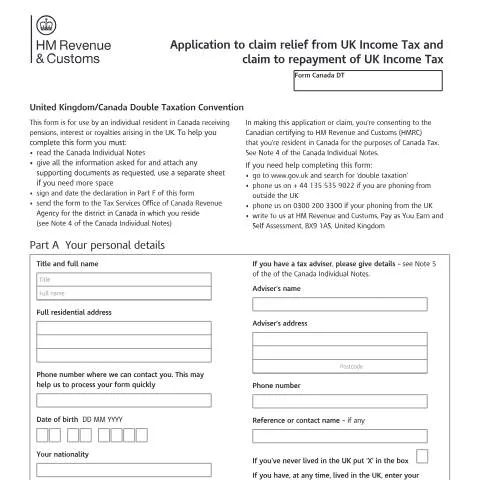
Picture this: you've settled in Toronto after decades in Manchester, drawing a UK state pension whilst enjoying your Canadian retirement. Or perhaps you're a Montreal-based author receiving royalties from your London publisher. These scenarios exemplify the complex web of international taxation that affects thousands of UK-Canada migrants annually. The Double Taxation: UK/Canada Form (Canada/Individual) serves as your passport through this maze, enabling Canadian residents to claim relief from UK income tax on specific types of income.
This HMRC-administered form operates within the framework of the UK-Canada Double Taxation Convention, a bilateral agreement designed to prevent the same income being taxed twice. Unlike standard UK tax forms, this document requires Canadian Revenue Agency certification, making it a unique cross-jurisdictional instrument that bridges two tax systems.
The Regulatory Foundation: UK-Canada Double Taxation Treaty Mechanics
The UK-Canada Double Taxation Convention, first established in 1978 and subsequently updated, creates specific rules for determining where income should be taxed. The treaty operates on the principle of residence-based taxation, meaning your Canadian tax residency generally takes precedence for treaty benefits.
Under this framework, certain types of UK-sourced income become eligible for reduced or eliminated UK tax deduction at source. The treaty distinguishes between various income categories:
- Government pensions: UK state pensions remain taxable exclusively in the UK, regardless of your Canadian residence
- Private pensions: Occupational and personal pensions are typically taxable in your country of residence (Canada)
- Interest payments: Subject to specific conditions and exemptions under treaty provisions
- Royalties: Copyright royalties often qualify for complete UK tax exemption when paid to Canadian residents
The Statutory Residence Test (SRT) plays a crucial role in determining your UK tax status. Even after departing the UK, certain connections—such as retaining property or spending significant time in the UK—can affect your eligibility for treaty benefits. The form specifically addresses these scenarios through detailed residency questions.
Eligible Claimants: Decoding Canadian Residence Requirements
Canadian tax residence forms the cornerstone of your eligibility. However, residence encompasses more than simply holding a Canadian passport or owning property in Vancouver. The Canada Revenue Agency applies a comprehensive test considering:
| Residence Factor | Primary Indicators | Secondary Considerations |
|---|---|---|
| Physical presence | 183+ days in Canada during tax year | Pattern of stays over multiple years |
| Residential ties | Home, spouse/family, dependants in Canada | Social, economic connections |
| Immigration status | Permanent resident or citizen status | Work permits, study permits |
The form accommodates various migration scenarios. Recent emigrants who departed the UK within the current tax year must confirm their status under the Statutory Residence Test—either as non-resident or eligible for split-year treatment. Split-year treatment applies when you're UK resident for part of the tax year and non-resident for the remainder, typically following a clear break in UK residence.
For long-term Canadian residents who've never lived in the UK, the process simplifies considerably. However, those maintaining UK property connections face additional scrutiny. Retaining a UK property—even if let to tenants—requires detailed disclosure including tenant information and expected rental income.
Business connections create particular complexity. If you operate a UK trade or business, or perform independent personal services from a UK fixed base, treaty benefits may be restricted or eliminated entirely. This affects consultants, freelancers, and business owners maintaining UK operations whilst residing in Canada.
Income Categories and Relief Mechanisms: From Pensions to Royalties
The form divides UK income into distinct categories, each with specific relief mechanisms and requirements.
State Benefits and Government Pensions
UK State Pensions occupy a unique position under the treaty. Unlike private pensions, state pensions remain exclusively taxable in the UK, regardless of your Canadian residence. This means no relief from UK tax deduction, but you'll typically receive credit for UK tax paid when filing your Canadian return.
UK Incapacity Benefit follows similar principles, remaining subject to UK taxation. The form requires precise commencement dates for these payments, enabling HMRC to verify eligibility periods and payment authenticity.
Occupational and Private Pensions
Private pensions represent the most common relief category. Former UK employees now resident in Canada can claim relief from UK tax deduction on:
- Occupational pension schemes from UK employers
- Personal pensions and SIPPs (Self-Invested Personal Pensions)
- Purchased life annuities from UK insurance companies
- Section 32 policies and retirement annuity contracts
Each pension source requires comprehensive details including the payer's name, address, reference number, and payment commencement date. HMRC uses this information to instruct pension providers to cease UK tax deduction, typically from the following payment date.
Investment Income and Interest
Interest relief operates under specific limitations. The form explicitly excludes bank and building society interest from relief at source arrangements. HMRC cannot arrange for UK banks to pay interest gross to Canadian residents; instead, you must claim repayment of tax already deducted through Part D of the form.
Qualifying interest sources include:
- UK government securities (gilts)
- Corporate bonds and debentures
- Privately arranged loans to UK residents
- Investment trust and unit trust distributions (interest element)
Royalty Payments and Intellectual Property
Royalty relief varies significantly based on your relationship to the intellectual property. Original creators—authors, composers, inventors—typically qualify for complete UK tax exemption on copyright royalties paid by UK licensees.
However, if you've acquired rights through assignment, licence, or purchase, additional documentation becomes essential. You must provide copies of the original licence, contract, or assignment demonstrating how you acquired rights from the original creator. This prevents abuse where individuals attempt to claim treaty benefits on commercially purchased rights.
Completing the Application: Section-by-Section Navigation
Personal Details and Adviser Information
Part A establishes your identity and Canadian residence claim. The consent provision is crucial—by completing this section, you're authorising the Canadian Revenue Agency to certify your Canadian residence to HMRC. This cross-border information sharing forms the treaty's foundation.
Your UK National Insurance number remains important even after emigration, serving as a unique identifier for HMRC records. If you've never lived in the UK, mark the designated box; otherwise, provide your exact departure date, which HMRC will verify against their residence records.
Tax adviser details prove valuable for complex cases. HMRC may contact advisers directly to resolve queries, potentially expediting processing times.
Residence History and UK Connections
Part B's residence questions determine treaty eligibility. The sequence follows logical progression:
- Lifetime Canadian residence: If you've always lived in Canada, skip to question 6
- Canadian residence commencement: Your arrival date in Canada for residence purposes
- Canadian tax liability commencement: When you first became liable to Canadian tax on the income claimed—this may differ from your arrival date
- UK property retention: Detailed disclosure requirements for any UK property interests
- Statutory Residence Test status: Current year residence determination under UK rules
Question 4's property disclosure extends beyond ownership to rental arrangements. If you maintain a UK property but let it to tenants, provide full tenant details including expected annual rental income. This information helps HMRC assess whether you retain sufficient UK ties to affect treaty benefits.
Income Source Documentation
Parts C.1 through C.4 require meticulous completion matching your specific income sources. Each section demands different supporting evidence:
Pension details must include payer reference numbers—these appear on pension statements and enable HMRC to identify your pension with the provider's systems. Incorrect or missing reference numbers can delay processing significantly.
Interest source registration details matter particularly for government securities. Your name must match exactly with registrar records, and account numbers must be current and accurate.
Royalty documentation proves most complex, requiring evidence of your relationship to the intellectual property. Original creators need minimal documentation, but rights purchasers must demonstrate the acquisition chain from original creator through to current ownership.
Canadian Revenue Agency Certification: The Cross-Border Bridge
The form's unique feature lies in its mandatory Canadian certification requirement. Unlike purely UK forms, this document must route through the Canada Revenue Agency's Tax Services Office for your Canadian district before reaching HMRC.
The certification process serves multiple purposes:
- Verifies your Canadian tax residence status
- Confirms your eligibility for treaty benefits
- Establishes official communication channels between tax authorities
- Creates an audit trail for both jurisdictions
Canadian tax officials examine your residence status against their own criteria before certifying to HMRC. This dual-verification system prevents treaty abuse whilst ensuring legitimate claimants receive appropriate relief.
Processing times vary by Canadian district, but typically range from 4-8 weeks for straightforward cases. Complex scenarios involving business connections or unusual income sources may require additional time for Canadian review.
Repayment Claims and Retrospective Relief
Part D addresses situations where UK tax has already been deducted from your income. This commonly occurs with:
- Bank interest paid gross initially, then subject to retrospective tax charges
- Pension payments where relief hadn't yet been arranged
- Royalty payments made before treaty position clarification
- Investment income from new sources not yet covered by relief arrangements
Repayment claims require supporting evidence of tax deducted. For pensions, provide P60 certificates or pension statements showing gross amounts and tax deducted. Interest repayments need bank statements or certificates of tax deducted. Royalty repayments require payment advices showing gross payments and UK tax withheld.
HMRC typically processes repayments within 6-8 weeks of receiving complete applications, though complex cases may take longer. Interest on overpaid tax may be available if delays exceed reasonable processing times.
Processing Outcomes and Ongoing Obligations
Successful applications result in HMRC issuing coding notices to UK payers, instructing them to cease tax deduction from specified dates. For pensions, this typically takes effect from the next payment date following HMRC's instruction.
However, treaty benefits aren't permanent entitlements. Changes in circumstances can affect your eligibility:
| Change in Circumstances | Potential Impact | Required Action |
|---|---|---|
| Return to UK residence | Loss of treaty benefits | Notify HMRC immediately |
| Commence UK business activities | Restriction of benefits | Disclose business details |
| Change in Canadian residence status | Potential benefit loss | Update both tax authorities |
| Acquisition of new income sources | May require separate applications | Submit supplementary forms |
Split-year treatment recipients face particular ongoing obligations. If you claimed split-year treatment when departing the UK, you must remain non-resident for the following complete tax year. Any return to UK residence during this period requires immediate HMRC notification and may result in benefit withdrawal.
The form establishes a continuing relationship between you, HMRC, and the Canadian Revenue Agency. Regular monitoring ensures treaty benefits remain appropriate to your circumstances, protecting the integrity of the double taxation agreement whilst providing legitimate relief to qualifying individuals navigating the complexities of cross-border taxation.
Navigating Provincial Tax Considerations in UK-Canada Double Taxation Relief
When claiming double taxation relief between the UK and Canada, many taxpayers overlook the crucial impact of provincial taxation on their overall liability calculations. Canada's federal-provincial tax system creates additional layers of complexity that can significantly affect the relief available under the UK-Canada Double Taxation Agreement.
Each Canadian province maintains its own tax rates and thresholds, which can vary substantially from the federal rates. For instance, Alberta's combined federal-provincial top marginal rate differs markedly from Ontario's or British Columbia's rates. This variation becomes particularly relevant when calculating the foreign tax credit on your UK Self Assessment return, as the total Canadian tax paid (federal plus provincial) forms the basis for your relief claim.
HMRC recognises that Canadian provincial taxes qualify as creditable foreign taxes under the double taxation treaty. However, the calculation method requires careful attention to ensure you're claiming the correct amounts. Your Canadian Notice of Assessment will typically show both federal and provincial tax components separately, and both elements should be included when completing the foreign tax credit sections of your SA106 or SA109 forms.
The timing of provincial tax payments can also create complications, particularly for those who pay instalments throughout the tax year. Canadian residents earning over certain thresholds must make quarterly instalment payments, which include both federal and provincial components. When these instalments span across UK tax years (remember, the UK tax year runs from 6 April to 5 April), you'll need to carefully allocate the payments to ensure they're claimed in the correct UK tax year.
For individuals who change provinces during a tax year, the situation becomes even more intricate. Canadian tax law requires a proportional calculation based on the number of days resident in each province, potentially resulting in tax liability to multiple provinces within a single Canadian tax year. This multi-provincial liability must be properly documented and allocated when claiming UK double taxation relief.
Quebec presents a unique case within the Canadian system, as it operates its own separate tax collection system rather than using the Canada Revenue Agency for provincial taxes. Quebec residents file separate federal and provincial returns, which can create additional documentation requirements when supporting your UK double taxation relief claim. Ensure you retain both the federal Notice of Assessment and Quebec's separate provincial assessment when preparing your UK tax documentation.
Cross-Border Investment Income and Withholding Tax Complications
Investment income flowing between the UK and Canada creates particularly complex double taxation scenarios that require sophisticated planning and meticulous record-keeping. The treatment varies significantly depending on the type of investment, the jurisdiction where it's held, and your residency status in both countries.
Canadian withholding taxes on dividends, interest, and other investment income paid to UK residents typically range from 5% to 25%, depending on the specific type of income and the provisions of the double taxation treaty. However, the actual rate applied may not always reflect the treaty rate, particularly if proper documentation wasn't provided to the Canadian payer at the time of payment. This discrepancy can result in over-withholding, requiring either a refund application to the Canada Revenue Agency or an adjustment in your UK double taxation relief calculation.
Registered Retirement Savings Plans (RRSPs) and Registered Retirement Income Funds (RRIFs) present unique challenges for UK tax residents. While these accounts enjoy tax-deferred status in Canada, HMRC generally treats them as transparent for UK tax purposes, meaning the underlying income and gains may be taxable in the UK as they arise, not when withdrawn. This timing mismatch can create situations where you're paying UK tax on income that hasn't yet been subject to Canadian withholding tax, complicating your double taxation relief calculations.
The treatment of capital gains on Canadian investments adds another layer of complexity. Canada typically doesn't impose withholding tax on capital gains realised by non-residents, but the calculation of the gain itself may differ between Canadian and UK tax rules. Currency fluctuations between the Canadian dollar and pound sterling can result in gains or losses that are recognised differently in each jurisdiction, potentially affecting the amount of double taxation relief available.
Dividend income from Canadian corporations requires particular attention to the gross-up and tax credit mechanism used in Canadian taxation. Canadian residents receive a grossed-up dividend amount and claim a dividend tax credit, but non-residents typically receive only the actual dividend less withholding tax. When claiming double taxation relief in the UK, you should base your calculation on the actual cash received (after withholding tax), not the grossed-up amount that would apply to Canadian residents.
For those holding investments through Canadian trusts or partnerships, the flow-through nature of these entities can create additional complications. The character of income (whether ordinary income, capital gains, or other types) must be preserved and properly reported in both jurisdictions, which may require detailed allocation calculations if the entity has income from multiple sources or jurisdictions.
Employment Income Complications: Remote Work and Cross-Border Assignments
The increasing prevalence of remote work arrangements and cross-border employment assignments has created new challenges in applying double taxation relief between the UK and Canada. These situations often involve complex allocations of employment income between jurisdictions and require careful consideration of both tax treaty provisions and domestic employment tax rules.
When UK residents work remotely for Canadian employers, the source of employment income generally depends on where the work is physically performed. However, this straightforward principle becomes complicated when employees split their time between jurisdictions or when employment duties span multiple countries. The UK-Canada tax treaty provides specific tie-breaker rules for employment income, but applying these rules requires detailed documentation of work locations, duration of assignments, and the nature of employment responsibilities.
Canadian employment income subject to source withholding through the payroll system creates timing issues for UK tax reporting. Canadian employers typically withhold income tax, Canada Pension Plan contributions, and Employment Insurance premiums from each pay period, but these amounts may not align perfectly with UK tax year boundaries. You'll need to convert Canadian withholdings to UK tax years and ensure proper allocation when claiming double taxation relief on your Self Assessment return.
Stock option benefits present particularly complex scenarios in cross-border employment situations. Canadian and UK tax rules differ significantly in their treatment of employee stock options, including the timing of taxation, valuation methods, and available reliefs. An option that qualifies for favourable tax treatment in Canada may not receive equivalent treatment in the UK, potentially resulting in economic double taxation that isn't fully relieved by the tax treaty provisions.
Pension contributions made by Canadian employers on behalf of UK resident employees require careful consideration of both jurisdictions' pension rules. While the contributions may be deductible for Canadian tax purposes, they might not qualify for equivalent relief under UK pension rules, particularly if the Canadian pension scheme doesn't meet UK registered pension scheme requirements. This can result in the employee being taxable on the employer contributions in the UK while receiving a deduction in Canada.
Termination payments and redundancy packages often involve complex source rules that can affect double taxation relief calculations. Payments made by Canadian employers to UK residents may be subject to Canadian withholding tax, but the UK treatment depends on various factors including the nature of the payment, the employee's length of service, and specific exemptions available under UK employment income rules. The interaction between Canadian withholding obligations and UK exemptions can create situations where careful planning is required to optimise the overall tax position.
For employees on temporary assignments in Canada, the 183-day rule in the tax treaty provides potential relief from Canadian taxation, but meeting this exemption requires strict compliance with both the physical presence test and other treaty conditions. Detailed records of days present in Canada, the nature of employment duties, and payment arrangements are essential for supporting any treaty-based exemption claims.