When UK-Netherlands Tax Treaties Meet Real Life: Navigating Cross-Border Income
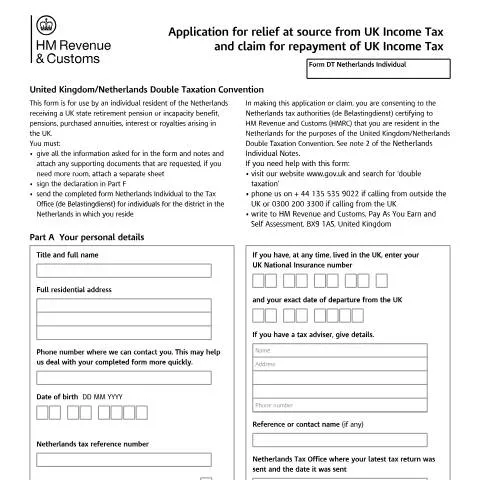
Living in the Netherlands whilst receiving UK income creates a complex web of tax obligations that can trap even seasoned expatriates. The DT Netherlands Individual form stands as the official gateway for Dutch residents to claim their rightful position under the UK-Netherlands Double Taxation Convention, yet its completion demands precision that goes far beyond basic personal details.
This particular form serves Dutch tax residents receiving specific types of UK-sourced income: state retirement pensions, incapacity benefits, occupational pensions, purchased annuities, interest payments, and royalties. Unlike general tax relief applications, this document requires dual certification – both your declaration and official endorsement from de Belastingdienst before HMRC will process any claim.
The stakes are considerable. Without proper completion, UK payers may continue deducting tax at source rates of 20% or higher, whilst Dutch tax authorities expect you to declare the same income. This double taxation scenario can persist for years if the initial application contains errors or omissions that trigger HMRC rejections.
Establishing Your Dutch Tax Residence: More Complex Than Geographic Location
The form's foundation rests on proving Netherlands tax residence under treaty definitions, which differ substantially from simple physical presence tests. Part A requires your Netherlands tax reference number – not your BSN (burgerservicenummer) but your specific tax file reference used by de Belastingdienst for income tax purposes.
Recent arrivals face particular scrutiny. If you've relocated from the UK within the current or previous tax year, questions 4 and 5 in Part B become critical. The form specifically references the UK's Statutory Resident Test, requiring you to confirm your non-resident status or eligibility for split-year treatment. This isn't merely bureaucratic box-ticking – incorrect responses can void your entire application.
For those claiming split-year treatment, a crucial caveat applies: you must remain UK non-resident for the complete following tax year. Should your circumstances change – perhaps through extended UK visits exceeding the automatic overseas test thresholds – you're obligated to inform HMRC immediately. Failure to do so can result in retrospective tax charges plus interest penalties.
Property Ownership Complications
Question 3 probes UK property connections, requiring detailed disclosure of any property you or your spouse/civil partner own or rent. This extends beyond obvious second homes to include:
- Properties held in trust where you remain a beneficiary
- Rental properties where you retain landlord responsibilities
- Family homes made available to relatives
- Commercial premises connected to ongoing UK business interests
The form demands specific details: full addresses, rental arrangements, expected annual income, and crucially, the date any property ceased being available for your personal use. HMRC cross-references this information against Land Registry records and rental income declarations, making accuracy essential.
Income Categories: Navigating the Treaty's Specific Provisions
Part C divides into distinct income streams, each governed by different treaty articles with varying relief entitlements. Understanding these distinctions prevents costly misclassifications that can delay processing or trigger investigations.
State Pensions and the Residence Rule
UK state pensions paid to Netherlands residents qualify for complete UK tax exemption under Article 18 of the treaty. However, the form requires precise commencement dates for payments – HMRC uses this to determine applicable tax years and calculate any refunds due on previously taxed amounts.
Deferred state pension recipients face additional complexity. Lump sum payments often suffer UK tax deduction at source, requiring Part D completion to claim refunds. The calculation involves determining the tax-free portion based on your Netherlands residence period versus the deferral accumulation period.
Occupational Pensions and PAYE Adjustments
Section C.2 addresses occupational pensions and purchased annuities, where treaty relief operates differently. Rather than complete exemption, the Netherlands-UK treaty typically reduces UK withholding tax rates. The form's reference to PAYE adjustments acknowledges that many UK pension administrators continue operating standard tax deductions pending treaty clearance.
Providing payer reference numbers proves crucial – these unique identifiers allow HMRC to communicate directly with pension administrators, expediting relief implementation. Without accurate references, your application may succeed whilst practical tax relief remains delayed for months.
| Income Type | Treaty Article | Typical Relief | Key Requirements |
|---|---|---|---|
| State Pension | Article 18 | Full exemption | Netherlands residence only |
| Private Pension | Article 17 | Reduced withholding | Residence plus source verification |
| Interest | Article 11 | Rate reduction/exemption | Beneficial ownership proof |
| Royalties | Article 12 | Potential exemption | Originator status confirmation |
Interest and Investment Income: Beyond Basic Bank Accounts
Section C.3 specifically excludes bank and building society interest – HMRC cannot arrange relief at source for standard deposit account interest. This limitation often surprises applicants expecting comprehensive coverage. The section instead targets:
- Government and corporate bond interest
- Debenture and loan stock payments
- Privately arranged loan interest
- Investment trust distributions classified as interest
For each qualifying source, you must provide security titles, registrar details, account references, and payment due dates. This granular detail enables HMRC to coordinate with paying agents, ensuring future payments reflect treaty benefits automatically.
Privately arranged loans require separate sheet disclosure covering loan amounts, interest due dates, and borrower details. HMRC scrutinises these arrangements for potential tax avoidance schemes, particularly where loans involve connected parties or complex structures.
Royalty Claims: Proving Originator Status
Question 8 in Part B specifically addresses royalty recipients, distinguishing between original creators and subsequent rights holders. This distinction carries significant treaty implications – original authors, inventors, and creators typically qualify for enhanced relief compared to assignees or licensees.
If you're not the original creator, the form demands supporting documentation: licence agreements, contracts, or assignments demonstrating how you acquired rights from the originator. HMRC examines these documents for substance, ensuring genuine commercial transactions rather than artificial arrangements designed purely for tax benefits.
Copyright royalties receive particular attention, with treaty provisions varying based on the underlying intellectual property type and your relationship to its creation. Software licensing, publishing rights, and patent royalties each carry different qualification criteria and relief rates.
The Certification Process: De Belastingdienst's Critical Role
The form's unique feature lies in its mandatory certification requirement. Unlike self-declaration systems, this process requires de Belastingdienst to officially confirm your Netherlands tax residence before HMRC processing begins. This two-stage approach reflects both countries' commitment to preventing treaty shopping and ensuring genuine residence claims.
The certification section at Part A's bottom must be completed by authorised de Belastingdienst officials, not tax advisers or intermediaries. The official stamp requirement adds another authentication layer, preventing fraudulent submissions that plagued earlier treaty relief systems.
Timing and Submission Logistics
You must submit the completed form to your local Netherlands tax office – specifically the district office handling your personal tax affairs. This isn't necessarily your nearest geographical office but rather the one processing your annual tax returns. The form notes require you to identify this office and provide your most recent submission date.
After certification, de Belastingdienst returns the form to you for transmission to HMRC's Pay As You Earn and Self Assessment office at BX9 1AS. This indirect routing ensures both tax authorities maintain proper audit trails whilst giving you visibility over the process timeline.
Complex Scenarios: When Standard Applications Aren't Sufficient
Several situations demand enhanced documentation and careful consideration beyond the form's standard requirements. Recent UK departures face particular complexity, especially those maintaining business connections or property interests.
Split-Year Treatment Implications
Individuals claiming split-year treatment under UK rules must coordinate this with Netherlands tax residence timing. The form requires confirmation of your non-resident status, but Netherlands tax law may consider you resident from a different date than UK rules suggest your departure.
This misalignment can create periods where both countries consider you resident, potentially invalidating treaty benefits. Professional advice becomes essential when departure dates, residence establishment, and income payment periods overlap in complex ways.
Business Connections and Permanent Establishments
Question 7 probes UK business activities or fixed base operations. Positive responses don't automatically disqualify treaty benefits but may limit their scope. UK-sourced income attributable to permanent establishments typically remains subject to UK taxation regardless of Netherlands residence.
The form requires "full details on a separate sheet" for any business connections. These disclosures should include:
- Nature and duration of UK activities
- Physical premises or operational bases
- Income attribution between Netherlands and UK operations
- Professional licensing or regulatory approvals
Administrative Practicalities: Managing the Process Effectively
Successful form completion extends beyond accurate information provision to strategic process management. HMRC's contact details – +44 135 535 9022 from outside the UK or 0300 200 3300 domestically – provide direct access to specialist treaty staff who understand the form's complexities.
However, these helplines operate during UK business hours and may experience high demand during peak filing periods. Preparing comprehensive questions in advance maximises the value of any consultation calls.
The form's reference to additional space requirements acknowledges that complex situations rarely fit standard boxes. When attaching separate sheets, maintain clear cross-references to specific questions and ensure all additional documentation carries your name and Netherlands tax reference for proper file association.
Documentation Standards and Evidence Requirements
While the form doesn't explicitly list required supporting documents beyond royalty assignments, practical experience suggests gathering comprehensive evidence before submission. This might include:
- Netherlands tax residence certificates or recent assessment notices
- UK departure documentation (P85 forms, final payslips, tenancy terminations)
- Property sale/rental agreements if UK connections have ceased
- Business registration cancellations or professional licence surrenders
Proactive evidence provision reduces HMRC follow-up queries and accelerates processing timelines, particularly important given the form's impact on ongoing income tax deductions.
The DT Netherlands Individual form represents more than administrative compliance – it serves as your formal entry into bilateral tax coordination systems that can significantly impact your long-term tax efficiency. Understanding its requirements, preparing comprehensive responses, and managing the certification process effectively ensures you capture available treaty benefits whilst avoiding the pitfalls that can complicate cross-border tax affairs for years to come.
Claiming Relief Through the UK Self Assessment System
For UK residents receiving Dutch-source income, the Self Assessment process provides the primary mechanism to claim double taxation relief. The timing and methodology of these claims require careful attention to both jurisdictions' tax years and administrative requirements.
When completing your SA100 tax return, Dutch income must be declared in the relevant foreign income sections. Investment income from Dutch sources typically appears in the SA106 supplementary pages, whilst employment income earned in the Netherlands requires completion of SA109 if you're employed by a non-UK employer. The critical consideration lies in demonstrating that Dutch tax has been properly withheld or paid, as HMRC requires substantial evidence before granting relief.
The relief mechanism operates through two primary routes: credit relief under the double taxation agreement or unilateral relief provisions. Credit relief, governed by Article 24 of the UK-Netherlands treaty, allows you to offset Dutch tax paid against your UK liability on the same income. However, this credit cannot exceed the UK tax attributable to that specific income stream. For instance, if you've paid 25% Dutch withholding tax on dividend income but your UK marginal rate is only 20%, you cannot claim the excess 5% as a refund—though you may be able to reclaim this directly from the Dutch authorities.
Unilateral relief under UK domestic legislation provides an alternative where treaty relief isn't available or beneficial. This mechanism, outlined in Part 2 of the Taxation (International and Other Provisions) Act 2010, can sometimes offer more generous relief than treaty provisions, particularly for certain types of business income or where the Dutch tax exceeds treaty withholding rates.
Documentation requirements prove extensive and non-negotiable. HMRC expects to see original or certified copies of Dutch tax certificates, employment contracts specifying tax treatment, and detailed calculations showing how foreign tax has been computed. For employment income, you'll need documentation proving whether you've claimed the Dutch 30% ruling or other special regimes, as these affect the relief calculations. Bank statements showing net receipts help verify withholding tax amounts, whilst translation of key documents may be necessary for complex arrangements.
The timing of claims presents particular challenges given the misalignment between tax years. The Dutch tax year runs from 1 January to 31 December, whilst the UK operates on a 6 April to 5 April basis. This creates timing differences that can affect which tax year claims should be made in. Generally, you should claim relief in the UK tax year when the income arose, but where Dutch tax is assessed later due to their different procedures, you may need to make protective claims and amend returns once final Dutch assessments are available.
Special Considerations for Different Income Types
The application of double taxation relief varies significantly depending on the nature of your income, with each category presenting distinct challenges and opportunities under the UK-Netherlands agreement.
Employment income creates particular complexity where individuals work across both jurisdictions or hold positions with multinational employers. The treaty's employment article (Article 15) establishes that employment income is generally taxable in the country where services are performed, but exceptions apply for short-term assignments, cross-border workers, and those employed by international organisations. UK residents working temporarily in the Netherlands may find their income remains taxable only in the UK if assignments don't exceed 183 days in any twelve-month period, provided their employer isn't Dutch resident and doesn't maintain a permanent establishment there.
However, the Dutch 30% ruling significantly complicates these calculations. This regime allows qualifying foreign employees to receive 30% of their employment income tax-free, effectively reducing their Dutch tax burden. UK residents benefiting from this ruling must carefully consider how to report this income for UK tax purposes, as HMRC doesn't automatically recognise the Dutch exemption. The tax-free element typically remains subject to UK taxation, though credit may still be claimed for Dutch tax actually paid on the remaining 70%.
Pension income presents another area of complexity, particularly given the ageing population and increased cross-border mobility. The treaty generally allocates taxing rights to the source country for private pensions, meaning Dutch pensions paid to UK residents typically remain taxable in the Netherlands with credit relief available in the UK. However, government pensions follow different rules, with Article 19 generally preserving exclusive taxing rights for the paying state. Former Dutch civil servants residing in the UK may find their pensions remain exclusively taxable in the Netherlands, eliminating any UK liability.
Investment income categories each carry specific treaty provisions and practical considerations. Dividend income from Dutch companies typically suffers 15% withholding tax under the treaty (reduced from the domestic rate of 25% for non-residents), but qualifying substantial shareholdings may benefit from reduced rates or exemptions. Portfolio dividends generally face the standard 15% rate, whilst dividends from substantial holdings (typically 5% or more) may qualify for complete exemption under the EU Directive on the taxation of savings income or specific treaty provisions for holding companies.
Interest income presents fewer complications, with the treaty generally eliminating withholding tax on most types of interest payments between the jurisdictions. However, interest on certain government securities or from financial institutions may still attract withholding tax, requiring careful analysis of the specific arrangements and any applicable exemptions.
Property rental income creates ongoing compliance obligations in both countries. Dutch rental properties typically require annual Dutch tax returns regardless of your UK residence status, with the Netherlands maintaining primary taxing rights over property income. UK residents must declare this income on their Self Assessment returns but can claim credit relief for Dutch tax paid. The calculation becomes complex where Dutch deductions (such as mortgage interest or property expenses) differ from those allowable under UK rules, potentially creating timing differences in relief claims.
Compliance Strategies and Administrative Coordination
Effective management of UK-Netherlands double taxation requires strategic coordination between the two tax systems, with particular attention to filing deadlines, payment obligations, and ongoing compliance requirements that can significantly impact your overall tax position.
The fundamental challenge lies in managing two distinct administrative cycles with different deadlines and requirements. Dutch tax returns (aangifte inkomstenbelasting) are typically due by 1 April following the tax year, though extensions to 1 September are commonly available for straightforward cases. Complex situations or professional representation can secure extensions to 1 February of the following year. Meanwhile, UK Self Assessment returns face the rigid 31 January deadline, with penalties applying from 1 February regardless of circumstances.
This timing disparity necessitates careful planning, particularly where Dutch tax assessments aren't finalised before the UK filing deadline. In such cases, you may need to file protective claims or estimated positions in your UK return, subsequently amending once Dutch positions are confirmed. HMRC generally accepts such amendments without penalty provided they're made promptly after foreign tax positions are finalised, but you must demonstrate reasonable efforts to obtain accurate information by the original deadline.
Payment timing creates additional complexity, as relief mechanisms operate differently in each jurisdiction. The Netherlands typically requires advance payments (voorlopige aanslag) based on estimated income, with final reconciliation following year-end assessment. These advance payments may exceed final liabilities, creating refund positions that affect UK relief calculations. Conversely, UK payments on account under Self Assessment may not reflect foreign tax credits accurately, potentially creating cash flow challenges where substantial foreign income is involved.
Record-keeping requirements demand systematic approach given the need to satisfy both jurisdictions' documentation standards. Beyond basic income records, you must maintain evidence of tax payments, withholding certificates, currency conversion rates for the relevant dates, and correspondence with tax authorities. The UK's requirement to retain records for six years from the filing deadline extends to all supporting documentation for foreign tax relief claims, whilst Dutch authorities may request information for longer periods in certain circumstances.
Professional representation considerations become particularly relevant given the complexity of coordinating between jurisdictions. Whilst UK tax advisers can handle most aspects of treaty relief claims, complex Dutch tax positions may require local expertise, particularly where business income, property investments, or substantial shareholdings are involved. The cost of dual representation must be weighed against the risks of incorrect positions or missed opportunities for optimisation.
Currency considerations add another layer of complexity to ongoing compliance. Income received in euros must be converted to sterling for UK tax purposes using appropriate exchange rates, typically HMRC's published monthly rates or daily rates for the date of receipt. However, Dutch tax may be calculated on euro amounts, creating potential mismatches in relief calculations. Careful documentation of exchange rates used and consistent application across tax years helps avoid disputes with either authority.
The mutual agreement procedure under Article 25 of the treaty provides a mechanism for resolving disputes or double taxation situations not adequately addressed through domestic procedures. This procedure allows competent authorities in both countries to consult and reach agreement on cases where treaty application results in taxation not in accordance with the treaty's intentions. However, the procedure can be lengthy and is typically reserved for substantial cases or novel situations rather than routine compliance matters.