Understanding the Simplified Self-Employment Return: When Less Is More
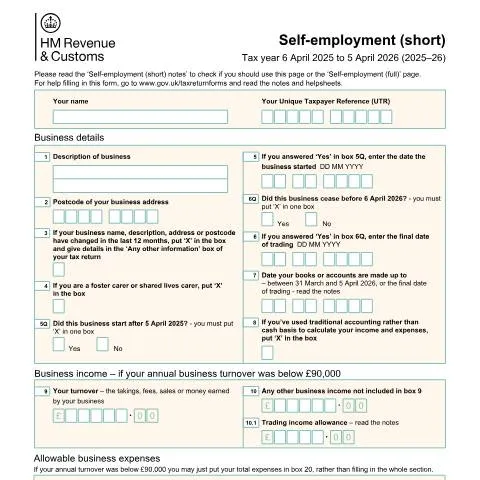
For millions of self-employed individuals across the UK, the annual Self Assessment process represents both a legal obligation and a source of considerable anxiety. Yet for those with straightforward business arrangements, HMRC's SA103S form – the Self-employment (short) page – offers a streamlined pathway through what can otherwise be a labyrinthine process. This simplified version strips away much of the complexity found in its full-length counterpart, making it particularly valuable for sole traders, freelancers, and small business owners whose annual turnover falls below £90,000.
The SA103S form serves as a supplementary page within the broader SA100 Self Assessment tax return, designed specifically for individuals whose self-employment activities are relatively uncomplicated. Unlike traditional employment where tax is deducted at source through PAYE, self-employed individuals must calculate and declare their own income and expenses, making accurate completion of this form essential for compliance with UK tax law.
What distinguishes the SA103S from standard business accounting is its focus on cash basis accounting – a method that records income when actually received and expenses when actually paid, rather than when invoiced or committed. This approach aligns more closely with how most small business owners naturally think about their finances, eliminating the need to understand complex accruals accounting principles.
Eligibility Criteria and the £90,000 Threshold
The cornerstone requirement for using the SA103S form centres on annual business turnover remaining below £90,000 during the tax year in question. This threshold isn't arbitrary – it reflects HMRC's recognition that businesses operating at this level typically have simpler financial structures and fewer complex transactions requiring detailed analysis.
Turnover calculation includes all money received from business activities: sales of goods, provision of services, fees, commissions, and any other business-related income. Crucially, it's the gross figure before deducting any expenses, and it's measured on a cash received basis rather than invoiced amounts.
Several specific circumstances can affect eligibility beyond the turnover threshold:
- Multiple business ventures: If you operate more than one self-employed business, each with turnover below £90,000, you can use separate SA103S forms for each business
- Partnership involvement: Self-employed individuals who also participate in business partnerships may still use SA103S for their sole trading activities
- Property income: Those with both self-employment and property rental income can use SA103S for the business element while completing separate property pages
- Foster and shared lives carers: Special provisions apply, with specific tick-box recognition on the form
However, certain situations preclude SA103S usage entirely. Businesses using traditional accrual accounting methods, those claiming complex capital allowances beyond standard categories, or enterprises with significant stock valuations typically require the full SA103 form instead.
Decoding Business Income Categories and Trading Allowances
The income section of SA103S appears deceptively simple, yet proper categorisation can significantly impact your tax liability. Box 9 captures your primary business turnover – the core revenue from your trade or profession. This includes sales receipts, service fees, commission payments, and any other money received in exchange for business activities.
Box 10 addresses other business income – a category often misunderstood by taxpayers. This encompasses income related to your business but not part of your main trading activities. Examples include:
- Insurance payouts for business equipment or premises
- Grants or subsidies received for business purposes
- Income from subletting part of business premises
- Interest received on business bank accounts
- Refunds of business expenses from previous years
Perhaps most significantly, Box 10.1 introduces the Trading Income Allowance – a relatively recent addition to UK tax law that can provide substantial benefits for qualifying businesses. This allowance permits eligible taxpayers to deduct up to £1,000 of trading income without needing to prove specific expenses, effectively creating a tax-free threshold for small-scale business activities.
The trading allowance operates as an alternative to claiming actual expenses, not in addition to them. Taxpayers must choose between claiming the allowance or deducting their actual business expenses – whichever proves more beneficial. For individuals with minimal business expenses but income exceeding £1,000, claiming actual expenses typically yields better results.
Navigating Allowable Business Expenses
The expenses section of SA103S provides a structured framework for claiming legitimate business costs, but the apparent simplicity masks several important considerations. HMRC permits two approaches: detailed expense categorisation using boxes 11-19, or a simplified total in box 20 for businesses with turnover below £90,000.
| Expense Category | Box Number | Key Considerations |
|---|---|---|
| Goods for resale | 11 | Raw materials, stock purchases, direct production costs |
| Car, van and travel | 12 | Must deduct private use proportion; mileage rates available |
| Staff costs | 13 | Wages, PAYE, pension contributions, but not your own salary |
| Premises costs | 14 | Rent, rates, utilities, insurance – business proportion only |
| Repairs and maintenance | 15 | Routine repairs only; improvements require capital allowance treatment |
Private use adjustments represent a common source of confusion and potential errors. Many business expenses – particularly vehicle costs, home office expenses, and mobile phone bills – include elements of private use. HMRC requires taxpayers to make reasonable estimates of business use percentages and claim only the business element.
For vehicle expenses, taxpayers can choose between claiming actual costs (fuel, insurance, repairs, depreciation) with private use deductions, or using HMRC's simplified mileage rates: 45p per mile for the first 10,000 business miles annually, then 25p per mile thereafter. The mileage approach often proves simpler for record-keeping but may not always be most beneficial financially.
Client entertaining costs are explicitly excluded from allowable expenses, reflecting long-standing UK tax policy. However, staff entertaining and reasonable hospitality as part of normal business operations may qualify, creating a nuanced distinction requiring careful consideration.
Capital Allowances and Asset Depreciation
The capital allowances section addresses one of the most complex aspects of business taxation: how to claim tax relief for business assets that provide benefit over multiple years. Unlike expenses that provide immediate deductions, capital allowances spread the cost of qualifying assets over time, reflecting their ongoing contribution to business operations.
Annual Investment Allowance (AIA) in box 23 provides the most generous relief, currently allowing 100% first-year deductions for most plant and machinery purchases up to £1 million annually. This allowance covers computers, office furniture, production equipment, and most other business assets except cars and buildings.
The Zero-emission car allowance (box 24.1) reflects government policy encouraging environmentally friendly vehicle choices. Electric cars and those with zero CO2 emissions qualify for 100% first-year allowances, while hybrid and conventional vehicles receive more limited relief through standard capital allowance rates.
Structures and Buildings Allowance (box 25.1) and its Freeport/Investment Zone variant (box 25.2) address commercial property investments. These allowances provide 3% annual deductions for qualifying commercial buildings, though complex eligibility rules and timing requirements often necessitate professional advice.
Balancing charges (box 26) capture situations where asset disposals exceed their tax written-down values, effectively clawing back excess allowances claimed in previous years. This commonly occurs when business vehicles or equipment are sold for more than their depreciated tax value.
Profit Calculation and Loss Relief Mechanisms
The transition from gross income and expenses to taxable profit involves several adjustments that can significantly impact tax liability. Box 21 captures net profit where business income exceeds allowable expenses, while box 22 addresses loss situations – both crucial for accurate tax calculation.
However, net profit for tax purposes (box 28) often differs from simple income minus expenses calculations. Additional factors include:
- Goods or services taken for personal use (box 27) – valued at cost price and added to taxable income
- Capital allowances and balancing charges from the previous section
- Trading income allowance deductions where applicable
Loss relief provisions provide valuable flexibility for businesses experiencing temporary difficulties or significant start-up costs. Current year losses can be offset against other income for the same tax year (box 33), carried back to previous years subject to specific rules (box 34), or carried forward indefinitely against future profits from the same business (box 35).
Loss carry-back rules permit offsetting current year losses against income from the three previous tax years, but only for the same business. This can generate immediate tax refunds, providing crucial cash flow relief for struggling enterprises. However, the carry-back must be claimed within specific time limits, typically four years from the end of the relevant tax year.
Forward loss relief operates differently, allowing unlimited carry-forward against future profits from the same business. These losses retain their value indefinitely but can only offset profits from the specific business that generated them, not general income from other sources.
National Insurance Implications and Construction Industry Considerations
Self-employment triggers National Insurance obligations distinct from those affecting employees, with SA103S incorporating provisions for both Class 2 and Class 4 contributions. Understanding these requirements proves essential for accurate compliance and avoiding unexpected liabilities.
Class 2 National Insurance operates as a flat-rate weekly contribution, currently £3.45 per week for the 2025-26 tax year. However, individuals with total self-employment profits below £6,845 annually are exempt from Class 2 contributions, though they may choose to pay voluntarily to maintain benefit entitlement records.
Box 36 allows voluntary Class 2 payments for those below the profit threshold. This election can prove valuable for maintaining State Pension credits and ensuring eligibility for contributory benefits like Maternity Allowance or Contribution-based Jobseeker's Allowance.
Class 4 National Insurance applies to profits exceeding £12,570 annually at 9% up to £50,270, then 2% on profits above that threshold. Certain individuals – including those over State Pension age, those with exemption certificates, and some non-residents – may claim exemption using box 37.
The Construction Industry Scheme (CIS) receives special treatment through box 38, recognising the sector's unique subcontractor arrangements. Under CIS, contractors deduct tax at source from subcontractor payments, with these deductions credited against the subcontractor's eventual tax liability. Accurate recording of CIS deductions ensures proper credit and prevents double taxation.
Submission Pathways and Deadline Management
SA103S forms cannot be submitted independently – they form part of the broader SA100 Self Assessment return, with submission options and deadlines governed by overall Self Assessment rules. The critical deadline of 31st January following the relevant tax year applies to both online and paper submissions for the 2025-26 tax year, meaning returns must be completed by 31st January 2027.
Online submission through HMRC's Self Assessment digital service offers several advantages: automatic calculations, built-in validation checks, immediate submission confirmation, and typically faster processing. The system automatically transfers figures between different sections, reducing transcription errors and ensuring mathematical accuracy.
Paper submission remains available but involves longer processing times and increased error risk. HMRC strongly encourages digital submission, and certain complex calculations may require online completion regardless of taxpayer preference. Paper forms must be posted to HMRC's centralised processing centres, with specific addresses varying by taxpayer location.
Early submission provides significant advantages beyond mere compliance. Submitting by 31st October (for online returns) or 31st December (for paper returns) allows HMRC to calculate any tax due and establish payment arrangements. Late submission triggers automatic penalties, starting at £100 regardless of whether any tax is actually due.
Payment obligations operate separately from submission requirements. Tax due must be paid by 31st January following the tax year, with penalties and interest applying to late payments. The system also requires payments on account for the following year where tax due exceeds £1,000, effectively requiring advance payments based on the current year's liability.
Record-keeping requirements extend beyond form completion, with HMRC expecting taxpayers to retain supporting documentation for at least five years after the 31st January submission deadline. Digital records are acceptable, but they must be accessible and complete, covering all income sources, expense claims, and business transactions reported on the SA103S form.