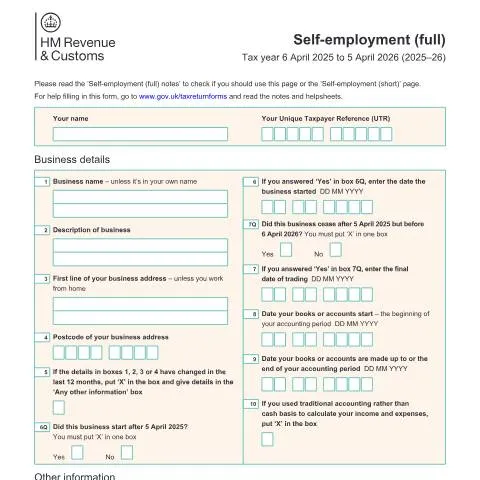
Understanding the SA103F: Your Gateway to Comprehensive Self-Employment Tax Reporting
Every January, millions of self-employed individuals across the UK face the familiar challenge of Self Assessment. Yet many find themselves puzzled when deciding between the 'short' and 'full' self-employment pages. The SA103F Self-employment (full) form represents the comprehensive route – a detailed supplementary page that forms part of your main SA100 tax return, designed specifically for those whose business affairs require more nuanced reporting than the simplified alternative allows.
This four-page supplement captures the complete financial picture of your self-employment activities for the tax year running from 6 April 2025 to 5 April 2026. Unlike its shorter counterpart, the SA103F acknowledges that business reality often involves complex expense categories, capital allowances, and accounting adjustments that cannot be squeezed into simplified boxes. Whether you're a contractor navigating Construction Industry Scheme deductions, a retailer managing substantial stock purchases, or a consultant claiming significant capital allowances on equipment, this form provides the granular detail HMRC requires for accurate tax assessment.
Decoding the Critical £90,000 Turnover Threshold
The decision between using SA103F or the shorter SA103S hinges on several factors, but the £90,000 annual turnover threshold serves as a key indicator. If your business turnover exceeded this figure during the 2025-26 tax year, you're generally required to use the full form and provide detailed expense breakdowns rather than a single total expenses figure.
However, turnover isn't the only determining factor. You must use SA103F if you operated under traditional accounting methods rather than cash basis, claimed capital allowances, or need to report specific business circumstances such as:
- Construction Industry Scheme payments to subcontractors
- Significant capital allowances on vehicles, equipment, or buildings
- Business cessation or commencement during the tax year
- Complex accounting period adjustments
- Balancing charges on asset disposals
The cash basis rules, which many smaller businesses use, allow expenses to be deducted when paid rather than when incurred. If you've opted out of cash basis accounting – perhaps because your business model makes traditional accruals accounting more suitable – the SA103F becomes mandatory regardless of turnover levels.
Navigating Business Details and Timing Complexities
The opening section of SA103F demands precision in business identification and timing details that often trip up first-time users. Box 1 requires your business name only if it differs from your personal name – a common oversight for sole traders who assume they must always provide a business name.
Boxes 6Q and 7Q address business commencement and cessation, triggering additional requirements if answered 'Yes'. Starting a business after 5 April 2025 requires the exact start date in box 6, while ceasing operations during the tax year demands the final trading date in box 7. These dates carry significant implications for your tax liability calculation and may affect your entitlement to certain allowances or reliefs.
| Business Status | Required Information | Tax Implications |
|---|---|---|
| New business (started after 5 April 2025) | Exact start date in box 6 | Pro-rated annual allowances |
| Ceased business (before 6 April 2026) | Final trading date in box 7 | Possible balancing charges on assets |
| Continuing business | Accounting period dates (boxes 8-9) | Standard allowances and reliefs |
The accounting period dates in boxes 8 and 9 define the twelve-month period your accounts cover. While many businesses align this with the tax year (6 April to 5 April), others use different year-ends for commercial reasons. Misalignment between your accounting period and the tax year can trigger adjustment calculations in later sections of the form.
Dissecting the Fifteen-Category Expense Framework
The heart of SA103F lies in its detailed expense analysis, spanning boxes 17 through 31. This granular approach serves multiple purposes: it enables HMRC to identify unusual expense patterns, supports audit trails, and ensures taxpayers consider all legitimate business costs.
Cost of goods bought for resale (box 17) captures direct costs for businesses selling physical products. This includes raw materials for manufacturers or finished goods for retailers, but excludes items used in service delivery unless they form part of the final product sold to customers.
Construction industry payments to subcontractors (box 18) specifically addresses CIS obligations. Main contractors must report gross payments made to subcontractors here, with corresponding tax deductions reported elsewhere in the Self Assessment return. This box remains zero for most non-construction businesses.
The wages, salaries and other staff costs category (box 19) encompasses all employment-related expenses, including employer's National Insurance contributions, pension contributions, and staff training costs. However, drawings or salary payments to yourself as a sole trader cannot be claimed as business expenses.
Car, van and travel expenses (box 20) often generate confusion regarding private use elements. Business mileage can be claimed at HMRC's approved rates, currently 45p per mile for the first 10,000 business miles annually, then 25p per mile thereafter. Alternatively, you can claim actual running costs proportionate to business use, but this requires detailed record-keeping.
Mastering Capital Allowances and Asset Management
The capital allowances section (boxes 49-57) represents one of the most valuable yet complex aspects of business tax relief. These allowances provide tax relief for capital expenditure on business assets, effectively allowing you to deduct the cost of equipment, vehicles, and certain buildings against your taxable profits over time.
Annual Investment Allowance (box 49) currently permits 100% first-year relief on qualifying plant and machinery expenditure, subject to annual limits. For the 2025-26 tax year, most businesses can claim AIA on expenditure up to £1 million, making this an extremely valuable relief for businesses investing in equipment.
The writing-down allowances in boxes 50 and 51 apply different rates based on CO2 emissions for vehicles. Cars with emissions of 50g/km or less qualify for the 18% rate (box 50), while higher-emission vehicles receive only 6% annual allowances (box 51). This environmental distinction incentivises businesses toward cleaner vehicle choices.
Zero-emission vehicle allowances (boxes 52 and 52.1) provide 100% first-year relief for qualifying electric goods vehicles and cars, regardless of cost. This powerful incentive supports the government's net-zero objectives while offering substantial immediate tax savings for businesses investing in clean transport.
Balancing charges (box 59) arise when assets are sold for more than their tax-written-down value, effectively clawing back excess allowances previously claimed. Conversely, balancing allowances (box 56) provide additional relief when assets are disposed of for less than their remaining tax value.
Calculating Taxable Profits Through Complex Adjustments
The final calculation section transforms your accounting profit into taxable profit through a series of adjustments that reflect the difference between commercial accounting and tax law. This process, known as 'computing taxable profits', ensures that tax is charged on the correct amount while maintaining the integrity of your business accounts.
Box 47 captures your net accounting profit (business income minus expenses), while box 48 records net losses. These figures form the starting point for tax calculations but rarely represent the final taxable amount due to various adjustments required by tax legislation.
The disallowable expenses column (boxes 32-46) identifies costs that appear in your business accounts but cannot be deducted for tax purposes. Common disallowable items include:
- Business entertainment costs (with limited exceptions)
- Fines and penalties imposed by law
- Personal elements of mixed-use expenses
- Capital expenditure incorrectly treated as revenue costs
- Provisions and reserves that don't represent actual liabilities
Box 60 addresses goods and services extracted from the business for personal use, requiring an adjustment to prevent tax avoidance through artificial expense inflation. This commonly applies to retailers who take stock for personal consumption or contractors who use business materials for private projects.
Submission Protocols and HMRC Processing Expectations
The SA103F must be submitted alongside your main SA100 Self Assessment return, sharing the same deadline structure. For the 2025-26 tax year, paper returns require submission by 31 October 2026, while online submissions have until 31 January 2027. However, any tax due remains payable by 31 January 2027 regardless of submission method.
HMRC's digital-first approach means online submission through the Government Gateway provides the most reliable route, offering immediate acknowledgment and reducing processing delays. The online system also performs basic validation checks, highlighting mathematical errors or missing mandatory fields before submission.
Your completed SA103F integrates with HMRC's risk assessment algorithms, which analyse expense ratios, profit margins, and year-on-year variations to identify returns requiring further scrutiny. Significant changes in business performance or unusual expense patterns may trigger compliance checks, making accurate record-keeping essential.
Processing typically completes within four weeks of submission for straightforward returns, with HMRC issuing a Statement of Account confirming your tax liability calculation. However, complex returns involving significant capital allowances, loss claims, or accounting adjustments may require extended processing periods as HMRC's technical teams review the computations.
Post-submission amendments remain possible through the online service for twelve months after the filing deadline, though significant changes may attract penalties if HMRC determines they result from careless or deliberate errors. The form's detailed structure supports HMRC's compliance activities while providing taxpayers with a comprehensive framework for reporting their self-employment income accurately and completely.
Navigating Capital Allowances and Business Asset Purchases
Capital allowances represent one of the most valuable yet complex aspects of SA103F completion, particularly for self-employed individuals making significant business investments. Unlike business expenses which provide immediate tax relief, capital allowances spread the cost of qualifying assets over multiple years, requiring careful planning and accurate record-keeping.
The Annual Investment Allowance (AIA) currently permits businesses to claim 100% first-year allowances on qualifying plant and machinery up to £1 million per year. This substantial relief applies to most business equipment including computers, machinery, commercial vehicles, and office furniture. However, the allowance excludes cars (except those with zero emissions), items for personal use, and assets acquired from connected parties.
For assets exceeding the AIA limit or non-qualifying items, the Writing Down Allowance (WDA) system applies different rates depending on the asset pool. Main rate assets attract an 18% annual allowance, whilst special rate assets receive 6%. Understanding which pool applies proves crucial—for instance, integral features of buildings such as lifts, escalators, and air conditioning systems fall into the special rate pool, significantly impacting long-term tax planning.
Motor vehicles require particular attention on SA103F. Cars with CO2 emissions exceeding 50g/km fall into the special rate pool, limiting annual allowances to 6%. Zero-emission vehicles qualify for 100% first-year allowances, providing immediate full relief. Commercial vehicles under 3.5 tonnes typically qualify for main rate treatment, though specific circumstances may vary.
Private use adjustments complicate capital allowance calculations when business assets serve dual purposes. HMRC expects realistic apportionment based on actual usage patterns. A computer used 70% for business and 30% personally requires corresponding restriction of allowances claimed. Maintaining detailed usage logs strengthens your position during enquiries, particularly for high-value items like vehicles or home office equipment.
Disposal of business assets triggers balancing adjustments that can create unexpected tax consequences. When disposal proceeds exceed the written-down value, a balancing charge arises, effectively clawing back excess allowances previously claimed. Conversely, disposing of assets for less than their written-down value generates balancing allowances, providing additional tax relief. Strategic timing of disposals around year-end can optimise these adjustments.
Managing Multiple Income Streams and Business Structures
Modern self-employment increasingly involves multiple income streams, partnerships, and hybrid arrangements that complicate SA103F completion. Understanding how different business structures interact with self-employment income prevents double taxation and ensures compliance with complex anti-avoidance rules.
Sole traders operating multiple unconnected businesses face decisions about whether to complete separate SA103F forms or consolidate activities. HMRC generally expects separate returns for genuinely distinct trades, particularly where different accounting periods apply or activities serve unrelated markets. However, related activities under common control may combine on a single form, simplifying administration whilst maintaining accurate profit allocation.
Partnership income requires careful coordination between partnership returns (SA800) and individual SA103F completion. Partners receive Form SA805 detailing their profit share, which transfers to their personal Self Assessment. However, partners may also conduct separate sole trade activities requiring SA103F completion alongside partnership income. Ensuring consistent treatment of shared resources and avoiding double claims for the same expenses demands meticulous record-keeping.
Limited company directors undertaking additional self-employed work must navigate complex interaction between employment income (reported on SA102) and self-employment profits (SA103F). Anti-avoidance rules, particularly IR35 legislation, may reclassify apparent self-employment as disguised employment, fundamentally altering tax treatment and National Insurance obligations.
The intermediaries legislation (IR35) scrutinises arrangements where individuals provide services through personal service companies or partnerships. Where HMRC determines that relationships would constitute employment if conducted directly, deemed employment rules apply, requiring PAYE and National Insurance deductions. This particularly affects consultants, IT contractors, and other professional service providers operating through corporate structures.
Rental income alongside self-employment creates additional complexity, particularly where properties serve business purposes. Home-based businesses may claim proportionate household expenses through SA103F whilst declaring rental income from other properties on SA105. However, renting business premises to your own company or claiming expenses for properties later rented requires careful documentation to support legitimate business purposes.
Investment income intersecting with trading activities demands precise categorisation. Dividends from companies where you hold significant stakes may constitute trading receipts if dealing in securities forms part of your business. Similarly, interest received on business accounts clearly represents trading income, whilst investment portfolio returns typically fall outside SA103F scope. Professional advice becomes invaluable when boundaries blur, particularly for financial services professionals.
Advanced Expense Strategies and Compliance Considerations
Sophisticated expense management extends beyond basic allowable costs to encompass strategic timing, apportionment methodologies, and compliance with evolving HMRC guidance. Professional self-employed individuals can legally optimise their tax position through careful expense planning whilst maintaining robust audit trails.
Research and development expenses offer enhanced relief through the SME R&D scheme, potentially providing 230% tax relief on qualifying costs. Software developers, engineers, and other technical professionals may claim enhanced deductions for staff costs, consumables, and subcontracted R&D activities. However, HMRC applies strict criteria distinguishing genuine R&D from routine product development or problem-solving.
Professional indemnity insurance, continuing professional development, and regulatory compliance costs represent significant expense categories for many self-employed professionals. Legal and accountancy fees incurred wholly for business purposes qualify for relief, though costs relating to personal matters or capital transactions require careful apportionment. Court costs defending professional negligence claims typically qualify, whilst fines and penalties remain non-deductible.
Entertainment expenses follow complex rules distinguishing staff entertainment (generally allowable) from client entertainment (typically disallowed). Annual staff parties costing up to £150 per head qualify for relief, whilst client hospitality faces blanket prohibition with limited exceptions for overseas clients visiting the UK. Marketing events require careful structuring to maximise allowable elements whilst complying with entertainment restrictions.
Bad debt provisions demand sophisticated treatment on SA103F, particularly for service providers with extended payment terms. Specific provisions against identified doubtful debts qualify for immediate relief, whilst general provisions across healthy debtor populations face restriction. Writing off genuinely irrecoverable debts provides full relief, though subsequent recoveries create taxable income requiring careful timing considerations.
Pension contributions through SA103F offer powerful tax planning opportunities beyond personal pension arrangements. Employers' contributions to staff pension schemes qualify for corporation tax relief, whilst self-employed individuals may contribute to personal arrangements or, where incorporated, company pension schemes. Annual and lifetime allowance limits require coordination across different contribution types to avoid excess charge penalties.
Pre-trading expenditure incurred up to seven years before commencing business may qualify for relief as if incurred on the first day of trading. This particularly benefits professionals establishing practices after extended qualification periods. Legal fees for lease negotiations, professional registration costs, and equipment purchases during setup phases often qualify, though personal living costs during training remain excluded.
International considerations affect SA103F completion for businesses with overseas elements. Foreign exchange gains and losses require careful tracking, particularly where trading involves significant currency exposure. Overseas business trips generate allowable travel costs, though extended periods abroad may trigger residence complications affecting overall tax liability. Professional advice becomes essential when international elements create complexity beyond straightforward domestic operations.