Multiple Employment Situations: When One Form Per Job Becomes Crucial
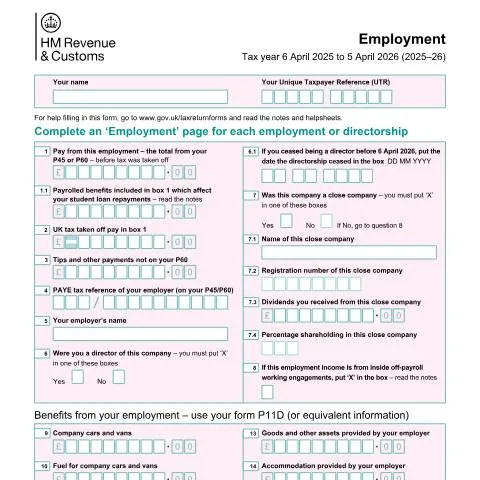
The SA102 Employment supplement represents a fundamental shift in how HMRC handles complex employment scenarios during Self Assessment. Unlike the standard employment section within the main SA100 return, this dedicated supplement accommodates taxpayers juggling multiple employments, directorships, or intricate benefit arrangements that demand granular reporting. Each SA102 form captures the complete financial picture of a single employment relationship, ensuring no income stream escapes proper taxation.
This granular approach becomes particularly vital when employment income exceeds £100,000, triggering the high income child benefit charge, or when benefits-in-kind create complex tax calculations. The form's structure reflects HMRC's recognition that modern employment patterns—from portfolio careers to executive roles with substantial perks—require more sophisticated reporting mechanisms than traditional PAYE can handle alone.
The Multi-Employment Reality
Consider a senior marketing director who also serves on three company boards whilst maintaining a consultancy role. Each position generates distinct income streams: base salary from the marketing role, director's fees from board positions, and project-based payments from consultancy work. Without separate SA102 forms for each arrangement, HMRC cannot accurately assess the overall tax liability or apply the correct rates to different income types.
The form's design accommodates this complexity through repeated sections, allowing identical information capture across varied employment relationships. This repetition isn't bureaucratic inefficiency—it's essential precision for accurate tax calculation across multiple PAYE schemes.
Decoding the P11D Connection: Benefits That Demand Declaration
The SA102's benefits section directly mirrors information from the P11D form, creating a crucial link between employer reporting and individual Self Assessment. This connection ensures that taxable benefits receive proper treatment regardless of whether the employer has correctly calculated the benefit-in-kind values.
| Benefit Category | SA102 Box | Common Scenarios | Tax Implications |
|---|---|---|---|
| Company Cars and Vans | Box 9 | Executive vehicles, pool cars with private use | Based on CO₂ emissions and list price |
| Fuel Provision | Box 10 | Fuel cards, private mileage reimbursement | Fixed charge based on vehicle type |
| Medical Insurance | Box 11 | Private healthcare, dental coverage | Full premium value taxable |
| Accommodation | Box 14 | Company flats, overseas housing | Annual value minus employee contributions |
The P11D Discrepancy Challenge
Employers occasionally miscalculate benefit values on P11D forms, creating discrepancies that surface during Self Assessment. The SA102 allows taxpayers to report correct benefit values, supported by independent valuations where necessary. This self-correction mechanism prevents HMRC from pursuing incorrect tax assessments based on flawed employer reporting.
For instance, accommodation benefits often involve complex calculations considering property values, rental equivalents, and employee contributions. When employers apply incorrect methodologies, the SA102 enables precise benefit reporting using HMRC's official calculation methods.
Director Status: Special Rules for Company Control
Questions 6 and 7 on the SA102 address directorship status and close company relationships—areas where standard employment rules give way to more complex tax arrangements. Director status fundamentally alters how HMRC views the employment relationship, introducing additional responsibilities and potential tax implications that don't apply to regular employees.
Directors face different National Insurance contribution rules, particularly regarding timing of payments and annual earnings periods. The SA102 captures these distinctions, ensuring that director's remuneration receives appropriate tax treatment regardless of when payments actually occur during the tax year.
Close Company Complexities
Close companies—essentially companies controlled by five or fewer shareholders—create unique tax scenarios for director-employees. The SA102's close company section (questions 7.1-7.4) captures both employment income and dividend receipts from the same entity, enabling HMRC to apply appropriate tax rates to each income stream.
This dual relationship often emerges in family businesses or small professional practices where individuals simultaneously serve as employees and shareholders. The form's structure prevents double taxation whilst ensuring both employment income and dividend receipts face proper tax treatment.
Off-Payroll Working: The IR35 Dimension
Box 8's focus on "inside off-payroll working engagements" reflects HMRC's ongoing emphasis on IR35 compliance. This designation signals that the engagement, whilst structured as self-employment or through an intermediary company, should be taxed as employment income due to the working relationship's characteristics.
When contractors work through personal service companies but operate under employment-like conditions—receiving regular payments, using client equipment, and lacking genuine business risk—the off-payroll working rules apply. The SA102 ensures this income receives employment tax treatment, including National Insurance contributions that wouldn't apply to genuine self-employment.
The Determination Process
Large and medium-sized clients now make off-payroll determinations before engagements commence, but contractors remain responsible for accurate Self Assessment reporting. The SA102's checkbox system enables clear identification of affected income, preventing disputes over tax treatment during HMRC investigations.
For small company clients where contractors make their own determinations, the SA102 provides a declaration mechanism that supports the chosen tax treatment. This self-assessment approach places responsibility on the contractor whilst giving HMRC clear visibility of potentially contentious arrangements.
Expense Claims: Professional Deductions Under Scrutiny
The SA102's expense section (boxes 17-20) enables claims for employment-related costs that weren't reimbursed by employers. However, these claims face increasingly stringent HMRC scrutiny, particularly following changes to travel and subsistence rules for temporary workplaces.
Business travel expenses in box 17 now require careful distinction between permanent and temporary workplace travel. The 24-month rule fundamentally changed how HMRC views workplace permanence, making many previously allowable travel claims inadmissible. Professional fees and subscriptions in box 19 demand clear employment relevance—personal development costs rarely qualify unless directly required for job performance.
Fixed Deductions and Capital Allowances
Box 18's fixed deductions accommodate employees with agreed annual expense allowances that don't require detailed receipts. These arrangements, typically negotiated for roles with predictable but varied expense patterns, require careful documentation to withstand HMRC challenges.
Capital allowances in box 20 apply to employees who purchase equipment for employment use—computers, professional tools, or specialized clothing. The annual investment allowance provides immediate tax relief for qualifying purchases, but personal use elements must be excluded from claims.
Timing and Coordination: The Self Assessment Calendar
SA102 submission follows the standard Self Assessment timeline, with the 31st January deadline applying to both online and paper submissions for the 2025-26 tax year. However, the form's complexity often demands earlier preparation, particularly when multiple employments generate extensive benefit and expense calculations.
The coordination challenge intensifies when employers provide P11D information late in the tax year. HMRC typically expects P11D forms by 6th July, but practical receipt often occurs weeks later. This timing creates pressure for Self Assessment preparation, as benefit valuations require P11D accuracy for proper SA102 completion.
Amendment Windows and HMRC Reviews
SA102 amendments follow standard Self Assessment rules, allowing corrections within 12 months of the filing deadline. However, employment-related amendments often trigger HMRC inquiries, particularly when benefit values or expense claims change significantly from previous years.
HMRC's compliance focus on employment income means SA102 forms face higher review probability than other Self Assessment supplements. The department's employment compliance teams specifically target discrepancies between P11D reporting and Self Assessment declarations, making accuracy essential for avoiding prolonged investigations.
Student Loan Interactions: The Payrolled Benefits Trap
Box 1.1's focus on "payrolled benefits included in box 1 which affect your student loan repayments" addresses a relatively recent complication in employment taxation. When employers include benefits-in-kind in regular payroll calculations—rather than collecting tax through coding adjustments—these amounts can artificially inflate student loan repayment calculations.
This technical issue particularly affects high-earning employees with substantial benefits packages. Without proper SA102 reporting, student loan repayments may exceed required amounts, with recovery requiring separate applications to the Student Loans Company. The form's specific provision for this scenario enables accurate loan liability calculation during Self Assessment processing.
The Payrolling Election Impact
Employers increasingly elect to payroll benefits-in-kind rather than using traditional P11D reporting. This approach provides employees with more predictable tax deductions but complicates Self Assessment when multiple employments involve different benefit treatment methods.
The SA102 accommodates these mixed approaches, allowing separate reporting for payrolled and non-payrolled benefits across different employments. This flexibility ensures accurate tax calculation regardless of individual employer preferences for benefit tax collection.
Record-Keeping Requirements: Documentation Beyond the P60
Successful SA102 completion demands comprehensive record-keeping extending well beyond standard P60 documentation. Employment relationships generating SA102 requirements typically involve complex arrangements requiring detailed supporting evidence for accurate reporting.
Benefit documentation must include independent valuations for accommodation or asset provision, mileage logs for company car private use, and detailed expense receipts with clear business purpose explanations. Professional subscription renewals, training course certificates, and equipment purchase invoices provide essential support for expense claims.
The multi-employment scenario compounds documentation requirements, as each position demands separate record sets. Directors face additional obligations regarding board meeting attendance, resolution documentation, and dividend payment records that support close company reporting requirements.
HMRC's digital record-keeping initiatives increasingly expect electronic documentation retention, with scanning and cloud storage replacing traditional paper filing systems. The SA102's detailed requirements make digital organization essential for efficient form completion and subsequent HMRC correspondence.
Complex Employment Scenarios and SA102 Reporting
Whilst straightforward PAYE employment typically requires minimal SA102 completion, various complex scenarios demand careful attention to specific sections of the form. Understanding these nuances ensures accurate reporting and prevents potential disputes with HMRC.
Multiple Employment Situations
When you hold multiple employments simultaneously, each position must be reported separately on SA102. This commonly affects individuals working part-time roles, seasonal positions, or those transitioning between jobs during the tax year. Each employment requires its own set of boxes, with particular attention to:
- Overlapping PAYE reference numbers from different employers
- Varying tax codes applied across positions
- Emergency tax deductions that may require adjustment
- National Insurance contributions calculated separately for each role
The form accommodates up to six separate employments directly, though additional employments require supplementary pages. When reporting multiple positions, ensure you've received P60s or P45s from each employer, as missing documentation can lead to incomplete submissions.
Director and Shareholder Complications
Company directors face unique reporting requirements on SA102, particularly when they also hold shares in their employing company. Directors' remuneration often includes complex elements beyond basic salary:
Beneficial loan arrangements from the company must be declared, including any interest below commercial rates. The taxable benefit calculation depends on the loan amount, duration, and official interest rate applicable during each period.
Share option schemes require careful reporting, especially when options vest or are exercised during the tax year. Different schemes (EMI, CSOP, SAYE) have varying tax treatments and reporting requirements.
Dividend income received as a shareholder-director must be reported elsewhere in your Self Assessment, but any salary substitute arrangements or disguised remuneration through dividends may require disclosure in the additional information sections.
International Employment Elements
UK residents with overseas employment elements, or foreign nationals working in the UK, encounter specific SA102 reporting requirements. These situations often involve:
Split-year treatment may apply when you arrive in or leave the UK during the tax year, affecting which employment income falls within UK tax scope. Each part of the year requires separate consideration of residence status and applicable reliefs.
Double taxation relief becomes relevant when you've paid foreign tax on employment income that's also taxable in the UK. This requires careful documentation of foreign tax paid and application of relevant treaty provisions.
Seafarer's earnings deduction applies to qualifying merchant seafarers, with specific conditions around voyage length, ship registration, and duties performed outside UK territorial waters. The relief can be substantial but requires detailed record-keeping of time spent at sea.
Expenses, Benefits, and Deductions Strategy
The SA102 form provides opportunities to claim legitimate employment expenses and report taxable benefits accurately, but success depends on understanding HMRC's specific requirements and maintaining appropriate evidence.
Professional Expenses and Subscriptions
Employment expenses claimable through SA102 must meet strict criteria of being wholly, exclusively, and necessarily incurred in performing your employment duties. Common qualifying expenses include:
Professional fees and subscriptions to bodies relevant to your employment are generally allowable, provided they're required for your role or maintain professional standards necessary for your work. This includes regulatory body fees for lawyers, accountants, engineers, and medical professionals.
Specialist clothing and uniforms qualify when they're distinctive occupational clothing or protective equipment required by your employer. Standard business suits don't qualify, but specialist safety equipment, branded uniforms, or professional vestments typically do.
Travel and subsistence expenses are complex, with different rules for temporary workplaces versus permanent bases. The 24-month rule affects whether accommodation and meal costs qualify for relief when working away from your normal workplace.
Home Working and Office Expenses
Since the pandemic, home working arrangements have become more prevalent, affecting SA102 reporting for many employees. HMRC recognises two approaches to claiming home working expenses:
Flat rate relief of £6 per week (£312 annually) requires no evidence but limits your claim to this amount regardless of actual costs incurred. This simplified approach suits most home workers with modest additional costs.
Actual cost method allows claims for the business proportion of household expenses including heating, lighting, insurance, and council tax. This requires detailed calculations and evidence of business use percentage, typically based on room usage and time spent working from home.
Phone and internet costs qualify when there's demonstrable business use beyond what you'd incur for personal purposes. Mobile phone contracts provided by employers create taxable benefits unless private use is insignificant.
Benefit-in-Kind Reporting Nuances
Whilst your P11D typically captures most benefits, certain situations require additional SA102 disclosure or adjustment:
Car and fuel benefits calculations can be disputed, particularly around availability periods, private use restrictions, or CO2 emissions classifications. If you believe your P11D shows incorrect figures, you can make adjustments through SA102 with supporting evidence.
Accommodation benefits have complex valuation rules, especially for job-related accommodation or properties owned by the employer. The annual value, additional facilities, and any rent paid by the employee all affect the final taxable amount.
Loan benefits depend on the official rate of interest prevailing during different parts of the tax year, and partial year calculations may be necessary when loans are taken or repaid during the year.
Timing, Amendments, and Compliance Management
Successful SA102 management extends beyond mere form completion, encompassing strategic timing decisions, amendment procedures, and ongoing compliance maintenance throughout and beyond the tax year.
Strategic Submission Timing
Whilst the Self Assessment deadline remains fixed at 31st January, the timing of your SA102 submission can have practical implications for your tax position and cash flow management.
Early submission advantages include earlier certainty about your tax liability, potential identification of errors whilst correction is straightforward, and avoiding the January rush when HMRC systems experience heavy demand. Additionally, if you owe tax, you can arrange payment plans earlier, though interest still accrues from 31st January.
Late submission considerations may be necessary when employment information arrives late, particularly P60s from slow employers or complex benefit calculations requiring employer clarification. However, automatic penalties apply from 1st February, regardless of the reason for delay.
Payment on account implications affect your timing strategy if your employment income varies significantly between years. Understanding how your current year's tax liability influences next year's payment requirements helps with cash flow planning.
Amendment Procedures and Deadlines
HMRC allows amendments to SA102 submissions within specific timeframes, but different amendment types have varying procedures and deadlines:
Customer amendments can be made online or by post within 12 months of the original submission deadline (typically by 31st January following the submission). These cover straightforward corrections like missed expenses, incorrect figures, or additional employment income.
Discovery amendments by HMRC can occur much later, particularly where they believe income has been understated or expenses overclaimed. These typically arise from employer reporting discrepancies, PAYE audits, or data matching exercises.
Error or mistake claims provide relief when you've overpaid tax due to errors in your original return, but these require formal claims and supporting evidence. The time limit is generally four years from the end of the relevant tax year.
Record Keeping and Evidence Management
Effective SA102 compliance requires systematic record keeping throughout the tax year, not just at submission time. HMRC's enquiry powers mean you may need to substantiate your return contents several years later.
Employment documentation should include all P60s, P45s, P11Ds, and any additional employer statements. Keep payslips throughout the year, particularly if they show varying deductions, bonuses, or benefits that may not appear clearly on year-end summaries.
Expense evidence requires contemporaneous records including receipts, mileage logs, home working calculations, and professional body correspondence. Credit card and bank statements alone aren't sufficient without underlying documentation showing the business purpose.
Digital record keeping is acceptable to HMRC provided records remain accessible and accurate. However, ensure backup procedures prevent data loss, and consider whether digital records will remain readable if technology changes over the statutory retention period.
Retention periods typically extend to at least five years after the 31st January submission deadline, though longer periods apply in cases of careless or deliberate errors. For complex employment situations involving international elements or substantial benefits, consider extending retention periods to protect against extended enquiry timeframes.