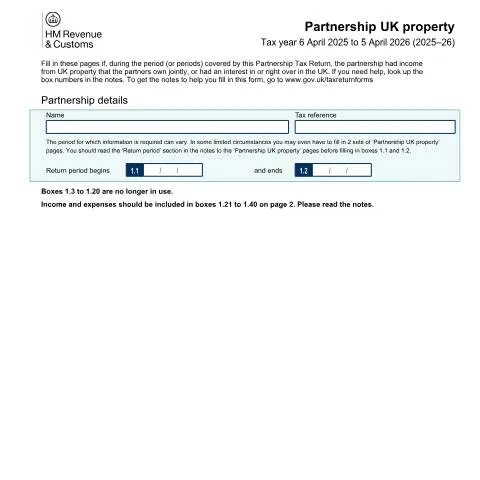
When Partnership Property Rental Income Meets Self Assessment Requirements
Property partnerships face a distinct challenge when it comes to Self Assessment reporting. Unlike individual landlords who complete the standard SA105 property pages, partnerships owning UK rental property must navigate the SA801 form – a specialised return that captures the collective property income and expenses of multiple partners. This requirement emerges whenever two or more individuals jointly own rental property, whether as formal business partners or simply as co-owners sharing rental income.
The SA801 form serves as the partnership's primary vehicle for reporting property rental activities to HM Revenue & Customs, covering everything from basic rental income to complex capital allowances. What makes this form particularly significant is its role in determining each partner's individual tax liability – the figures reported here flow directly into each partner's personal Self Assessment return, affecting their overall income tax calculation for the year.
Understanding the SA801's intricacies becomes crucial when considering that partnership property income often involves shared responsibilities, joint expenses, and proportional profit distributions that must be accurately reflected in the tax system. The form's structure reflects these complexities, requiring careful coordination between partners to ensure consistent and compliant reporting.
Decoding the SA801 Structure: Income, Expenses, and Capital Calculations
The SA801 form divides partnership property activities into clearly defined sections, each serving a specific purpose in calculating the partnership's taxable profit or loss. The income section begins with boxes 1.21 through 1.23A, capturing various forms of property-related revenue that partnerships commonly encounter.
Property Income Categories and Their Implications
Box 1.21 handles standard rental income – the monthly or quarterly payments received from tenants. However, partnerships must be particularly careful about timing differences when multiple partners collect rents on behalf of the partnership. The cash basis versus traditional accounting choice, indicated by box 1.22A, significantly impacts how this income is reported and when it's recognised for tax purposes.
Chargeable premiums, reported in box 1.23, require special attention in partnership contexts. When tenants pay premiums for lease arrangements, the tax treatment depends on the lease length and the partnership's accounting method. Reverse premiums in box 1.23A capture situations where landlords pay tenants – increasingly common in commercial property partnerships seeking to attract quality tenants in challenging market conditions.
| Income Type | Box Reference | Partnership Considerations |
|---|---|---|
| Standard Rental Income | 1.21 | Ensure all partners report consistently |
| Chargeable Premiums | 1.23 | Calculate based on lease terms and partnership share |
| Reverse Premiums | 1.23A | Consider timing of payment and tax relief |
Expense Allocation Across Partnership Activities
The expense section, spanning boxes 1.25 through 1.30, requires partnerships to categorise costs accurately while ensuring proper allocation between partners. Rent, rates, insurance, and ground rents in box 1.25 typically represent the most straightforward expenses, but partnerships must document how these costs are shared, especially when properties are owned in unequal proportions.
Box 1.27 addresses non-residential property finance costs, a category that has gained importance following recent tax changes affecting residential property interest relief. Partnerships with mixed property portfolios must carefully segregate these costs to ensure proper tax treatment.
Professional costs in box 1.28 often generate questions in partnership contexts. Legal fees for lease negotiations, surveyor costs, and accountancy expenses must be allocated appropriately, considering which partner initiated the expenditure and whether it benefits the entire partnership or specific properties.
Capital Allowances Strategy for Partnership Property Ventures
The capital allowances section of SA801 presents unique opportunities and challenges for property partnerships. Unlike individual landlords, partnerships must coordinate their capital expenditure decisions to maximise tax efficiency across all partners' circumstances.
Annual Investment Allowance Coordination
Box 1.35A captures the Annual Investment Allowance, currently set at £1 million for most businesses. Property partnerships can claim this allowance on qualifying plant and machinery, but the allowance must be shared across all the partnership's activities, not just property rental. This requires careful planning when partnerships engage in multiple business activities or when partners have other business interests.
The Electric charge-point allowance in box 1.35B reflects the government's push towards electric vehicle infrastructure. Property partnerships installing charging points for tenants can claim 100% first-year allowances, making this an attractive investment for forward-thinking partnerships with commercial or residential properties.
Structures and Buildings Allowance Applications
Boxes 1.35C and 1.35D address the Structures and Buildings Allowance, including the enhanced rates available in Freeports and Investment Zones. Property partnerships acquiring or renovating qualifying commercial buildings can claim these allowances at 3% annually, or higher rates in designated areas.
The key challenge for partnerships lies in documenting the qualifying expenditure and ensuring all partners understand how these long-term allowances will affect their individual tax positions over the 33-year claim period (or shorter periods in enhanced zones).
Residential Property Finance Costs: Partnership Implications
Box 1.40 handles residential property finance costs – a critical area where partnership taxation differs significantly from individual property investment. The restriction of interest relief to basic rate tax has created complex planning opportunities for property partnerships.
When partnerships own residential rental property, mortgage interest and other finance costs cannot be deducted from rental income in the traditional manner. Instead, these costs receive basic rate tax relief through the tax system. For partnerships where some partners are higher rate taxpayers and others are basic rate taxpayers, this can create uneven tax impacts that require careful consideration in profit-sharing arrangements.
Partnerships must track residential finance costs separately from non-residential property costs, as the latter continue to receive full deduction against rental profits. This segregation becomes particularly important for partnerships with mixed property portfolios or those considering refinancing arrangements.
Strategic Considerations for Multi-Rate Partnerships
When partnership members have different marginal tax rates, the restricted relief on residential finance costs can create imbalances. A basic rate taxpayer partner receives the same proportional relief as a higher rate taxpayer partner, despite their different overall tax positions. Some partnerships address this through profit-sharing adjustments that account for these differential impacts, though such arrangements require careful documentation and legal advice.
Navigating Return Periods and Multiple Property Accounting Periods
Boxes 1.1 and 1.2 on the SA801 form capture the return period, but partnerships face unique complications when property acquisitions, disposals, or accounting period changes occur during the tax year. The form's notes specifically mention that limited circumstances may require completing two sets of partnership property pages – a situation that arises more frequently in active property partnerships.
When Multiple Return Periods Apply
Property partnerships may encounter multiple return periods when they change their accounting date, acquire properties with different accounting periods, or restructure during the tax year. For instance, if a partnership acquires a property business from another entity mid-year, they might need to report two distinct periods: their own trading period and the acquired business's period.
The complexity increases when partnerships operate across different property types or geographical areas with varying accounting requirements. Mixed-use properties or properties with seasonal letting patterns may require separate period calculations to ensure accurate tax reporting.
Coordination with Individual Partner Returns
The figures from SA801 flow directly into each partner's individual Self Assessment return, specifically affecting their property income calculations. Partners must ensure their individual returns reflect the same accounting periods and profit shares reported in the partnership return. Discrepancies between partnership and individual returns frequently trigger HMRC enquiries, making consistency crucial.
| Return Period Scenario | SA801 Requirement | Partner Impact |
|---|---|---|
| Standard tax year | Single return period | Straightforward individual reporting |
| Mid-year acquisition | Potentially two periods | Adjusted profit shares and timing |
| Accounting date change | Transitional period calculations | Complex individual return implications |
Compliance Coordination and HMRC Interaction Protocols
Property partnerships face enhanced scrutiny from HMRC, particularly regarding profit allocation consistency and expense legitimacy. The SA801 form serves as HMRC's primary tool for identifying discrepancies between partnership reporting and individual partner returns, making accurate completion essential for avoiding unwanted attention.
Partnership Statement Integration Requirements
The SA801 form explicitly requires copying specific figures to the Partnership Statement (Full), creating multiple cross-references that HMRC uses for consistency checking. Box 1.39 figures must appear in box 19 of the Partnership Statement, while box 1.40 transfers to box 26. These cross-references create an audit trail that HMRC can easily verify using automated systems.
When partnerships fail to maintain consistency across these forms, HMRC's processing systems flag the discrepancies for manual review. This can delay processing and increase the likelihood of formal enquiries, particularly when the amounts involved are substantial or when patterns suggest systematic under-reporting.
Record-Keeping Standards for Partnership Properties
HMRC expects property partnerships to maintain detailed records supporting all SA801 entries, with particular attention to expense allocation methodologies and capital allowance calculations. Unlike individual landlords, partnerships must document decision-making processes and partner agreement terms that affect tax reporting.
The digital record-keeping requirements under Making Tax Digital may eventually extend to property partnerships, requiring real-time or quarterly reporting of rental income and expenses. Partnerships should consider implementing systems now that can accommodate these potential changes while ensuring current compliance standards are met.
Strategic Tax Planning Through Partnership Property Structures
The SA801 form reveals opportunities for sophisticated tax planning that individual property investors cannot access. Property partnerships can structure their affairs to optimise tax efficiency across multiple partners with different circumstances, income levels, and tax planning objectives.
Profit Sharing Optimisation Strategies
While partnerships must reflect genuine commercial arrangements, there's considerable flexibility in structuring profit-sharing arrangements to achieve tax efficiency. Partners with different marginal tax rates can benefit from arrangements that allocate income and expenses to minimise the overall partnership tax burden, provided these arrangements reflect genuine commercial substance.
The restriction on residential property finance cost relief creates particular opportunities for asymmetric profit sharing, where partners with lower marginal tax rates absorb a greater proportion of profits affected by these restrictions, while higher rate taxpayers benefit from allowable expense deductions.
Capital Allowances Coordination Across Partners
Property partnerships can coordinate capital expenditure timing across multiple properties and partners to maximise Annual Investment Allowance utilisation. Unlike individual investors limited to their personal circumstances, partnerships can plan expenditure across the entire partnership's activities, potentially accessing higher allowance thresholds and better timing opportunities.
The Structures and Buildings Allowance provides long-term planning opportunities for partnerships willing to coordinate their property development and acquisition strategies. By understanding how these allowances interact with individual partners' tax positions, partnerships can make more informed investment decisions that benefit all participants.
Managing Partnership Property Transitions and Structural Changes
The SA801 form must accommodate various partnership lifecycle events, from initial formation through expansion, partner changes, and eventual dissolution. Each transition creates specific reporting requirements that affect both the partnership return and individual partner obligations.
Partner Entry and Exit Implications
When new partners join existing property partnerships, the SA801 reporting must reflect changed profit-sharing arrangements and potential adjustments for capital contributions or property revaluations. The form's structure allows for mid-year changes, but partnerships must carefully document the effective dates and proportional allocations to ensure accurate reporting.
Partner exits create more complex issues, particularly when departing partners retain interests in specific properties or receive capital distributions. The SA801 must reflect these changes while ensuring continuity of tax reporting for ongoing partnership activities.
Property Portfolio Restructuring Through Partnership Vehicles
Established property partnerships often use the SA801 reporting framework to facilitate portfolio restructuring, whether through property transfers between partnerships, conversions to limited liability partnerships, or preparations for incorporation. Each restructuring scenario requires careful consideration of tax implications and reporting continuity.
The form's flexibility in handling multiple return periods becomes crucial during restructuring, allowing partnerships to maintain compliant reporting while implementing strategic changes. However, partnerships must ensure that restructuring activities don't inadvertently create gaps or overlaps in tax reporting that could attract HMRC attention or create compliance issues for individual partners.