When Rental Property Income Demands the SA105: Understanding Your UK Tax Obligations
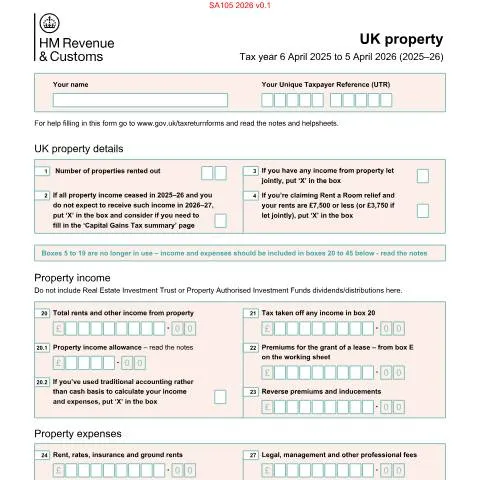
The SA105 form sits at the heart of UK rental property taxation, serving as the dedicated supplementary page for Self Assessment returns where property income takes centre stage. For the 2025-26 tax year, landlords across England, Scotland, Wales and Northern Ireland must navigate this two-page document to declare rental income exceeding £1,000 annually, alongside the complex web of allowable expenses and capital allowances that shape their final tax liability.
Unlike other Self Assessment supplements that deal with employment or business income, the SA105 specifically handles the unique challenges of property taxation: from Rent a Room relief calculations to the intricate residential property finance costs restrictions introduced in recent years. Whether you're managing a single buy-to-let property or an extensive portfolio, this form captures the financial reality of UK property investment with precision that directly impacts your tax bill.
The Landlord's Profile: Who Must Complete This Supplementary Return
The SA105 becomes mandatory for UK taxpayers whose rental property income exceeds the £1,000 property income allowance threshold during the 2025-26 tax year. This encompasses a diverse spectrum of property investors, each facing distinct reporting requirements based on their specific circumstances.
Individual Buy-to-Let Investors
Single property owners letting residential accommodation represent the largest group of SA105 users. Whether you've inherited a property and decided to rent it out, or deliberately invested in buy-to-let, any gross rental income above £1,000 triggers the requirement to complete this form. This threshold applies regardless of whether you ultimately make a profit after expenses.
Portfolio Landlords and Property Businesses
Investors managing multiple rental properties must aggregate their total rental income across all UK properties when determining SA105 obligations. The form accommodates this complexity through box 1, where you declare the number of properties in your portfolio, enabling HMRC to understand the scale of your rental operation.
Joint Property Ownership Scenarios
Married couples, civil partners, or business partners who jointly own rental property face specific reporting requirements. Box 3 of the SA105 requires an 'X' if you receive income from jointly let property, triggering additional considerations around how rental profits and losses are allocated between parties for tax purposes.
Rent a Room Participants
Homeowners utilising the Rent a Room scheme occupy a unique position within SA105 requirements. If your rental income from lodgers remains at or below £7,500 annually (or £3,750 for joint ownership), you can claim complete tax exemption by marking box 4. However, those exceeding these thresholds must still complete the full SA105, though they may elect to use the scheme's alternative calculation method.
Decoding Property Income: Beyond Simple Rental Receipts
The SA105's income section captures far more than monthly rent payments, reflecting the complex nature of modern property investment returns. Understanding each income category ensures accurate reporting and prevents costly oversights during HMRC reviews.
Core Rental Income and the Property Income Allowance
Box 20 records your total rental income, encompassing monthly rent, service charges passed to tenants, and any additional property-related income streams. The adjacent box 20.1 allows you to claim the property income allowance up to £1,000, which directly reduces your taxable income without requiring proof of actual expenses.
This allowance operates on an either/or basis: you can claim the full £1,000 allowance or deduct your actual property expenses, but not both. For landlords with minimal expenses, the allowance often provides greater tax benefits than itemising actual costs.
Lease Premiums and Commercial Arrangements
Box 22 captures premiums received for granting leases, particularly relevant for landlords dealing with commercial tenants or longer-term residential arrangements. These premiums face special tax treatment, with only a portion typically taxable as income in the year received, while the remainder may qualify for capital treatment.
Reverse premiums and inducements (box 23) handle situations where landlords pay tenants to enter leases or make property improvements, creating taxable income that must be declared even though no cash changed hands in the landlord's favour.
Tax Deducted at Source
Box 21 becomes crucial when dealing with corporate tenants or property management companies that deduct tax before paying rental income. This commonly occurs with commercial lettings where tenants withhold basic rate tax, requiring careful record-keeping to ensure proper credit against your final tax liability.
| Income Type | SA105 Box | Special Considerations |
|---|---|---|
| Monthly rental payments | 20 | Include service charges passed to tenants |
| Lease premiums | 22 | May qualify for spreading over lease term |
| Reverse premiums | 23 | Taxable even when no cash received |
| Tax deductions | 21 | Credit against final tax bill |
Navigating Allowable Expenses: Maximising Your Property Tax Relief
The SA105's expense section (boxes 24-29) represents where most landlords can significantly reduce their tax liability through legitimate business deductions. However, HMRC's scrutiny of property expenses has intensified, making accurate categorisation and documentation essential.
Core Property Running Costs
Box 24 encompasses the fundamental costs of property ownership: rent (for leasehold properties), business rates, buildings insurance, and ground rents. These expenses typically qualify for full tax relief, provided they relate wholly to the rental business rather than personal use.
Property repairs and maintenance (box 25) attract particular HMRC attention, as the distinction between allowable repairs and capital improvements significantly impacts tax treatment. Repairs that restore property to its previous condition qualify for immediate tax relief, while improvements that enhance the property beyond its original state may only qualify for capital allowances.
Professional and Management Expenses
Box 27 captures legal fees, property management charges, accountancy costs, and other professional services directly related to your rental business. Estate agent fees for finding tenants qualify for immediate relief, while legal costs for purchasing property typically form part of the capital cost rather than allowable expenses.
Service costs and wages (box 28) cover payments to gardeners, cleaners, maintenance contractors, and any employees directly involved in property management. These expenses must be supported by proper documentation and relate exclusively to the rental business.
Finance Costs and Recent Legislative Changes
The treatment of property finance costs has undergone significant changes, creating a complex landscape that the SA105 addresses through multiple boxes. Box 26 handles non-residential property finance costs, which continue to receive full tax relief as allowable expenses.
However, residential property finance costs (box 44) face restricted relief under rules introduced from April 2017. Rather than reducing rental income directly, these costs now qualify only for basic rate tax relief, regardless of your marginal tax rate. This fundamental change has substantially increased the tax burden for higher-rate taxpaying landlords.
Capital Allowances and Investment Incentives: Claiming Your Due
The SA105's capital allowances section (boxes 32-35) offers landlords opportunities to claim tax relief on property investments and improvements, though residential property faces more restrictions than commercial lettings.
Annual Investment Allowance Opportunities
Box 32 enables landlords to claim Annual Investment Allowance (AIA) on qualifying plant and machinery purchases. For the 2025-26 tax year, this allowance permits 100% first-year relief on eligible items up to the annual limit, providing immediate tax benefits for property investment.
Typical qualifying items include boilers, kitchen appliances provided for tenant use, carpets, and furniture in furnished lettings. However, items with expected lives exceeding 25 years typically qualify for the less generous Structures and Buildings Allowance instead.
Structures and Buildings Allowance
Box 33 captures relief under the Structures and Buildings Allowance, introduced to provide tax relief on construction and renovation costs at a flat 3% annual rate. This allowance particularly benefits landlords undertaking significant property improvements or developing new rental properties.
The enhanced allowances for Freeport and Investment Zones (box 33.2) offer accelerated relief rates for qualifying properties in designated areas, reflecting government policy to encourage investment in specific economic development zones.
Environmental and Technology Incentives
Box 33.1 addresses the electric charge-point allowance, enabling landlords to claim relief on electric vehicle charging infrastructure. This relatively new allowance reflects environmental policy objectives while providing practical tax benefits for forward-thinking property investors.
Zero-emission car allowances (box 34.1) extend environmental incentives to landlords using electric vehicles in their property business, though this typically applies mainly to larger portfolio investors or property management companies.
Residential Property Finance Costs: Understanding the Tax Restriction
The residential property finance costs restriction represents one of the most significant changes to UK property taxation in recent decades, fundamentally altering the tax landscape for leveraged property investors. The SA105 dedicates considerable space to capturing these costs and calculating their restricted relief.
The Mechanics of Finance Cost Restriction
Box 44 requires landlords to separately declare residential property finance costs, which include mortgage interest, arrangement fees, and other borrowing costs related to residential rental properties. Unlike other allowable expenses, these costs no longer reduce rental income pound-for-pound.
Instead, residential finance costs receive tax relief equivalent to basic rate tax (currently 20%), regardless of the landlord's marginal tax rate. This creates a significant disadvantage for higher and additional rate taxpayers, who previously enjoyed relief at their marginal rates of 40% or 45%.
Carrying Forward Unused Relief
Box 45 captures unused residential property finance costs brought forward from previous years. When rental profits are insufficient to fully utilise finance cost relief in the current year, the unused portion carries forward indefinitely until sufficient profits arise to absorb the relief.
This carry-forward mechanism provides some protection for landlords experiencing temporary rental voids or high maintenance costs, ensuring that finance cost relief isn't permanently lost due to timing differences.
Strategic Implications for Property Investors
The finance cost restriction has prompted many landlords to reconsider their investment structures. Some have transferred properties into limited companies, where full finance cost relief remains available, while others have reduced borrowing levels to minimise the restriction's impact.
The SA105 captures these costs with clinical precision, but the strategic response to the restriction often requires broader restructuring beyond the scope of annual tax returns.Profit, Loss, and Carry-Forward Calculations: The Bottom Line
The SA105's final section transforms rental income and expenses into the figures that ultimately determine your tax liability. This calculation process involves several steps that can significantly impact your overall tax position.
Determining Adjusted Profit or Loss
Boxes 38 and 41 require landlords to calculate their adjusted profit or loss using the working sheets provided in HMRC's notes. These calculations involve adding back any disallowable expenses, accounting for capital allowances, and making adjustments for private use where properties serve dual purposes.
The working sheet methodology ensures consistency across different landlord situations while capturing the complex interactions between various income streams and expense categories that characterise modern property investment.
Loss Relief and Carry-Forward Provisions
Property losses receive favourable tax treatment, with box 39 enabling landlords to utilise losses brought forward from previous years against current profits. This loss relief operates automatically, reducing taxable profits without requiring separate claims or elections.
Box 42 handles the unusual situation where landlords elect to set current year losses against their total income for 2025-26, providing immediate tax relief rather than carrying losses forward. However, this election typically proves beneficial only when landlords have substantial other income and face time constraints on utilising property losses.
The Final Taxable Position
Box 40 captures the taxable profit that flows through to your main Self Assessment return, where it combines with other income sources to determine your overall tax liability. This figure represents the culmination of all SA105 calculations and directly impacts your tax bill.
For landlords reporting losses, box 43 calculates the amount carrying forward to future years, including any unused losses from previous periods. These carried-forward losses provide valuable tax relief against future property profits, creating a reservoir of relief for successful rental periods.
Cash Basis vs Traditional Accounting: A Critical Election
Box 20.2 of the SA105 requires landlords to indicate whether they've used traditional accruals accounting rather than the default cash basis. This seemingly simple tick box represents a fundamental choice that affects how rental income and expenses are recognised for tax purposes.
Cash Basis: The Default Position
Under cash basis accounting, rental income is recognised when received, and expenses are deductible when paid. This approach aligns tax liabilities with actual cash flows, providing predictability and simplicity for most landlords.
The cash basis particularly suits smaller landlords with straightforward rental arrangements, as it eliminates complex accruals calculations and reduces compliance burdens. However, it also restricts certain reliefs, including capital allowances on most assets and some finance cost deductions.
Traditional Accounting: Enhanced Flexibility
Landlords can elect to use traditional accruals accounting, where income and expenses are recognised when earned or incurred rather than when cash changes hands. This approach offers access to the full range of capital allowances and may provide timing advantages in certain circumstances.
However, traditional accounting requires more sophisticated record-keeping and may create tax liabilities before rental income is actually received, particularly problematic when dealing with difficult tenants or rent arrears.
The election between cash basis and traditional accounting cannot be changed frequently, making the initial choice crucial for landlords' long-term tax planning strategies.
Cessation of Rental Business: Managing Property Disposals
Box 2 of the SA105 addresses the specific situation where landlords have ceased their rental activities during 2025-26 and don't expect to resume property letting in the following tax year. This scenario triggers important considerations around final tax returns and potential capital gains implications.
Final Year Reporting Requirements
When marking box 2, landlords must ensure their SA105 captures all rental income and expenses up to the cessation date, including any terminal expenses associated with ending the rental business. This includes final utility bills, end-of-tenancy cleaning costs, and professional fees for property sales or transfers.
The cessation also crystallises any unused losses or capital allowances, which may require different treatment compared to ongoing rental businesses. Unused losses typically remain available for offset against future property income, even if the landlord subsequently resumes property letting after a break.
Capital Gains Tax Implications
Box 2 specifically mentions considering whether to complete the Capital Gains Tax summary page, reflecting the common situation where rental business cessation coincides with property disposal. Former rental properties often qualify for various capital gains reliefs unavailable to investment properties held for capital appreciation alone.
The interaction between final rental profits and capital gains calculations can be complex, particularly where landlords have claimed capital allowances that create balancing charges upon disposal or where properties have been used for both rental and personal purposes during the ownership period.