The Critical Role of Property Valuation in Estate Administration
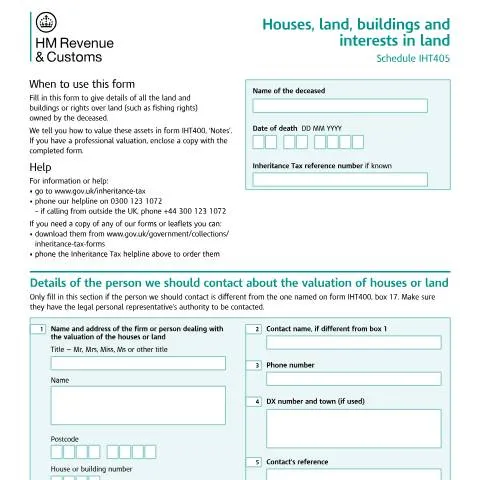
When someone dies owning property in the UK, their personal representatives face a complex web of valuation requirements that can significantly impact the Inheritance Tax liability of the estate. Form IHT405 sits at the heart of this process, serving as HMRC's comprehensive mechanism for capturing details of every house, building, plot of land, and property-related right that formed part of the deceased's assets. Unlike simpler financial assets with clear market values, property requires careful documentation of tenure arrangements, letting agreements, and potential reliefs that could dramatically alter the tax calculation.
The form becomes particularly crucial when estates approach or exceed the nil-rate band threshold, currently £325,000, where every pound of accurate valuation matters. For properties qualifying for Agricultural Relief, Business Relief, or heritage exemptions, the stakes become even higher, as incorrect declarations can trigger substantial penalties and interest charges from HMRC.
Navigating Complex Property Ownership Structures
Modern property ownership rarely follows simple patterns, and IHT405 reflects this reality through its detailed sections addressing various tenure types and ownership arrangements. Freehold properties represent the most straightforward scenario, where the deceased owned both the land and any buildings outright. However, leasehold arrangements introduce additional complexity, requiring personal representatives to specify the remaining lease term and annual ground rent obligations.
The form's structure acknowledges that many deceased individuals owned properties with active tenancy agreements. Each letting arrangement demands comprehensive documentation, including:
- Complete copies of lease agreements, subleases, or tenancy documents
- Rental income details and review mechanisms
- Responsibility allocation for property maintenance and outgoings
- Tenant identification and contact information
- Specific terms for agricultural or business tenancies
For vacant properties at the date of death, the form requires clear notation of this status, as vacant possession can significantly affect market valuation. Properties undergoing renovation, suffering from disrepair, or subject to planning restrictions may command different values than comparable occupied properties in good condition.
Strategic Relief Applications and Their Financial Impact
The most financially significant aspect of IHT405 involves the calculation and application of various tax reliefs available for qualifying properties. The form dedicates specific columns to Agricultural Relief, Business Relief, Woodlands Relief, and heritage exemptions, each carrying distinct qualification criteria and percentage relief rates.
| Relief Type | Typical Rate | Key Qualification Requirements | Documentation Needed |
|---|---|---|---|
| Agricultural Relief | 100% or 50% | Working farmland, occupied for agricultural purposes | Form IHT414, tenancy agreements, land use evidence |
| Business Relief | 100% or 50% | Property used in qualifying business activities | Form IHT413, business accounts, usage documentation |
| Woodlands Relief | 100% | Commercial woodland management | Management plans, forestry documentation |
| Heritage Exemption | 100% | Outstanding historic or architectural merit | Heritage body assessments, access undertakings |
Recent legislative changes have introduced significant modifications to relief calculations. For deaths occurring on or after 6 April 2026, a combined relief cap of £2.5 million applies to Agricultural and Business Relief at 100%. Property values exceeding this threshold qualify for relief at only 50%, potentially creating substantial additional tax liabilities for larger estates. This change particularly affects farming families and business owners who previously relied on full relief for property-heavy estates.
The legislation also permits the transfer of unused relief allowances from deceased spouses or civil partners, provided claims are submitted within four years of the survivor's death or within six months of personal representatives assuming their duties. This provision requires careful coordination with the main IHT400 form and supporting documentation.
Professional Valuation Requirements and Quality Standards
HMRC expects property valuations to meet professional standards, particularly for significant assets or those claiming relief. The form specifically requests copies of professional valuations when available, and the accompanying guidance in form IHT400 outlines acceptable valuation methodologies.
Qualified surveyors typically provide the most robust valuations, especially for:
- Commercial properties with complex letting arrangements
- Agricultural land with development potential
- Historic properties requiring specialist knowledge
- Properties affected by environmental factors or restrictions
The form's design accommodates situations where professional valuers handle the assessment process. Section 1 allows personal representatives to designate different contact persons for valuation queries, ensuring HMRC can communicate directly with property professionals while maintaining appropriate authorisation from legal personal representatives.
For properties without clear market comparables, such as unique historic buildings or specialist agricultural facilities, professional valuations become essential. HMRC's Valuation Office Agency may challenge amateur assessments, particularly where significant tax advantages depend on the declared values.
Documentation Strategies for Complex Property Portfolios
Deceased individuals with substantial property holdings present particular challenges for IHT405 completion. The form acknowledges this reality by permitting multiple form submissions for extensive portfolios, but this approach requires careful coordination to ensure complete coverage without duplication.
Each property entry demands specific supporting documentation:
- Title deeds and registration documents establishing ownership and tenure details
- Current tenancy agreements for let properties, including rent review clauses and break options
- Planning permissions or restrictions that might affect development potential
- Environmental reports highlighting contamination, flooding risks, or conservation designations
- Structural surveys identifying significant repair requirements or building defects
For properties without conventional addresses, such as agricultural land or woodland, the form requires detailed boundary plans clearly showing the extent of ownership. Ordnance Survey extracts often provide the necessary detail, but larger holdings may require professional surveying to establish precise boundaries.
Special Circumstances Affecting Property Values
Section 8 of IHT405 addresses special factors that might influence property valuations, recognising that standard market assessments may not capture all relevant circumstances. Major structural damage represents one common scenario, particularly where building insurance claims are pending or where damage occurred close to the date of death.
Development potential creates another complex valuation scenario. Properties with planning permission for extensions, conversions, or redevelopment may command premium values, but this potential must be balanced against implementation costs and market conditions. The form requires detailed explanations of such factors, supported by planning documentation and professional assessments where available.
Environmental constraints can significantly impact property values, including:
- Flood risk designations affecting insurance and marketability
- Conservation area restrictions limiting development options
- Listed building status requiring specialist maintenance approaches
- Contaminated land issues affecting future use potential
The form's flexible structure allows personal representatives to provide comprehensive explanations of these factors, ensuring HMRC's valuation specialists receive complete information for accurate assessment purposes.
Integration with the Broader Inheritance Tax Process
IHT405 operates as a crucial component within the broader Inheritance Tax framework, requiring careful integration with the main IHT400 return and various supplementary schedules. The form's totals feed directly into specific boxes on the main return, with different property categories allocated to distinct sections reflecting their tax treatment.
Properties qualifying for relief require additional form submissions. Business Relief claims necessitate completion of form IHT413, detailing the business activities that justify the relief claim. Agricultural Relief applications require form IHT414, providing comprehensive information about farming activities and land use patterns.
The timing of IHT405 submission aligns with broader Inheritance Tax deadlines, typically twelve months after the end of the month in which death occurred. However, personal representatives often require additional time for complex property valuations, and HMRC may grant extensions where reasonable justification exists.
For estates requiring immediate property sales to meet tax obligations, the form's completion becomes urgent. Conditional exemption properties or those subject to heritage undertakings may require specialist legal advice before any disposal decisions, as premature sales could trigger retrospective tax charges.
Managing Valuation Disputes and HMRC Challenges
Property valuations frequently attract HMRC scrutiny, particularly where substantial relief claims reduce tax liabilities or where declared values appear inconsistent with local market conditions. The Valuation Office Agency conducts systematic reviews of property declarations, often requesting additional documentation or commissioning independent valuations.
Personal representatives can strengthen their position by maintaining comprehensive valuation files, including:
- Contemporary market evidence supporting declared values
- Professional correspondence detailing valuation methodologies
- Photographs documenting property condition at the relevant date
- Expert reports addressing any special circumstances or constraints
Where disputes arise, the formal appeals process allows challenges to HMRC determinations, but success depends heavily on the quality of supporting evidence provided with the original IHT405 submission. Retrospective valuation exercises often prove more difficult and expensive than comprehensive initial assessments.
The form's emphasis on professional contact details reflects HMRC's preference for direct communication with qualified valuers during any challenge process. Ensuring authorised professionals remain available throughout the estate administration period helps facilitate efficient resolution of valuation queries and reduces delays in estate finalisation.
Valuation Methods and Professional Requirements for Property Assets
Accurate valuation of property assets forms the cornerstone of Inheritance Tax reporting to HMRC. The valuation date is typically the date of death, though different rules may apply for gifts made within seven years of death or assets held in trust.
For residential properties, HMRC expects valuations to reflect the open market value - the price the property might reasonably fetch if sold on the open market at the valuation date. This includes considering factors such as location, condition, size, and local market conditions at the time. You must account for any restrictions on the property, such as agricultural ties, listed building constraints, or leasehold arrangements that might affect marketability.
Professional valuations become mandatory when the gross value of the estate exceeds £325,000 (the current nil-rate band threshold). HMRC accepts valuations from qualified surveyors who are members of the Royal Institution of Chartered Surveyors (RICS). The surveyor must provide a detailed report including comparable sales evidence, methodology used, and any assumptions made during the valuation process.
Commercial properties require specialist commercial property valuers familiar with investment yields, rental values, and market conditions in the relevant sector. Agricultural land demands expertise in factors such as milk quotas, single farm payments, and agricultural tenancies under the Agricultural Holdings Act 1986 or Agricultural Tenancies Act 1995.
For unusual properties - such as historic buildings, properties with development potential, or those subject to planning restrictions - HMRC may request additional supporting evidence. This could include planning permissions, conservation area restrictions, or specialist heritage property valuations.
When multiple properties are involved, consider whether any discount for related property applies. HMRC recognises that a portfolio of similar properties might be worth less than the sum of individual valuations due to flooding the local market. However, such discounts require robust professional support and detailed justification.
Overseas properties present additional complexity, requiring valuations in local currency converted to Sterling at the exchange rate prevailing on the date of death. You must also consider any local taxes or restrictions that might affect the UK valuation for Inheritance Tax purposes.
Joint Ownership Structures and Their Inheritance Tax Implications
The way property is owned significantly impacts how it's reported for Inheritance Tax purposes, with joint tenancy and tenancy in common creating different obligations and reliefs.
Under joint tenancy (joint ownership with right of survivorship), the deceased's interest passes automatically to the surviving joint owner(s) by operation of law. For Inheritance Tax purposes, you must still report the deceased's share of the property value. HMRC typically treats this as 50% of the total value for two-person joint tenancy, though this can vary if contributions to purchase or improvement were unequal.
Tenancy in common allows owners to hold specific percentage shares, which form part of the deceased's estate and can be left by will. The valuation must reflect any discount applicable to a minority share - a 25% stake in a property may be worth less than 25% of the whole property value due to lack of control and restricted marketability.
Matrimonial homes benefit from special considerations. The surviving spouse exemption means transfers between spouses or civil partners are generally exempt from Inheritance Tax, regardless of the property value. However, you must still report these transfers accurately, particularly where the surviving spouse is not UK-domiciled, as different rules and annual limits may apply.
Business property relief may apply to certain jointly-owned commercial properties, potentially reducing the Inheritance Tax liability by up to 100%. This relief requires the property to qualify as a business asset and may depend on factors such as whether the property was used in the deceased's business or let to a partnership in which the deceased was a partner.
For properties owned through companies or partnerships, the deceased's share is typically valued as their percentage holding in the entity rather than a direct property interest. This can affect both valuation and available reliefs, particularly where business property relief might apply to the shares or partnership interest.
Trust ownership creates additional complexity, with different reporting requirements depending on whether the deceased was a life tenant, remainderman, or held other interests in the trust property. Powers of appointment, rights of occupation, or other beneficial interests must all be carefully considered and reported.
Agricultural and Business Property Relief Applications
Agricultural Property Relief (APR) and Business Property Relief (BPR) can significantly reduce or eliminate Inheritance Tax on qualifying land and buildings, but strict conditions must be met and properly documented in your HMRC submission.
Agricultural Property Relief applies to agricultural land and buildings used for agricultural purposes. The relief rate is typically 100% for land let on or after 1 September 1995, and for land occupied by the deceased for agricultural purposes. Older tenancies may qualify for 50% relief. To qualify, the deceased must have owned the property for at least two years if they occupied it for agriculture, or seven years if it was let to tenants.
The agricultural requirement is strictly interpreted - land used for non-agricultural purposes, even temporarily, may lose qualification. HMRC examines factors such as diversification activities, planning permissions for non-agricultural use, and the proportion of income derived from agricultural versus other activities. Farmhouses qualify only if they are of a character appropriate to the property and are occupied for agricultural purposes in connection with the agricultural land.
Business Property Relief can apply to certain business assets, including land and buildings used in a business. The relief is typically 100% for unquoted business shares and assets used in the business, but 50% for controlling shareholdings in quoted companies. Land let to a partnership in which the deceased was a partner may qualify, but standard commercial lettings to third parties typically do not.
The business must be a qualifying business - investment businesses, dealing in land, and businesses making or holding investments generally do not qualify. Mixed businesses require careful analysis to determine what proportion qualifies for relief. HMRC will examine the nature of activities, sources of income, and business assets to determine qualification.
Ownership requirements mirror those for agricultural relief - generally two years for business assets used in the business, or five years for shares in the business. However, replacement property rules may allow qualification where business assets have been replaced with others serving the same business purpose.
When claiming either relief, provide comprehensive supporting documentation including business accounts, tenancy agreements, agricultural subsidy claims, and evidence of business activities. HMRC may request additional information about business operations, succession arrangements, or the agricultural nature of activities claimed.
Interaction between APR and BPR requires careful consideration - you cannot claim both reliefs on the same asset, so choose the most advantageous. Where property qualifies for both reliefs, agricultural relief typically takes precedence, but business relief might be more beneficial in specific circumstances such as partnerships or company structures.