Understanding the D36 Schedule: When Property Meets Inheritance Tax
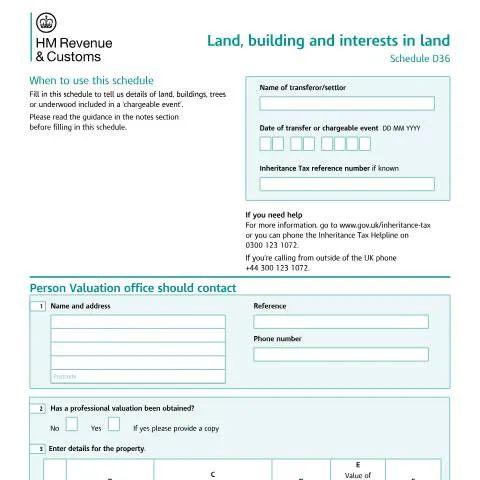
When dealing with inheritance tax matters involving land, buildings, or woodland interests, HMRC requires detailed property information through the D36 schedule. This document becomes essential during chargeable events – circumstances where inheritance tax liability may arise, such as transfers from discretionary trusts, failed potentially exempt transfers, or certain lifetime gifts that trigger tax obligations.
The D36 schedule serves as a comprehensive property declaration, capturing everything from market valuations to lease arrangements and recent sales activity. Unlike standard property transactions, inheritance tax scenarios often involve complex timing considerations, relief calculations, and valuation challenges that require meticulous documentation.
Navigating Chargeable Events and Property Declarations
The term chargeable event encompasses various circumstances beyond straightforward inheritance. Trustees of discretionary trusts face periodic charges every ten years, whilst beneficiaries may trigger exit charges when assets leave the trust structure. Additionally, failed potentially exempt transfers – where the donor dies within seven years of making a gift – can retrospectively create inheritance tax liabilities requiring D36 completion.
Property within these scenarios presents particular complexities. Agricultural land may qualify for business property relief, reducing its taxable value by up to 100%. Heritage assets might benefit from conditional exemption, whilst woodland can often defer tax liability entirely. The D36 schedule captures these nuances through dedicated columns for relief calculations and market valuations.
Trust-Related Property Transfers
Discretionary trusts holding property face unique reporting requirements. The ten-year anniversary charge applies to trust assets exceeding the nil-rate band, currently £325,000. Trustees must declare all property interests, including:
- Freehold residential and commercial properties
- Leasehold interests with unexpired terms
- Agricultural land and farm buildings
- Woodland and timber rights
- Development land and building plots
Exit charges arise when property leaves the trust, calculated as a proportion of the last ten-year charge. The D36 schedule documents these transfers, establishing the property's value at the relevant date and any applicable reliefs.
Professional Valuations and Market Assessment Requirements
HMRC's approach to property valuation centres on open market value – the price a hypothetical willing buyer would pay a willing seller in an arm's length transaction. This standard applies regardless of actual sale circumstances or family relationships involved in the transfer.
The D36 schedule specifically asks whether professional valuations have been obtained, reflecting HMRC's expectation that complex or valuable properties warrant expert assessment. Chartered surveyors with RICS qualifications typically provide these valuations, considering factors like location, condition, planning constraints, and comparable sales evidence.
When Professional Valuations Become Essential
Several circumstances make professional valuations virtually mandatory:
| Property Type | Valuation Threshold | Key Considerations |
|---|---|---|
| Residential property | Above £500,000 | Local market conditions, unique features |
| Commercial property | All values | Rental income, lease terms, tenant quality |
| Agricultural land | Above £200,000 | Productive capacity, development potential |
| Woodland | All values | Timber maturity, access rights, management |
Properties with unusual characteristics – such as listed buildings, those with restrictive covenants, or land with development potential – invariably require professional input. The valuation date proves crucial, as property markets can fluctuate significantly between the chargeable event and the D36 submission.
Documenting Tenure, Lettings and Lease Arrangements
Column C of the D36 schedule requires comprehensive tenure details, distinguishing between freehold and leasehold interests whilst capturing lease terms that significantly impact valuation. A 999-year lease with minimal ground rent effectively mirrors freehold ownership, whilst short leases face the challenge of diminishing value as expiry approaches.
Leasehold properties must declare remaining term length and ground rent obligations. Modern leases often include escalation clauses, service charges, and maintenance responsibilities that affect the property's investment appeal. Ground rents exceeding £1,000 annually for houses or £250 for flats can impact mortgage availability, reducing market value.
Rental Income and Letting Arrangements
Column D captures existing letting arrangements, which can significantly enhance or constrain property values. Sitting tenants with protected rights under the Rent Act 1977 may substantially reduce a property's market value compared to vacant possession. Conversely, modern assured shorthold tenancies with market rents can demonstrate income-generating potential.
Key letting details requiring disclosure include:
- Rental amounts and review patterns
- Tenant security of tenure rights
- Lease break clauses and renewal options
- Repair and maintenance responsibilities
- Any rent arrears or disputes
Agricultural tenancies under the Agricultural Holdings Act 1986 create particular complexities, often providing tenants with lifetime security and succession rights that substantially reduce the landowner's reversionary interest value.
Relief Calculations and Heritage Considerations
Column E addresses various inheritance tax reliefs that can dramatically reduce property values for tax purposes. Agricultural Property Relief (APR) offers 50% or 100% relief depending on occupation arrangements, whilst Business Property Relief (BPR) may apply to commercial properties used in qualifying trades.
Woodland presents unique opportunities through woodland relief, allowing inheritance tax deferral until the timber is eventually sold. This relief applies only to the woodland itself, not associated agricultural land or the house, creating complex apportionment requirements that the D36 schedule must reflect accurately.
Heritage Assets and Conditional Exemption
Properties of outstanding historic or architectural interest may qualify for conditional exemption from inheritance tax. This relief requires ongoing public access arrangements and proper maintenance, with HMRC monitoring compliance through regular reviews.
The exemption covers:
- Historic houses and their contents
- Scenic land of outstanding natural beauty
- Buildings of architectural importance
- Archaeological sites and ancient monuments
Conditional exemption creates ongoing obligations for property owners, including maintenance to appropriate standards and providing reasonable public access. Failure to meet these conditions triggers the deferred tax charge, often with accumulated interest over many years.
Sales Activity and Valuation Benchmarking
Section 5 of the D36 schedule examines recent sales activity, recognising that actual transaction prices provide valuable evidence for inheritance tax valuations. Properties sold within twelve months of the chargeable event may establish market value more reliably than theoretical valuations, though HMRC considers various factors before accepting sale prices as definitive.
The sale price analysis distinguishes between different transaction types – arm's length sales to unconnected parties carry greater weight than family transactions or forced sales. Auction sales may reflect distressed circumstances rather than true market value, whilst private treaty sales between willing parties typically provide the most reliable evidence.
Fixtures, Fittings and Apportionment Issues
Column M requires separate identification of fixtures, carpets and curtains values, reflecting inheritance tax law's distinction between land and chattels. Items forming part of the property's fabric – such as fitted kitchens, built-in wardrobes, and central heating systems – constitute fixtures included in the property valuation.
Removable items like free-standing furniture, artworks, and personal effects typically fall outside the D36 schedule's scope, though valuable chattels may require separate inheritance tax treatment. The £6,000 chattel exemption means individual items below this threshold escape inheritance tax entirely.
Damage Assessment and Valuation Adjustments
Section 4 addresses property damage that might affect valuation, acknowledging that inheritance tax events often occur during periods of family upheaval when property maintenance may suffer. Fire damage, flood impacts, or structural problems can significantly reduce market value, requiring careful documentation and often professional assessment.
Damage categories requiring particular attention include:
- Structural issues: Subsidence, foundation problems, roof failures
- Environmental damage: Flooding, contamination, Japanese knotweed
- Neglect and deterioration: Deferred maintenance, vandalism, weather damage
- Planning enforcement: Unauthorised alterations, breach of conditions
The timing of damage assessment proves crucial – valuations must reflect the property's condition at the chargeable event date, not its current state when completing the D36 schedule. Photographic evidence and professional reports from the relevant date provide essential supporting documentation.
Woodland and Timber Rights Documentation
Section 6 specifically addresses trees and underwood sales, recognising woodland's unique inheritance tax treatment. Timber sales generate income that may trigger deferred inheritance tax charges, requiring careful tracking of disposal dates, amounts realised, and market values.
The distinction between timber and land proves essential – whilst woodland relief defers tax on growing timber, the underlying land remains immediately chargeable unless qualifying for agricultural or business property relief. Commercial forestry operations may qualify for business property relief, eliminating inheritance tax entirely on both land and timber.
Underwood sales – including coppicing, thinning, and Christmas tree harvesting – require separate documentation as these activities may indicate commercial forestry qualifying for business relief rather than investment woodland eligible only for deferral relief.
The D36 schedule's comprehensive approach ensures HMRC receives complete property information necessary for accurate inheritance tax assessments, though completing it thoroughly requires careful consideration of complex valuation principles, relief entitlements, and documentation requirements that often benefit from professional guidance.
Common Scenarios Requiring D36 Submission
Understanding when the D36 form becomes necessary helps ensure compliance with HMRC's reporting requirements. The most frequent scenarios involve substantial changes to property ownership structures or significant disposals that trigger capital gains implications.
Company liquidations and winding up procedures often generate chargeable events requiring D36 notification. When a company enters voluntary liquidation, any land and buildings distributed to shareholders constitute a disposal at market value. This applies whether the distribution occurs as part of a members' voluntary liquidation or a creditors' voluntary liquidation. The timing of the chargeable event typically coincides with the date of distribution, not the formal winding-up resolution.
Similarly, demergers and company reconstructions frequently trigger D36 requirements. Under sections 192-197 of the Taxation of Chargeable Gains Act 1992, certain demergers may qualify for relief, but the land and buildings involved must still be reported. The form captures details of properties transferred between group companies or distributed to shareholders as part of the reconstruction scheme.
Transfers to connected persons represent another common category. When land or buildings pass between connected parties—such as family members, business partners, or companies under common control—the transfer occurs at market value for capital gains purposes, regardless of the actual consideration paid. This anti-avoidance measure ensures HMRC captures the full economic value of such transactions.
Gifts and settlements also generate chargeable events. Creating a trust involving land or buildings, or making outright gifts of property, typically constitutes a disposal at market value. The D36 form must detail the property transferred, even where holdover relief under sections 165 or 260 might apply to defer the gain.
Less obvious scenarios include appropriations to trading stock. When a property development company appropriates land from its investment portfolio to trading stock, this internal transfer creates a chargeable event. The appropriation occurs at market value, potentially crystallising significant gains that require D36 reporting.
Emigration and residence changes can also trigger reporting requirements. Individuals becoming non-UK resident may face deemed disposal rules on certain assets, including land and buildings. While these rules primarily affect non-resident landholding companies, direct ownership scenarios may also require notification through D36.
Property Valuation Considerations and HMRC's Approach
Accurate property valuation forms the cornerstone of D36 compliance, as HMRC relies heavily on the declared values to assess potential tax liabilities and determine whether further investigation is warranted.
Market value determination follows established principles under section 272 of the Taxation of Chargeable Gains Act 1992. The value represents the price the property might reasonably fetch in an open market transaction between a willing buyer and seller, assuming both parties have reasonable knowledge of relevant facts. This definition encompasses various factors including location, condition, planning permissions, and comparable sales evidence.
For residential properties, HMRC typically accepts professional valuations from chartered surveyors, particularly RICS-qualified valuers. However, the department maintains sophisticated property databases and may query valuations that appear inconsistent with local market trends. Online valuation tools, while convenient, rarely provide sufficient accuracy for D36 purposes, especially for unique or high-value properties.
Commercial and industrial properties present greater complexity. Valuation methods vary significantly depending on property type—offices might use rental capitalisation approaches, while manufacturing facilities rely more heavily on depreciated replacement cost methodology. HMRC's Valuation Office Agency (VOA) maintains expertise in specialist property types and may challenge valuations that appear optimistic or lack supporting evidence.
Development land and planning considerations require particular attention. Properties with development potential, existing planning permissions, or hope value must reflect these factors in their valuation. The timing of planning applications relative to the chargeable event can significantly impact values, as can changes in local development plans or infrastructure projects.
Specialist properties such as listed buildings, agricultural land, or properties with restrictive covenants need expert valuation. These assets often have limited comparable evidence, requiring valuers to apply specialist knowledge of relevant markets and statutory restrictions. Agricultural Property Relief or Business Property Relief considerations may affect the ultimate tax position but don't alter the underlying market value for D36 purposes.
HMRC's enquiry procedures increasingly focus on property valuations, particularly where significant gains arise or reliefs are claimed. The department may request detailed valuation reports, comparable evidence, or independent VOA assessments. Maintaining comprehensive valuation documentation from the outset reduces the risk of prolonged enquiries and potential penalties for negligent or deliberate undervaluation.
Timing considerations affect valuation accuracy. Property markets can be volatile, and values may change significantly between the chargeable event date and the D36 submission deadline. Using retrospective valuation evidence—sales of comparable properties occurring after the relevant date—requires careful adjustment for market movements and should be clearly documented in any supporting valuation report.
Integration with Other Tax Returns and Compliance Obligations
The D36 form operates within a broader framework of tax reporting obligations, and understanding these interconnections helps ensure comprehensive compliance while avoiding duplication or contradictory submissions.
Self Assessment integration represents the most direct connection. Capital gains arising from chargeable events reported on D36 must be included in the relevant Self Assessment returns, whether for individuals, partnerships, or companies subject to Corporation Tax Self Assessment. The timing of these returns may differ—D36 requires submission within 60 days of the chargeable event, while Self Assessment deadlines follow the standard tax year cycle.
For company disposals, the chargeable gains must appear in the Corporation Tax computation and supporting schedules. Companies filing CT600 returns should ensure consistency between D36 submissions and their detailed capital gains computations. HMRC's systems increasingly cross-reference these submissions, identifying discrepancies that may trigger enquiries.
Partnership reporting adds complexity where partnerships own land and buildings. The partnership must submit its own D36 form for qualifying chargeable events, while individual partners report their share of any resulting gains in their personal Self Assessment returns. Partnership statements must clearly identify the allocation of gains among partners, particularly where profit-sharing ratios have changed during the relevant period.
Trust and estate reporting requires careful coordination between trustees and beneficiaries. When trustees dispose of land and buildings, the D36 form captures the disposal details, but the tax consequences depend on the trust type and beneficiary circumstances. Discretionary trusts face different rates and reliefs compared to interest in possession trusts, affecting the overall compliance strategy.
Non-resident reporting obligations interact with D36 requirements in complex ways. The Annual Tax on Enveloped Dwellings (ATED) regime requires separate reporting for high-value residential properties owned through corporate structures. Disposals of ATED properties may require both D36 submission and ATED relief claims, with careful attention to the interaction between different tax charges and reliefs.
Stamp Duty Land Tax (SDLT) connections arise where chargeable events involve actual property transfers. While D36 focuses on capital gains implications, SDLT may apply to the same transaction, requiring separate compliance procedures and potentially different valuation approaches. Connected party transactions often involve SDLT at market value, creating consistency requirements between D36 and SDLT submissions.
International reporting obligations may overlay D36 requirements where non-UK elements exist. Country-by-Country reporting, transfer pricing documentation, or foreign tax credit claims might all interact with property disposals reported through D36. Professional advice becomes essential where multiple jurisdictions' tax rules apply to the same underlying transaction.
Record-keeping requirements extend beyond the D36 form itself. Supporting documentation—valuation reports, legal completion statements, correspondence with HMRC—must be retained for potential future enquiries. The standard record-keeping period extends to at least six years after the relevant tax year, but complex transactions or international elements may require longer retention periods.
HMRC's data matching capabilities increasingly connect D36 submissions with Land Registry records, SDLT returns, and other property-related databases. Ensuring consistency across all relevant submissions reduces the risk of automatic enquiry flags and demonstrates a coherent approach to tax compliance obligations.