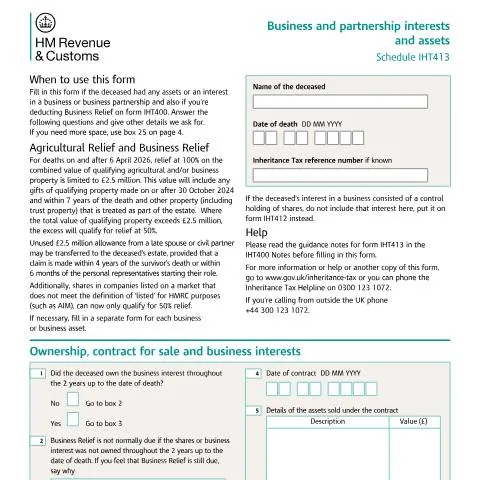
Navigating the IHT413: A Critical Step in Inheritance Tax Filing
When a loved one passes away, dealing with the aftermath can be a complex process. Among the various responsibilities is understanding the implications of Inheritance Tax (IHT). One crucial document in this process is the IHT413, which focuses on business and partnership interests and assets. This form is not merely a bureaucratic requirement; it plays a significant role in determining tax liabilities that can affect the value of an estate and the financial future of heirs.
Understanding Who Files the IHT413 Form
The IHT413 is specifically designed for use by personal representatives or executors of the deceased's estate. This includes individuals who are responsible for settling the estate's affairs, such as:
- Executors named in the deceased's will.
- Administrators appointed by the court if there is no will.
- Any individual who inherits business interests, shares, or assets of the deceased.
It's essential for the person filling out the form to have a thorough understanding of the deceased's business interests and any relevant agreements. If there is ambiguity regarding ownership or business operations, seeking professional valuation and legal advice is recommended.
Decoding the Essential Sections of the IHT413
The IHT413 consists of several sections that require detailed information. Each section is designed to capture specifics regarding the deceased's business interests, and understanding these areas will facilitate a smoother completion process. Here’s a detailed breakdown of key segments within the form:
Ownership Verification
The first few questions (boxes 1 through 6) assess ownership of the business interest within the two years preceding the death. One must confirm whether the deceased owned the business throughout this time frame. If the answer is "No," box 2 stipulates that Business Relief may not be applicable unless a compelling reason is provided.
Binding Contracts and Sale
Boxes 3 through 6 delve into whether any part of the business was subjected to a binding contract for sale at the date of death. This section is vital because it directly affects the eligibility for Business Relief. If a sale was underway, detailed information about the contract and assets sold must be provided.
Assessment of Business Value
Moving to boxes 7 through 10, the form requests the value of the business or partnership interest at the date of death. This value must then be included in the IHT400 (the main Inheritance Tax return). It's advisable to provide any professional valuations or financial accounts that can substantiate the reported figures.
Preparation of Justifying Documents
Completing the IHT413 requires meticulous documentation. Here are some important documents to gather based on the specific situation:
- Partnership Agreement: If the deceased was part of a partnership, include a copy. If none exists, outline the informal agreements in box 25.
- Financial Statements: Provide the last three years’ financial accounts for the business to demonstrate its value accurately.
- Contracts: Any contracts pertaining to business operations, especially those relevant to sales, must be kept handy.
Having these documents organized will not only streamline the filling process but also prove essential if HM Revenue & Customs (HMRC) requires further clarification.
Addressing Complex Scenarios: What Ifs and Exceptions
Inheritance scenarios can often be intricate. Here are some unique cases and how they may affect the IHT413:
Non-Resident Business Owners
If the deceased was a non-resident of the UK, different rules apply. The estate might be subject to different tax considerations, and navigating through international tax rules can be challenging. In this case, consulting a tax specialist with expertise in cross-border inheritance tax is advisable.
Minors and Vulnerable Beneficiaries
When the deceased leaves behind minors or beneficiaries who cannot manage their affairs, a guardian or appointed representative will likely need to supervise any business interests until the beneficiaries reach maturity. Understanding the implications of business ownership in such contexts is crucial.
Handling Refusals and Missing Documentation
In cases where HMRC rejects the IHT413 due to missing information or errors, the process can become more daunting. Here’s how to navigate potential hurdles:
Responding to HMRC Queries
If HMRC indicates that additional information is required or queries the submitted valuations, it is essential to respond promptly. Gather the requested documentation and provide a clear explanation. Ignoring communication from HMRC can lead to penalties or extended delays.
Correcting Mistakes
In the event of an error in the filed form, contact HMRC immediately to rectify the mistake. Mistakes can lead to incorrect tax calculations, subsequently impacting the estate and heirs. Ensure all corrections are documented to maintain transparency.
The Complete Timeline: From Filing to Follow-Up
Understanding the timeline for completing and submitting the IHT413 is vital. Below is a typical timeline:
| Event | Date | Action Required |
|---|---|---|
| Date of Death | DD MM YYYY | Begin collecting documents and information about the estate. |
| Submission of IHT413 | Within 12 months of death | Ensure the form is completed and submitted to HMRC. |
| HMRC Response | Variable | Await further communication or queries from HMRC. |
| Payment of Tax | Within 6 months of death | Pay any Inheritance Tax owed to avoid interest and penalties. |
This timeline emphasizes the importance of prompt action in managing the estate’s obligations. Missing deadlines can result in financial consequences, further complicating the inheritance process.
Submission Channels: Digital vs Paper
The IHT413 can be submitted through various channels, each with its pros and cons:
- Online Submission: This method is often seen as more efficient, allowing for quicker processing times. However, it may require digital verification and the need for an HMRC online account.
- Paper Submission: Traditional mailing of the completed form can be more cumbersome and slower, but it allows for physical documentation to be submitted.
Regardless of the chosen method, it’s advisable to keep copies of all documentation submitted and any correspondence with HMRC for future reference.
What Happens After Submission?
Once the IHT413 is submitted, one might wonder about the next steps. Typically, these include:
- Awaiting an IHT reference number from HMRC, which is critical for future correspondence.
- Monitoring the status of the IHT400 form, as it incorporates the values declared in the IHT413.
- Preparing for further inquiries from HMRC, as they may require additional documentation or clarifications.
Understanding these components will help in effectively managing the administrative aspects of dealing with an estate post-death. The IHT413 is not just a form; it’s a pivotal piece of the inheritance puzzle.
Understanding Business and Partnership Interests in Inheritance Tax
Inheritance Tax (IHT) can significantly impact the transfer of wealth in the UK, especially concerning business and partnership interests. When an individual passes away, their estate may include shares in a company or interests in a partnership, which can complicate the IHT calculations. The valuation of these interests must be meticulously undertaken to ensure compliance with HM Revenue & Customs (HMRC) requirements.
For businesses, the valuation is largely dependent on the type of entity—such as a sole trader, partnership, or corporation. Sole traders and partnerships often have their total business value calculated based on the net profit of the business, while for limited companies, it involves the valuation of shares. Assets owned by the business that can be sold or liquidated may also need to be considered. In addition, the treatment of goodwill can raise questions, as it is often viewed differently in tax considerations compared to tangible assets.
Partnership interests in a business can involve complications regarding how the partnership is structured. For instance, a partnership may have different classes of partners - general partners and limited partners - which can affect the valuation of the partnership interest for IHT purposes. General partners typically have unlimited liability and may hold more significant control over the partnership's operations, potentially leading to a higher valuation. Limited partners, however, may have liability limited to their investment, which could lower their interest’s valuation.
It’s also essential to understand how IHT reliefs apply to business interests. Business Property Relief (BPR) and Agricultural Property Relief (APR) can play critical roles in reducing the IHT liability on an estate. BPR can allow a reduction of up to 100% on the value of qualifying business assets, which is a significant consideration for business owners.
How to Complete the IHT413 Form: A Step-by-Step Guide
The IHT413 form is pivotal for individuals declaring business and partnership interests in their estate. Completing this form accurately is crucial to ensure that HMRC processes your inheritance tax liability efficiently. Here's a comprehensive step-by-step guide on how to fill out the IHT413 form:
Step 1: Gather Required Information Before starting your IHT413, ensure you have all necessary documents and information at hand. This includes financial statements, partnership agreements, share certificates, and any other relevant paperwork that reflects the value of your business or partnership interests.
Step 2: Provide Details of the Business Begin with section one of the IHT413, where you will need to provide detailed information about the business. This includes the business name, registration number (if applicable), type of business, and the address. If it’s a partnership, specify the number of partners and their roles.
Step 3: Valuation of Assets Move to section two, where you will provide the valuation of the business assets. Utilize the last financial statements to ascertain the value of the business. If you have engaged an accountant or a professional valuer, include their findings. Clearly indicate any goodwill and intangible assets as separate line items.
Step 4: Business Property Relief If you qualify for Business Property Relief, detail this in section three, citing relevant sections of the Inheritance Tax Act. Provide the basis for your relief claim and any documentation that supports your application for relief.
Step 5: Review and Sign Lastly, review the completed form for accuracy. Ensure all sections are filled correctly and that your valuation reflects current market conditions. Once satisfied, sign and date the form, certifying its accuracy.
Remember to keep a copy of the completed form for your records. Filing the IHT413 accurately can expedite the handling of your estate by HMRC and potentially reduce the overall tax liability.
Common Challenges and Pitfalls in Reporting Business Interests for IHT
Navigating the complexities of Inheritance Tax reporting, particularly concerning business and partnership interests, can present several challenges. Understanding common pitfalls can enhance compliance and reduce the risk of errors that could result in penalties or increased tax liabilities.
1. Misvaluation of Business Assets One of the most significant challenges is accurately valuing business assets. Many individuals mistakenly inflate or underestimate the value of their business interests, which can lead to incorrect tax liabilities. Engaging a qualified valuer or accountant can help mitigate this risk and ensure that your reporting aligns with HMRC standards.
2. Lack of Documentation Another common issue is the failure to maintain comprehensive documentation. All assets, liabilities, and partnership agreements must be well documented and readily available. Failing to document the terms of a partnership or the value of tangible and intangible assets can complicate the valuation process and lead to disputes with HMRC.
3. Ignoring Business Property Relief Some individuals overlook the potential for Business Property Relief, assuming their business interests are not eligible. It is crucial to assess whether your business qualifies for relief and to substantiate this claim on your IHT413 form accurately. Failure to claim appropriate relief can result in higher tax liabilities.
4. Overlooking Changes in Business Structure Changes in business structure, such as transitioning from a partnership to a limited company, can have tax implications. When such transitions occur, it's vital to reassess the business's valuation for IHT, as prior reliefs or valuations may no longer apply. Regular reviews of your business structure concerning tax planning can help address this issue.
5. Delays in Submission Lastly, delays in submitting the IHT413 can result in fines or increased scrutiny from HMRC. Keeping abreast of deadlines, specifically the 12-month period following the death, is critical. Proper planning and seeking advice early can help streamline the submission process.
Awareness of these common challenges can empower individuals to approach their IHT responsibilities with greater confidence and accuracy, ensuring a smoother transition for their estates and beneficiaries.