Understanding the UK-France Double Taxation Relief Framework
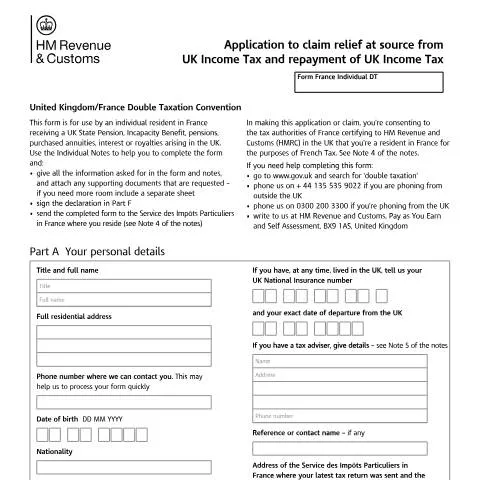
When French residents receive income from UK sources—whether state pensions, private pensions, interest, or royalties—they often face the prospect of being taxed twice: once by HMRC and again by the French tax authorities. The Form France-Individual DT serves as the primary mechanism to prevent this double taxation burden, implementing the provisions of the UK-France Double Taxation Convention established under Statutory Instrument 2009 Number 226.
This specialised form enables French residents to claim relief at source from UK income tax or seek repayment of tax already deducted. The process involves a unique three-party arrangement: the taxpayer, HMRC, and the French Service des Impôts Particuliers, creating a coordinated approach to international tax relief that requires careful navigation of both jurisdictions' requirements.
Eligibility Criteria and Residence Requirements
The form's application hinges entirely on demonstrating genuine French tax residency. This isn't simply about holding a French address; it requires meeting France's specific tax residence criteria, which the Service des Impôts Particuliers must formally certify to HMRC through their official stamp on the form.
French tax residency typically requires one of several conditions: having your principal home in France, spending more than 183 days per year in France, or having your principal economic interests located in France. The form specifically accommodates various scenarios:
- Lifelong French residents who have never lived in the UK
- UK emigrants who have established French residency after departing the UK
- Dual residents navigating complex residence rules between both countries
- Split-year residents under the UK's Statutory Residence Test provisions
The form requires detailed disclosure of any continuing UK connections, particularly property ownership or rental arrangements, which could affect residence determinations. Even if you've moved to France, retaining available accommodation in the UK can complicate your residence status and impact your eligibility for double taxation relief.
Income Categories Covered Under the Convention
The form addresses four distinct categories of UK-source income, each governed by different articles of the Double Taxation Convention and requiring specific documentation:
UK State Benefits and Pensions
UK State Pensions and Incapacity Benefits receive preferential treatment under the convention. These payments can often be received gross (without UK tax deduction) once French residency is established. The form requires the exact commencement date of these benefits, as this affects the relief period calculation.
Occupational and Private Pensions
Work pensions and purchased annuities from UK providers follow different rules. The form demands comprehensive details including the pension scheme name, provider address, reference numbers, and payment commencement dates. Each pension arrangement must be listed separately, as different schemes may have varying tax treatments under the convention.
Investment Income and Interest
The form specifically excludes bank and building society interest, as HMRC cannot arrange gross payment for these sources through this process. Instead, it focuses on interest from securities, gilts, and corporate bonds. For privately arranged loans, additional documentation proving the commercial nature of the arrangement may be required.
Royalty Payments
Royalties present particular complexity, as the convention's benefits depend on whether you're the original creator or have acquired rights through assignment. Copyright royalties on literary, dramatic, musical, or artistic works receive different treatment than industrial royalties for patents or technical processes. The form requires detailed contract information and, for acquired rights, copies of licence agreements or assignments.
Navigating the UK Statutory Residence Test Implications
The form incorporates the UK's Statutory Residence Test (SRT), introduced in April 2013, which creates a structured framework for determining UK tax residence. This is particularly relevant for recent UK emigrants claiming French residence.
The SRT operates through a series of automatic tests: if you spend 183 days or more in the UK during a tax year, you're automatically UK resident. However, the form addresses more nuanced situations through split-year treatment, which can apply when you leave the UK mid-tax year to establish residence elsewhere.
| Departure Scenario | SRT Consideration | Form Requirement |
|---|---|---|
| Current tax year departure | Non-resident or split-year treatment | Must confirm status and future year non-residence |
| Previous tax year departure | Current year non-residence expected | Confirmation of ongoing non-resident status |
| Retained UK property | Available accommodation test | Full property details and availability status |
If claiming split-year treatment, you must demonstrate non-residence for the following complete tax year. Any change in circumstances that affects this status must be promptly reported to HMRC, as it could invalidate the relief granted.
The French Tax Authority Certification Process
Unlike many international tax forms, the France-Individual DT requires active participation from French tax authorities before submission to HMRC. This creates a unique validation mechanism that ensures genuine French residence and prevents abuse of the double taxation convention.
The process begins with submitting the completed form to your local Service des Impôts Particuliers—the same office where you file your annual French tax return. The form must include the exact address of this office and the date of your most recent French tax return submission, demonstrating an established relationship with French tax authorities.
The French tax official reviews your residence status and, if satisfied, provides an official certification stamp with their signature and date. This certification specifically confirms that you are "resident in France for the purposes of French tax," using the precise language required by the convention.
Critical timing consideration: The French certification process can take several weeks, particularly during busy periods like the French tax return season (May to June). Plan accordingly, especially if you need relief to take effect from a specific date.
Detailed Form Completion Requirements
Personal Information and Tax Identifiers
Part A demands comprehensive personal details, with particular attention to tax identification numbers from both jurisdictions. Your French tax reference number (numéro fiscal de référence) is essential, as it enables the French authorities to verify your tax compliance status.
For UK connections, the form requires either your UK National Insurance number (if you've lived in the UK) or explicit confirmation that you've never been UK resident. If you have lived in the UK, you must provide your exact departure date, which affects the application of various convention articles.
Residence History and Ongoing Connections
Part B creates a detailed residence timeline, focusing on potential dual residence situations. The form distinguishes between when you became a French resident and when you began paying French tax on the UK income—these dates may differ due to transitional arrangements or delayed tax obligations.
Property connections receive particular scrutiny. Any continued ownership or rental of UK property must be disclosed, including investment properties let to third parties. The form requires tenant details and expected rental income, as this affects your UK tax obligations and may create a UK permanent establishment for tax purposes.
Income Source Documentation
Parts C1 through C4 require systematic documentation of each income source. For pensions, this includes not just payment amounts but also scheme-specific reference numbers and provider details. Investment income requires security registration details and registrar account numbers, enabling HMRC to coordinate with paying agents for future gross payments.
Royalty income demands the most detailed documentation, particularly the distinction between original creation and acquired rights. If you've acquired royalty rights through purchase or assignment, you must attach copies of all relevant contracts, demonstrating the chain of title from the original creator to your current position.
Processing Timeline and Ongoing Obligations
Once submitted to HMRC at their BX9 1AS address, processing typically takes 6-8 weeks, though complex cases involving multiple income sources or residence issues may require longer. HMRC may request additional documentation, particularly for royalty claims or where UK residence status remains unclear under the Statutory Residence Test.
Successful applications result in HMRC issuing instructions to UK paying agents (pension providers, investment managers, royalty payers) to make future payments gross or at reduced rates. For tax already deducted, HMRC processes repayments directly to your nominated account.
The relief isn't automatically permanent. Changes in residence status, income sources, or personal circumstances may require updated applications. HMRC conducts periodic reviews, particularly for pensioners, and may request updated French residence certification every few years.
Maintaining accurate records becomes crucial, as you may need to demonstrate ongoing French residence and continued entitlement to convention benefits. This includes keeping copies of French tax returns, residence certificates, and any correspondence with either tax authority regarding your status.
Strategic Considerations for Cross-Border Tax Planning
The Form France-Individual DT operates within a broader framework of international tax planning that extends beyond simple double taxation relief. Understanding its strategic implications can significantly impact your overall tax efficiency and compliance obligations.
Timing considerations often prove crucial. If you're planning to establish French residence, submitting the form early in your first French tax year can prevent UK tax deductions on income received throughout that period. However, premature applications before establishing genuine French residence can result in rejection and potential complications with future applications.
The form's impact varies significantly depending on your total income profile. High-rate UK taxpayers moving to France may find substantial savings, particularly on pension income taxed at 20% in the UK but potentially eligible for lower French rates or allowances. Conversely, those with modest incomes might find French tax obligations exceed UK deductions, making the relief less beneficial from a purely financial perspective.
Professional advice becomes particularly valuable when navigating the intersection between UK departure rules and French arrival obligations. The form's residence certification requirement means your French tax adviser must be comfortable confirming your residence status, potentially affecting their liability for incorrect certifications.
Cross-Border Employment and Social Security Coordination
When working across UK-France borders, employees and employers must navigate complex social security coordination rules that interact directly with double taxation provisions under SI 2009/226. The coordination primarily follows EU regulations retained in UK law post-Brexit, though bilateral agreements now supplement these arrangements.
Frontier workers—those residing in one country whilst working in another—face particular complexity. A French resident working in London typically pays UK National Insurance contributions and income tax under PAYE, but may also have French social security obligations depending on their employment structure. The double taxation agreement prevents income being taxed twice, but social security coordination operates under separate rules.
Certificate A1 (formerly E101) remains crucial for posted workers. British employees temporarily working in France must obtain this from HMRC to confirm their UK social security position, preventing dual contributions. The certificate typically covers periods up to 24 months, though extensions may be possible for longer assignments. Without proper certification, French authorities may demand local social security contributions regardless of UK payments.
Self-employed individuals crossing borders face additional complexity. A UK consultant working regularly in France might qualify as habitually resident in either jurisdiction depending on factors including time spent, business registration location, and client base distribution. This determination affects both tax obligations under the double taxation agreement and social security liability.
Multi-state workers—those employed simultaneously in both countries—require careful analysis. The general rule prioritises the residence state for social security, but substantial activity thresholds (typically 25% of working time) can shift liability to the employment state. These determinations directly impact available double taxation reliefs and the mechanics of claim procedures.
Pension contributions present particular challenges. UK workplace pension contributions may not receive equivalent tax relief in France, even where double taxation agreements apply. French residents with UK employment must often navigate both countries' pension systems, potentially facing timing mismatches between contribution periods and relief availability.
Healthcare coordination affects tax planning decisions. S1 certificates for pensioners or A1 certificates for workers influence residence determinations, which in turn affect double taxation agreement application. Changes in healthcare entitlement can trigger tax residence shifts with significant implications for ongoing tax obligations.
Specialized Income Categories and Treaty Interpretation
The UK-France double taxation agreement contains specific provisions for income types that require detailed interpretation, particularly where domestic law definitions diverge between jurisdictions. Understanding these specialized categories proves essential for accurate treaty application and optimal tax outcomes.
Royalty income attracts particular attention given different intellectual property regimes. UK patent box provisions may reduce corporate tax rates on patent royalties to 10%, whilst France applies standard corporate rates but offers different depreciation rules. The treaty's royalty article prevents double taxation but doesn't harmonize these preferential regimes, creating planning opportunities for multinational intellectual property structures.
Capital gains from share disposals follow complex rules depending on shareholding percentages and holding periods. The treaty generally allocates taxing rights to the residence state, but substantial shareholdings (typically over 25%) in property-rich companies may trigger source state taxation. French residents disposing of UK property company shares might face UK capital gains tax despite treaty protection, requiring careful structuring and timing considerations.
Partnership income creates interpretation challenges where UK partnership concepts don't directly translate to French fiscal transparency rules. A UK limited liability partnership may be treated as transparent for UK tax but opaque under French domestic law, potentially creating double taxation despite treaty provisions. The mutual agreement procedure becomes particularly relevant for resolving such classification conflicts.
Employment income from share schemes requires detailed analysis of vesting, exercise, and disposal timing across jurisdictions. UK approved schemes like EMI or SAYE may not receive equivalent treatment in France, even where the double taxation agreement applies. French residents with UK employment must often navigate restricted stock vesting periods that span multiple tax years and residence changes.
Trust income presents complex interpretation issues given fundamental differences between UK trust concepts and French usufruit arrangements. The treaty's trust article provides some guidance, but beneficiary taxation often requires case-by-case analysis, particularly for discretionary trusts where distribution timing affects tax residence and treaty application.
Pension income from occupational schemes faces detailed sourcing rules. UK registered pension schemes paying French residents generally trigger UK withholding obligations, but treaty relief may reduce rates. However, pension commencement lump sums might receive different treatment depending on scheme type and recipient residence history, requiring careful documentation of entitlement periods.
Director's fees and similar payments require source analysis based on where duties are performed rather than company residence. A French resident serving as director of a UK company might face UK taxation on fees, but treaty relief could apply if directorial duties are performed in France. Documentation of meeting locations and decision-making venues becomes crucial evidence.
Compliance Obligations and Cross-Border Reporting
Cross-border tax compliance between UK and France involves multiple reporting streams that extend beyond standard domestic obligations. These requirements often carry significant penalties for non-compliance and interact directly with double taxation agreement benefits.
HMRC's requirement for overseas income disclosure affects all UK residents with French source income. Self Assessment returns must include foreign income even where treaty relief eliminates UK tax liability. Failure to disclose, even with no additional tax due, can trigger penalties based on potential lost revenue calculations. The disclosure requirement covers rental income, employment income, pensions, and investment returns from French sources.
French tax residents must navigate strict reporting requirements for overseas assets and income. The declaration of foreign accounts (formulaire 3916) requires detailed disclosure of UK bank accounts, investment accounts, and life insurance policies. Penalties for non-disclosure can reach €1,500 per undeclared account, applying even where no French tax is ultimately due thanks to double taxation agreement relief.
Common Reporting Standard (CRS) obligations create automatic information exchange between UK and French tax authorities. Financial institutions in both countries report account holder information to their respective tax authorities, who then exchange data automatically. This exchange occurs regardless of double taxation agreement provisions and can trigger compliance reviews in either jurisdiction.
Transfer pricing documentation requirements affect businesses operating across both jurisdictions. UK companies with French subsidiaries or branches must maintain detailed documentation supporting intercompany pricing, even where double taxation agreement provisions apply to prevent economic double taxation. The OECD guidelines, implemented in both jurisdictions, require contemporaneous documentation that can withstand scrutiny from either tax authority.
VAT reporting obligations operate separately from income tax double taxation agreements but create additional compliance burdens for cross-border traders. UK businesses supplying services to French consumers must often register for French VAT, creating ongoing filing obligations that interact with corporate income tax positions. The mechanics of VAT recovery can affect cash flow timing for businesses claiming double taxation agreement benefits.
Country-by-country reporting requirements affect multinational groups with operations in both jurisdictions. Parent companies meeting the €750 million revenue threshold must file detailed reports showing tax positions across all jurisdictions where they operate. These reports are exchanged between UK and French tax authorities and may inform transfer pricing audits or treaty interpretation discussions.
Beneficial ownership disclosure requirements in both jurisdictions affect corporate structures claiming double taxation agreement benefits. UK companies must maintain PSC (People with Significant Control) registers, whilst French entities face similar beneficial ownership disclosure obligations. These requirements can expose treaty shopping arrangements or highlight potential abuse of agreement provisions.
Anti-avoidance reporting obligations require disclosure of certain arrangements that might circumvent double taxation agreement provisions. UK promoters of tax arrangements involving French elements may face DOTAS (Disclosure of Tax Avoidance Schemes) obligations, whilst French authorities have similar disclosure requirements for cross-border arrangements under DAC6 implementation.