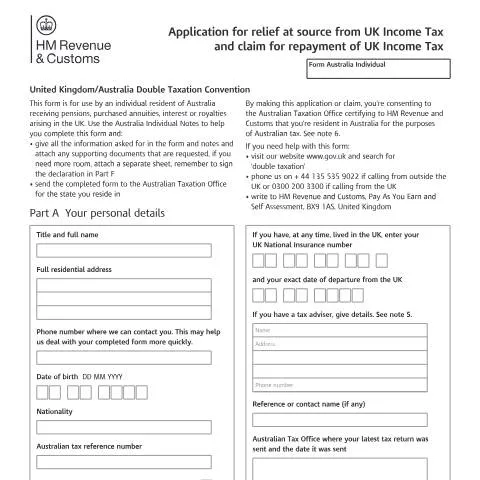
When UK-Australia Tax Treaties Intersect: Navigating the Form Australia-Individual 2003
Australian residents receiving UK-sourced income face a complex web of tax obligations spanning two jurisdictions. The Form Australia-Individual 2003, formally titled "Application for relief at source from UK Income Tax and claim for repayment of UK Income Tax," serves as the crucial bridge between HMRC and the Australian Taxation Office (ATO) for resolving double taxation issues. This bilateral form, established under Statutory Instrument 2003 Number 3199, enables Australian tax residents to claim relief from UK withholding taxes on specific income streams whilst ensuring compliance with both countries' tax frameworks.
The form's unique positioning within the UK-Australia Double Taxation Convention creates particular obligations for both taxpayers and tax authorities. Unlike standard HMRC forms processed exclusively within the UK system, this document requires certification by the Australian Taxation Office before submission to HMRC, establishing a distinctive two-stage authentication process that reflects the international nature of the tax relief being sought.
Eligibility Criteria and Residency Complexities Under Australian Tax Law
The form specifically targets Australian tax residents receiving four distinct categories of UK-sourced income: state pensions, work pensions and purchased annuities, interest payments, and royalties. However, the definition of "Australian tax resident" for double taxation treaty purposes carries nuanced implications that extend beyond simple geographical presence.
Individuals holding Temporary Resident Visas face particularly restrictive conditions. The form explicitly limits their claims to UK income paid before 1 July 2006, reflecting legislative changes in Australian tax treatment of temporary residents. This temporal restriction creates a diminishing pool of eligible claimants as older income streams naturally expire or cease.
The residency determination process involves careful examination of ties to both jurisdictions. Former UK residents must demonstrate their departure date and provide evidence of their current Australian tax obligations. The form requires detailed disclosure of any continuing UK property interests, recognising that retained property ownership can complicate residency status under both countries' domestic tax rules.
| Residency Status | Eligible Income Types | Key Restrictions |
|---|---|---|
| Australian permanent resident | All four categories | Must be liable to Australian tax on claimed income |
| Temporary Resident Visa holder | Limited scope | Only pre-1 July 2006 UK income |
| Former UK resident (under 4 years) | All four categories | Must confirm non-resident status under Statutory Resident Test |
The Dual Authority Process: ATO Certification Requirements
The form's most distinctive feature lies in its mandatory Australian Taxation Office certification before HMRC processing can commence. This requirement, detailed in Part A's final section, establishes the ATO as gatekeeper for treaty benefit claims, ensuring that only legitimate Australian tax residents access reduced UK withholding rates.
The certification process requires the taxpayer to submit their completed form to the appropriate state-based ATO office where their latest tax return was filed. The ATO official must then verify the individual's Australian tax residency status and affix an official stamp alongside their signature. This authentication serves multiple purposes: it validates the claimant's Australian tax status, confirms their eligibility for treaty benefits, and creates an audit trail for both tax authorities.
For Temporary Resident Visa holders, the ATO certification includes specific confirmation that the individual "is a holder of a Temporary Resident Visa and only entitled to claim relief for income paid before 1 July 2006." This additional certification layer reflects the restricted treaty access available to this category of Australian residents.
Processing Timeframes and Inter-Authority Coordination
The dual-authority structure inevitably extends processing timeframes beyond typical HMRC forms. Initial ATO processing for certification purposes typically requires several weeks, particularly during peak tax season periods. Following ATO certification, HMRC processing begins, with the BX9 1AS processing centre handling international treaty claims.
The form includes contact provisions acknowledging this complexity, providing both UK domestic (0300 200 3300) and international (+44 135 535 9022) phone numbers for enquiries. However, the bifurcated process means that enquiries about certification delays must be directed to the relevant Australian state tax office, whilst post-certification processing queries fall under HMRC jurisdiction.
Income Stream Categorisation and Relief Mechanisms
The form's structure reflects the diverse nature of UK-sourced income requiring treaty protection. Each income category in Parts C and D carries distinct relief mechanisms and documentation requirements, reflecting the varying withholding tax treatments applied by UK payers.
State Pensions and the PAYE Integration Challenge
UK State Pension payments to Australian residents create unique administrative challenges due to the PAYE system's automatic withholding mechanisms. The form addresses this through Section C.1, which enables prospective relief applications for ongoing pension payments. Claimants must provide their pension commencement date, enabling HMRC to coordinate with the Department for Work and Pensions' payment systems.
For work pensions and purchased annuities (Section C.2), the form includes a specific question about PAYE adjustments. This reflects the common scenario where UK pension providers have already applied withholding tax under domestic rules, requiring subsequent adjustment rather than prospective relief.
Interest and Royalty Complexities
The interest provisions (Section C.3) explicitly exclude bank and building society interest, acknowledging HMRC's limited ability to arrange gross payment of retail banking products. This exclusion reflects practical limitations in the UK's withholding tax infrastructure for widely-distributed financial products.
Royalty provisions (Section C.4) introduce additional complexity through the originator test. Claimants must confirm whether they are the original creator of the licensed work or product, with non-originators required to provide copies of licensing agreements or assignments. This requirement prevents treaty shopping by intermediary entities whilst ensuring legitimate royalty recipients access appropriate relief.
UK Statutory Resident Test Integration and Split Year Considerations
The form's incorporation of the UK's Statutory Resident Test reflects legislative changes introduced in 2013 that fundamentally altered UK tax residency determination. Questions 6 and 7 in Part B require specific confirmations about residency status under these rules, creating potential conflicts between UK domestic law and treaty-based residency positions.
Individuals departing the UK in the current tax year must confirm their expected status as either non-resident or eligible for split year treatment. The split year election carries particular significance, as it enables partial-year UK residency whilst maintaining eligibility for treaty benefits on post-departure income. However, the form includes a crucial warning: split year claimants must remain non-resident for the following complete tax year, with any change requiring immediate HMRC notification.
This integration creates a sophisticated framework where Australian tax residency (for treaty purposes) operates alongside UK non-residency (for domestic purposes). The temporal alignment requirements ensure that treaty benefits align with the individual's actual tax obligations in both jurisdictions.
Property Ownership and Continuing UK Ties
Question 5's detailed property ownership enquiries reflect the complex relationship between physical presence, property ownership, and tax residency. Retained UK property ownership doesn't automatically disqualify treaty claims, but it requires full disclosure including rental arrangements and availability for personal use.
The form distinguishes between different property scenarios: owner-occupied properties available for the taxpayer's use, investment properties let to third parties, and former properties no longer available. Each scenario carries different implications for residency determination and treaty eligibility, requiring careful documentation of the property's status and the taxpayer's continuing relationship with it.
Documentation Requirements and Supporting Evidence Frameworks
Beyond the form's completion, successful claims require comprehensive supporting documentation that varies according to the claimant's circumstances and income types. The form's instruction to "attach any supporting documents that are requested" encompasses a broad range of potential requirements determined by the specific facts presented.
Australian tax documentation forms the foundation of most claims, with the ATO certification process requiring access to recent tax returns and residency evidence. Claimants must identify the specific Australian Tax Office location where their latest return was filed, enabling verification of their ongoing Australian tax compliance.
For individuals with UK tax adviser representation, Part A requires full adviser details including contact information and reference numbers. This facilitates professional representation throughout the process, though it doesn't alter the fundamental requirement for ATO certification before HMRC processing.
Business Activities and Professional Services Disclosure
Question 8's enquiry about UK trade, business, or professional service activities reflects treaty provisions that can limit relief availability. Individuals maintaining active UK business interests may face restrictions on treaty benefits, as their continuing UK economic connections suggest ongoing UK tax obligations beyond simple investment income.
The requirement for "full details on a separate sheet" for any UK business activities enables HMRC to assess whether the claimant's UK connections exceed the scope appropriate for treaty relief. This assessment considers both the nature and extent of UK activities, potentially affecting the available relief rates or eligible income categories.
Repayment Claims and Retrospective Relief Applications
Part D of the form addresses repayment claims for UK tax already withheld, creating a parallel process to the prospective relief applications covered in Part C. This dual functionality acknowledges that many claimants discover their treaty entitlements only after UK tax has been deducted, requiring retrospective correction rather than prospective prevention.
Repayment claims carry additional complexity due to their interaction with UK tax year boundaries and Australian income recognition timing. The UK tax year runs from 6 April to 5 April, whilst Australian tax years follow calendar years ending 30 June, creating potential timing mismatches that require careful documentation.
The form's structure enables simultaneous prospective and retrospective claims, allowing claimants to address historical overpayments whilst establishing ongoing relief arrangements. This comprehensive approach reduces the need for multiple applications whilst ensuring complete resolution of the taxpayer's UK withholding tax position.
Processing of repayment claims involves verification of the original UK tax withholding through coordination with UK payers and payment systems. HMRC's central processing approach ensures consistency in treaty interpretation whilst maintaining the necessary security protocols for international tax relief applications.
Treaty Benefits for Cross-Border Employment and Self-Employment
The UK-Australia double taxation agreement provides specific provisions for individuals working across both jurisdictions, addressing complex scenarios that frequently arise in modern cross-border employment arrangements. Understanding these provisions is crucial for determining your tax obligations in each country.
For employees working temporarily in the other country, the 183-day rule typically applies. If you're UK tax resident working in Australia for less than 183 days in any 12-month period, and your employer remains UK-based without a permanent establishment in Australia, your employment income may remain taxable only in the UK. However, this rule contains several nuances that require careful consideration.
The permanent establishment test becomes particularly relevant for secondments and consulting arrangements. If your UK employer maintains a fixed place of business in Australia through which you perform your duties, this could create a permanent establishment, potentially shifting the taxation rights to Australia regardless of the 183-day threshold.
Self-employed individuals face different considerations under the treaty. Business profits are generally taxable in the country where the business is effectively managed and controlled. For consultants or freelancers operating between the UK and Australia, determining the source of business profits involves examining where key decisions are made, where the main business activities occur, and where client relationships are managed.
Digital nomads and remote workers present emerging challenges for treaty interpretation. If you're UK tax resident working remotely for an Australian company while physically present in the UK, your employment income would typically be taxable in the UK. However, if you spend significant time working from Australia, you may trigger Australian tax residence and face obligations in both jurisdictions.
For individuals receiving director's fees or board remuneration, the treaty generally allocates taxation rights to the country where the company is resident. This means UK residents receiving director's fees from Australian companies would typically declare this income in Australia first, then claim relief in the UK through the foreign tax credit mechanism.
Seconded employees must pay particular attention to social security obligations alongside income tax. The UK-Australia social security agreement operates independently of the taxation treaty and may require separate applications for certificates of coverage to avoid dual social security contributions.
Pension Fund Contributions and Cross-Border Retirement Planning
Cross-border pension arrangements between the UK and Australia involve complex interactions between different retirement savings systems, each with distinct tax treatment and contribution limits. The double taxation treaty provides specific relief mechanisms, but navigating these requires understanding both countries' domestic pension rules.
For UK residents contributing to Australian superannuation funds, the treaty generally recognises these contributions for tax relief purposes, subject to certain conditions. However, the UK's pension input annual allowance (currently £60,000 for most individuals) may limit the extent of tax relief available. Contributions exceeding this threshold could trigger annual allowance charges, even where the Australian system permits higher contributions.
The timing of pension contributions can significantly impact your tax position. Superannuation contributions made by Australian employers on behalf of UK tax residents are typically treated as employment income in the UK, requiring careful coordination to avoid double taxation. The treaty's employment income provisions ensure that appropriate relief is available through the foreign tax credit mechanism.
Australian residents maintaining UK pension arrangements face different considerations. Contributions to UK registered pension schemes may qualify for tax relief in Australia under certain circumstances, particularly for individuals who remain members of existing schemes following relocation. However, the Australian Taxation Office applies strict tests for determining whether overseas pension contributions qualify for tax deductions.
Pension fund earnings present another layer of complexity. Investment growth within UK registered pension schemes is generally tax-free, but Australian tax residents may face attribution of this income under Australia's controlled foreign company rules if they hold significant interests in UK pension arrangements. The treaty provides some relief through its provisions on pension fund income, but specific circumstances determine the extent of this protection.
For individuals approaching retirement, the treaty's pension provisions become particularly relevant. UK pension payments to Australian tax residents are generally taxable in Australia, with credit available for any UK tax withheld. However, the UK's 25% tax-free pension commencement lump sum retains its tax-free status in Australia under the treaty, providing valuable planning opportunities.
Self-managed superannuation funds (SMSFs) and small self-administered schemes (SSAS) require special attention. These arrangements may not automatically qualify for treaty benefits if they're deemed to be investment vehicles rather than genuine pension funds. Professional advice becomes essential when establishing or maintaining such arrangements across both jurisdictions.
The UK's pension freedoms, introduced in 2015, allow greater flexibility in accessing pension savings but can create unexpected Australian tax consequences. Uncrystallised fund pension lump sums and flexi-access drawdown payments may be taxed differently in Australia compared to traditional annuity payments, requiring careful coordination of withdrawal strategies.
Investment Income Allocation and Withholding Tax Optimisation
Investment income flowing between the UK and Australia faces varying withholding tax rates and domestic tax treatments, creating opportunities for tax-efficient structuring while requiring compliance with both countries' reporting obligations. The double taxation treaty establishes maximum withholding rates but doesn't eliminate the need for careful tax planning.
Dividend income from Australian companies paid to UK tax residents faces a maximum withholding tax rate of 5% where the beneficial owner holds at least 10% of the voting power, or 15% in other cases. However, Australia's dividend imputation system adds complexity, as UK residents cannot generally access franking credits attached to dividends. This can result in economic double taxation even where legal double taxation is eliminated by the treaty.
UK dividends paid to Australian tax residents are not subject to UK withholding tax, but Australia taxes this income as part of the recipient's assessable income. The timing of dividend recognition can create cash flow challenges, particularly where dividends are paid in different tax years or where currency fluctuations affect the Australian dollar value of UK dividend income.
Interest income presents different considerations. UK interest paid to Australian tax residents is generally exempt from UK withholding tax under the treaty, provided the beneficial owner is an Australian tax resident. However, bank interest and building society interest may face different treatment, requiring careful identification of the income source and payer.
Australian interest paid to UK tax residents may face withholding tax at source, but this is creditable against UK tax liabilities. The interaction with the UK's personal savings allowance (£1,000 for basic rate taxpayers, £500 for higher rate taxpayers) can create situations where Australian withholding tax exceeds the actual UK tax liability, potentially resulting in overpayment.
Rental income from property investments requires careful consideration of both countries' domestic rules. UK residents owning Australian rental property must declare this income in the UK but may face Australian withholding tax and compliance obligations. The treaty ensures double taxation relief, but timing differences between the countries' tax years can create temporary cash flow impacts.
Capital gains on share disposals receive different treatment depending on the type of shares and the taxpayer's circumstances. Australian tax residents disposing of UK shares may face capital gains tax in Australia, while UK tax residents disposing of Australian shares generally face UK capital gains tax. However, shares in land-rich companies may be taxable in the country where the underlying land is situated, creating exceptions to the general residence-based taxation rule.
Collective investment schemes, including unit trusts and managed funds, can create complex tax consequences. UK residents investing in Australian managed investment trusts may face attribution of income and gains under Australia's managed investment trust rules, while Australian residents investing in UK unit trusts may trigger UK tax obligations depending on the fund's structure and distribution policies.
Currency considerations add another dimension to investment income planning. Exchange rate movements between the pound sterling and Australian dollar can create additional gains or losses for tax purposes, requiring careful record-keeping and potentially triggering different tax consequences in each country depending on their respective foreign currency rules.