When Two Tax Systems Collide: Navigating the US-Individual Form for UK-US Double Taxation Relief
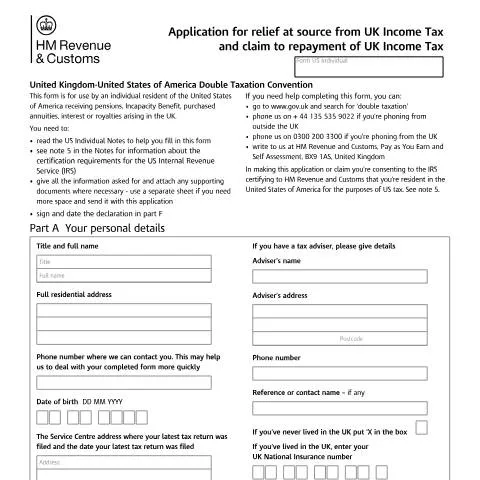
For US residents receiving income from the United Kingdom, the prospect of facing taxation in both countries can create a significant financial burden. The Double Taxation: UK-USA form (US-Individual 2002) serves as a crucial lifeline, enabling American residents to claim relief from UK income tax on specific types of income under the bilateral tax treaty. This HMRC form addresses the complex scenario where UK-sourced income—ranging from state pensions to investment returns—would otherwise be subject to dual taxation.
The form operates within the framework of the United Kingdom-United States Double Taxation Convention, a comprehensive agreement designed to prevent the same income from being taxed by both nations. However, navigating this relief mechanism requires understanding not just the form itself, but the intricate web of residency tests, income classifications, and certification requirements that determine eligibility.
Residency Requirements and the Foundation of Treaty Protection
The cornerstone of accessing double taxation relief lies in establishing legitimate US tax residency. The form demands rigorous proof of this status, beginning with Part A's personal details section which requires your US Social Security number and the Service Centre address where your latest tax return was filed. This isn't merely administrative housekeeping—HMRC uses this information to verify your standing with the Internal Revenue Service.
A critical component involves the official IRS certification process. The form explicitly states that by making this application, you're consenting to the IRS certifying your US residency status to HMRC. This certification typically involves Form 6166, which the IRS must attach and stamp before the application reaches HMRC. Without this official endorsement, your claim for relief will likely face rejection regardless of how thoroughly you've completed other sections.
The Statutory Resident Test Complications
Questions 5 and 6 in Part B address the UK's Statutory Resident Test, a complex framework that can significantly impact your eligibility. If you've departed the UK in the current tax year, you must confirm whether you'll be classified as non-resident or eligible for split-year treatment. The latter option carries a crucial stipulation: you must remain non-resident for the entire following tax year. Should your circumstances change, HMRC requires immediate notification, as this could invalidate your relief claim.
For those who departed in previous tax years, the form requires confirmation of non-resident status under the Statutory Resident Test for the current tax year. This seemingly straightforward question can become complex for individuals with continuing UK ties, such as property ownership or business interests.
Dissecting Income Categories: From Pensions to Investment Returns
The form categorises eligible income into distinct sections, each with specific requirements and relief mechanisms. Understanding these categories is essential for accurate completion and successful processing.
State Benefits and Government Pensions
Part C.1 covers UK State Pension and Incapacity Benefit payments. These government benefits represent the most straightforward category for relief, requiring only the benefit type and commencement date. The UK typically taxes these payments at source, but treaty provisions often allow for reduced rates or complete exemption for US residents.
Occupational Pensions and Purchased Annuities
Section C.2 delves into private pension arrangements and purchased annuities, requiring comprehensive details about each income source. You must provide the payer's full name, address, and reference number, alongside payment schedules. The form includes an option to request adjustments for tax already deducted under the PAYE system—a crucial feature for those who've been overtaxed before applying for relief.
Including a photocopy of your latest P60 certificate can expedite this adjustment process. The P60 provides HMRC with precise details of tax already deducted, enabling accurate recalculation of your liability under treaty provisions.
Investment Income Considerations
Part C.3 addresses UK interest payments, while subsequent sections cover dividends and royalties. These investment income categories often present the most complex scenarios, particularly regarding the "conduit arrangement" provisions referenced in question 12 of Part B. This anti-avoidance measure targets artificial structures designed to exploit treaty benefits inappropriately.
| Income Type | Treaty Article | Typical Relief Rate | Key Requirements |
|---|---|---|---|
| Government Pensions | Article 18 | Full exemption | US tax residency |
| Private Pensions | Article 18 | Variable | Beneficial ownership |
| Interest | Article 11 | Reduced rate | No conduit arrangements |
| Royalties | Article 12 | Reduced rate | Beneficial ownership |
The Certification Maze: IRS Involvement and Form 6166
One of the most frequently misunderstood aspects of this process involves the mandatory IRS certification. The form includes a dedicated section for the US Internal Revenue Service's official stamp, and Form 6166 must be attached before submission to HMRC. This creates a multi-step process that can extend processing times significantly.
Form 6166 serves as the IRS's official certification of your US tax residency status. Obtaining this document requires a separate application to the IRS, typically taking several weeks to process. The certification must be current—generally issued within the same tax year as your HMRC application or the immediately preceding year.
Timing Considerations and Processing Delays
The dual-authority requirement creates inherent delays in the relief process. US residents planning to claim UK tax relief should initiate Form 6166 applications well in advance, particularly if time-sensitive relief at source is required. HMRC cannot process your application without proper IRS certification, regardless of how urgent your circumstances may be.
Property Ownership and Continuing UK Ties
Question 4 in Part B addresses a critical area that often determines eligibility: continuing property interests in the UK. The form requires disclosure of any property owned or rented since departing the UK, extending this requirement to spouses and civil partners. This provision reflects the UK's concern about individuals claiming non-resident status while maintaining substantial UK connections.
If you continue to own UK property, you must provide comprehensive details including the property address and, if let to tenants, expected annual rental income. Properties no longer available for your personal use require explanation of the circumstances—such as sale dates or tenancy terminations. These details help HMRC assess whether your residency claims align with your actual circumstances.
The Business Connection Factor
Question 7 probes whether you're engaged in UK trade or business activities. Any ongoing commercial connections can complicate your relief claim, as they may indicate continuing UK tax obligations beyond the specific income covered by your application. Business activities require detailed explanation on separate sheets, including the nature of operations and expected income levels.
Strategic Completion: Avoiding Common Pitfalls
Successfully navigating this form requires attention to several critical details that frequently trap unwary applicants. The requirement for comprehensive supporting documentation cannot be overstated—incomplete applications face automatic rejection or extensive delays while HMRC seeks additional information.
When providing additional information on separate sheets, as frequently required throughout the form, ensure each sheet clearly identifies the relevant question number and your full name. HMRC processes thousands of these applications annually, and proper identification prevents your supporting documents from becoming separated from your main application.
The Declaration Requirements
Part F contains the formal declaration that must be signed and dated to validate your application. This declaration carries legal significance—false statements can result in penalties and may jeopardise future relief claims. The declaration encompasses not only the accuracy of information provided but also your consent to IRS certification of your US residency status.
Processing Pathways and Response Timelines
HMRC processes US-Individual forms through their Pay As You Earn and Self Assessment division at BX9 1AS. Standard processing times vary considerably depending on the complexity of your circumstances and the completeness of your initial submission. Applications with proper IRS certification and comprehensive supporting documentation typically process more quickly than those requiring additional information.
For urgent enquiries, HMRC provides dedicated phone lines: +44 135 535 9022 for international callers or 0300 200 3300 for UK-based calls. However, phone support focuses primarily on procedural guidance rather than specific case processing updates.
Relief at Source Versus Retrospective Claims
The form accommodates both prospective relief at source and retrospective refund claims. Relief at source prevents future UK tax deductions on eligible income, while retrospective claims seek refunds of tax already paid. The distinction affects processing priorities and timelines, with relief at source applications often receiving expedited handling to prevent ongoing overwithholding.
Retrospective claims require more extensive documentation, particularly P60 certificates and evidence of tax already paid. These claims can extend back several years, but older claims face increased scrutiny and may require additional supporting evidence of your circumstances during the relevant periods.
Managing Ongoing Compliance and Changes in Circumstances
Securing initial relief represents only the beginning of ongoing compliance obligations. The form's provisions regarding split-year treatment and continuing UK connections create ongoing reporting requirements that extend well beyond the initial application processing.
If you've claimed split-year treatment, you must monitor your residency status throughout the following complete tax year. Any changes that might affect your non-resident classification require immediate notification to HMRC, as these could invalidate your relief entitlement and trigger recovery of benefits already received.
Similarly, changes in your US tax status—such as loss of residency or changes in IRS filing requirements—can affect your ongoing eligibility for treaty benefits. The interconnected nature of UK and US tax obligations means that developments in either jurisdiction can impact your relief entitlement under the double taxation convention.
For individuals with complex international tax situations, the US-Individual form represents one component of a broader compliance strategy. Professional tax advice often proves valuable, particularly for those with multiple income sources, complex residency histories, or significant business interests spanning both jurisdictions. The form itself provides space for tax adviser details, recognising the complexity many applicants face in navigating these dual-jurisdiction requirements.
Claiming Relief Under the UK-USA Double Taxation Treaty: Practical Steps and Documentation
Successfully claiming relief under SI 2002/2848 requires meticulous documentation and understanding of the specific relief mechanisms available. The treaty provides several methods for avoiding double taxation, each with distinct procedural requirements that UK taxpayers must navigate carefully.
Credit Relief Mechanism: Under Article 24 of the treaty, UK residents can claim credit for US federal income tax paid against their UK tax liability. This relief applies to income that would otherwise be taxed in both jurisdictions, such as US rental income or employment earnings. HMRC requires detailed evidence of US tax paid, including Form 1040 copies, payment confirmations, and currency conversion calculations using rates applicable on the payment date.
The credit calculation follows specific rules: relief cannot exceed the UK tax attributable to the foreign income. For instance, if your US rental income generates £2,000 UK tax but you paid $3,500 US tax (equivalent to £2,800), your credit relief caps at £2,000. The excess cannot offset other UK tax liabilities, though it may carry forward in certain circumstances.
Exemption Relief Applications: Certain income types qualify for complete exemption from UK tax under treaty provisions. US government pensions paid to UK residents, for example, may be exempt from UK taxation if specific conditions are met. Claiming this exemption requires Form US-Individual 2002 completion, demonstrating treaty entitlement and providing evidence of the income's qualifying nature.
Employment income presents particular complexities. The treaty's "183-day rule" under Article 15 may exempt short-term US employment income from UK tax, but only if the employer isn't UK-resident and you're physically present in the US for fewer than 183 days in any 12-month period beginning or ending in the tax year concerned.
Mutual Agreement Procedure (MAP): When disagreements arise between HMRC and the Internal Revenue Service regarding treaty interpretation, taxpayers can invoke the MAP under Article 25. This procedure addresses situations where tax authorities apply conflicting interpretations, potentially resulting in economic double taxation despite treaty provisions.
MAP cases typically involve complex issues like transfer pricing adjustments, permanent establishment determinations, or residency disputes. The procedure requires initial contact with your competent authority (HMRC's International Division) within three years of the first notification of action resulting in taxation not in accordance with the treaty. Documentation must include detailed explanations of the facts, legal positions, and specific treaty articles allegedly breached.
Tie-Breaker Rules for Dual Residents: Individuals potentially resident in both countries must apply Article 4's tie-breaker rules to determine treaty residence. The sequence considers: permanent home location, centre of vital interests, habitual abode, and finally nationality. Each test requires substantial evidence - property ownership documents, family ties documentation, professional activity records, and detailed presence logs.
The centre of vital interests test particularly demands comprehensive evidence of personal and economic relations. HMRC examines factors including family location, property ownership, bank accounts, club memberships, professional activities, and administrative home base. US authorities apply similar scrutiny, making consistent documentation across both jurisdictions essential.
Form US-Individual 2002: Section-by-Section Completion Guide and Common Errors
Form US-Individual 2002 serves as the primary mechanism for UK taxpayers to claim treaty benefits, but its completion requires precise attention to detail and thorough understanding of both UK and US tax concepts. Each section demands specific information types, and errors can delay processing or result in benefit denial.
Personal Information Sections: The form's opening sections require UK taxpayers to provide information in formats that may differ from standard UK practices. Social Security Numbers, for instance, aren't mandatory for UK residents, but Individual Taxpayer Identification Numbers (ITINs) may be required depending on the relief claimed. Name formatting must match exactly across all supporting documentation, including any variations used on US tax returns or financial accounts.
Address information presents particular challenges for UK taxpayers. The form expects US-style formatting, but UK addresses must be clearly identifiable. Include postal codes, avoid abbreviations that might cause confusion, and ensure consistency with addresses used on related US tax filings. Date formats should follow the US convention (MM/DD/YYYY) throughout the form to avoid processing delays.
Income Classification and Reporting: The form's income sections require careful mapping between UK and US tax concepts. UK employment income through PAYE may need reclassification for US purposes, particularly where benefits-in-kind or expense reimbursements are involved. Self-employment income from UK sources must be reported using US business income categories, which may not align perfectly with UK trading income classifications.
Investment income requires particular attention to source rules and classification differences. UK dividend income may be treated differently for US treaty purposes than for domestic UK tax. Interest from UK banks, building societies, or gilts may qualify for reduced US withholding under specific treaty articles, but only if properly documented and claimed.
Treaty Article Selection and Justification: Each income type claimed for treaty relief must reference specific treaty articles. Article 10 (Dividends), Article 11 (Interest), Article 12 (Royalties), and Article 15 (Employment Income) each contain different conditions and relief levels. Incorrect article citation can result in inappropriate relief or complete claim rejection.
The form requires detailed explanations of how each claimed benefit meets treaty requirements. Generic statements are insufficient; specific factual circumstances must demonstrate treaty entitlement. For employment income claims under Article 15, provide detailed presence records, employer information, and work location specifics. For investment income under Articles 10-12, include source documentation and beneficial ownership confirmations.
Supporting Documentation Requirements: Form US-Individual 2002 must be accompanied by comprehensive supporting evidence. UK tax returns (SA100 series), P60 certificates, and bank statements provide income verification. For treaty residence claims, include evidence of UK tax residence determination - typically your Self Assessment computation or HMRC residence determination letter.
Currency conversion documentation is essential for amounts originally in pounds sterling. Use rates from reliable sources (such as HMRC's published rates or major financial institutions) and maintain consistency throughout the form. Include the conversion rate source and date in your supporting documentation.
Common Completion Errors and Avoidance Strategies: Frequent errors include mismatching income periods between UK and US tax years, incorrect treaty article citations, and inadequate supporting documentation. The UK tax year runs 6 April to 5 April, while the US tax year follows the calendar year - ensure income allocation reflects the correct periods for each jurisdiction's purposes.
Another common error involves claiming relief for income not covered by treaty provisions. Certain UK government pensions, for example, may be exclusively taxable in the UK under Article 19, making US relief claims inappropriate. Review each income type against specific treaty articles before claiming relief.
Special Circumstances and Advanced Treaty Applications
The UK-USA double taxation treaty contains numerous specialized provisions addressing complex cross-border situations that standard guidance rarely covers comprehensively. These advanced applications require sophisticated understanding of both treaty mechanics and underlying tax principles in both jurisdictions.
Triangular Cases and Third-Country Elements: Situations involving income sourced in third countries but flowing through UK or US entities create complex treaty application scenarios. For instance, UK residents receiving US mutual fund distributions that include income from multiple countries must analyze each component's treaty eligibility separately. The treaty's benefits may not extend to third-country source income, even when received through US investment vehicles.
Similarly, UK pension schemes investing in US securities may generate US-source income subject to different withholding rates depending on the pension scheme's treaty status. Registered pension schemes typically qualify for treaty benefits, but Self-Invested Personal Pension (SIPP) arrangements may face different treatment depending on their specific structure and investment approach.
Corporate-Individual Hybrid Situations: UK individuals involved in US partnerships, Limited Liability Companies (LLCs), or S-Corporations face complex treaty applications. These entities' "pass-through" nature for US tax purposes may conflict with UK tax treatment, creating potential gaps or overlaps in treaty coverage. Form US-Individual 2002 may require supplementation with additional documentation explaining the entity structure and income allocation methods.
UK residents holding interests in US Real Estate Investment Trusts (REITs) through various structures encounter layered treaty applications. Direct REIT ownership typically qualifies for treaty benefits under Article 10 (Dividends), but ownership through UK investment funds or offshore structures may alter the treaty analysis significantly.
Timing Differences and Multi-Year Adjustments: The treaty's effectiveness can be complicated by timing differences between UK and US tax recognition. UK residents using cash accounting for US rental income while the US requires accrual accounting may face periods where income is taxed in one country but not yet recognized in the other. These timing differences may require careful coordination of treaty claims across multiple tax years.
US tax law changes affecting treaty application retroactively can create complex adjustment situations. When US tax reforms alter the treatment of specific income types, UK taxpayers may need to file amended returns and revised Form US-Individual 2002 submissions to maintain appropriate treaty benefits. The three-year amendment window for both countries requires prompt action when such changes occur.
Estate and Trust Complications: UK residents involved in US estate or trust arrangements face specialized treaty applications under Articles 1 and 4. Determining treaty residence for trust beneficiaries requires analysis of both UK and US trust residence rules, which may produce conflicting results. The treaty's tie-breaker rules may not adequately address modern trust structures, particularly discretionary trusts or those with multiple jurisdictional connections.
US estate tax treaty provisions under the separate estate tax treaty (not SI 2002/2848) may interact with income tax treaty claims, creating coordination requirements. UK residents inheriting US assets may need to navigate both treaties simultaneously, ensuring consistent positions across different tax types and filing obligations.
Professional and Business Income Complexities: UK professionals providing services in the US face intricate treaty applications under Articles 7 (Business Profits) and 14 (Independent Personal Services, though this article was eliminated in 2001 protocol updates). Determining whether activities create a US permanent establishment requires detailed analysis of physical presence, service duration, and client relationship patterns.
Digital economy activities present emerging treaty interpretation challenges. UK residents providing online services to US clients may trigger US tax obligations that require treaty analysis, but existing treaty language may not adequately address modern business models. Cloud computing, digital platforms, and remote service delivery create new permanent establishment questions that may require competent authority guidance or MAP procedures to resolve definitively.