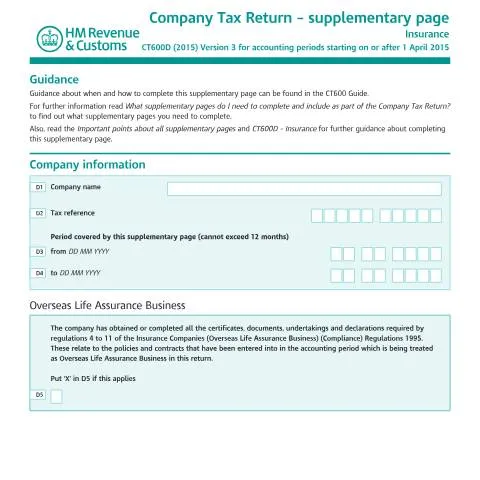
Navigating the CT600D: A Practical Overview for Insurance Companies
Understanding the intricacies of tax documentation is essential for businesses, particularly those operating in the insurance sector. The CT600D form, a critical component of the Corporation Tax return, caters specifically to insurance businesses, especially in the realm of overseas life assurance. Businesses must navigate its requirements to ensure compliance with HM Revenue & Customs (HMRC) regulations. This article delves deeply into the CT600D, focusing on its purpose, completion process, and key implications for businesses.
Decoding the CT600D Form: Essential Sections
The CT600D form supplements the standard Corporation Tax return (CT600) and is mandatory for companies involved in overseas life assurance. It is divided into various sections, and understanding each part is vital for accurate completion. Here, we dissect the form into its key components:
Company Information
At the top of the CT600D, you must provide basic information about your company. This includes:
- Company Name (D1): Ensure the registered name matches the official records.
- Tax Reference (D2): This unique number identifies your company in the tax system.
- Period Covered (D3 & D4): Clearly state the accounting period, which must not exceed 12 months. Incorrect dates can lead to delays or rejections, so double-check these entries.
Insurance Business Declaration
One of the pivotal aspects of this form is the declaration concerning overseas life assurance business. This section, where you indicate compliance with the Insurance Companies (Overseas Life Assurance Business) (Compliance) Regulations 1995, requires careful attention:
- D5: Mark this box with an 'X' if your company has completed the necessary requirements as per regulations 4 to 11. This includes obtaining all relevant certificates and declarations related to policies and contracts during the specified accounting period.
This step is crucial; failure to declare correctly can trigger penalties or further inquiries from HMRC.
Timelines: When to Complete and Submit the CT600D
Adhering to deadlines is imperative in the tax landscape. For the CT600D, companies should be aware of the following timeline nuances:
- The fiscal year for tax purposes in the UK runs from 6 April to 5 April the following year. If your accounting period aligns with this, your submission should reflect this timeline.
- The completion deadline for the CT600D, alongside your Corporation Tax return, is 12 months after the end of your accounting period. For instance, if your period ends on 5 April 2023, your deadline for submission would be 31 January 2024.
Missing this deadline can incur substantial financial penalties, so ensure timely submission to HMRC.
Submission Process: Ensuring Proper Delivery to HMRC
Completing the CT600D is only half the battle; ensuring it reaches HMRC correctly is equally important. Here's how to navigate the submission process:
- Compilation: Assemble the CT600D along with the main CT600 form and any other supplementary pages necessary based on your business activities.
- Digital Submission: Most companies are encouraged to submit their Corporation Tax returns online for efficiency. Ensure you have the correct software or platform that supports CT600 submissions.
- Retain Copies: It’s critical to keep copies of all documents submitted. These records will be invaluable in case of inquiries or audits by HMRC.
Post-Submission: Tracking Your CT600D Status
Once your CT600D has been dispatched, it's essential to know how to track its status:
- HMRC Online Account: If you submit online, you can easily check the status of your submission through your HMRC online account. This platform provides insights into whether your return has been received and processed.
- Communication from HMRC: HMRC will typically correspond regarding any issues or requests for further information. Keep an eye on correspondence, as responding promptly can prevent complications down the line.
In case of discrepancies or if you don’t receive confirmation, it’s advisable to contact HMRC directly for clarification.
Special Considerations: Unique Circumstances and Exceptions
Businesses can sometimes find themselves in unique situations that affect their tax obligations. Here are some special considerations related to the CT600D:
- Foreign Entities: Companies based outside the UK that have overseas life assurance business must ensure compliance with both UK regulations and their home country’s requirements. It’s advisable to consult with a tax advisor familiar with international tax law.
- Partnerships and Joint Ventures: In cases where insurance businesses operate as partnerships, ensure that the correct entity completes the CT600D. Misidentification can lead to significant complications with tax assessments.
- Complex Policies: If your business deals with complex insurance products, such as those involving multiple jurisdictions, professional guidance is strongly recommended to ensure all regulatory obligations are met.
Impacts of Compliance: Rights, Obligations, and Consequences of Non-Filing
Understanding the implications of filing the CT600D is crucial for any business:
- Rights: Filing correctly ensures your business can claim any allowable deductions and credits. This can significantly impact your overall tax liability and hence the financial health of your company.
- Obligations: Businesses are required to maintain accurate records and retain them for at least six years after the end of the accounting period. This is essential for supporting your return in case of an audit.
- Consequences of Non-Filing: Failing to submit the CT600D can lead to penalties, interest on unpaid tax, and potentially legal action by HMRC. In severe cases, persistent non-compliance may result in criminal charges.
Conclusion: Proactive Management of Your Corporation Tax Obligations
The process surrounding the CT600D and the associated Corporation Tax return is intricate but manageable with the right information and support. Companies that prioritize understanding their obligations and stay ahead of deadlines will find that compliance not only safeguards them from penalties but also optimizes their tax position. By maintaining clear records and seeking expert advice when necessary, businesses can navigate the complexities of tax law with confidence.
Understanding the CT600D Form for Insurance Companies
The CT600D form is a crucial document for insurance companies in the UK, serving as the Corporation Tax Return specifically designed for entities conducting insurance business. This form is a variation of the standard CT600 and includes additional questions and sections pertinent to the operations of insurance companies. Understanding the unique aspects of the CT600D is essential for compliance with HM Revenue & Customs (HMRC) regulations.
When filling out the CT600D, insurance companies must declare their taxable profits, which typically include gross premiums, investment income, and any other relevant income sources while deducting claims and expenses. The calculation of taxable profits can be complex due to the different accounting methods permitted under UK tax law, such as the use of Generally Accepted Accounting Principles (GAAP) or International Financial Reporting Standards (IFRS).
Moreover, companies must be aware of the specific legislation governing insurance business taxation, which includes the Insurance Premium Tax (IPT) and the taxation of investment income. Accurate reporting is imperative not only to meet statutory obligations but also to avoid penalties. As such, companies are encouraged to maintain meticulous records and seek professional advice if needed.
Exemptions and Reliefs Available for Insurance Companies
Insurance companies in the UK may be entitled to various reliefs and exemptions that can significantly reduce their Corporation Tax liabilities. One notable relief is the "Non-Domestic Business Allowance," which certain qualifying insurance companies can claim. This allowance can be particularly beneficial for newer and smaller firms looking to mitigate their tax burden in the early years of operation.
Another important aspect is the treatment of losses. Under UK tax law, insurance companies can carry forward trading losses to offset against future profits, which can provide a crucial lifeline for firms that may face fluctuating profitability due to market conditions or catastrophic events. In this context, it’s essential for companies to properly document their losses and ensure compliance with the requirements set forth by HMRC to claim these benefits effectively.
Furthermore, there are reliefs available specifically related to investment income. The "Investment Business Relief" allows insurance companies to receive tax relief on certain types of income derived from investments, making it advantageous for firms to engage in investment activities. Companies should assess their investment strategies carefully, ensuring that they maximize available reliefs while adhering to regulatory requirements.
Filing and Payment Deadlines: What You Need to Know
Understanding the filing and payment deadlines associated with the CT600D form is vital for insurance companies to avoid unnecessary penalties. The standard deadline for filing the CT600D returns is usually 12 months after the end of the accounting period. For instance, if a company’s accounting period ends on 31 December 2023, the CT600D must be submitted by 31 December 2024.
It is important to note that Corporation Tax must be paid nine months and one day after the end of the accounting period. Therefore, using the same example, the tax payment would be due by 1 October 2024. Late payments can incur significant penalties, making it crucial for companies to plan their cash flow accordingly and ensure timely submissions.
Insurance companies with complex structures or those involved in international operations may have additional considerations, such as transfer pricing rules or the implications of double taxation agreements. Thus, consulting with tax professionals can help navigate these intricacies and ensure compliance with all applicable deadlines and regulations.