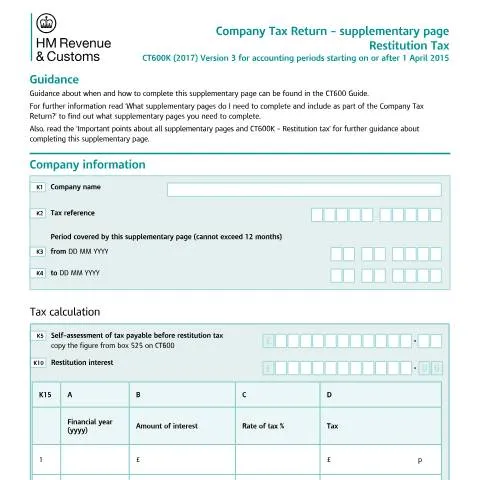
Understanding the CT600K: The Essentials of Restitution Tax
The CT600K form plays a crucial role in the realm of corporate taxation in the UK, specifically concerning the restitution tax aspect of Company Tax Returns. This form is essential for companies that have overpaid taxes and are eligible for a refund. By submitting this supplementary page, businesses ensure that they accurately report and reclaim amounts owed to them by HM Revenue & Customs (HMRC). The CT600K is not just a bureaucratic footnote; it encapsulates a company’s rights and obligations regarding tax restitution.
Historical Context and Regulatory Framework
The framework for the CT600K is rooted in the broader regulations governing corporation tax in the UK. This form emerged alongside the corporation tax reforms that were enacted to simplify taxation and promote transparency within corporate financial practices. These changes aimed to ensure that businesses can readily claim back any overpayments, thereby encouraging compliance and fostering trust between companies and the HMRC.
The Corporation Tax Act 2009 and subsequent amendments laid down the legal basis for how restitution tax is assessed and claimed. It’s essential for companies to understand this regulatory backdrop, as it not only dictates the procedures involved but also the rights to which they are entitled if they discover tax overpayments. The CT600K is therefore a reflection of legislative initiatives aimed at supporting fair taxation practices.
The Importance of Accurate Reporting
Filing the CT600K isn’t just about numbers; it’s about ensuring that the financial representations made to HMRC are precise. Misreporting can lead to delays in refunds, potential penalties, and increased scrutiny from tax authorities. Companies must therefore pay close attention to every detail when completing this form. The self-assessment feature encourages a proactive approach to tax management, allowing companies to calculate their tax liabilities accurately prior to submitting their returns.
Who Needs to File the CT600K?
The CT600K is specifically targeted at companies that have previously made overpayments on their corporation tax. Typically, this involves:
- Limited companies that have been assessed for corporation tax
- Companies that have adjusted their taxable profits for any reason, leading to a lower tax liability
- Businesses that have received restitution interest on their overpaid tax
Additionally, not all companies will need to file a CT600K; understanding the criteria is essential. For example, small businesses that operate under specific thresholds or those that have not incurred overpayments may not find this form relevant to their tax situation.
Identifying Specific Cases and Exceptions
It’s important to note that certain exceptions may apply. For instance, companies that have undergone structural changes, such as mergers or acquisitions, may require a different approach in handling their tax filings, including restitution tax. Furthermore, companies that are part of a tax group must also consider group relief provisions that may affect how restitution claims are filed.
Navigating the CT600K: A Closer Look at the Form’s Structure
The CT600K comprises several sections, each designed to capture vital financial information regarding the restitution tax. Understanding these sections in-depth will enable businesses to complete the form effectively.
- Company Information: This section includes essential details like the company name (K1), tax reference (K2), and the period covered by the form (K3 & K4). Accurate data entry here is paramount, as it directly ties back to the company’s official records.
- Self-Assessment of Tax Payable: Boxes K5 and K30 require companies to assess their tax obligations before and after accounting for restitution tax. It’s critical to copy figures correctly from the primary CT600 to avoid discrepancies.
- Restitution Interest: Box K10 captures the restitution interest, which is pivotal in determining the overall tax refund.
- Total Restitution Tax Calculation: Companies must ensure that the figures reported in K20 accurately reflect all amounts owed as restitution tax, with K35 summarizing the net payable after deductions.
- Additional Financial Data: The financial year breakdown in K15 allows companies to provide detailed reporting of interest amounts and applicable tax rates, facilitating a comprehensive view of their tax position.
A Detailed Walkthrough of Each Section
| Section | Description | Common Pitfalls |
|---|---|---|
| K1 & K2 | Company name and tax reference | Incorrect or incomplete company name; misspelled tax reference leading to rejection of claims. |
| K5 | Self-assessment of tax payable | Copying the wrong figure; failing to include adjustments from earlier periods. |
| K10 | Restitution interest | Omitting interest or miscalculating it, which affects overall tax calculations. |
| K20 | Total restitution tax | Inaccurate total leading to incorrect refund requests. |
| K35 | Restitution tax now payable | Failure to account for previous payments, resulting in overclaims. |
Submission Channels: Paper vs. Online
When it comes to submitting the CT600K, companies have options. Understanding these options can significantly influence the speed and efficiency of the filing process.
- Online Submission: Filing the CT600K online is typically the preferred method. The HMRC’s online portal provides a streamlined approach, allowing for instant validation of entries and faster processing times. Companies can also receive immediate feedback on common errors, enabling them to rectify issues before submission.
- Paper-Based Submission: While less common, some companies may opt for paper submissions. It's vital to send the completed form to the appropriate HMRC address and ensure it’s postmarked correctly to meet deadlines. Companies should be aware that paper submissions may take longer to process and may not provide immediate confirmation of receipt.
Understanding Processing Times and Tracking Status
Once the CT600K is submitted, the wait begins. Processing times can vary significantly based on the method of submission and the complexity of the tax claim. Generally, online submissions are processed more swiftly, often within a few weeks, whereas paper submissions can take several weeks or even months.
Companies can track the status of their claims by contacting HMRC directly or checking their online account, if applicable. It’s crucial to keep records of all submitted documentation and correspondence to facilitate any necessary follow-ups.
Understanding the Implications of Tax Overpayment
Overpayment of taxes can arise from various scenarios, including miscalculations, changes in business operations, or errors in tax returns. The significance of accurately reporting these overpayments through the CT600K cannot be overstated, as it impacts a company’s cash flow and operational finances.
Restitution tax not only allows businesses to reclaim funds but also sets the stage for future tax practices. An understanding of the intricacies involved in the CT600K can lead to better financial management, ensuring that companies remain compliant while optimizing their tax obligations.
Future Considerations and Ongoing Compliance
As the tax landscape evolves, companies should remain vigilant about updates to tax legislation that may affect their reporting obligations. Engaging with tax professionals or consultants can provide tailored guidance, ensuring that businesses are well-positioned to adapt to any changes that may arise.
Furthermore, it’s beneficial for companies to regularly review their tax positions, particularly in relation to overpayments. Establishing robust internal controls for financial reporting can help mitigate the risk of overpayment, making the process of completing the CT600K smoother and more efficient.
The Role of Expert Guidance in Completing the CT600K
Given the complexities involved in corporation tax and the specific requirements of the CT600K, seeking expert advice can greatly enhance a company's ability to navigate the filing process successfully. Tax advisors can offer insights into best practices, compliance strategies, and error prevention techniques.
Whether businesses opt for internal resources or external consultations, investing time and resources into understanding the CT600K can lead to more favorable outcomes in tax recovery and overall financial health.
Understanding the Corporation Tax Self-Assessment Process
In the UK, Corporation Tax is a tax on the profits of companies and certain organisations, known as 'corporation tax entities.' It is essential for these entities to accurately assess their tax obligations and file their returns on time. The UK tax year operates from 6 April to 5 April, and the standard rate for Corporation Tax is currently at 19% for most companies, although recent changes may impact specific sectors and profits.
To begin the self-assessment process, a corporation must first calculate its taxable profits, which generally include income from trading, investments, and the sale of assets. It's crucial to note that not all income is taxable, and certain expenses can be deducted. For instance, costs associated with running the business, such as salaries, rent, and utilities, can reduce the taxable amount.
After determining the taxable profits, corporations must complete the CT600 tax return form, which is the primary document used to report Corporation Tax liability to HM Revenue & Customs (HMRC). Alongside the CT600, corporations may also need to submit accounts and additional forms, depending on their specific circumstances. Corporations with a taxable profit of more than £1.5 million must pay their tax in quarterly instalments, which is referred to as 'quarterly instalment payments' (QIPs).
Once the CT600 is submitted, HMRC processes the information and, if all is in order, will send a tax calculation to confirm the amount owed. Any discrepancies or audits may arise if the initial calculations appear inconsistent or if further scrutiny is warranted. Understanding the self-assessment process not only helps ensure compliance but can also uncover opportunities for tax reliefs and exemptions.
Tax Reliefs and Exemptions: Navigating Corporation Tax Benefits
Corporation Tax legislation in the UK allows various tax reliefs and exemptions that corporations can utilise to reduce their tax liabilities. One of the most significant reliefs is the 'Research and Development (R&D) Tax Credit,' which is designed to encourage innovation among companies. If your company engages in qualifying R&D activities, you may be eligible for substantial tax relief that can either be claimed as a reduction in your Corporation Tax or as a cash rebate.
Additionally, the UK government offers several allowances, such as the Annual Investment Allowance (AIA), which lets businesses deduct the full value of qualifying equipment from their profits before tax. This allowance can significantly reduce the taxable profit for companies that invest in new machinery or equipment.
Another vital exemption pertains to capital gains on the disposal of certain assets. If a company sells an asset that has appreciated in value, it may be subject to Capital Gains Tax; however, under specific conditions, reliefs such as 'Entrepreneurs' Relief' can reduce the tax burden, encouraging reinvestment into the business.
Moreover, small companies may qualify for 'Small Companies Rate' of Corporation Tax, further reducing their tax liabilities. Understanding and navigating these reliefs and exemptions can lead to significant financial advantages and ensure that corporations are not overpaying their tax obligations.
Common Mistakes in Completing the CT600 and How to Avoid Them
Filing the CT600 accurately is crucial, but many companies fall prey to common mistakes that can lead to penalties or overpayments. One prevalent error is miscalculating taxable profits. Many businesses may overlook allowable expenses that could significantly reduce their taxable income. It's essential to keep detailed records of all business transactions and consult with a tax professional to ensure that no deductible expense is missed.
Another common mistake is failing to file the return by the 12-month deadline from the end of the accounting period. Late submissions can lead to automatic penalties, which escalate the longer the return remains unfiled. Companies should set reminders or use digital accounting tools to streamline their filing processes.
Inaccurate reporting of capital gains and losses is also a prevalent issue. Many businesses either fail to report gains or incorrectly calculate losses. Maintaining precise records of asset purchases and sales will mitigate these mistakes. Additionally, providing full support for any capital gains reported can help substantiate claims during HMRC audits.
Finally, not seeking professional advice can be detrimental. The tax landscape is complex, and the guidance of an accountant or tax advisor can help navigate the intricacies of Corporation Tax, ensuring compliance and maximising potential reliefs.