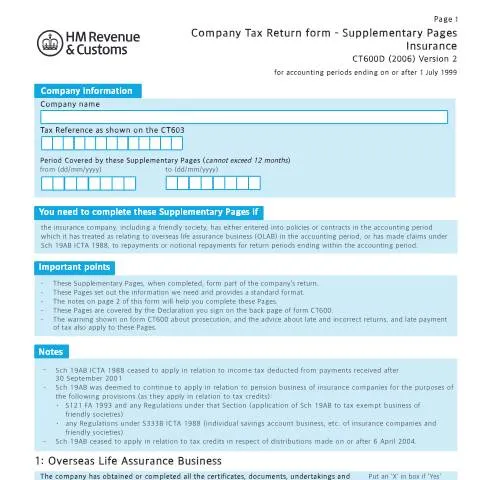
A Comprehensive Guide to Completing the CT600D Form for Insurance Companies
Navigating the complexities of tax returns can be a daunting task, especially for insurance companies operating within the UK. The CT600D form, specifically designed for insurance companies handling Overseas Life Assurance Business (OLAB), is a critical document in this landscape. Understanding its nuances is essential for compliance and to maximize the tax advantages associated with OLAB.Understanding the Importance of the CT600D Form
The CT600D (2006) Version 2 is not merely a supplementary page; it plays a pivotal role in the larger framework of the Corporation Tax return process. This form gathers specific information concerning policies and contracts treated as OLAB during the accounting period. For insurance companies, completing the CT600D accurately can unlock certain tax benefits. Failing to do so may lead to significant financial repercussions, including penalties and missed opportunities for tax rebates. This form is an essential piece of the tax return puzzle that is vital for ensuring the company is in compliance with HM Revenue & Customs (HMRC) regulations.The Scope of the CT600D Form: Who Should Complete It?
Only insurance companies, including friendly societies, that have entered into policies or contracts in the accounting period must complete the CT600D. These companies must have treated such contracts as relating to OLAB during that period. However, it’s vital to understand the sub-categories and the specific conditions that necessitate the use of this form:- Companies entering into qualifying policies for OLAB must possess the necessary documentation as outlined in the Insurance Companies (Overseas Life Assurance Business) (Compliance) Regulations 1995.
- Those companies that have made claims under Schedule 19AB of the Income and Corporation Taxes Act (ICTA) 1988 for repayments that fall within the accounting period.
- Companies entitled to tax advantages must ensure that all necessary certificates and documents have been obtained within the stipulated time limits.
Decoding the CT600D: Key Sections and Their Implications
Completing the CT600D requires meticulous attention to detail. Each section holds specific relevance, and mistakes can lead to complications. Here’s a closer examination of its contents and potential pitfalls:Company Information
The top section requires basic company information:- Company Name: Ensure the full, registered name of the company is entered accurately.
- Tax Reference: This must match the information provided on form CT603.
- Period Covered: Clearly define the period in question, ensuring it does not exceed 12 months. This is critical for the accuracy of your tax return.
Overseas Life Assurance Business Certification
A crucial section of the CT600D focuses on whether the company has generated or completed all necessary certifications for policies treated as OLAB. Here, the company must:- Indicate with an 'X' if the specific conditions for OLAB certification have been met.
- Recognize that failure to certify this can compel the company to submit returns based on a different taxation basis, potentially forgoing tax advantages.
The Timeline: When to Submit the CT600D
Every insurance company must be aware of the timeline for submitting the CT600D as part of their Corporation Tax return. The tax year runs from 6 April to 5 April, and specific deadlines must be adhered to:- Returns must generally be submitted no later than 12 months after the end of the accounting period.
- Any adjustments or corrections should also be made within this timeframe to avoid penalties.
Submission Channels: Navigating Through Options
Understanding how to submit the CT600D is essential for compliance. HMRC offers several options, each with its nuances:- Online Submission: The preferred method for many companies due to its speed and convenience. Using HMRC’s online services allows for immediate confirmation of receipt.
- Paper Submission: While still an option, submitting via post can lead to delays, and companies must ensure that they allow adequate time for postal service delivery.
- Third-Party Agents: Some companies may opt to employ tax professionals or accountants to handle their submissions. This can be beneficial for those unfamiliar with the intricacies of the CT600D form.
The Aftermath of Submission: What Comes Next?
Upon submitting the CT600D, companies enter a waiting period during which HMRC processes the submitted information. Companies should be proactive in following up to ensure there are no complications. Here’s how to manage the post-submission phase effectively:- Monitor the status of your submission through HMRC’s online portal if submitted online.
- Be prepared to respond to any queries from HMRC. Notably, if they request additional information or clarification, it’s crucial to respond promptly to avoid delays in processing.
- Understand that any discrepancies could lead to an audit, which may involve further scrutiny of your submissions and records.
Consequences of Non-compliance: The Risks Involved
Filing the CT600D with inaccuracies or failing to submit it altogether can have severe consequences. Companies may face penalties from HMRC, which can include:- Financial Penalties: Late submissions or errors can result in fines that vary based on the severity of the issue.
- Interest Charges: Failure to pay the correct amount of tax on time can lead to accruing interest, further increasing the financial burden.
- Legal Repercussions: In extreme cases, the company may face legal action, especially if discrepancies are deemed to be deliberate.
Seeking Guidance: Resources and Support for Tax Filers
For insurance companies navigating the complexities of the CT600D form, there are various resources and support mechanisms available:- HMRC Website: A wealth of information is available, including detailed guides and FAQs related to the CT600D and Corporation Tax.
- Professional Advisors: Engaging tax professionals can provide tailored advice and support, particularly for complex cases or larger companies.
- Networking with Peers: Joining industry groups or forums can provide insights and shared experiences from other insurance companies dealing with similar issues.
Final Thoughts on the CT600D Form
Completing the CT600D is a critical aspect of the Corporation Tax return for insurance companies involved with OLAB. The precision required in this form is paramount, and understanding its implications can lead to significant financial advantages. Navigating this process is not just about compliance; it’s also about leveraging opportunities available to ensure the company maximizes its financial health. By adhering to guidelines, being diligent in submission, and engaging with resources, insurance companies can mitigate risks and reap the benefits of submitting the CT600D accurately and on time.Understanding Corporation Tax for Insurance Companies
Corporation Tax for insurance companies follows distinct regulations compared to other corporate entities. As per UK legislation, insurance firms are subject to specific rules outlined by HM Revenue and Customs (HMRC) which govern their tax obligations. This section will elaborate on the unique aspects of Corporation Tax relevant to insurance businesses, the implications of their financial structuring, and the distinctions that arise in taxation when compared to other sectors.
Insurance companies typically operate within a framework of statutory regulations that include the Financial Services and Markets Act 2000, which impacts how they report earnings and manage capital reserves. Importantly, the CT600D form is tailored for insurance companies, and it includes particulars about the type of insurance business conducted, with separate reporting for life and non-life insurance.
One significant focus for insurance companies is the underwriting profit, which is calculated by deducting claims from premiums received. This profit is subject to Corporation Tax, and it’s essential for companies to accurately report these figures to avoid penalties. Furthermore, the treatment of reinsurance contracts and how they affect capital gains and losses is crucial in calculating the tax liability, requiring careful consideration and adherence to HMRC guidelines.
Another key area is the management of reserves and their tax implications. Insurance companies are expected to maintain adequate reserves to cover future claims, which can influence their taxable income. The proper accounting treatment of these reserves, in accordance with the rules set out in the Insurance Accounts Directive, must be reflected accurately in the CT600D submission.
Filing Requirements and Deadlines for the CT600D
Filing the CT600D requires insurance companies to comply with some specific deadlines and conditions, which can differ from standard corporation tax returns. The tax year in the UK runs from 6 April to 5 April of the following year, and companies are required to submit their CT600D to HMRC within 12 months of the end of their accounting period. It's crucial for companies to maintain awareness of this timeframe to avoid late filing penalties.
In cases where a company has changed its accounting period, it must ensure that the CT600D accurately reflects this change. The company should notify HMRC of any such changes, as this can affect both the tax periods involved and the timing of payments. Additionally, companies should be prepared to provide supplementary documents, including actuarial reports that justify the reserves and claims projections they report.
Moreover, companies must also consider the need for payment of Corporation Tax, which is often due nine months after the end of their accounting period. Early payment can be advantageous as it minimizes any potential interest or penalties. Companies need to be judicious about estimating their tax liabilities, particularly because an underestimation can lead to substantial large interest charges.
Common Challenges and Queries Related to CT600D for Insurance Companies
Insurance firms frequently encounter various challenges when navigating the filing of the CT600D form. Common queries often revolve around the treatment of reinsurance agreements, which can complicate income calculations. For instance, understanding how to report the income and expenses associated with reinsurance can be a complex task, as it involves reconciling premiums received and claims paid out.
Another frequent concern is related to the classification of certain types of income, particularly investment income. Insurance companies often earn significant income from investments, and the classification of this income can affect both the calculation of taxable income and the overall tax strategy of the business. It’s essential for companies to ensure they are appropriately reporting this income to HMRC, as discrepancies can result in audits or investigations.
Additionally, firms often seek clarification on the tax treatment of capital gains. For insurance companies, understanding how gains from investments or sales of assets can impact their overall tax liability is critical. There are specific provisions under UK tax law that can affect how these gains are reported and taxed, necessitating expert advice.
To address these challenges, companies may benefit from consulting tax professionals who specialize in insurance taxation. Keeping abreast of ongoing changes in legislation and HMRC guidelines is crucial to ensure compliance and optimize tax liabilities.