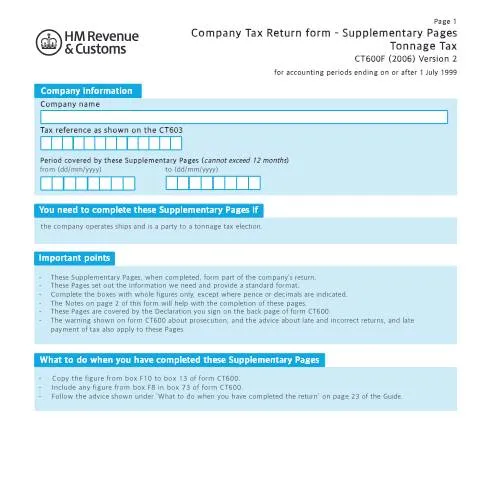
Understanding the CT600F Supplementary Pages in the Context of Tonnage Tax
When navigating the complexities of taxation in the UK, businesses engaged in maritime activities often encounter the Tonnage Tax regime. Specifically, the CT600F (2006) Version 2 serves as an essential document for companies electing to enter or renew their participation in this taxation scheme. This document is designed to capture specific financial details related to the operating of qualifying ships, thereby facilitating the calculation of tax obligations in a straightforward manner.
The Significance of the CT600F Form
The CT600F is critical for companies that participate in the Tonnage Tax scheme. Without this supplementary form, a company cannot accurately report its qualifying shipping profits, which are essential for tax assessment under this regime. It is compulsory for companies to complete this form if they operate ships and have chosen to be part of a tonnage tax election. This includes not only individual companies but also groups of companies that may elect a representative entity to handle these obligations.
Key Stakeholders: Who Needs to Fill Out the CT600F?
The primary users of form CT600F are companies that:
- Operate qualifying vessels for transport or marine assistance
- Are part of a tonnage tax group election
- Have chosen to renew their election into the Tonnage Tax scheme
Understanding who is involved is crucial, as the requirements may differ based on the company’s size, type of operations, and whether they are part of a group election.
Categories of Companies Involved
There are several types of companies that may need to submit this form:
- Independent Shipping Companies: Companies operating their own ships.
- Group Companies: Multiple companies that come together under a joint tonnage tax election.
- Representative Companies: A nominated entity within a group handling the tonnage tax matters.
Filling Out the CT600F: Step-by-Step Breakdown
Completing the CT600F requires meticulous attention to detail. Companies must include accurate financial figures reflecting their operational capacity and taxation eligibility. Here’s a closer look at how to fill it out:
Preliminary Information
Initially, the company must provide its name, tax reference as indicated on the CT603, and the period covered by these supplementary pages. It's crucial to note that this period cannot exceed 12 months.
Sections of the CT600F Form
| Section | Description | Key Points |
|---|---|---|
| F1 | Tonnage tax group election | Must be jointly completed by all qualifying companies in a group. |
| F2 & F3 | Group & representative company | Nominations for a representative company must be jointly signed. |
| F4 | Training commitment | Requires a certificate from the Department of Environment, Transport and the Regions. |
| F5 & F6 | Chartering-in limit | Limits chartered-in ships to 75% of net tonnage. |
| F7 | Offshore activities | Specifies conditions under which offshore activities may be considered. |
| F10 | Qualifying ships | Defines criteria for ships to be classified as qualifying. |
| F12 | Computation of profits | Details the calculation method for tonnage tax profits. |
Submission Channels: Online vs. Paper vs. In-Person
Once the CT600F is completed, the next step is submission. Companies have several options for submitting their forms:
Online Submission
Filing the CT600F online offers convenience and efficiency. Companies can complete the form through the HMRC portal, which often provides prompts and checks to ensure accuracy.
Paper Submission
For those preferring traditional methods, printed forms can be sent via post. It is essential to verify that all sections are filled out correctly to avoid delays or complications.
In-Person Submission
While less common, some firms may prefer to submit documents in person, especially if there are complex issues or additional documents that need clarification. Contacting HMRC directly for guidance is advisable.
The Aftermath of Submission: What Happens Next?
After filing the CT600F, companies must remain vigilant. Depending on the completeness and accuracy of the submitted information, HMRC may take several actions:
- Processing the Form: Typically takes a few weeks, during which HMRC will review the submission for any discrepancies.
- Requesting Additional Information: If HMRC identifies any gaps or requires clarification, they may reach out to the company.
- Issuing a Tax Assessment: Once processing is complete, HMRC will issue a tax assessment based on the reported figures.
What to Do If Your Submission Faces Challenges
In the event of an issue—be it a rejection, a request for more information, or a late submission—there are steps companies can take to mitigate problems:
Addressing a Refusal
If HMRC refuses the submission due to inaccuracies or incomplete information, the company has the right to appeal. This process involves providing the requested information and any necessary documentation to substantiate claims made on the form.
Handling Missing Information
If a company realizes that it has omitted key information after submission, it is crucial to contact HMRC immediately. Transparency and prompt communication can often alleviate further complications.
Dealing with Late Submissions
Late submissions may incur penalties. Companies should be aware of the deadlines and strive to meet them. If unable to meet a deadline, applying for a reasonable excuse can be considered to avoid penalties.
Regulatory Framework: The Legal Basis for the CT600F
The CT600F is embedded within a broader legal context governed by the Tonnage Tax Regulations 2000 and subsequent amendments. This framework ensures that the Tonnage Tax regime is applied fairly and consistently across all qualifying companies. Understanding this legal backdrop helps companies appreciate the importance of compliance and accurate reporting.
Key Legislation and Regulations
- Finance Act 2000: Introduced the Tonnage Tax scheme.
- Tonnage Tax Regulations 2000: Provides detailed guidance on tax calculations and eligibility.
- HMRC Statements of Practice: Offer interpretations on how to apply the regulations.
Timeframes: Understanding Key Dates and Deadlines
Timing is critical when filing the CT600F. Companies must be aware of various deadlines related to both the form and the overall corporation tax obligations:
Key Dates to Remember
- Accounting Period: The period covered by the CT600F cannot exceed 12 months.
- Submission Deadline: Company tax returns, including supplementary forms, must be filed by the 31st of January following the end of the accounting period.
- Payment Deadline: Any tax owed should be paid by the same deadline to avoid penalties.
Post-Submission Timeline
Following submission, companies typically receive confirmation of processing within a few weeks, allowing them to plan accordingly based on their tax obligations.
Final Thoughts: The Importance of Diligence and Accuracy
Completing the CT600F is not merely a formality; it is a critical component of a company's financial obligations under the Tonnage Tax regime. Taking the time to ensure accuracy can significantly impact the company's tax position and overall financial health. Companies are encouraged to consult with financial advisors or tax professionals experienced in the maritime sector to navigate the complexities of the Tonnage Tax and ensure compliance with all statutory obligations.
Understanding Tonnage Tax: Key Features and Eligibility Criteria
The Tonnage Tax regime is a special tax scheme that benefits qualifying shipping companies in the UK by providing them with a more predictable and lower rate of Corporation Tax. To understand whether your company can take advantage of this regime, it’s crucial to look at the eligibility criteria that define qualifying vessels and companies. The Tonnage Tax scheme applies to UK resident companies and groups that own qualifying ships. These vessels must be used for the carriage of goods or passengers and must meet specific tonnage thresholds as set forth by HMRC.
One of the main requirements is that the vessels must be registered with a Recognised Organisation, such as the Maritime and Coastguard Agency. Additionally, there are models for measurement, predominantly the 'gross tonnage' of the ship, which determines how much tax the company pays. As of now, qualifying companies must ensure that at least 75% of their trading income is generated from the operation of qualifying ships.
Companies involved in mixed activities—where ships may be used for both qualifying and non-qualifying activities—must carefully calculate the proportion of income attributable to qualifying activities to maintain eligibility for the scheme. Maintaining accurate records and evidence of operations becomes particularly important in these scenarios to demonstrate compliance during audits.
Filing Requirements for Tonnage Tax: The CT600F Form
Once a company opts into the Tonnage Tax regime, it must file a specific tax return, known as the CT600F (2006) Version 2. This form is tailored specifically for companies operating under the Tonnage Tax regime, and it differs significantly from the standard CT600 form. Detailed reporting is essential; therefore, the CT600F requires information on gross tonnage, the type of vessels operated, and the income derived from their operation.
Moreover, the CT600F form must be meticulously completed to comply with the legislative requirements stipulated in the Corporation Tax Act 2009 and further guidance issued by HMRC. Companies must be aware of deadlines for submission—typically, the form should be submitted within 12 months of the end of the accounting period it covers. Failure to file correctly and on time can lead to penalties and interest charges, adding unnecessary costs to already complex financial operations.
It's also worth noting that, unlike traditional Corporation Tax forms, the CT600F has additional sections that require disclosures about any changes in vessels, including sales or acquisitions, which could impact the company's tonnage and tax liability. Consultation with a tax professional, familiar with maritime taxation, is advisable to navigate the complexities of this form effectively.
Potential Benefits and Challenges of the Tonnage Tax Scheme
The Tonnage Tax regime offers several financial benefits, one of which is the ability to calculate taxable profit based on the tonnage of the vessels rather than traditional profit measures. This can result in a more favorable tax position for shipping companies, particularly those with large fleets. The predictability of the Corporation Tax liability aids in financial planning and provides a stable economic environment for businesses in the maritime sector.
However, there are challenges associated with the scheme as well. As previously mentioned, the requirement for meticulous record-keeping can pose a logistical challenge. Companies must ensure they are compliant with the ongoing eligibility criteria, which can lead to administrative burdens. Failure to meet the predefined thresholds for qualifying income or correct tonnage measurements can jeopardize a company’s position within the scheme, leading to a reassessment of tax liabilities.
Companies should also consider potential changes in maritime regulations, which may impact their operations and eligibility for Tonnage Tax. Keeping abreast of changing legislation and the implications for compliance is crucial for maintaining the benefits of this tax scheme. Regular consultations with legal and tax advisors who specialize in maritime taxation can help mitigate risks and ensure that companies remain compliant with the evolving landscape.