Understanding the Role of DASVOIT3 in Tax Avoidance Disclosure
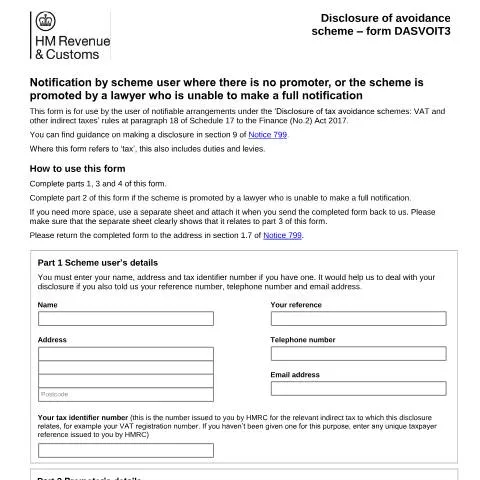
The DASVOIT3 form serves as a crucial tool in the UK’s taxation framework, particularly for individuals and entities engaged in tax avoidance schemes involving indirect taxes. This document becomes relevant when there are no promoters available to disclose the necessary details. It is vital for ensuring compliance with the regulations established under the Finance (No.2) Act 2017.
Who Needs to Submit the DASVOIT3 Form?
This form is aimed specifically at users of notifiable arrangements, typically those who find themselves in possession of an indirect tax scheme but lack a promoter to report the details. The range of taxpayers who might need to submit this form includes:
- Small business owners utilizing complex tax arrangements.
- Individuals or entities involved in VAT planning.
- Law firms representing clients in a situation where full disclosure cannot be made.
- Foreign entities operating within the UK tax system.
The requirement to use DASVOIT3 arises when the user is aware of an arrangement that appears to circumvent tax obligations, thus necessitating formal notification to HMRC.
Step-by-Step Process for Completing DASVOIT3
Completing the DASVOIT3 form may seem complex, but it can be broken down into manageable steps:
- Personal Details: Start with Part 1, where you must provide your name, address, and tax identifier number. It is advisable to include additional contact information like a telephone number and email address, which facilitates HMRC's processing.
- Promoter Information (if applicable): If a lawyer promotes the scheme but cannot make a full notification, you will need to fill out Part 2 with their details.
- Scheme Details: In Part 3, describe the scheme thoroughly. This involves stating the name of the proposal, selecting the appropriate indirect tax category (e.g., VAT, Insurance Premium Tax), and detailing the expected tax advantages.
- Declaration: Finally, Part 4 requires you to declare the accuracy of the information provided. This includes your signature and the date of completion.
Ensuring all sections are accurately filled will prevent delays in processing and potential penalties.
Consequences of Not Submitting DASVOIT3
Failure to submit the DASVOIT3 form when required can lead to severe ramifications:
- Financial Penalties: HMRC can impose fines for non-compliance, which may escalate over time.
- Legal Repercussions: Engaging in undisclosed tax schemes could result in criminal charges if HMRC deems the avoidance intentional.
- Loss of Credibility: Businesses found to be non-compliant may face reputational damage, affecting future operations and relationships with financial institutions.
Thus, timely and accurate filing of the DASVOIT3 is essential for avoiding these unintended consequences.
Particular Cases: Foreign Entities and Complex Situations
Foreign entities operating in the UK tax system often encounter unique challenges. For instance, a foreign corporation may engage in a tax avoidance scheme without a UK-based promoter. In such scenarios, the foreign entity becomes responsible for submitting the DASVOIT3 form to HMRC. This requirement brings about additional considerations:
- Understanding UK Tax Laws: Foreign entities must have a solid grasp of applicable UK tax regulations to complete the form accurately.
- Engaging UK Professionals: It is advisable for foreign firms to engage UK tax professionals to assist with the filings, ensuring compliance.
- Exchange of Information: Foreign entities may also need to navigate international tax treaties and agreements that affect their tax obligations in the UK.
Legal Framework and Historic Context of DASVOIT3
The DASVOIT3 form is embedded within a broader legal framework established to combat tax avoidance. The Finance (No.2) Act 2017 introduced stricter measures requiring taxpayers to report schemes that could be construed as tax avoidance. This legislation was a response to increasing public and governmental concern over tax evasion and avoidance tactics.
Key provisions of the Act include:
- Mandatory disclosure of notifiable arrangements.
- Regulations governing the conduct of promoters and users of tax avoidance schemes.
- Penalties for failure to comply with disclosure requirements.
Such measures reflect the UK government’s commitment to transparency and accountability in the taxation system.
Implications of Tax Avoidance Reporting on Business Practices
The introduction of the DASVOIT3 form and the associated regulations has prompted shifts in how companies approach tax planning. Businesses are now encouraged to engage in more transparent and compliant tax strategies to avoid the pitfalls associated with tax avoidance schemes:
- Increased Scrutiny: Companies need to be aware that their tax strategies may be examined more closely by HMRC.
- Adopting Best Practices: Emphasizing compliance can lead to better business practices and improved relationships with tax authorities.
- Reputation Management: Organizations may find that responsible tax practices enhance their brand image and stakeholder confidence.
Engaging with HMRC: Communication and Follow-Up
Once the DASVOIT3 form is submitted, users may wonder about the subsequent steps. The process of engaging with HMRC does not end with filing the form; communication is essential:
- Confirmation of Receipt: HMRC should provide an acknowledgment of the received form, which is crucial for your records.
- Potential Queries: Be prepared for HMRC to contact you for additional information or clarification regarding your submission.
- Outcomes: Following review, HMRC will either accept your disclosure or may initiate further investigation into the scheme.
Maintaining open lines of communication with HMRC can facilitate a smoother resolution process.
Conclusion: The Importance of Timely Disclosure
The DASVOIT3 form plays a pivotal role in the UK tax landscape, particularly for users of tax avoidance schemes. Understanding the intricacies of this form, the obligations it imposes, and the implications of non-compliance are vital for any taxpayer navigating complex tax arrangements.
By ensuring compliance with the disclosure requirements, taxpayers not only adhere to legal obligations but also contribute to a fairer tax system, ultimately benefiting society as a whole. It is imperative for taxpayers to stay informed about their responsibilities and to seek professional advice when in doubt.