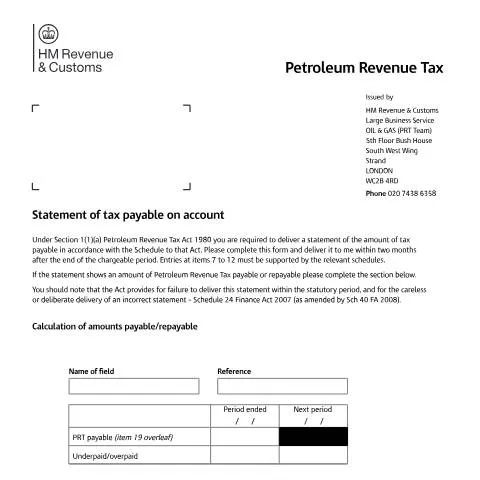
Understanding the Petroleum Revenue Tax Statement
The Petroleum Revenue Tax (PRT) Statement issued by HM Revenue & Customs (HMRC) holds significant importance for operators involved in oil extraction within the UK. This document is a testament to the underlying fiscal responsibilities associated with extracting petroleum resources. The PRT is specifically designed for companies operating in the oil and gas sector, and it is essential for them to report accurately the amounts payable to HMRC as dictated by the Petroleum Revenue Tax Act 1980.
The Role of the PRT Statement in the Oil and Gas Sector
The PRT Statement serves several key functions. Firstly, it quantifies the tax payable or repayable by operators at the end of each chargeable period. Secondly, it ensures compliance with the legal obligations set forth in the Petroleum Revenue Tax Act 1980, which mandates the declaration of petroleum revenue tax amounts within a stipulated timeframe. This process is particularly relevant for businesses that extract oil and gas, as the PRT is based on the profits derived from these activities.
Identifying Who Must Submit the PRT Statement
Not every entity involved in oil and gas extraction is required to submit this statement. Only companies engaged in the production of oil and gas in UK waters are obligated to report using this document. Operators must maintain accurate records of their operations to facilitate proper reporting. A company must also possess a valid National Insurance number for identification and tracking purposes.
Important Deadlines: Timing Your Submission
The completion and submission of the PRT Statement is governed by strict deadlines. Operators are required to deliver their completed statement within two months after the end of each chargeable period. The chargeable periods run from 6 April to 5 April of the following year, aligning with the UK tax year.
Consequences of Late or Incorrect Submission
Timeliness and accuracy are pivotal when it comes to submitting the PRT Statement. Failure to deliver within the statutory period, or submitting an incorrect statement, can result in penalties as outlined in Schedule 24 of the Finance Act 2007. This schedule dictates that both careless and deliberate errors can lead to financial repercussions for the submitting entity.
Preparation Steps: What to Gather Before Completing the Statement
Before embarking on the completion of the PRT Statement, it's crucial to gather the necessary documentation and information. This preparation can streamline the process and reduce the likelihood of errors.
- Gross Profit Details: First and foremost, ascertain your gross profit, as indicated on forms PRT1 (Part 1)(F).
- Expenditure Records: Collect all pertinent expenditure records that may affect your tax calculation.
- Previous Statements: Review previous PRT Statements to ensure continuity and accuracy in the reporting of figures.
Documentation Checklist for Submission
When preparing to complete your statement, ensure you have the following:
- Accurate gross profit figures from operations.
- Details of any allowable expenditures under the Petroleum Revenue Tax regulations.
- Any previous overpayments or underpayments from earlier chargeable periods.
Completing the PRT Statement: Tips for Accuracy
Completing the PRT Statement requires attention to detail. The statement consists of multiple items that must be filled out accurately, as outlined in the official guidance.
Key Items to Focus On
When filling out the statement, pay particular attention to the following areas:
- Items 1-12: These require precise calculations related to gross profits, allowable expenditures, and any other relevant figures.
- Item 19: This is where you declare the final amount of Petroleum Revenue Tax payable or repayable.
- Addenda: If you have any complex computations, consider attaching separate sheets as needed for clarity.
Utilizing the Correct Forms
Ensure that the PRT Statement is filled out using the correct forms, as incorrect forms can lead to processing delays. The guidelines specify that the PRT (D3) declaration form must accompany the PRT Statement.
Submission Process: How and Where to Send Your PRT Statement
Once your PRT Statement is fully completed, it is time for submission. This process involves a few essential steps to ensure your statement reaches HMRC without any hitches.
Methods of Submission
You have options on how to submit your completed PRT Statement:
- Mail Submission: Send your statement to the specified address for HM Revenue & Customs, Large Business Service, OIL & GAS (PRT Team) at 5th Floor Bush House, South West Wing, Strand, London, WC2B 4RD.
- Online Submission: If applicable, consider utilizing online submission services that may be available for PRT reporting. This can expedite the process.
Tracking Your Submission
After submitting your PRT Statement, you may wish to confirm its acceptance. Keep a copy of the statement and any accompanying documents for your records. If you do not receive confirmation of receipt within a reasonable timeframe, contact HMRC to verify that your statement was received and is being processed.
Understanding the Tax Calculations: Breaking Down the Figures
The calculation of Petroleum Revenue Tax can be intricate, involving numerous variables. Companies must understand how to compute the amounts accurately to ensure compliance and avoid penalties.
Components of the Tax Calculation
The PRT calculation involves several components derived from your operations:
| Item | Description |
|---|---|
| 1 | Gross profit - reported on form PRT1 (Part 1)(F) |
| 2 | Licence debit or credit - reported on form PRT1 (Part 1)(H) |
| 3 | Chargeable sum/Allowable sum - as per PRT1 |
| 4 | Excess chargeable under previous finance acts |
| 5 | Disposal receipts - based on form PRT1 |
| 19 | Amount of tax payable - calculated using the total of above items |
Seeking Professional Assistance
Given the complexity of the calculations involved, companies may benefit from consulting with a tax advisor or accountant experienced in oil and gas taxation. They can provide guidance on how to approach the calculations and ensure compliance with HMRC regulations.
Post-Submission: Anticipating Potential Outcomes
After your PRT Statement is submitted, several outcomes may occur based on the calculations provided and the review by HMRC.
Receiving Payment or Refunds
If your statement indicates an overpayment of PRT, you may request a refund or set off the overpayment against future tax liabilities. Ensure you indicate this preference clearly on your submission to avoid delays.
Dealing with Queries or Inspections
HMRC may reach out if there are questions regarding your submission. It is crucial to respond promptly and thoroughly to any queries to facilitate a smooth resolution process. Furthermore, be prepared for potential audits or inspections if there are significant discrepancies or compliance concerns.
Final Thoughts: Navigating the PRT Landscape
Successfully navigating the complexities of the Petroleum Revenue Tax Statement requires diligence and an understanding of both the legal framework and the practicalities of oil and gas taxation in the UK. By preparing thoroughly, adhering to deadlines, and maintaining clear communication with HMRC, operators can ensure they fulfill their tax obligations effectively. Continuous engagement with tax professionals can also provide tailored insights that will help streamline this often intricate process.
Understanding Petroleum Revenue Tax (PRT) in the UK
Petroleum Revenue Tax (PRT) is a significant tax in the UK that applies specifically to profits from oil and gas extraction activities in the UK continental shelf. Established in 1975, PRT is levied on profits generated by companies engaged in the exploration and production of oil and gas within designated areas of the continental shelf. The tax is calculated on profits earned from the sale of crude oil and natural gas, and it is crucial for companies to accurately report their liabilities to HM Revenue & Customs (HMRC).
To understand the implications of PRT, it is essential to grasp the structure of the tax. PRT is charged at a rate of 35% on profits from oil and gas production, but it is important to note that companies can deduct certain costs incurred in the production process. This includes exploration costs, development costs, and operational expenses. Importantly, PRT is separate from other taxes such as Corporation Tax, which may also apply to oil and gas companies.
Companies that find themselves within the scope of PRT must adhere to specific reporting guidelines set forth by HMRC. This involves filing the appropriate tax returns, including the Petroleum Revenue Tax Return (form PRR) by the deadline of 31 January following the end of the applicable tax year, which runs from 6 April to 5 April. Non-compliance can lead to penalties and additional scrutiny from HMRC.
Calculating Your Payable Amount for Petroleum Revenue Tax
When calculating the payable amount of Petroleum Revenue Tax (PRT), companies must first determine their gross income from oil and gas sales. This involves accounting for all revenue streams, including profits from crude oil and natural gas sales. After establishing the gross income, companies can deduct allowable expenses, which significantly influence the taxable amount.
Allowable expenses under PRT include:
- Exploration and Development Costs: All costs incurred for locating and developing oil and gas reserves.
- Decommissioning Costs: Expenses related to the dismantling of production assets and site restoration.
- Operational Costs: Regular operational expenses, such as wages, utilities, and equipment maintenance.
Once these costs are deducted, the remaining profit is subject to PRT at the standard rate of 35%. It's also vital for companies to maintain comprehensive records of all income and expenses to support their calculations and provide evidence if questioned by HMRC.
Furthermore, companies may be eligible for PRT allowances, which can substantially reduce their tax liability. For instance, if a company has carried forward losses from previous years, those losses can offset profits in the current tax year, reducing the taxable amount. Companies should also be aware of the transfer of reliefs between different fields and how they may further lower their payable PRT amount.
Reporting and Compliance: Essential Steps for PRT Obligations
Reporting and compliance with Petroleum Revenue Tax (PRT) obligations require diligent record-keeping, accurate reporting, and adherence to HMRC timelines. The tax year for PRT corresponds with the general UK tax year, running from 6 April to 5 April of the following year. Consequently, all calculations and filings must reflect this period.
Key Steps in Reporting PRT:
Maintain Accurate Records: Companies must keep detailed records of all transactions, including sales revenue, production costs, and any deductions claimed. This documentation is crucial in substantiating claims made in the tax return.
Complete the Petroleum Revenue Tax Return (PRR): Companies must complete the PRR, detailing income, expenses, and resulting profits. This return must be submitted to HMRC by the deadline of 31 January following the end of the tax year.
Pay Any Tax Due: After submitting the PRR, companies must calculate the payable amount of PRT and ensure that payment is made by the same deadline. Late payments can incur penalties and interest charges.
Respond to HMRC Queries: Following the submission of the PRR, HMRC may inquire for further information or clarification regarding specific entries. It is imperative for companies to respond promptly and provide any additional documentation requested.
Annual Review of Tax Position: Companies should conduct an annual review of their PRT obligations and tax position. This includes reassessing allowable expenses, any changes in production volumes, and potential changes in tax legislation that could impact future liabilities.
By adhering to these steps and maintaining a proactive approach to compliance, companies can effectively manage their Petroleum Revenue Tax obligations and minimize the risks associated with non-compliance.