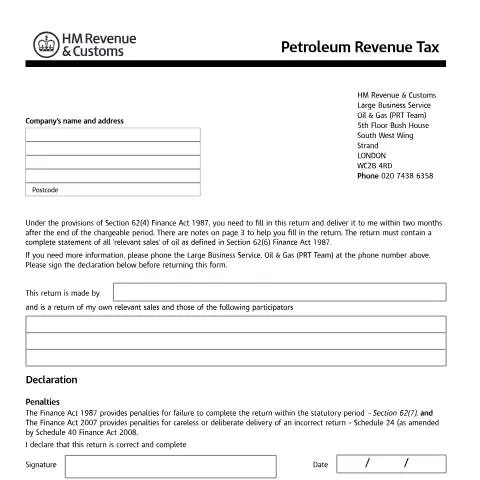
Understanding the Petroleum Revenue Tax Return: A Vital Component for Oil and Gas Companies
In the intricate world of oil and gas taxation, the Petroleum Revenue Tax (PRT) return represents a crucial obligation for companies engaged in the exploration and production of oil within the UK. The form, titled "File an additional Petroleum Revenue Tax return," ensures that businesses comply with regulations outlined in the Finance Act 1987. This essential document serves as a mechanism for reporting relevant sales of oil, allowing HM Revenue & Customs (HMRC) to assess the appropriate tax liabilities.
Navigating the Submission Process: Who Files and When?
The PRT return must be filed by any participator involved in the sale of oil who is subject to PRT obligations. This includes companies that own a share in the production of oil. According to the regulations, the return must be submitted within a two-month window following the end of the chargeable period, which typically aligns with the financial year ending on 5 April. Failure to comply with this deadline may result in penalties as stipulated under Section 62(7) of the Finance Act 1987.
Differentiating Between Participators
It is essential to identify whether multiple participators are involved in the same field. In cases where two or more companies belong to the same corporate group (i.e., if one is a 75% subsidiary of the other), only one participant needs to submit the PRT return on behalf of all involved. Proper identification of all relevant parties in the return is essential for compliance.
Key Preparatory Steps: Gathering Required Justifications
Preparation is key to a successful submission. Companies must compile a comprehensive statement detailing all 'relevant sales' of oil as defined by the Finance Act 1987. This includes:
- Type of oil sold
- Seller and buyer details
- Quantity sold
- Contract details, including dates and pricing
In addition, companies must ensure that all sales related to contracts requiring delivery of less than 500 metric tonnes of oil are excluded from the return. Notably, sales involving gas primarily composed of methane or ethane are also not reportable.
Dissecting the Return: Insights into Individual Sections
The PRT return consists of various sections that need careful attention. Here’s a breakdown of critical components:
| Section | Details Required | Common Pitfalls |
|---|---|---|
| Seller | Name and address of the seller | Incorrect company name or address may lead to misdirected correspondence. |
| Buyer | Name and address of the buyer | Omitting buyer details raises compliance issues. |
| Quantity Sold | Exact metric tonnes sold | Failing to report the correct quantity leads to inaccuracies in tax calculations. |
| Contract Dates | Deal and delivery dates | Mixing up dates can affect the reporting period. |
| Pricing | Price per unit | Errors in pricing format could create discrepancies in tax owed. |
Processing the Return: What Happens After Submission?
Once the PRT return is submitted, HMRC undertakes several review processes. It is crucial to retain a copy of the submission for your records. In case of queries or clarifications, HMRC may contact the participating company directly via the provided contact details. It is advisable to maintain open lines of communication, and proactive responses to HMRC inquiries can facilitate smoother processing.
Tracking Your Submission: Ensure Compliance
To ensure that your submission has been successfully processed, you might consider contacting HMRC’s Large Business Service, Oil & Gas (PRT Team) directly at the provided phone number: 020 7438 6358. Keeping a record of any correspondence or confirmation can provide peace of mind in the event of disputes or audits.
Regulatory Framework: The Legal Backbone of PRT Compliance
The importance of timely and accurate PRT returns cannot be overstated, as they are governed by the Finance Act 1987 and subsequent amendments. These regulations stipulate the penalties associated with underreporting or failing to submit the return. Typically, penalties can be imposed for:
- Failure to submit within the statutory timeframe
- Deliberate or careless submission of incorrect information
Understanding the legal backbone of the PRT helps companies recognize the stakes involved in their reporting obligations.
Multiple Submission Channels: Adapting to Your Business Needs
Companies have several options for submitting the PRT return, each with its own advantages:
- Online Submission: Using HMRC’s online services for quicker processing and confirmation.
- Paper Submission: Sending completed returns via post, allowing for physical documentation.
- In-Person Submission: Although less common, some firms may prefer to drop off documents at HMRC offices for immediate acknowledgment.
Choosing the appropriate channel may depend on the company’s size, the number of transactions, and past experience with HMRC processes.
Special Cases: Navigating Complex Scenarios
Sometimes, unique situations may complicate the PRT return process. Companies operating internationally, for instance, may need to consider additional compliance requirements under UK tax law. It is advisable for businesses involved in cross-border transactions to consult with a tax advisor or HMRC directly to ensure all implications are understood and followed.
Addressing Urgency: Handling Last-Minute Filings
In cases where companies might find themselves nearing the deadline without having finalized their return, it's critical to act quickly. Establish a clear process for gathering all required information and ensure that every detail is accurate. If time is running out, consider reaching out to HMRC for guidance on extending deadlines or managing outstanding obligations.
Final Thoughts: Staying Compliant in a Complex Tax Environment
Filing an additional PRT return represents a significant undertaking for oil and gas companies, demanding meticulous attention to detail and a solid understanding of the underlying regulations. By following the guidelines outlined above, businesses can navigate the complexities of PRT reporting with confidence. Continuous engagement with HMRC and diligent record-keeping will further enhance compliance and reduce the risk of penalties, ensuring that your operations remain focused on what they do best—nurturing and growing within the dynamic oil and gas landscape.
Understanding the Petroleum Revenue Tax (PRT) System
The Petroleum Revenue Tax (PRT) is a key component of the UK fiscal framework governing the extraction of oil and gas from the UK continental shelf. Instituted to ensure that the government benefits from the depletion of natural resources, PRT applies to profits generated from oil and gas extraction activities. It is crucial for companies engaged in hydrocarbon production to understand their obligations under this tax regime. The tax is levied at a rate of 35% on profits, and it is separate from other taxes such as Corporation Tax. Understanding the implications of PRT is essential for ensuring compliance and optimizing tax liabilities.
Filing an additional PRT return may become necessary for various reasons, including adjustments to previous financial statements, changes in profit calculations, or when a company has been subject to an audit. Each scenario may influence how a company approaches its additional return filing and requires attention to detail to meet HM Revenue & Customs (HMRC) standards.
The PRT system is intricately linked with specific operational and financial timing. Companies must be aware that the fiscal year for PRT aligns with the standard UK tax year, running from 6 April to 5 April the following year. This timing is crucial for synchronizing financial reporting and tax obligations. Companies need to assess their financial gains during this period accurately to ensure compliance and avoid penalties.
Special Circumstances for Filing Additional PRT Returns
Several unique situations may prompt a company to file an additional PRT return. Understanding these circumstances can facilitate better strategic planning and compliance:
- Audit Adjustments: If HMRC conducts an audit that results in adjustments to previous profit declarations, an additional PRT return may be required. Companies must be prepared to provide comprehensive documentation to support any changes, highlighting the importance of accurate record-keeping.
- Change in Ownership or Corporate Structure: If there is a merger, acquisition, or significant restructuring of the organization, it may affect how profits are calculated and reported. Understanding the impact of such changes on tax obligations is essential to ensure compliance.
- Profit Reassessment: If a company has realized an increase or decrease in profits due to changes in market conditions or operational efficiency, an additional return may be necessary to reflect these changes accurately.
In these scenarios, it is advisable for companies to consult with tax professionals who specialize in petroleum taxation to ensure that they meet all filing requirements and avoid potential penalties.
Practical Steps for Filing Additional PRT Returns
Filing an additional PRT return involves several practical steps which, if followed meticulously, can help streamline the process and ensure compliance:
- Gather Necessary Documentation: Before filing an additional return, gather all relevant documents, including financial statements, profit calculations, and any correspondence with HMRC regarding previous PRT filings. This documentation will be crucial in supporting your return.
- Assess the Timing: Be mindful of the filing deadlines associated with the additional return. The deadline for submitting an amended PRT return typically aligns with the original filing dates. For additional returns to be submitted after the original due date, refer to the specific guidelines provided by HMRC.
- Complete the Correct Forms: Ensure that you are using the most up-to-date forms provided by HMRC for PRT. The relevant forms will typically include sections addressing the changes being reported and must be filled out accurately.
- Consult with Experts: Engaging with tax advisors or professionals who specialize in petroleum taxation can facilitate the process and help identify any potential pitfalls in your filing.
- Submit the Return: Once the form is completed, double-check for any errors or omissions before submitting it to HMRC. Ensure that you keep a copy of the submitted return and any supporting documents for your records.
By following these practical steps, companies can navigate the complexities of filing additional PRT returns more effectively, ensuring compliance with HMRC regulations.