Navigating the Statement of Concurrence: An Essential Guide for Insolvency Practitioners
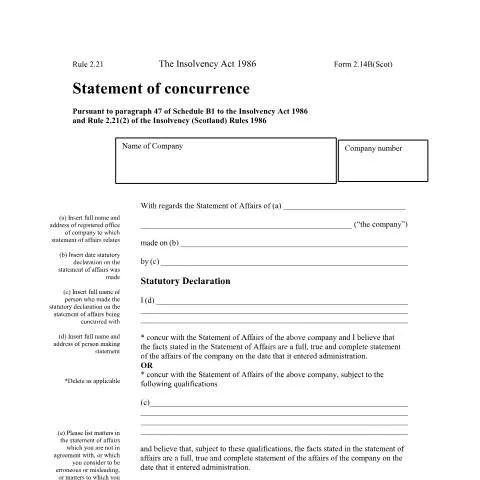
When a business enters administration in Scotland, the intricacies of the insolvency process necessitate meticulous documentation. One pivotal document in this landscape is the Statement of Concurrence, officially known as Insolvency Form 2.14B. This essential form serves multiple roles in the insolvency proceedings, particularly concerning the Statement of Affairs (SoA) of the company involved. Understanding this form’s purpose, completion details, and subsequent actions is critical for those navigating insolvency matters.
Understanding the Statement of Concurrence’s Role in Insolvency
The Statement of Concurrence is a statutory declaration required under the Insolvency Act 1986, specifically referenced in Rule 2.21 of the Insolvency (Scotland) Rules 1986. Its primary function is to affirm or challenge the contents of the Statement of Affairs submitted by the company entering administration. The individual completing the form—typically a director or an officer of the company—affirms their agreement with the SoA or highlights qualifications regarding its accuracy.
The Context of the Statement of Affairs
The Statement of Affairs outlines the financial position of the company at the time it enters administration, detailing assets, liabilities, and other critical information pertinent to creditors and administrative processes. The Statement of Concurrence thus serves as a verification tool that ensures transparency and accuracy in these proceedings.
Breaking Down the Components of Form 2.14B
Completing the Statement of Concurrence demands attention to detail. Each section of the form requires precise information that reflects the current state of the company. Here’s a breakdown of the key components:
-
(a) Company Information:
This section requires the full name and registered office address of the company undergoing insolvency. Accuracy is critical because incorrect information could lead to delays or complications in the administration process.
-
(b) Date of Declaration:
The date on which the statutory declaration regarding the SoA was made must be accurately indicated. This date is vital for establishing a timeline for the administration process.
-
(c) Declarant's Information:
Here, the full name of the person who made the Statement of Affairs must be entered. This person’s role in the company can significantly impact their authority to declare concurrence.
-
(d) Declarant’s Details:
This section captures the full name and address of the individual completing the Statement of Concurrence. It’s essential for establishing accountability and ensuring the declaration is made by an authoritative figure.
-
(e) Qualifications:
Should the declarant disagree with aspects of the Statement of Affairs, this section is used to outline specific qualifications. It’s vital to provide detailed reasons for any disagreements, as these qualifications will be scrutinized during the insolvency review process.
Preparation: Justifying Your Concurrence or Qualifications
Before submitting Form 2.14B, it is imperative to prepare adequately, particularly if there are qualifications. Gather relevant evidence and documentation that supports your position. This could include:
- Financial statements that contradict claims made in the SoA.
- Invoices or communications with creditors that reflect outstanding debts inaccurately represented.
- Contracts or agreements that could affect the assessment of liabilities or assets.
Each item should be carefully cataloged and referenced in the qualifications section to substantiate claims made. A well-prepared submission can streamline the insolvency process, facilitating a clearer understanding of the company’s financial situation.
What to Expect After Submission: Next Steps in the Procedure
Once the Statement of Concurrence is duly completed and submitted, several outcomes may arise:
-
Acceptance of Concurrence:
If the insolvency practitioner accepts the Statement of Concurrence, the process continues as planned, relying on the provided Statement of Affairs for the administration.
-
Review of Qualifications:
If qualifications are presented, they will be reviewed by the insolvency practitioner, who may seek further clarification or additional documentation. This could lead to delays if the discrepancies require significant investigation.
-
Potential Disputes:
In cases where there is substantial disagreement regarding the SoA, this can escalate to formal disputes, necessitating mediation or legal intervention.
Distinctive Features of Form 2.14B Compared to Similar Forms
The Statement of Concurrence (Form 2.14B) is often confused with other insolvency-related documents. Understanding these distinctions is critical for anyone involved in the insolvency process:
| Document | Purpose | Key Differences |
|---|---|---|
| Statement of Affairs (SoA) | Details the financial status of the company. | SoA outlines the company’s position, while Form 2.14B verifies or disputes its accuracy. |
| Creditor’s Voluntary Liquidation (CVL) Consent | Consent document for initiating liquidation. | CVL consent is broader, involving all creditors, whereas Form 2.14B focuses on an individual’s concurrence with the SoA. |
| Statutory Declaration | Affirmation of facts for legal purposes. | While both are declarations, Form 2.14B specifically pertains to insolvency and includes qualifications linked to the SoA. |
Legal Framework Underpinning the Statement of Concurrence
The Statement of Concurrence is anchored in robust legal provisions. The Insolvency Act 1986 lays the groundwork for all insolvency proceedings in the UK, delineating the responsibilities of directors and the rights of creditors. Specifically, paragraph 47 of Schedule B1 and Rule 2.21(2) dictate the requirements for the Statement of Concurrence, emphasizing transparency and accountability in the insolvency process.
Understanding the legislative context not only enriches practitioners' comprehension of the form’s purpose but also mandates adherence to procedural nuances. This ensures stakeholders act within their legal capacities and safeguards the integrity of the insolvency process.
Common Challenges and How to Overcome Them
Filing the Statement of Concurrence can present various challenges, particularly regarding accuracy and completeness. Common challenges include:
-
Erroneous Information:
Submitting incorrect data can lead to significant complications. To counteract this, cross-check all provided information against the Statement of Affairs and other relevant documents.
-
Inadequate Qualifications:
Vague qualifiers can lead to misinterpretations. Instead, clearly outline specific items of disagreement, ensuring each point is well-supported by documentation.
-
Missed Deadlines:
Timeliness is crucial in insolvency processes. Adhere to submission deadlines meticulously. Setting reminders or utilizing digital calendars can aid in managing time effectively.
By anticipating these challenges and implementing strategies to mitigate them, individuals can enhance the accuracy and efficacy of their Statements of Concurrence.
Final Thoughts on the Statement of Concurrence
Navigating the insolvency landscape in Scotland requires diligence, understanding, and meticulous documentation. The Statement of Concurrence (Form 2.14B) plays a vital role in ensuring a transparent and effective insolvency process. By grasping its components, significance, and the steps required for successful completion and submission, individuals and practitioners can better manage the complexities of insolvency. Empowering oneself with knowledge and thorough preparation can pave the way for a smoother transition through the administration phase, fostering accountability and clarity in an otherwise challenging situation.
Understanding the Statement of Concurrence: Insolvency Form 2.14B
The Statement of Concurrence is a crucial document in the Scottish insolvency process, particularly when it comes to voluntary arrangements and the administration of companies. Form 2.14B serves the purpose of allowing creditors to signify their agreement to a proposal made by an insolvent debtor or the appointed administrator. This form is integral to ensuring that all involved parties are on the same page regarding the terms of the insolvency arrangement.
When completing Form 2.14B, it's important to provide accurate details about the creditor's claims against the debtor. This includes the total amount owed, any security interests held, and the classification of the debt. Moreover, creditors must also state whether they opt to vote in favour of the proposal or if they are abstaining from voting. The information presented in this form helps to facilitate a transparent process, reducing disputes and misunderstandings later in the insolvency proceedings.
One critical aspect of the Statement of Concurrence is the need for timeliness. Creditors are usually given a specific period to submit their Form 2.14B. Failure to do so can result in their exclusion from participating in the vote on the proposal, potentially affecting their recovery prospects. Therefore, it's advisable for creditors to stay informed about the deadlines and to act swiftly when they receive notice of insolvency proceedings.
The Role of the Insolvency Practitioner in Completing Form 2.14B
In the context of Scottish insolvency, the insolvency practitioner plays a pivotal role in guiding creditors and debtors through the process of completing Form 2.14B. The practitioner, typically appointed by the creditors or the court, has the expertise necessary to ensure that all procedural requirements are met and that the interests of all parties are adequately represented.
Insolvency practitioners can help creditors understand the implications of their votes on the proposal outlined in the Statement of Concurrence. They will explain how the terms of the proposal may affect each creditor's recovery and outline the consequences of either supporting or opposing the arrangement. Additionally, they ensure that all submitted forms are compiled accurately and submitted within the regulatory timeframe to the Office of the Accountant of Court.
Moreover, practitioners can facilitate communication among creditors, the debtor, and the court, reducing the risk of confusion or conflict during the process. Their involvement can significantly streamline the proceedings and contribute to a more efficient resolution of insolvency cases.
Potential Challenges and Considerations for Creditors
While Form 2.14B is designed to inform and facilitate the creditors' agreement to a proposal, there are potential challenges and considerations that creditors should keep in mind. One of the primary challenges is the assessment of the debtor's financial situation. Creditors must carefully evaluate the viability of the proposal being presented. They must ask questions like whether the proposed payments will be sustainable and whether the debtor has a realistic plan for recovery.
Additionally, creditors should be aware of the implications of voting against the proposal. While it may be tempting to reject a proposal that appears unfavorable, this decision can lead to more complex and protracted proceedings. In some cases, creditors who oppose a proposal may find that they have limited options for recovery if the debtor’s financial situation worsens, leading to a more severe insolvency procedure.
It's also essential for creditors to maintain accurate records of all correspondence and documents related to the insolvency. This documentation may be crucial if disputes arise or if the recovery process becomes contentious. Keeping detailed notes of meetings, decisions, and proposals can provide vital evidence to support a creditor's position should the need for clarification or enforcement arise later on.