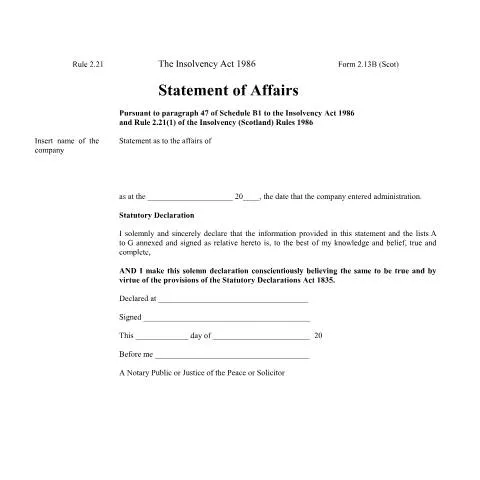
Navigating the Statement of Affairs: A Key Component in Scottish Insolvency Proceedings
When a company in Scotland faces financial distress, the Statement of Affairs (Form 2.13B) emerges as a pivotal document within the insolvency process. This form lays out a comprehensive overview of the company's financial position at the moment it enters administration, allowing all stakeholders—including creditors, administrators, and the company itself—to understand the assets and liabilities involved.
Who is Responsible for Filling Out the Statement?
The responsibility for completing the Statement of Affairs falls primarily on the company directors or appointed administrators. These individuals must provide accurate and complete information as of the date the company entered administration. The document is a declaration of the company’s financial status, and any dishonesty may lead to severe penalties under the Insolvency Act 1986.
- Directors: If the company is still operational, the directors are to fill out the form.
- Administrators: If the company has been taken into administration, the appointed administrator will typically complete the document.
Key Roles in Completing the Statement
Understanding the roles of key individuals in this process is crucial:
- Company Directors: Must ensure the information is accurate and reflects the company’s financial condition.
- Administrators: Take over the management of the company and are responsible for administering the Statement of Affairs as part of their duties.
- Notaries and Legal Professionals: Required to witness the declaration of the Statement when it is submitted.
A Timeline of Key Events: From Submission to Outcome
Filing the Statement of Affairs is not a standalone step; it is part of a broader timeline in the insolvency process. Here’s a breakdown of what to expect:
| Event | Date | Details |
|---|---|---|
| Company Enters Administration | Day 0 | The process officially begins. |
| Submission of Statement | Within 14 days | The Statement must be submitted by the directors or administrators. |
| Initial Review | 1-2 weeks post submission | Creditors and stakeholders review the submitted documents. |
| Creditors Meeting | 4-6 weeks | Major creditors discuss the findings and next steps. |
| Conclusion of Administration | Varies | The outcome depends on the financial recovery plan. |
The Impact of an Accurate Statement of Affairs
Providing a well-prepared Statement of Affairs can significantly affect the ensuing proceedings:
- Rights of Creditors: Creditors rely on this document to assess their potential recoveries. An accurate representation can foster trust and potentially lead to better outcomes in negotiations.
- Obligations of the Company: Inaccuracies or omissions can result in personal liability for directors if found negligent.
- Consequence of Omissions: Failure to disclose all liabilities or assets can lead to further legal action, including disqualification from directorship.
Consequences of Not Filing Properly
The implications of an improperly filed Statement can be severe, ranging from financial repercussions to criminal charges. The following points outline potential outcomes:
- Legal Repercussions: Directors can face legal action for failing to submit an accurate Statement.
- Increased Scrutiny: Inaccuracies may lead to further investigations into the company’s affairs.
- Reputational Damage: A poorly managed insolvency process can damage relationships with creditors and stakeholders.
Dissecting the Statement: Essential Sections and Common Pitfalls
The Statement of Affairs consists of several critical sections that provide a detailed snapshot of the company's financial health. Each section demands careful attention to detail. Let’s explore them.
Assets Section
- Assets Not Specifically Secured (List A): This includes all assets that are not tied to loans or guarantees. It’s crucial to estimate these values realistically, as they form the basis of what is available to creditors.
- Assets Specifically Secured (List B): These assets are linked to secured creditors. The estimated realisable value must be given, alongside the amounts owed to these creditors.
Common pitfalls:
- Overvaluing assets can mislead creditors.
- Failing to include certain assets can result in a lack of confidence in the declaration.
Liabilities Section
The liabilities section is equally crucial, detailing amounts owed to various classes of creditors:
- Preferential Creditors (List C): These are typically employees' wages and certain taxes owed. The estimated balance of assets available for these claims must be outlined clearly.
- Floating Charges (List D): This section captures liabilities against floating charges, which are often attached to overall business assets rather than specific items.
- Unsecured Creditors (Lists E, F, G): These lists detail trade accounts, bills payable, and other contingent liabilities. Accurately compiling these lists is critical to avoid future disputes.
Common pitfalls:
- Omitting smaller creditors can lead to disputes later.
- Failing to specify the type of liability can create confusion.
Completing the Form: Compliance and Best Practices
As this document is legally binding, strict adherence to guidelines is non-negotiable. Here are several best practices to ensure compliance:
- Use Legible Print: It’s advised to complete the form in black ink or bold block lettering to avoid any misinterpretation.
- Double-Check Figures: Ensure all financial figures are accurate and clearly stated. This helps to maintain transparency with all stakeholders.
- Seek Professional Advice: Engaging with insolvency practitioners can enhance the quality of disclosures made through the Statement of Affairs.
Document Assembly and Submission
Once completed, the Statement of Affairs must be submitted alongside relevant schedules detailing specific asset and liability categories. Ensure the following before submission:
- All sections are thoroughly completed.
- Any necessary statutory declarations are signed in the presence of a notary public or solicitor.
- Submit it within the specified timeframe, usually 14 days post-administration commencement.
What Happens After Submission?
Following submission, the Statement of Affairs is reviewed by the appointed administrator and may be discussed in creditors' meetings. Stakeholders will evaluate the company’s financial prospects based on the provided information. A few important outcomes include:
- Creditors' Meetings: These meetings serve as a platform for creditors to voice concerns or propose arrangements based on the Statement.
- Rescue Plans: Depending on the financial analysis, arrangements may be proposed that could allow the company to continue operations under a new framework.
- Liquidation Decisions: In some cases, it may be determined that liquidation is the only feasible path forward, leading to the sale of assets to satisfy creditor claims.
Administrator’s Role Post-Submission
The appointed administrator plays a crucial role in managing the outcomes following the Statement’s submission. Their responsibilities include:
- Communication with Creditors: Keeping all creditors informed of proceedings and decisions made regarding the Statement of Affairs.
- Asset Management: Overseeing the realization of assets listed and ensuring that all creditor claims are handled according to legal requirements.
- Reporting to the Court: Providing updates and reports to the court regarding the progress of the administration.
Final Thoughts: The Importance of Diligence
The accuracy of the Statement of Affairs is paramount, as it lays the groundwork for future insolvency proceedings. By diligently preparing this document, company directors and administrators can navigate the complexities of insolvency more effectively, minimizing potential liabilities and fostering cooperation among stakeholders.
It’s advisable for anyone involved in the insolvency process to seek professional assistance to ensure compliance and accuracy in the completion of the Statement of Affairs. This not only facilitates a smoother insolvency process but also protects personal and corporate interests.
Understanding the Statement of Affairs Form 2.13B in Detail
The Statement of Affairs (SoA) form 2.13B is a crucial document in the insolvency process in Scotland, primarily serving to provide a comprehensive overview of an individual's financial situation. This form is often completed by individuals seeking to declare bankruptcy or enter into a Protected Trust Deed. Understanding the intricacies of this form is essential, as it not only outlines your debts and assets but also helps creditors assess your financial circumstances.
In filling out the SoA, you will encounter various sections that require careful consideration. The first section typically asks for personal details, including your name, address, and National Insurance number. It is vital to ensure that this information is accurate, as it will be used to identify your case and may affect the processing of your insolvency application. One common pitfall is neglecting to include all forms of income; make sure to account for regular wages, any rental income, and even side businesses. Any discrepancies could lead to complications or delays.
The subsequent sections of the form require you to detail all your assets, liabilities, and income. When listing your assets, be thorough—include cash, property, vehicles, and any investments. For liabilities, provide details such as credit card debts, loans, and any other outstanding financial obligations. Remember, the objective is to offer a true reflection of your financial standing. To avoid issues, consider using a spreadsheet to tally your assets and debts before entering them into the form. This preparatory step can help ensure no important details are overlooked.
Common Mistakes and How to Avoid Them
Completing the Statement of Affairs form effectively can be challenging, and many individuals make common mistakes that can jeopardise their insolvency applications. One frequent error is underreporting or failing to disclose specific debts or assets. In an attempt to simplify their situation, some individuals might inadvertently omit minor debts, thinking they won't matter. However, all financial information is critical in the eyes of the Insolvency Service.
Another common mistake occurs when individuals do not accurately assess the value of their assets. Overestimating the value can lead to unrealistic expectations from creditors, while underestimating can result in financial losses when the assets are sold. To prevent this, consider obtaining professional appraisals for significant assets or consult resources like the UK Government's valuation guidance. This ensures that the values you declare are justifiable and supported by evidence.
Moreover, the timing of your submissions can also be an area for error. The Statement of Affairs must be submitted alongside your bankruptcy petition or application for a Protected Trust Deed. Missing deadlines or submitting incomplete information can lead to delays, so keep track of submission dates and maintain a checklist of required documents to ensure compliance. It may be beneficial to seek legal advice or assistance from insolvency practitioners who can guide you through this complex process, helping you avoid common pitfalls.
Implications of the Statement of Affairs on Creditors and Your Financial Future
The Statement of Affairs plays a significant role in the broader context of your financial future, particularly concerning how creditors will treat your case. When you provide a full and accurate SoA, you enhance the ability of your creditors to make informed decisions regarding your financial obligations. It allows them to see your financial position transparently, which can sometimes lead to more favourable negotiations about debt repayment, especially if they perceive you as cooperative and honest.
Moreover, the accuracy of the Statement of Affairs can significantly impact your credit rating post-insolvency. Credit reporting agencies will consider the information presented in your SoA when determining your creditworthiness in the future. A well-documented and comprehensive SoA can support your case when seeking to rebuild your credit after insolvency, as a clear history of your financial obligations and the steps you've taken to manage them can work in your favour.
Finally, it’s essential to bear in mind that the completion of the Statement of Affairs is not merely a procedural step; it is also an opportunity for reflection and planning. Understanding the full scope of your financial situation allows you to make informed decisions moving forward. It may also highlight areas where financial habits can be improved, thus paving the way for better financial management after the insolvency process is complete. Leveraging the insights gained from your SoA can ultimately help you establish a more sustainable financial future.