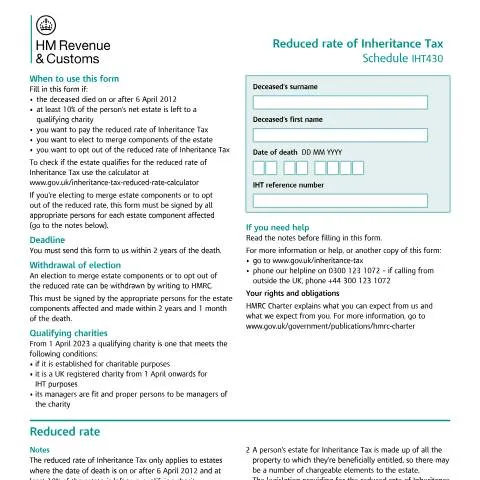
When charitable giving transforms your inheritance tax burden
Estate planning takes on a different dimension when charitable intentions meet tax efficiency. The IHT430 schedule represents HMRC's acknowledgement that substantial charitable bequests deserve recognition through reduced inheritance tax rates. Since April 2012, estates leaving at least 10% of their baseline amount to qualifying charities can benefit from inheritance tax charged at 36% rather than the standard 40% rate.
This isn't simply a matter of filling in another form—it's about understanding how HMRC calculates what constitutes sufficient charitable giving across different components of an estate. The reduced rate doesn't apply uniformly; it operates component by component, meaning parts of the same estate might face different tax rates depending on their charitable allocation.
The stakes are significant. For a £1 million estate with appropriate charitable giving, the difference between 40% and 36% taxation on the chargeable portion could save thousands in inheritance tax. However, the calculations involve complex baseline determinations, component splitting, and strict qualifying charity criteria that have evolved as recently as April 2023.
Decoding the three-component estate structure
HMRC's approach to the reduced rate centres on dividing every estate into three distinct components, each assessed independently for the charitable threshold. This segmentation reflects different legal ownership structures and tax treatment.
The survivorship component
Joint assets passing automatically to surviving joint owners form this component. The classic example involves joint bank accounts where both parties contributed equally—if the account held £60,000 at death and both contributed equally, £30,000 enters the survivorship component. This also encompasses Scottish special destinations and overseas assets governed by foreign succession laws.
Importantly, this component only exists where assets pass by operation of law rather than through the will or intestacy rules. The survivorship component often receives less attention in estate planning, yet it must meet the 10% charitable giving threshold independently to qualify for reduced rate treatment.
The settled property component
Trust assets where the deceased held a qualifying interest form this component. Whether the deceased was a life tenant, had a general power of appointment, or fell within other categories bringing trust assets into their estate for inheritance tax purposes, these assets require separate consideration for reduced rate qualification.
The complexity here lies in determining which trust assets actually form part of the deceased's estate and calculating the appropriate charitable giving percentage against the baseline amount for this component alone.
The general component
Everything else falls into the general component: solely owned assets and joint property held as tenants in common. This typically forms the largest component and often provides the greatest scope for charitable planning.
Using HMRC's example, an estate valued at £750,000 after liabilities, with £75,000 (10% of residue) left to charity, demonstrates how the general component calculation works. After deducting the appropriate nil rate band portion (£311,170 in the example), the remaining £363,830 plus the charity exemption of £75,000 creates a baseline amount of £438,830.
Mastering the baseline amount calculation
The baseline amount determines whether the estate component qualifies for the reduced rate. HMRC's three-step process appears straightforward but contains several technical pitfalls.
| Step | Calculation | Key considerations |
|---|---|---|
| Step 1 | Net value after all deductions | Include charity exemption in deductions |
| Step 2 | Deduct appropriate nil rate band portion | Apportion between all components including gifts with reservation |
| Step 3 | Add back charity exemption amount | This creates the baseline for the 10% test |
The appropriate portion of nil rate band allocation requires careful attention. The available nil rate band—currently £325,000 for deaths in 2024-25—gets apportioned between all estate components. Crucially, this doesn't include any residential nil rate band or transferred residential nil rate band, but does factor in any transferable nil rate band from a deceased spouse or civil partner.
Lifetime gifts subject to inheritance tax reduce the available nil rate band, but gifts with reservation don't affect this calculation despite being included in the estate for other purposes. This distinction often catches advisers off-guard when calculating the baseline amount.
Strategic elections: merging components and opting out
The IHT430 serves dual purposes beyond claiming the reduced rate. Estate representatives can elect to merge components or deliberately opt out of reduced rate treatment—decisions that require signatures from all appropriate persons for affected components.
Component merging elections
Merging allows estate components that individually fail the 10% charitable giving test to combine and potentially qualify together. Consider an estate with a survivorship component giving 5% to charity and a general component giving 15%—separately, only the general component qualifies for the reduced rate. Merged, the combined charitable giving might exceed 10% of the combined baseline amount.
However, merging isn't automatically beneficial. The calculation becomes more complex, and the result isn't guaranteed to produce tax savings. Professional analysis of the specific figures determines whether merging advantages the estate.
Opting out considerations
Counterintuitively, some estates benefit from opting out of the reduced rate. This typically occurs where the reduced rate calculation produces a higher tax charge than the standard 40% rate would generate—usually due to complex interactions between component allocations and charitable exemptions.
The opt-out election must be made within two years of death but can be withdrawn within two years and one month, providing a safety net for decisions made without complete information.
Qualifying charity criteria and recent changes
The definition of qualifying charities underwent significant revision from April 2023, tightening the requirements and potentially affecting estates with deaths after this date.
A qualifying charity must now satisfy three cumulative conditions: establishment for charitable purposes, UK registered charity status from 1 April onwards for inheritance tax purposes, and managers who are fit and proper persons. The fit and proper persons test represents a new hurdle, potentially disqualifying charities whose management fails to meet HMRC's standards.
These changes particularly affect international charitable giving. Charities registered outside the UK face additional scrutiny, and estate representatives should verify qualifying status before finalising charitable bequests or completing the IHT430.
The timing element also matters—charities must maintain their qualifying status throughout the relevant period, not merely at the date of death or legacy distribution.
Completing the IHT430: technical requirements and common oversights
The form's apparent simplicity masks several technical requirements that frequently cause processing delays or rejections.
The signature requirements deserve particular attention. All appropriate persons for each affected estate component must sign personally—HMRC explicitly rejects agent signatures, regardless of power of attorney or professional standing. For complex estates with multiple components and various liable parties, coordinating signatures can prove challenging.
Identifying the appropriate persons requires understanding who bears inheritance tax liability for each component. Executors sign for general component assets, surviving joint owners for survivorship components, and trustees for settled property components. Where multiple parties share liability, those actually paying the tax must sign.
The capacity declaration often gets overlooked—signatories must clearly state their role (executor, administrator, surviving joint owner, trustee, or donee). Generic signatures without capacity identification lead to form rejection.
The two-year deadline trap
HMRC's two-year deadline from death applies strictly, with limited discretion for late applications. This deadline encompasses both initial elections and any component merging or opt-out decisions. Given the complex calculations often required, starting the process early prevents last-minute rushes.
The withdrawal window extends slightly longer—two years and one month—but still requires signatures from all appropriate persons. This extended period acknowledges that full estate valuations and tax calculations might not complete within the initial two-year window.
Interaction with other inheritance tax reliefs and planning opportunities
The reduced rate calculation operates independently of other inheritance tax reliefs, creating both opportunities and complications for estate planning.
Business property relief and agricultural property relief reduce the estate value before applying the charitable giving test, potentially making it easier to achieve the 10% threshold. However, these reliefs apply at different rates and to different assets, requiring careful coordination in the overall estate plan.
The residential nil rate band, while excluded from baseline amount calculations, still affects the overall inheritance tax position. Estates qualifying for both the reduced rate on charitable components and residential nil rate band relief can achieve significant tax savings, but the calculations become correspondingly complex.
Deed of variation planning offers post-death opportunities to restructure charitable giving to meet the 10% threshold. However, such variations must occur within two years of death and satisfy strict legal requirements to be effective for inheritance tax purposes.
Professional guidance and calculation verification
HMRC provides an online calculator at gov.uk/inheritance-tax-reduced-rate-calculator to help determine eligibility, but this tool handles only straightforward scenarios. Complex estates with multiple components, various reliefs, or borderline charitable percentages require professional analysis.
The calculator particularly struggles with component merging scenarios and opt-out evaluations. These decisions involve comparing multiple tax calculations and often require detailed modelling to identify the optimal approach.
Given the two-year deadline and the complexity of calculations, early professional engagement proves essential for estates potentially qualifying for the reduced rate. The interplay between charitable giving, component allocation, and other reliefs creates numerous variables that significantly impact the final tax position.
The IHT430 represents more than administrative compliance—it's the gateway to substantial tax savings for charitably minded estates. However, accessing these savings requires understanding HMRC's component-based approach, meeting strict qualifying charity criteria, and navigating complex baseline calculations within tight deadlines. Professional guidance ensures estates maximise available opportunities while avoiding the technical pitfalls that could invalidate otherwise legitimate claims.
Conditional Exemptions and Their Impact on Reduced Rate Calculations
Conditional exemptions present one of the most intricate aspects of reduced rate calculations, particularly when heritage assets are involved alongside charitable giving. When an estate includes conditionally exempt property under sections 30-35 of the Inheritance Tax Act 1984, the interaction with charitable donations requires careful analysis to determine eligibility for the reduced rate.
Property qualifying for conditional exemption—such as works of art, historic buildings, or scientifically important collections—is initially exempt from inheritance tax provided specific undertakings are given regarding public access and preservation. However, this exemption creates complications when calculating the charitable giving threshold, as the conditionally exempt property must be excluded from both the baseline value and the charitable deduction calculations.
The technical challenge arises when determining whether the remaining estate, after excluding conditionally exempt assets, meets the 10% charitable giving threshold. HMRC's guidance stipulates that you must first establish the 'relevant estate' by removing all conditionally exempt property, then calculate whether charitable legacies represent at least 10% of this adjusted baseline. This can create situations where an estate that appears to fall short of the threshold actually qualifies once the conditionally exempt property is properly excluded.
Consider an estate valued at £800,000 including a conditionally exempt painting worth £200,000. The remaining £600,000 includes charitable donations of £55,000. While £55,000 represents only 6.9% of the total estate, it constitutes 9.2% of the relevant estate (£55,000 ÷ £600,000). If additional factors bring this above 10%, the reduced rate applies to the entire chargeable estate, excluding the conditionally exempt property.
Agricultural and business property reliefs add another layer of complexity. When an estate benefits from Agricultural Property Relief (APR) or Business Property Relief (BPR) at 50% or 100%, these reliefs are applied before calculating the charitable threshold. The interaction between these reliefs and conditional exemptions requires particularly careful documentation, as errors can result in significant overpayment of inheritance tax.
Heritage maintenance funds present unique challenges in reduced rate calculations. Settlements into such funds may qualify as charitable donations for reduced rate purposes, but only if they meet stringent conditions regarding public benefit and access. The timing of when property enters the heritage maintenance fund relative to death can affect whether it counts towards the 10% threshold, requiring careful coordination between estate executors and fund trustees.
Foreign conditionally exempt property adds international dimensions to these calculations. Property located overseas but qualifying for UK conditional exemption under double taxation agreements must be carefully evaluated to determine its treatment in reduced rate calculations. Currency fluctuations between death and the filing of IHT430 can also affect whether thresholds are met, particularly for estates with significant overseas assets.
Complex Estate Structures and Multiple Component Analysis
Multi-component estates requiring separate IHT430 submissions present sophisticated challenges that extend beyond straightforward single-estate calculations. When an estate comprises multiple components—such as UK assets, overseas property, trust interests, and jointly held assets—each component may require individual assessment for reduced rate eligibility while maintaining overall coherence in the inheritance tax calculation.
The component approach becomes essential when dealing with estates that span multiple jurisdictions. For instance, a deceased person domiciled in England may have left property in Scotland subject to different legal frameworks, overseas assets in jurisdictions with double taxation treaties, and interests in foreign trusts. Each component must be evaluated separately to determine whether charitable donations within that component meet the 10% threshold, while ensuring that reliefs and exemptions are correctly attributed across all components.
Joint tenancy complications require particular attention in component analysis. When property passes by survivorship to a joint tenant, it may not form part of the deceased's estate for inheritance tax purposes, but any associated debts or charges may still affect the calculation. If the deceased had pledged charitable donations secured against jointly held property, determining whether these donations count towards the reduced rate threshold requires careful analysis of the legal structures involved.
Trust interests create additional complexity in multi-component estates. When the deceased held interests in discretionary trusts, accumulation and maintenance trusts, or interest in possession trusts, the valuation of these interests and their treatment in reduced rate calculations depends on the specific trust terms and the nature of the deceased's interest. Charitable donations made by trustees following the deceased's death may or may not count towards the estate's charitable giving threshold, depending on whether they represent distributions of the deceased's interest or separate trust activities.
Pension death benefits present another challenging component, particularly when the deceased had discretion over beneficiary nominations. While most pension benefits fall outside the estate for inheritance tax purposes, charitable nominations made through pension arrangements may still be relevant for reduced rate calculations if they represent substitutions for direct estate gifts. The interaction between pension charitable giving and estate-based donations requires careful documentation to ensure optimal tax treatment.
Business succession arrangements often create multi-component scenarios requiring detailed analysis. When family businesses are structured through multiple entities—holding companies, trading subsidiaries, and associated partnerships—charitable donations may be distributed across these structures. Determining which donations count towards the reduced rate threshold for the individual's estate requires understanding the legal relationships between these entities and the deceased's interests in each.
The timing of component valuations can significantly impact reduced rate eligibility, particularly for estates with volatile assets such as shares in private companies or overseas property subject to currency fluctuation. HMRC's approach to valuation dates for different components may create opportunities or challenges for meeting the 10% threshold, requiring strategic consideration of when to finalise component valuations and submit the IHT430.
Practical Implementation Challenges and Administrative Considerations
The practical implementation of reduced rate claims through IHT430 involves numerous administrative challenges that can significantly impact both the timeline and outcome of estate administration. Understanding these practical considerations helps executors and their advisers navigate the process more effectively while avoiding common pitfalls that can delay or invalidate reduced rate claims.
Documentation requirements extend far beyond the basic IHT430 form, particularly for complex estates. HMRC may request detailed supporting evidence including charity registration confirmations, valuation reports, legal opinions on asset classification, and correspondence with charitable beneficiaries. Preparing this documentation proactively, rather than responding to subsequent HMRC enquiries, can significantly accelerate the inheritance tax clearance process.
The interaction between IHT430 submissions and broader estate administration creates timing pressures that require careful coordination. Executors must balance the need to finalise charitable donations and asset valuations for reduced rate purposes against practical requirements such as obtaining probate, realising assets to pay inheritance tax, and meeting beneficiary expectations regarding distribution timing. These competing demands often require interim arrangements such as borrowing against estate assets or seeking agreements from residuary beneficiaries to defer distributions.
Professional fee considerations become particularly significant in reduced rate cases due to the additional complexity involved. The potential inheritance tax saving from claiming the reduced rate must be weighed against the additional professional costs of preparing detailed IHT430 submissions, obtaining specialist valuations, and managing any subsequent HMRC enquiries. For estates close to the 10% threshold, the cost-benefit analysis may favour alternative approaches such as varying the will to increase charitable donations or disclaiming non-charitable legacies.
Communication with charitable beneficiaries requires careful management throughout the reduced rate claim process. Charities may have their own requirements regarding gift acceptance, due diligence on estate assets, or timing of receipts that must be coordinated with inheritance tax obligations. Some charities may be reluctant to accept gifts subject to potential HMRC challenge or may require additional documentation beyond standard estate administration procedures.
The potential for HMRC enquiries into reduced rate claims necessitates maintaining comprehensive records throughout estate administration. Even straightforward reduced rate claims may be selected for review, particularly where significant inheritance tax savings are involved or where the estate structure is complex. Preparing for potential enquiries from the outset—through detailed record-keeping, contemporaneous file notes, and retention of all supporting documentation—can significantly reduce the administrative burden if an enquiry does arise.
Technology considerations are increasingly important in managing complex IHT430 submissions. While basic forms can be completed manually, estates with multiple components, complex asset structures, or significant charitable giving may benefit from specialist software solutions that can model different scenarios and ensure mathematical accuracy across interconnected calculations. However, technology should supplement rather than replace professional expertise, particularly given the nuanced interpretation required for many reduced rate provisions.
Cross-border administrative challenges arise frequently in reduced rate claims involving overseas assets or international charitable giving. Coordination with foreign tax advisers, obtaining certified translations of overseas documents, and managing different legal systems' requirements for charitable gift validation can significantly complicate the administrative process. Early identification of these international elements allows for proper planning and resource allocation to address these challenges effectively.